
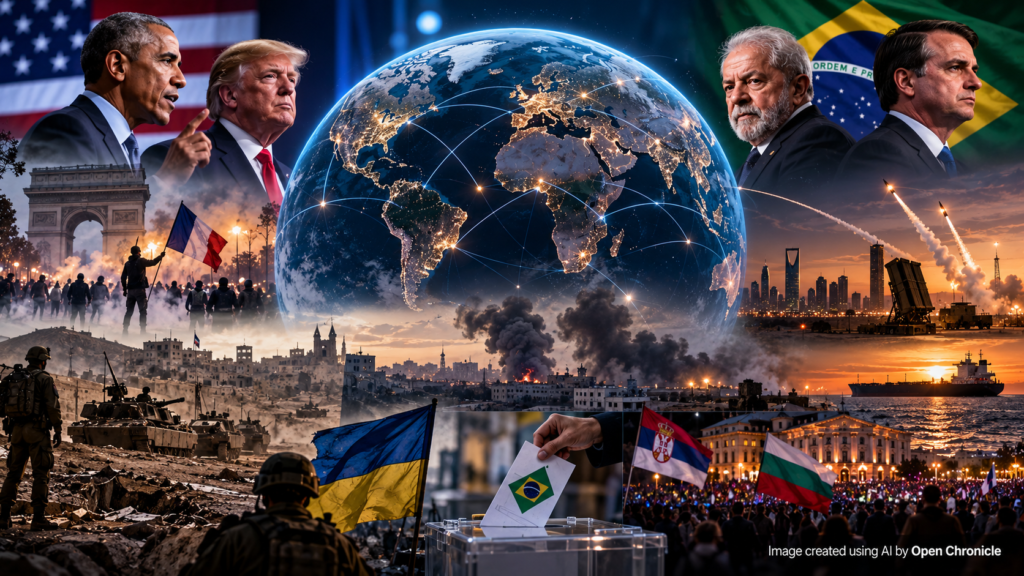
From a high-stakes presidential runoff in Brazil and elections across Europe to renewed fears of confrontation between the United States and Iran, escalating violence in the Middle East and continuing tensions over Ukraine, the international agenda is dominated by political uncertainty, military developments and growing public unrest.
By Open Chronicle News Desk with Agencies
Sunday, October 25, 2026
The world enters the final week of October amid a convergence of elections, security crises and diplomatic uncertainty.
Voters in Brazil, Serbia and Bulgaria are heading to the polls, while Israel approaches an election overshadowed by military operations in the occupied West Bank and the consequences of the Gaza war.
In the Middle East, reports of intercepted Houthi missiles and drones over Saudi Arabia coincide with renewed American warnings about Iran. Tehran has threatened retaliation against any further military action, raising concerns that an already unstable regional security environment could deteriorate.
Across Europe, demonstrations and political tensions continue in France and Italy, while Ukraine faces new Russian attacks and an unresolved dispute over restrictions on satellite communications.
In the Americas, the United States is approaching its November midterm elections, and a shooting near Florida A&M University has renewed concerns about public safety.
The following regional briefing brings together the principal developments reported in the headlines and updates supplied for October 25. Figures, military claims and rapidly evolving situations remain subject to confirmation.
North America
United States: Obama enters Michigan Senate contest as midterm campaign intensifies
Former President Barack Obama has endorsed Abdul El-Sayed in Michigan’s US Senate race, according to reports circulating Sunday, adding his political influence to a contest taking place against the backdrop of an increasingly confrontational national campaign.
Obama has also been campaigning for Democratic candidates, criticizing President Donald Trump’s leadership and policies. Trump, meanwhile, has continued his own appearances in Michigan as Republicans and Democrats compete for control of Congress in November.
The competing campaign messages reflect wider voter concerns about living costs, economic security, foreign policy and the direction of American institutions.
Florida: Shooting near university campus leaves multiple people injured
A shooting near Florida A&M University in Tallahassee has left at least 11 people wounded, according to initial reports.
Several accounts indicate that six of those injured were juveniles and that three people sustained serious injuries. Other updates put the total number of injured at 12.
The discrepancy in casualty figures reflects the developing nature of the investigation. The circumstances of the shooting, the number of suspects and any possible connection to the university have not been established in the supplied reports.
New York: Archdiocese and abuse survivors reportedly reach $1 billion settlement
The Archdiocese of New York and survivors of clergy sexual abuse have reportedly reached a legal settlement valued at approximately $1 billion.
If confirmed in the terms reported, the agreement would represent a significant development in the long-running legal and institutional reckoning over abuse within the Catholic Church.
Further information is needed concerning the number of claimants, the settlement’s financial structure and any conditions attached to the agreement.
Canada: British Columbia election signals political change
Reports indicate that a conservative party has won a provincial election in British Columbia, described in the supplied coverage as a historic political result.
The precise electoral outcome, the party’s identity and the implications for provincial government formation require confirmation from official election results.
Latin America and the Caribbean
Brazil: Lula and Flávio Bolsonaro face decisive presidential runoff
Brazilian voters are casting ballots in a closely contested presidential runoff between incumbent President Luiz Inácio Lula da Silva and Flávio Bolsonaro, the son of former President Jair Bolsonaro.
The election has become a defining political contest over Brazil’s economic direction, democratic institutions, environmental policies and international relationships.
Lula is seeking to defend his government’s record while appealing to voters concerned about social protections, employment and economic stability.
Flávio Bolsonaro is attempting to consolidate conservative support and capitalize on dissatisfaction with the incumbent administration.
The campaign has also attracted international attention because of its potential implications for Brazil’s relationship with the United States and the wider political balance in Latin America.
Reports describe the race as exceptionally close, with both campaigns making last-minute appeals to undecided voters.
No final result was established in the supplied updates.
Argentina: Flooding causes deaths and displacement
Flooding in Argentina has reportedly killed at least two people and forced thousands from their homes.
The reports connect the emergency to severe weather conditions associated with El Niño, although the precise contribution of climate patterns to the individual events requires further assessment.
Emergency response, displaced populations and infrastructure damage remain the principal concerns.
Mexico: Hurricane Vance remains off Pacific coast
Hurricane Vance has reportedly maintained Category 2 intensity off Mexico’s Pacific coast.
Coastal communities face potential risks from heavy rainfall, dangerous surf and strong winds, depending on the storm’s subsequent movement.
Official meteorological bulletins remain essential for determining the current track and any evacuation requirements.
Haiti: Uncertainty continues over missing Salvadoran personnel
El Salvador’s president has disputed reports that bodies discovered in Haiti belong to missing Salvadoran military personnel.
The competing accounts highlight the uncertainty surrounding the reported incident and the broader security challenges affecting international personnel operating in Haiti.
Europe
Serbia: Voters head to polls in major test for Vučić
Serbia is holding parliamentary elections amid one of the country’s most politically charged periods in recent years.
Long queues have been reported at polling stations, reflecting substantial public interest in a contest shaped by student-led protests, demands for institutional accountability and opposition to the political establishment.
President Aleksandar Vučić and his political allies face a significant challenge from opposition movements seeking to convert months of demonstrations into electoral change.
The outcome could influence Serbia’s domestic political direction and its relationships with the European Union, Russia and neighboring countries.
Bulgaria: Presidential election begins amid regional security concerns
Voters in Bulgaria are participating in a presidential election, with reports suggesting that a second round may be necessary.
The campaign has taken place against a background of economic concerns, political divisions and uncertainty linked to Russia’s war against Ukraine and security in the Black Sea region.
The election is being watched for indications of Bulgaria’s future foreign-policy orientation and the strength of competing political blocs.
France: Mass demonstrations and arrests deepen political crisis
France continues to experience widespread demonstrations and confrontations between protesters and police.
Reports indicate that large numbers of people have been detained, with some accounts referring to nearly 1,000 arrests and others citing higher figures across successive operations.
Demonstrations have focused on political grievances, economic pressures and dissatisfaction with President Emmanuel Macron’s administration.
Protest organizers have called for further mobilization, while security forces remain deployed in major urban centers.
The authorities face the challenge of maintaining public order without further escalating tensions.
Italy: Demonstrators clash with police in Rome
Italian police have confronted protesters attempting to march toward the prime minister’s office in Rome.
The demonstrations form part of a broader period of unrest across several European countries, with reports also describing significant security deployments in Milan.
The precise demands of individual protest groups vary, but economic pressures and dissatisfaction with government policies feature prominently in the supplied coverage.
United Kingdom: Debate reopens over European free movement
Reports that British Prime Minister Andy Burnham is open to discussing European Union free-movement arrangements have revived debate over Britain’s post-Brexit relationship with Europe.
The issue remains politically sensitive because of its implications for immigration, labor mobility, trade and the United Kingdom’s relationship with EU institutions.
The supplied headlines do not establish a formal government proposal or an agreed change in policy.
European security: NATO preparedness remains a central concern
European defense officials continue to emphasize military readiness amid concerns about Russian aggression.
Britain’s defense leadership has reportedly warned of the need to prepare for potential conflict by 2030, while France and Britain have participated in airborne military exercises in Germany.
Separately, reports describe continuing concern over suspected Russian hybrid operations across Europe.
These developments reflect a broader effort to strengthen deterrence and improve military preparedness, rather than confirmation of an imminent NATO-Russia conflict.
Russia and Ukraine
Ukraine: New strikes reported against Russian industrial and military facilities
Ukrainian drone operations have reportedly targeted industrial facilities and military-related infrastructure deep inside Russian territory.
Among the locations mentioned in the supplied reports are a titanium producer in the Urals, industrial facilities in the Perm region and targets in Belgorod.
Russian authorities have reported interceptions of large numbers of Ukrainian drones, while other accounts describe injuries and damage to industrial sites.
The reported scale of the attacks and the damage inflicted have not been independently verified within this briefing.
The operations underline Ukraine’s continued effort to disrupt Russian industrial and military capabilities beyond the immediate battlefield.
Starlink dispute continues despite restoration of service
Ukraine has reported that Starlink and Starshield satellite communications have returned to normal performance following more than a week of restrictions and reduced connectivity.
However, a dispute continues over responsibility for the limitations.
Elon Musk has defended restrictions on the use of commercial Starlink services for offensive military operations, while Ukrainian officials have emphasized the importance of reliable satellite communications for frontline troops, logistics and defensive systems.
The controversy has renewed questions about the dependence of national defense capabilities on commercial technology providers and the relationship between private companies and governments during wartime.
Diplomatic efforts remain uncertain
Reports indicate that Ukraine and Russia continue to explore possible negotiations, including discussions involving the United States and European governments.
Ukrainian President Volodymyr Zelenskyy has also raised concerns about delays in air-defense support, particularly Patriot missile deliveries.
Although diplomatic contacts remain under discussion, the supplied reports do not establish a comprehensive ceasefire agreement or an agreed timetable for ending the war.
Middle East
United States and Iran: Renewed threats raise fears of military escalation
Tensions between Washington and Tehran have intensified following reports that President Donald Trump is considering additional military action against Iran.
Some headlines suggest that strikes could occur as early as Sunday, October 25, although no confirmed authorization, operational timetable or target list is established in the supplied material.
Reports also describe additional American military deployments and Pentagon preparations for possible operations.
Iranian officials have responded with warnings of substantial retaliation.
Tehran has maintained that military threats will not force it to change its position, while some Iranian lawmakers have threatened consequences for Israel if Iran is attacked.
Iranian military sources have also claimed that a US drone was shot down near Bandar Abbas. That claim requires independent confirmation.
The situation remains particularly sensitive because any renewed confrontation could affect Iraq, Israel, Gulf states and maritime traffic through the Strait of Hormuz.
Saudi Arabia: Coalition reports interception of Houthi missiles and drones
Saudi Arabia continues to face attacks attributed to Yemen’s Houthi movement.
Coalition statements cited in the supplied reports say air defenses intercepted ballistic missiles, cruise missiles and drones targeting areas of the kingdom.
One update refers to the interception of 10 ballistic missiles aimed at southern Saudi Arabia.
Other reports describe attacks affecting oil facilities and threats against Riyadh’s international airport, which was reportedly reopening following earlier security disruptions.
The precise number of projectiles launched, intercepted and reaching their targets has not been independently confirmed.
The developments underscore the continuing threat posed by long-range missile and drone warfare to civilian infrastructure, aviation and energy facilities.
Israel: Election approaches amid major West Bank operation
Israel is approaching a closely watched election against the background of continued military operations in the occupied West Bank.
Reports describe extensive Israeli raids in Hebron and surrounding areas, including searches, arrests, the occupation of Palestinian homes for military purposes and the displacement of residents.
Some accounts refer to operations at hundreds of locations, although the precise scope and number of affected civilians remain subject to verification.
Israeli authorities have also announced plans to close crossings between Israel and the West Bank during the election period.
The election represents a major political test for Prime Minister Benjamin Netanyahu, whose opponents are seeking to capitalize on public dissatisfaction over security, governance and the consequences of the Gaza war.
Demonstrations against his government have continued, while competing political parties debate Israel’s future leadership and security strategy.
Jordan: Aftermath of deadly church attack
Jordan continues to confront the aftermath of a deadly attack on a church in Karak.
Reports describe mourning among affected communities and a strong response from Jordanian authorities.
King Abdullah II has reportedly pledged firm action against those responsible.
International condemnation has continued, with the incident raising renewed concerns about the protection of religious communities and public security.
Iraq and Kurdistan: Regional instability deepens
Iraq faces heightened security concerns as tensions involving Iran and the United States increase.
Reports describe Iranian drone attacks against Iranian Kurdish opposition groups operating in Iraqi Kurdistan, alongside wider fears that renewed US-Iran hostilities could affect Iraqi territory.
Political leaders in Iraq are also addressing budgetary and economic questions, including relations between Baghdad and the Kurdistan Regional Government.
Yemen: Humanitarian consequences of continued fighting
The fighting between Houthi forces and their opponents continues to affect civilians in Yemen, particularly around Taiz.
Reports describe civilian casualties, continued siege-related pressures and difficulties accessing essential services.
The humanitarian situation remains inseparable from the wider regional conflict involving Saudi Arabia and Iran.
Africa
Kenya: At least 22 killed in road accident
At least 22 people have reportedly died in a collision involving a bus and a truck on a Kenyan highway.
The incident has renewed attention to road safety and the dangers associated with major transport corridors.
Further details about the cause of the collision and the identities of those killed were not established in the supplied reports.
Nigeria: Gunmen kill villagers in northeast
Armed attackers have reportedly killed at least 10 villagers and looted shops in northeastern Nigeria.
The attack highlights the continuing insecurity affecting communities exposed to armed violence and insurgency.
The identity of the perpetrators and their precise motives have not been established in the supplied headlines.
Gabon: Offshore drilling incident leaves personnel missing
A drilling rig operated in waters off Gabon has reportedly sunk, leaving five personnel missing.
Search-and-rescue efforts and the circumstances surrounding the incident require further confirmation.
The accident raises immediate questions about worker safety and emergency response in offshore energy operations.
Algeria and Niger: Regional military cooperation
Algeria’s upper house of parliament has reportedly approved the deployment of an army unit to Niger.
Separately, Algerian officials are participating in diplomatic efforts involving Libya and neighboring countries.
The developments illustrate Algeria’s continuing role in regional security discussions across North Africa and the Sahel.
Guinea: Plastic restrictions expose water-access challenges
Reports from Guinea highlight tensions between environmental regulation and public access to safe drinking water.
Restrictions on plastic products have raised concerns about the availability and affordability of packaged water in communities where reliable alternatives may be limited.
The issue illustrates the challenge of reconciling environmental objectives with basic public-health needs.
Asia-Pacific
Japan: US Marine reportedly indicted over Okinawa killing
A US Marine has reportedly been indicted in connection with the robbery and killing of a Japanese woman in Okinawa.
The allegations are likely to renew scrutiny of criminal incidents involving American military personnel stationed in Japan.
An indictment is an accusation, not a finding of guilt, and the case remains subject to judicial proceedings.
North Korea: Kim Jong Un strengthens ties with China
North Korean leader Kim Jong Un has reportedly returned from a visit to China that included events in Dandong and activities connected to historical wartime remembrance.
The visit has been presented as another sign of efforts to strengthen relations between Pyongyang and Beijing.
Reports also describe North Korea’s continued development of missiles and drones, including allegations of Russian technological assistance that require further substantiation.
China: Military aviation and strategic technology developments
Reports suggest that China has begun serial production of a new airborne early-warning and control aircraft based on the Y-20B transport platform.
If confirmed, such a development would represent an expansion of China’s airborne surveillance and command capabilities.
The supplied information does not establish production numbers, deployment locations or operational readiness.
Philippines: South China Sea policy remains contested
Public debate continues in the Philippines over President Ferdinand Marcos Jr.’s handling of relations with China and disputes in the South China Sea.
The issue reflects the continuing tension between maritime security, economic relations and the country’s defense partnerships.
India and European Union: Trade negotiations advance
Reports suggest that India and the European Union could sign a trade agreement during Prime Minister Narendra Modi’s expected visit to Brussels in December.
No completed agreement is established in the supplied updates, but the reports point to continuing efforts to deepen economic ties between India and Europe.
Global Security, Economy and International Institutions
Energy and maritime security remain under pressure
The combination of military threats involving Iran, attacks attributed to the Houthis and uncertainty around the Strait of Hormuz continues to place energy infrastructure and maritime transport under scrutiny.
Reports also describe an oil leak affecting beaches in Ras Al Khaimah in the United Arab Emirates and a Russian-linked tanker requesting assistance in the North Atlantic.
These are separate incidents, but together they illustrate the vulnerability of maritime infrastructure and the importance of secure shipping routes.
Global economy faces political and security uncertainty
Several developments reported Sunday could have broader economic consequences.
Brazil’s election may influence trade and investment policy in Latin America. Conflict involving Iran and Saudi Arabia could affect oil markets, while European political unrest and continued fighting in Ukraine remain sources of uncertainty.
Rising living costs also feature prominently in domestic political debates across multiple countries.
United Nations prepares to address international crises
The United Nations Security Council is reportedly preparing discussions concerning the protection of children in conflict, maritime security, ongoing wars and the future of UN peacekeeping operations.
These discussions come amid growing pressure on international institutions to respond to multiple simultaneous emergencies.
The Big Picture: Elections and Escalation Define the Global Agenda
October 25 presents a striking contrast between democratic political competition and the continued use of military force.
In Brazil, Serbia and Bulgaria, voters are being asked to determine their countries’ political direction. In Israel, an election approaches amid continuing operations in the occupied West Bank and profound disagreements over national security.
At the same time, renewed threats between Washington and Tehran have heightened concerns about another major military confrontation in the Middle East. Missile and drone attacks involving Saudi Arabia and Yemen demonstrate how regional instability can directly threaten civilian infrastructure and international energy supplies.
Ukraine’s war remains a defining challenge for European security, while disputes over satellite communications expose the increasing importance of private technology in modern warfare.
Beyond the major geopolitical confrontations, fatal accidents, shootings, natural disasters and humanitarian emergencies continue to affect communities across the world.
The central question is whether political institutions and diplomatic channels can contain these overlapping crises—or whether military escalation and domestic polarization will further weaken international stability.
For now, the world remains in a period of heightened uncertainty, with several important political outcomes and security decisions still unresolved.
Editorial Note
This article is an original Open Chronicle international news synthesis based on the headlines and updates supplied for October 25, 2026. The source material includes developing reports, preliminary casualty figures, political statements and military claims that have not all been independently verified. Where reports conflict or remain incomplete, the information has been attributed or qualified. The briefing should not be interpreted as confirmation of anticipated military operations, election results or other developments that remain unresolved.