
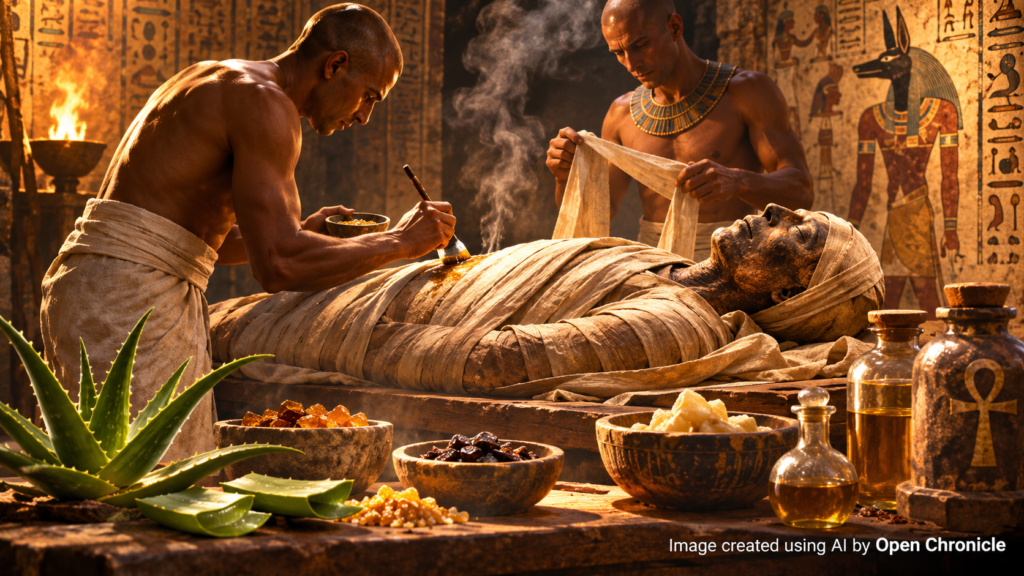
Scientists in Germany have identified molecular traces associated with aloe in ancient Egyptian embalming material, offering new clues about forgotten preservation techniques, historical medicines and the hidden connections between museum collections.
By Open Chronicle History Desk
ARCHAEOLOGY | ANCIENT EGYPT | SCIENTIFIC DISCOVERIES
A discovery hidden in an ancient mummy
For approximately 2,700 years, the remains of an ancient Egyptian individual preserved traces of substances used during the process of mummification.
Those chemical traces have now helped researchers uncover evidence of a plant ingredient that had long appeared in historical discussions of Egyptian embalming but had never previously been confirmed through molecular analysis.
Scientists at Germany’s University of Marburg have identified compounds associated with plants of the genus Aloe in embalming material recovered from a mummified skull dating to the eighth century BC.
The finding emerged from an interdisciplinary investigation combining modern chemistry, Egyptology, pharmaceutical history and the examination of historical museum collections.
Published in the scientific journal Proceedings of the National Academy of Sciences, the study provides new evidence that aloe-derived substances may have formed part of at least some ancient Egyptian embalming preparations.
The discovery is significant because it connects physical evidence from an ancient mummy with references preserved in much later medical and historical writings.
It also demonstrates how modern laboratory techniques can recover information from objects that have spent centuries in museum collections.
Yet the findings require careful interpretation.
The researchers detected aloe-associated compounds in only two of the 24 historical objects examined. Their results therefore do not establish that aloe was a standard ingredient in Egyptian mummification.
Instead, the study opens a new line of investigation into the complexity of ancient embalming practices.
The science behind Egyptian mummification
Ancient Egyptian mummification was far more sophisticated than simply wrapping a body in linen.
The process involved several stages intended to preserve the deceased and prepare the body for the afterlife.
Depending on the period, social status and particular embalming tradition, these procedures could include the removal of internal organs, dehydration using natron salts, treatment with oils and resins, and the careful wrapping of the body.
Preservation was closely connected with religious beliefs about death and the continued existence of the individual.
The Egyptians believed that maintaining the body played an important role in the deceased person’s journey into the afterlife.
The substances applied during embalming were therefore both practical materials and elements of a wider religious tradition.
Previous scientific studies have identified numerous ingredients in Egyptian embalming mixtures.
These include coniferous resins, pistachio resin, vegetable oils, animal fats, beeswax, bitumen and other aromatic plant products.
Some investigations have also identified materials associated with plants that originated far beyond the Nile Valley, suggesting connections with wider commercial networks.
However, many questions remain unanswered.
Different embalming workshops may have used different preparations, while the composition of mixtures could vary according to the historical period, geographical location and part of the body being treated.
The exact botanical origins of some ancient substances have also remained uncertain.
The Marburg investigation adds another potential ingredient to this complex chemical history.
Examining 24 objects from historical collections
The research team studied 24 objects preserved in university and museum collections.
These included mummified human remains, embalming residues, bandages, historical medicinal preparations and two mummified skulls.
One particularly important specimen came from the Zoological Collection of the University of Marburg.
Radiocarbon dating placed the skull in the eighth century BC, approximately 2,700 years ago.
The researchers examined chemical residues associated with the specimen, looking for molecular signatures that could reveal the original substances used during embalming.
A second important sample came from a historical medicinal preparation known as Mumia vera aegyptiaca.
The preparation dated to the eighteenth century and originated from the Löwen Pharmacy in Offenbach am Main, Germany.
It is now preserved in the German Pharmacy Museum in Heidelberg.
Both samples contained compounds associated with aloe.
Among the substances identified were molecules related to aloin and aloeresin, chemical constituents associated with products derived from plants belonging to the genus Aloe.
The identification of aloeresin A was additionally supported through comparison with an authentic reference substance.
This provided a stronger basis for associating the detected compounds with aloe-derived material.
The findings represent the first reported molecular evidence connecting aloe with ancient Egyptian embalming materials.
How modern chemistry can identify ancient ingredients
The researchers used an analytical approach known as liquid chromatography coupled with tandem mass spectrometry.
This technique allows scientists to separate complex chemical mixtures and investigate the molecular structures of their components.
It is particularly valuable when studying ancient organic residues that have undergone substantial chemical changes over time.
Natural substances such as oils, resins and plant extracts do not necessarily remain chemically identical after centuries or millennia.
Exposure to oxygen, environmental conditions and the ageing process can transform their original molecules.
Researchers must therefore look for chemical signatures that remain identifiable despite degradation.
The Marburg team combined mass spectrometry with metabolomics, molecular networking and computational methods supported by machine learning.
Metabolomics involves examining a broad range of small molecules within a sample.
Rather than searching exclusively for one predetermined ingredient, researchers can compare molecular patterns across different objects.
This approach makes it possible to identify similarities that might otherwise remain unnoticed.
In the Egyptian embalming investigation, the method revealed both expected substances and previously unidentified chemical associations.
Several samples contained molecular signatures consistent with aged conifer resins.
Others displayed more unusual compounds, including those associated with aloe.
The findings demonstrate how archaeological chemistry can complement the physical examination of ancient objects.
A mummy may reveal information about its preservation through visible residues, but molecular analysis can uncover details that cannot be detected by ordinary observation.
Why aloe matters
Aloe is a genus of succulent plants that includes species historically valued for their medicinal and practical properties.
The plants contain chemically distinctive substances, some of which have been used in preparations associated with skin treatment and other traditional applications.
However, the new study does not identify the exact species of aloe used in the Egyptian material.
Nor does it establish precisely why the substance was included.
It may have been selected for practical properties, aromatic characteristics, religious associations or a combination of purposes.
These possibilities require further investigation.
The researchers also emphasise that the historical word aloe did not always refer to the plants understood by that name today.
In medieval and early modern texts, the term could describe different botanical products.
It was sometimes used for agarwood, an aromatic material obtained from trees of the genus Aquilaria.
The chemical evidence from the Marburg investigation points towards compounds associated with the botanical genus Aloe, rather than agarwood as the source of those particular molecules.
This distinction is important because historical terminology can change over time.
A word preserved in an ancient or medieval document does not necessarily identify the same substance that a modern reader would associate with it.
By combining molecular analysis with the study of historical language, the researchers have begun to narrow that uncertainty.
An ancient Egyptian word may hold another clue
One of the study’s most intriguing developments came from the examination of ancient Egyptian written sources.
The researchers revisited a substance name that has resisted definitive translation.
The term, transliterated as ꜥnḫ-jm.j, appears in historical material dating to the second millennium BC.
Descriptions of the substance and its uses suggest that it may have referred to aloe or a product derived from it.
If future research confirms that interpretation, the term could provide a valuable connection between ancient Egyptian botanical knowledge and the chemical evidence identified in the mummy.
For now, however, the identification remains provisional.
The researchers have not established a definitive translation.
This illustrates a central challenge in reconstructing ancient technologies.
Even when written records survive, their terminology may be difficult to interpret.
Plant names can change, ingredients may have several designations, and the same term can refer to different materials in different contexts.
Scientific analysis can help resolve such uncertainties, but it cannot automatically determine the meaning of an ancient word.
The strongest conclusions emerge when archaeological, chemical and textual evidence support one another.
When Egyptian mummies became European medicine
The investigation also explores a disturbing and little-known chapter in the history of medicine.
During the late Middle Ages and the early modern period, substances marketed as Mumia vera aegyptiaca circulated in European pharmaceutical practice.
These preparations were associated with Egyptian mummy material and substances used during embalming.
The products were consumed or applied in attempts to treat various medical conditions.
Their actual composition varied considerably.
Some contained materials associated with genuine mummified remains, while others incorporated resins or preparations whose origins were less certain.
The Marburg researchers examined historical examples of these products to better understand what they contained.
Their chemical analyses revealed substantial differences between samples, demonstrating that Mumia vera did not represent a single, consistently prepared medicine.
Several specimens contained molecular signatures associated with aged conifer resins.
The discovery of aloe-related compounds in one historical medicinal preparation was particularly interesting because aloe had appeared in older descriptions of mummy-derived substances.
Scholars had previously questioned whether such references reflected genuine knowledge of Egyptian embalming practices or later speculation influenced by religious and medical traditions.
The new chemical evidence suggests that some historical associations between aloe and mummy material may have deeper roots.
It does not establish that every medieval description was accurate.
Nevertheless, the findings demonstrate that later medical traditions sometimes preserved information that can now be reconsidered using modern scientific methods.
A surprising connection between two museum objects
The investigation produced another discovery unrelated to the identification of aloe.
Using molecular fingerprints, the researchers compared the chemical composition of objects preserved in historical collections.
They found striking similarities between a mummified head and a separately catalogued powder sample.
The objects had not been securely connected through surviving museum documentation.
Yet their molecular profiles suggested that they might originally have shared a material or historical association.
The finding does not prove that the powder came directly from the head.
It does, however, provide a new line of evidence that museum researchers can investigate.
This approach could become particularly valuable for collections assembled during periods when documentation standards differed considerably from those used today.
Historical museums sometimes contain objects whose original excavation locations, previous owners or associations with other specimens have been lost.
Chemical comparisons may help reconstruct aspects of those missing histories.
The technique could also support broader provenance investigations by identifying relationships between objects stored in different collections.
In this way, the study extends beyond ancient Egyptian embalming.
It demonstrates how scientific methods can contribute to understanding the histories of museum objects themselves.
An unexpected experiment involving influenza
The research team also examined whether selected historical preparations displayed biological activity under laboratory conditions.
One extract from a historical Mumia vera aegyptiaca sample showed a modest protective effect against damage caused by influenza virus infection in cultured cells.
The researchers then examined a major compound identified in the preparation, 7-oxodehydroabietic acid.
When tested separately, that compound did not reproduce the protective effect observed in the complete extract.
This suggests that the activity may involve other substances or interactions between multiple components.
The findings are scientifically interesting but should not be interpreted as evidence that mummy-derived preparations were effective medical treatments.
The experiments were conducted in cell culture, not in humans.
They do not establish clinical effectiveness, safety or therapeutic value.
The study’s importance lies in its investigation of the chemical and biological properties of historical materials, rather than in identifying a new medicine.
It also provides an example of how historical pharmaceutical research can investigate ancient remedies without endorsing their use.
What the discovery does not prove
The researchers are careful to distinguish their findings from broader conclusions that the available evidence cannot support.
Aloe-associated compounds were identified in only two of the 24 objects examined.
That limited distribution means the study cannot establish that aloe was widely used in Egyptian mummification.
The presence of the compounds in one ancient skull also does not reveal whether the ingredient was used throughout Egypt, restricted to particular workshops or associated with specific periods.
The original geographical source of the plant material remains uncertain.
The exact species of aloe has not been identified.
Researchers also cannot yet determine the precise purpose for which the substance was applied.
Further analyses of securely dated archaeological specimens will be necessary to establish whether similar compounds appear in other embalming contexts.
These limitations are essential to understanding the discovery.
The study provides evidence for a previously unconfirmed ingredient, not a complete reconstruction of an Egyptian embalming recipe.
A new chapter in the chemistry of the ancient world
The Marburg investigation demonstrates how modern scientific techniques are changing the study of ancient civilizations.
For generations, researchers relied primarily on archaeological remains, written sources and the visual examination of historical objects.
Today, molecular analysis can reveal information preserved within materials that appear ordinary or chemically degraded.
The discovery of aloe-associated compounds in an ancient Egyptian mummy adds another detail to the growing picture of embalming practices.
It also connects several periods of history.
An Egyptian burial from the eighth century BC, medical traditions recorded centuries later and historical pharmaceutical collections in modern Germany are now linked through chemical evidence.
The findings show that ancient materials can retain information long after their original purposes have been forgotten.
They also demonstrate the value of combining disciplines that are often studied separately.
Egyptologists can interpret historical terminology.
Chemists can identify molecular structures.
Historians of medicine can trace how substances were understood and used across different periods.
Museum specialists can investigate the provenance and relationships of objects.
Together, these approaches make it possible to recover fragments of knowledge that no single discipline could reconstruct independently.
Ancient knowledge, modern discoveries
The ancient Egyptians developed complex techniques for preserving the dead, but the full composition of their embalming preparations remains only partly understood.
Every new chemical discovery adds detail to that history.
The identification of aloe-associated compounds does not fundamentally rewrite the story of Egyptian mummification.
Instead, it reveals another layer of sophistication and diversity within practices that evolved over thousands of years.
It also offers a reminder that historical objects can continue to produce new knowledge long after their discovery.
A mummified skull preserved in a university collection may appear to have already yielded its most important information.
Yet modern laboratory methods have revealed chemical traces that were previously inaccessible.
Those traces have opened questions about ancient botanical knowledge, forgotten embalming ingredients, the interpretation of Egyptian texts and the history of European medicine.
The researchers have not solved every mystery.
But they have demonstrated that the chemistry of the ancient world still contains evidence waiting to be understood.
Historical Sources and Further Reading
The following scientific publications and institutional sources support the findings and historical context presented in this article.
Proceedings of the National Academy of Sciences
New molecular and historical evidence on ancient Egyptian embalming.
Berger, T., and colleagues. Published online 26 October 2026. The original research combines molecular analysis of 24 historical objects with the examination of 41 textual sources, providing evidence of aloe-associated metabolites in selected embalming materials.
Philipps University of Marburg
Ancient Egyptian Embalming: New Insights from Molecular Analysis and Historical Texts.
27 October 2026. Institutional explanation of the discovery, the approximately 2,700-year-old mummy, historical medicinal preparations, chemical methods and limitations of the findings.
Phys.org
2,700-year-old mummy head yields first molecular evidence linking aloe to Egyptian embalming.
1 November 2026. Scientific news coverage based on the University of Marburg’s research announcement.
Journal of Archaeological Science
Volatile compounds reveal the composition of embalming materials used in Egyptian mummification.
March 2026. Complementary research into Egyptian embalming substances, including fats, beeswax, resins and bitumen. Provides broader scientific context but does not independently confirm the new aloe finding.
This article is based primarily on the peer-reviewed research published in Proceedings of the National Academy of Sciences and the official announcement from the University of Marburg on 27 October 2026. The identification of aloe-associated molecular compounds in selected samples does not establish that aloe was universally used in ancient Egyptian embalming. The precise botanical species, historical purpose and geographical origin of the material remain uncertain. The interpretation of ancient Egyptian terminology is provisional. Laboratory observations concerning historical medicinal preparations do not demonstrate clinical effectiveness or safety in humans. Open Chronicle distinguishes the documented scientific results from historical interpretation and questions requiring further research.