
OPEN CHRONICLE HISTORY | ARCHAEOLOGY | 3 NOVEMBER 2026
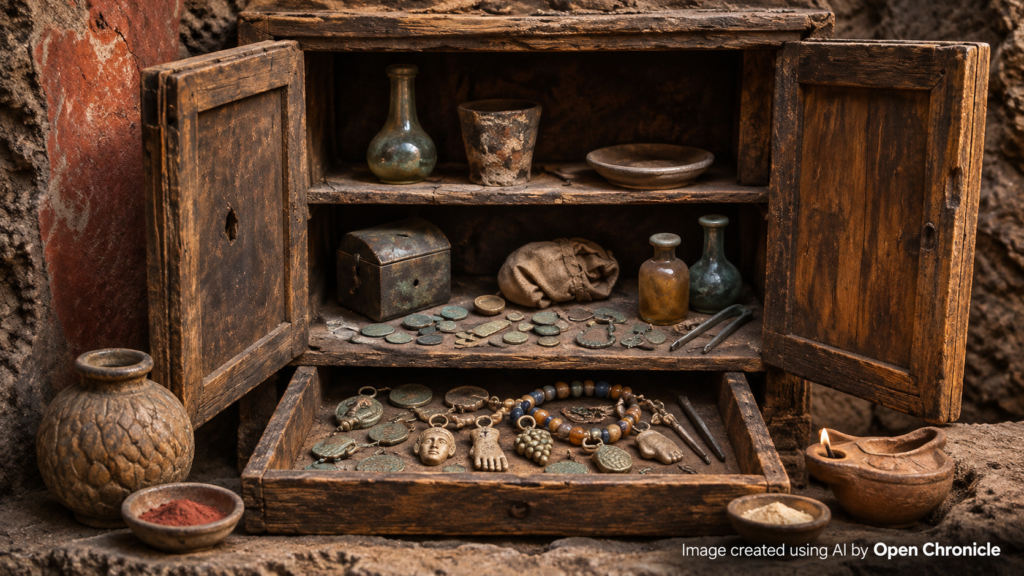
Nearly two thousand years after Mount Vesuvius buried Pompeii, archaeologists have reconstructed the contents of a household cupboard containing personal possessions, protective charms and traces of everyday economic activity. The discovery offers an unusually intimate glimpse into the lives of people whose identities remain uncertain.
By Open Chronicle History Desk
A cupboard that never reopened
For almost two thousand years, the contents of a household cupboard lay concealed beneath the volcanic deposits that engulfed Pompeii in AD 79.
There were objects associated with personal grooming, containers for everyday domestic use, a small collection of bronze coins and a necklace composed of protective charms traditionally associated with Roman childhood.
None was particularly monumental. Yet together, they offer something that grand temples, elaborate mosaics and public buildings cannot always provide: an intimate view of how ordinary people lived.
The discovery was announced by the Archaeological Park of Pompeii on 29 October 2026, following investigations inside a Roman house situated along Via dell’Abbondanza, one of the ancient city’s principal thoroughfares.
The building is traditionally known as the House of Cornelius Maximus, although the identity of its occupants remains uncertain.
Archaeologists did not recover a perfectly preserved wooden cupboard. The furniture had largely deteriorated over the centuries, but its former structure could be reconstructed through surviving fragments, impressions and the positions of objects within the volcanic deposits.
What emerged was an assemblage of possessions that had remained associated with the same domestic space since the catastrophe.
The collection provides evidence of personal care, household routines, religious beliefs and potentially commercial activity.
It also raises a more personal question: who left these objects behind, and why were they never recovered?
A Roman house on one of Pompeii’s busiest streets
The discovery took place in Regio IX, Insula 11, within a building facing Via dell’Abbondanza.
This important street connected different parts of Pompeii and formed part of the city’s active urban environment, where residential buildings existed alongside shops, workshops and other commercial premises.
The house had already attracted archaeological attention during earlier investigations. Its façade was excavated in 1912, when inscriptions contributed to its traditional association with Cornelius Maximus.
However, the name should not be treated as definitive proof of ownership.
Roman buildings could change occupants and functions, while inscriptions might refer to individuals who did not necessarily reside in the property.
The latest work formed part of a broader conservation and restoration programme connected with the nearby Insula of the Chaste Lovers.
Investigations undertaken to improve the stability and understanding of the archaeological area allowed researchers to examine rooms that had remained insufficiently explored.
Within one of these spaces, possibly associated with dining or domestic activities, archaeologists identified the remains of the cupboard.
The surrounding evidence suggests a building with several functions, including domestic and service activities.
Its complete architectural arrangement has not yet been established.
This uncertainty is important. Although the objects offer substantial information about daily life, the excavated context does not permit a complete reconstruction of the household or the relationships between its inhabitants.
The objects of personal care
Among the most revealing discoveries were several objects associated with grooming and bodily care.
Archaeologists identified bronze tweezers, a small glass vessel for perfume or ointment, and a tablet known as a coticula, used for preparing or mixing pigments and other substances.
Bone spatulas were also recovered, including an example with a decorative end resembling a finger.
Such objects are traditionally associated with the Roman mundus muliebris, a term referring to accessories connected with women’s personal care and adornment.
Their presence suggests that grooming and cosmetic practices formed part of the activities undertaken by people living in the house.
However, the objects do not establish that the cupboard belonged exclusively to a woman.
Roman households were shared environments, and individual implements could have several functions. Some tools associated with cosmetics could also be used in medical or practical contexts.
The glass vessel may once have contained perfume, ointment or another substance, but the precise contents cannot be established solely from the vessel’s form.
Even with these limitations, the discoveries illuminate a familiar aspect of Roman society.
People living in Pompeii devoted attention to their appearance, used specialised utensils and stored personal possessions alongside ordinary household equipment.
The archaeological record thus preserves not only the city’s public life but also the routines carried out behind domestic walls.
A necklace carrying the memories of childhood
Perhaps the most emotionally evocative discovery was a collection of at least 24 small objects associated with a necklace of protective charms.
These objects belong to a category known as crepundia.
The term is connected with the Latin idea of making a rattling sound, reflecting the use of small pendants that could produce noise when worn together.
Such objects were traditionally associated with Roman children.
They could function as protective amulets, ornaments and rattling accessories, while their distinctive shapes may also have helped adults recognise or identify a child.
The Pompeii collection includes objects made from materials such as bone, glass paste, faience and rock crystal.
Among the miniature representations are hands, feet, pinecones, grape clusters and figures associated with the deities Bes and Mercury.
Their imagery reveals the cultural diversity of religious symbols circulating in the Roman Mediterranean.
Bes, a protective deity originating in ancient Egyptian religious traditions, was particularly associated with households, children and childbirth.
Mercury, meanwhile, occupied an important place in Roman religion as a deity connected with communication, travel and commerce.
The presence of both figures illustrates how protective practices could incorporate symbols from different cultural traditions.
But the necklace’s significance may have extended beyond religion.
Objects first worn during childhood were sometimes retained later in life as personal keepsakes.
A small charm could become a reminder of family, upbringing or a distant home.
In a society characterised by extensive movement across the Mediterranean, such possessions could carry emotional importance for individuals separated from relatives or their places of origin.
The archaeological evidence does not establish who originally wore the necklace or whether its owner was still a child when Vesuvius erupted.
Its presence nevertheless provides a rare connection to the personal histories that usually remain invisible in the archaeological record.
Money, weights and the possibility of trade
The cupboard also contained evidence that may point towards economic activity.
Researchers identified 38 bronze coins preserved in a small container made from plant material.
Nearby were lead weights associated with the remains of a wooden box.
The combination suggests that someone connected with the household may have participated in commercial transactions.
Weights were essential to many forms of Roman trade, particularly where goods were measured and exchanged according to quantity.
However, the exact function of these objects remains under investigation.
Their presence alone does not establish that the house contained a shop or that its inhabitants belonged to a particular profession.
The distinction is especially important in Pompeii, where residential and commercial activities frequently overlapped.
A household might include storage areas, working spaces or equipment used for small-scale economic activities.
The 38 coins also offer a possible clue to the circumstances surrounding the eruption.
Money represented a practical resource that people might ordinarily attempt to retrieve when abandoning their homes.
Its survival among the possessions left behind suggests that the occupants may have departed in haste or were unable to return.
Yet this remains an interpretation rather than a demonstrated sequence of events.
Archaeologists cannot establish from the coins alone whether the residents escaped, died elsewhere or made particular decisions during the disaster.
The objects document what remained in the building, not the complete fate of the people who once lived there.
Everyday objects and the organisation of domestic life
Beyond the cosmetics, amulets and coins, the cupboard contained a variety of vessels and utensils.
These included pottery, glass and bronze containers, cooking equipment, an incense burner and a bronze oil lamp.
One particularly distinctive object was a small, carefully made drinking vessel decorated with a pattern resembling pinecone scales.
Its workmanship suggests that not every object stored in the cupboard was purely utilitarian.
Some possessions may have been valued for their appearance, craftsmanship or personal associations.
The coexistence of ordinary cooking vessels, personal accessories and potentially valuable objects demonstrates the variety of activities accommodated within Roman domestic spaces.
A single piece of furniture could serve as storage for objects connected with food preparation, grooming, household management and personal memory.
This challenges the temptation to imagine ancient homes as collections of rooms dedicated to rigidly separated functions.
Like modern households, Roman domestic environments could be adaptable.
Objects accumulated over time, were moved between rooms and remained in use long after their original acquisition.
The cupboard therefore offers a snapshot of a living environment rather than a carefully arranged collection.
Its archaeological importance comes partly from the association between objects that would otherwise be studied separately.
Two mice and another side of Roman domestic life
The investigation also produced a less glamorous but revealing discovery.
Archaeologists identified the remains of two young mice inside an amphora associated with the building.
Their presence provides evidence of the small animals that inhabited Pompeii’s domestic and storage environments.
Rodents could exploit stored food, containers and sheltered spaces in ancient towns, just as they do in modern settlements.
The discovery adds an ecological dimension to the archaeological picture.
Pompeii was not simply a city of human inhabitants, monumental architecture and commercial activity.
It was also an environment shared with animals that adapted to the opportunities created by urban life.
The remains of two mice may appear insignificant beside elaborate frescoes or valuable artefacts.
Yet they help reconstruct the ordinary conditions in which people lived, stored goods and managed their households.
How the eruption preserved an interrupted life
In AD 79, Mount Vesuvius erupted with devastating consequences for Pompeii and surrounding communities.
The eruption deposited volcanic material across the city, destroying buildings, killing inhabitants and forcing others to flee.
At the same time, those deposits preserved an extraordinary archaeological record.
Structures, wall paintings, household objects, food remains and traces of organic materials survived in conditions that would have been impossible in many other ancient urban settlements.
The preservation was not always direct.
Wooden furniture often decayed, leaving impressions or cavities that archaeologists could investigate centuries later.
The newly studied cupboard illustrates how the shape and arrangement of an object can sometimes be reconstructed even when much of its original material has disappeared.
This requires careful excavation and documentation.
Researchers must distinguish the original positions of objects from changes caused by structural collapse, volcanic deposits and subsequent deterioration.
The result is not a complete reconstruction of a single moment but an evidence-based interpretation of the physical remains.
In the House of Cornelius Maximus, the association of personal objects, coins and domestic utensils provides an unusually detailed record of possessions that were not retrieved after the eruption.
It does not reveal every event that occurred in the house during the catastrophe.
Instead, it preserves the material consequences of an abrupt interruption.
Why the discovery matters
Pompeii has been investigated for centuries, and its discoveries have transformed modern understanding of Roman urban life.
Public buildings, temples, wealthy residences and celebrated artworks have traditionally attracted much of the attention.
Yet smaller finds can be equally important.
A pair of tweezers reveals something about bodily care.
A glass vessel points towards the storage and use of scented substances.
Lead weights suggest economic practices.
A necklace of childhood charms reveals protective beliefs and possibly personal memories.
Taken together, these objects illuminate the relationship between material possessions and individual experience.
They also show why archaeologists increasingly examine ordinary domestic contexts with the same care given to monumental architecture.
The people who lived in Pompeii were not merely participants in a historical catastrophe.
They were individuals with routines, responsibilities, relationships and belongings.
The cupboard does not provide their names or tell us precisely what happened to them.
But it brings aspects of their daily lives into focus.
A human story beneath the volcanic ash
Nearly two millennia after the eruption of Mount Vesuvius, the remains of a Roman cupboard have reopened a small window onto the ancient world.
The discovery is significant not because the objects were exceptionally luxurious or because they belonged to a famous historical figure.
Their importance lies in their ordinariness.
They were the kinds of possessions that people used, stored, valued and sometimes carried with them through different stages of life.
Some may have been practical necessities. Others may have been connected with family, childhood or personal identity.
When the eruption came, they remained behind.
Today, their survival allows archaeologists to reconstruct a fragment of domestic life that would otherwise have disappeared.
Pompeii continues to reveal the consequences of one of antiquity’s most destructive natural disasters.
But discoveries such as this remind us that the city’s greatest historical value is not limited to the moment of its destruction.
It also lies in the countless ordinary lives that existed before it.
Historical Sources and Further Reading
The following sources document the archaeological discovery, its historical context and the interpretation of objects recovered from a Roman household in Pompeii.
Archaeological Park of Pompeii
Lo scavo di una domus nell’insula IX 11: il rinvenimento di un armarium con crepundia.
29 October 2026. Original excavation report in the E-Journal of the Excavations of Pompeii. Documents the cupboard, associated objects, archaeological context and preliminary interpretations.
Reuters
Pompeii cupboard opens window onto life before Vesuvius erupted.
29 October 2026. Independent reporting on the discovery, including the archaeological interpretation of personal belongings, coins and childhood amulets.
Archaeology Magazine
Household Cupboard Excavated in Pompeii.
30 October 2026. Specialist archaeological summary of the cupboard, its location and the recovered objects, including the necklace of crepundia.
Euronews
In Pompeii, a woman’s wardrobe resurfaces with beauty items and jewels.
29 October 2026. Additional reporting on the personal-care objects and the domestic setting. The proposed female association is interpreted cautiously in the Open Chronicle article.
This article is based primarily on the excavation report published by the Archaeological Park of Pompeii on 29 October 2026, supported by contemporary international and specialist archaeological reporting. The original wooden cupboard was not recovered intact; its form and contents were reconstructed from surviving archaeological evidence. The identity, gender and fate of the occupants remain uncertain. Interpretations concerning commercial activity, childhood memories and the circumstances in which possessions were abandoned are presented as archaeological possibilities rather than established facts. The article distinguishes documented discoveries from broader historical interpretation.