
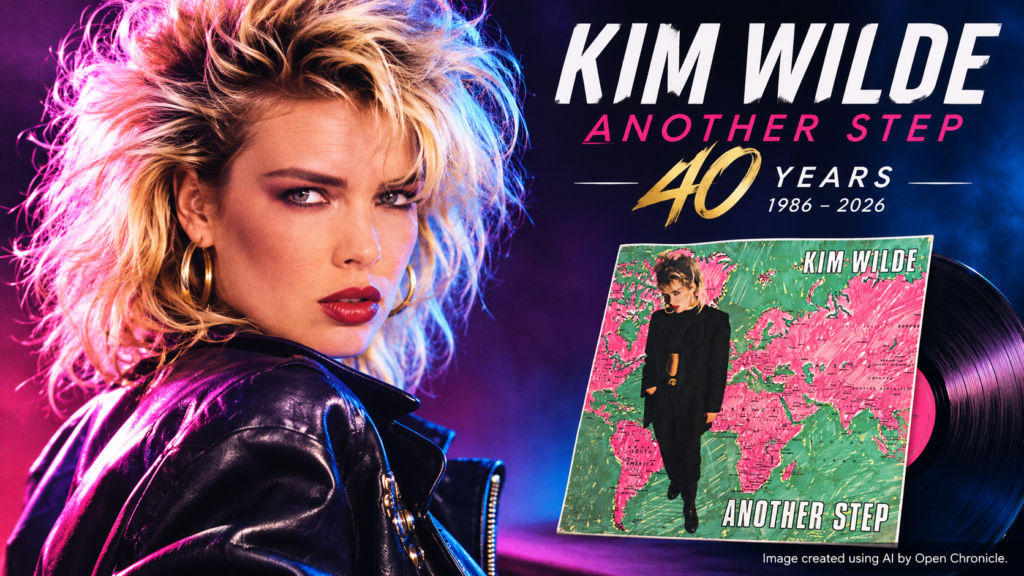
Released in November 1986, Kim Wilde’s fifth studio album brought together synthpop, dance music, soul influences and a bold reinterpretation of a Supremes classic. Forty years later, Another Step remains a fascinating portrait of an artist in transition.
By RhythmNest | The Record Shelf | 3 November 2026
Some albums become important because they introduce an entirely new musical direction. Others acquire their place in history because one recording changes the trajectory of an artist’s career.
For Kim Wilde, Another Step belongs partly to the second category.
Released in November 1986, her fifth studio album contained a version of “You Keep Me Hangin’ On”, the Holland, Dozier and Holland composition originally made famous by The Supremes two decades earlier.
Wilde’s interpretation transformed the Motown recording into a dramatic, synthesizer-driven pop anthem.
In Britain, the single reached number two. In June 1987, it climbed to the top of the American Billboard Hot 100, becoming Wilde’s only US number-one single.
Yet Another Step deserves to be remembered for more than that achievement.
The album also documents a period of artistic transition, when Wilde was moving beyond the sound that had defined her early career and experimenting with a broader network of producers, musicians and musical influences.
Forty years later, its combination of ambition, unevenness and commercial breakthrough makes it particularly interesting to revisit.
01 · The Record
Kim Wilde in 1986
By the time Another Step appeared, Kim Wilde was already an established figure in British and European pop.
Her debut single, “Kids in America”, had introduced her in 1981 with a striking combination of synthesizers, guitar-driven energy and a cool, distinctive vocal delivery.
The song became one of the defining recordings of the early British synthpop era.
Her subsequent albums developed that identity through a mixture of new wave, electronic pop and melodic rock.
But the musical landscape was changing.
By 1986, the synthesizer had become a central instrument in mainstream popular music. Digital recording technology, programmed rhythms and increasingly sophisticated studio production were reshaping the sound of international pop.
Artists who had emerged during the early new wave period were now competing in a musical environment dominated by elaborate production, powerful singles and increasingly global markets.
For Wilde, the challenge was not simply to repeat the success of “Kids in America”.
It was to develop a sound capable of carrying her into the second half of the decade.
Another Step represented an attempt to do exactly that.
02 · A More Ambitious Production
Beyond the Familiar Wilde Sound
One of the most revealing aspects of Another Step is its production.
Earlier Kim Wilde records had been closely associated with her brother Ricky Wilde, who played a central role in shaping her sound.
On Another Step, that creative foundation remained important, but the album also involved a wider group of collaborators.
The production credits included Richard James Burgess, Reinhold Heil, Rod Temperton, Richard Rudolph and Bruce Swedien, alongside Ricky and Kim Wilde.
The presence of Temperton and Swedien is particularly notable.
Both were associated with some of the most sophisticated pop productions of the era, including their work with Michael Jackson.
Their involvement reflected the album’s broader musical ambitions.
Rather than relying exclusively on the established formula of melodic synthpop, Another Step explored more polished dance arrangements, funk influences, contemporary American pop production and soul-inspired songwriting.
The album was recorded across studios in England and Los Angeles, reinforcing its international production character.
That variety is audible throughout the record.
Some tracks retain the directness of Wilde’s earlier work.
Others move toward the more elaborate, rhythmically sophisticated sound of mid-1980s American pop.
The result is not always completely unified.
But its stylistic diversity is also part of what makes the album an interesting historical document.
03 · You Keep Me Hangin’ On
A Motown Classic Reimagined
The centrepiece of Another Step is undoubtedly “You Keep Me Hangin’ On”.
The song was written by Brian Holland, Lamont Dozier and Eddie Holland, the legendary Motown songwriting and production team.
The Supremes released their original recording in 1966.
Led by Diana Ross, it became a number-one American hit and one of the group’s most recognisable recordings.
The original combined the emotional urgency of its lyrics with the precision and energy of Motown’s rhythm section.
Its central message concerned the frustration of a relationship that had ended emotionally but continued to exert a powerful hold.
Two decades later, Wilde approached the song from a very different musical perspective.
Her recording replaced much of the original’s rhythmic character with the driving pulse and electronic intensity associated with 1980s dance-pop.
The synthesizers became more prominent.
The drums acquired a harder, more mechanical character.
The arrangement expanded the song’s dramatic tension through repetition, layered textures and a powerful chorus.
Yet the emotional centre remained recognisable.
Wilde’s vocal performance preserved the frustration and determination of the composition while giving it a different personality.
The result was neither a faithful reconstruction nor an attempt to imitate Diana Ross.
It was a reinterpretation designed for a new musical generation.
04 · Two Decades, Two Number-One Records
The Extraordinary Journey of One Song
The commercial achievement of Wilde’s version is particularly striking.
The Supremes’ original recording had topped the Billboard Hot 100 in 1966.
On 6 June 1987, Kim Wilde’s interpretation reached the same position.
A song written during Motown’s golden era had returned to the summit of the American singles chart more than twenty years later.
The achievement demonstrated the enduring strength of the original composition.
But it also revealed how dramatically musical production had changed.
The Supremes’ version belonged to a world of tightly arranged rhythm sections, orchestral embellishments and vocal-group harmonies.
Wilde’s recording belonged to an era of synthesizers, electronic percussion and high-energy pop production.
The underlying songwriting remained effective in both settings.
That is one of the defining qualities of a durable popular song.
A strong composition can survive changes in instrumentation, recording technology and performance style.
In Britain, Wilde’s version reached number two, spending two weeks at that position in November 1986.
In America, its success gave her the biggest singles achievement of her career.
For many American listeners, “You Keep Me Hangin’ On” became their defining introduction to Kim Wilde.
05 · The Album Beyond the Hit
More Than One Successful Single
Although “You Keep Me Hangin’ On” dominates the album’s legacy, Another Step contains several recordings that illuminate Wilde’s artistic development.
“Another Step (Closer to You)”
The title track, recorded with British soul singer Junior, reveals the album’s interest in vocal collaboration and a smoother, soul-influenced approach.
Its duet format introduces a different emotional dynamic from Wilde’s more familiar solo performances.
The song was released as a single in 1987.
“Say You Really Want Me”
This recording reflects the album’s connection with sophisticated American pop production.
With contributions from Richard Rudolph, Rod Temperton and Bruce Swedien, it moves toward a polished dance-pop sound.
Its production provides a useful contrast with the more direct arrangements associated with Wilde’s early career.
“The Thrill of It”
Written by Kim Wilde and guitarist Steve Byrd, this track retains a stronger connection with melodic pop-rock.
It demonstrates that the album’s expansion into dance and soul influences did not require abandoning the guitar-driven elements of her established sound.
“Schoolgirl”
One of the album’s earlier singles, “Schoolgirl” reflects the melodic sensibility and electronic textures that remained central to Wilde’s musical identity.
“Missing”
Written by Wilde and Steve Byrd, “Missing” offers another example of the artist’s growing involvement in songwriting.
These tracks are important because they reveal the album as a broader creative project rather than merely a vehicle for its most successful single.
06 · Kim Wilde as a Songwriter
An Artist Taking Greater Control
One of the most significant developments surrounding Another Step was Wilde’s increasing contribution to the songwriting process.
Her early career had been strongly associated with compositions by Ricky and Marty Wilde.
That family collaboration remained important.
However, Another Step featured several songs written or co-written by Kim herself, including collaborations with Steve Byrd and Ricky Wilde.
This development deserves attention.
The 1980s pop industry often presented female performers primarily through their image, vocal delivery and commercial appeal.
But Wilde was increasingly involved in shaping the material she recorded.
Her songwriting contributions demonstrated an ambition to participate more directly in the creative process.
That evolution would continue in subsequent albums.
In this respect, Another Step can be understood as a transitional record not only musically, but also in terms of artistic authorship.
07 · The Sound of 1986
When Synthpop Met International Pop
To understand Another Step, it helps to consider the musical environment in which it appeared.
By the middle of the 1980s, synthpop was no longer an experimental movement operating on the margins of popular music.
Electronic instruments had become fundamental to mainstream recording.
Artists across rock, soul, dance and pop were incorporating synthesizers, drum machines and digital studio technology into their work.
At the same time, music production was becoming increasingly international.
British performers were working with American producers.
Dance music was influencing pop arrangements.
Soul and funk traditions were being reinterpreted through electronic instrumentation.
Another Step reflects this convergence.
Its production credits, recording locations and stylistic variety reveal an artist working within a rapidly changing musical industry.
The album is therefore valuable not only as a Kim Wilde release, but also as a snapshot of the period.
It captures the moment when the relatively direct electronic pop of the early 1980s was evolving into the elaborate international production style that would dominate the decade’s final years.
08 · Commercial Success and Artistic Complexity
A Breakthrough That Did Not Tell the Whole Story
The commercial history of Another Step contains an interesting contradiction.
Its most successful single became an international breakthrough.
Yet the album itself did not achieve the same level of chart dominance in every market.
In Britain, Another Step reached number 73 on the Official Albums Chart.
In the United States, it reached number 40 on the Billboard 200.
These figures illustrate the difference between the commercial impact of a single and the reception of the album containing it.
For many listeners, Wilde’s version of “You Keep Me Hangin’ On” became an essential recording of the period.
The album around it received a more mixed response.
Part of that may be explained by its stylistic diversity.
With several production teams and a range of musical approaches, Another Step does not possess the same consistent sonic identity as some of the most celebrated albums of the decade.
But consistency is not the only measure of artistic value.
The record documents experimentation, changing ambitions and the process of artistic development.
Its imperfections are part of its history.
09 · The Vinyl Revival
Another Step Returns to the Record Shelf
The album’s fortieth anniversary has also coincided with renewed interest in its physical presentation.
On 28 August 2026, Demon Records released Another Step in new vinyl editions, including a picture disc and a coloured vinyl version.
The reissue programme brought the album back to LP format after many years of limited availability in that form.
For collectors, the release offers an opportunity to revisit a record whose historical importance extends beyond its most famous single.
It also reflects the wider revival of interest in 1980s pop albums as complete artistic objects.
Vinyl encourages a different relationship with recorded music.
Rather than selecting an individual song from a digital catalogue, listeners encounter an album’s sequence, artwork and broader musical identity.
That experience can be particularly rewarding with a record such as Another Step.
Its contrasting production styles become more apparent when heard together.
The relationship between its singles and lesser-known tracks becomes easier to appreciate.
And the album’s role in Wilde’s development emerges more clearly.
10 · The RhythmNest Listening Perspective
Four Ways to Rediscover Another Step
First listening: The Motown transformation
Begin with The Supremes’ original version of “You Keep Me Hangin’ On”, then listen to Wilde’s recording.
Compare the rhythm sections, vocal delivery and use of instrumental space.
Notice how the emotional character changes even though the central composition remains the same.
Second listening: The production
Move through “Say You Really Want Me”, “The Thrill of It” and “Schoolgirl”.
Listen for differences in percussion, synthesizer textures and guitar arrangements.
The contrast reveals the album’s multiple production approaches.
Third listening: The songwriting
Focus on “Another Step (Closer to You)” and “Missing”.
Consider how Wilde’s own songwriting contributions broaden the album’s identity.
Fourth listening: The complete album
Finally, play Another Step from beginning to end.
Rather than approaching it as a collection of singles, listen to it as a document of an artist negotiating the changing musical landscape of 1986.
Its strengths and inconsistencies become part of the same story.
11 · Why Another Step Still Matters
The Album That Opened America
Forty years after its release, Another Step occupies a distinctive position in Kim Wilde’s discography.
It was not her debut.
It was not necessarily her most stylistically unified record.
And it did not become her biggest-selling album in every territory.
But it contained the recording that finally brought her to the top of the American singles chart.
It also marked a period of increasing songwriting involvement and a willingness to explore musical styles beyond the synthpop formula that had established her reputation.
The album’s central achievement remains its reinterpretation of “You Keep Me Hangin’ On”.
That recording demonstrated how a great song could cross generations without losing its emotional power.
It connected the musical world of Motown in 1966 with the electronic pop culture of 1986.
And it introduced Kim Wilde to a new American audience.
The album surrounding that single tells a more complicated story.
It is the sound of an artist experimenting, collaborating and searching for a broader musical identity.
That makes Another Step worth rediscovering.
Not simply because one of its songs became a classic.
But because the record captures an important moment in the evolution of both Kim Wilde and 1980s pop.
Forty years later, Another Step remains exactly what its title suggests: a record about moving forward.
RhythmNest File
| Field | Information |
|---|---|
| Artist | Kim Wilde |
| Album | Another Step |
| Original release | November 1986 |
| 40th anniversary | 2026 |
| Studio album | Fifth |
| Original label | MCA Records |
| Musical styles | Pop, synthpop, dance-pop, pop-rock |
| Key single | “You Keep Me Hangin’ On” |
| UK singles peak | No. 2 |
| US singles peak | No. 1 |
| US number-one date | 6 June 1987 |
| UK album peak | No. 73 |
| US album peak | No. 40 |
| Notable collaborators | Ricky Wilde, Steve Byrd, Rod Temperton, Bruce Swedien, Richard James Burgess |
| 2026 vinyl reissue | Demon Records, 28 August 2026 |
RHYTHMNEST | THE RECORD SHELF | RESEARCH
Sources and Further Reading
Historical reporting, official chart records, record label documentation and specialist discographies supporting our examination of Kim Wilde’s Another Step, forty years after its original release.
01 | Anniversary Reporting
Noise11 | Kim Wilde’s Another Step Turns 40 as You Keep Me Hangin’ On Makes US Chart History
3 November 2026
Anniversary reporting on the album, its American breakthrough and its place in Wilde’s career.
02 | Official Record Label
Demon Music Group | Kim Wilde: Another Step, Picture Disc
Official record label documentation of the 2026 vinyl reissue, album history and track listing.
03 | Official Album Charts
Official Charts | Another Step
Official British album chart history, including the album’s peak position and chart run.
04 | Official Singles Charts
Official Charts | You Keep Me Hangin’ On
Official British singles chart history documenting the song’s number-two peak in November 1986.
05 | Discographic Documentation
MusicBrainz | Another Step
Detailed discographic information, recording credits, songwriting credits and production personnel.
06 | Specialist Discography
KimWilde.fr | L’album Another Step
Specialist discography documenting the album’s original production, collaborators, recording studios and songs.
Editorial Note
This article commemorates the fortieth anniversary of Kim Wilde’s Another Step and combines documented discographic information, official chart records, record label documentation and independent RhythmNest musical analysis. Chart positions, recording credits and reissue details are supported by the listed sources. Interpretations of the album’s artistic development, production identity and historical significance are editorial assessments. Some discographic databases differ on the precise original release date and on the configuration of certain editions; the album is consistently documented as a 1986 release, with November 1986 identified in the anniversary reporting and official reissue materials.
RhythmNest | The Music Magazine by Open Chronicle