
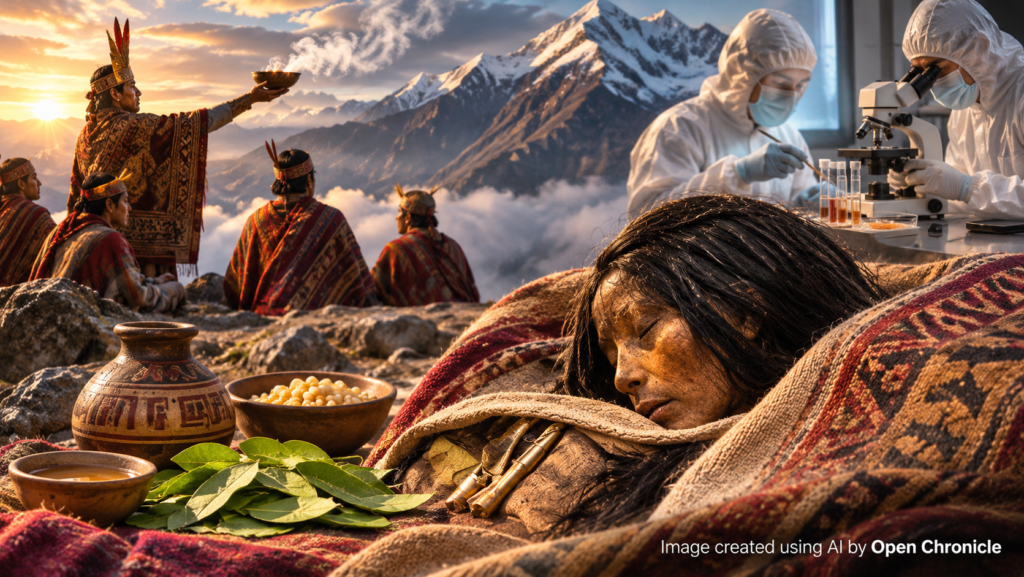
New toxicological research on eight individuals sacrificed in the Andes reveals evidence of coca consumption, alcohol and a psychoactive compound associated with certain South American plants. The findings suggest that one of the Inca Empire’s most important religious ceremonies was more diverse than previously understood.
By Open Chronicle History Desk
ARCHAEOLOGY | ANCIENT CIVILIZATIONS | SOUTH AMERICA | 3 NOVEMBER 2026
Five centuries beneath the Andean ice
High in the Andes, where freezing temperatures and thin air have preserved human remains for centuries, archaeologists are uncovering new details about the final months of people selected for some of the Inca Empire’s most important religious ceremonies.
A scientific study published on 3 November 2026 in the journal Antiquity presents toxicological evidence from eight individuals whose bodies were preserved at high-altitude archaeological sites in Peru and Argentina.
The research reveals that coca leaves were consumed by the individuals whose hair could be analysed, while evidence associated with alcohol and another psychoactive substance appeared in particular specimens.
The findings offer new insight into capacocha, a state-sponsored religious ceremony involving the sacrifice of children and young women.
They also challenge the idea that these ceremonies followed one uniform procedure throughout the empire.
Instead, the researchers suggest that the preparation of those selected for sacrifice could vary according to local religious traditions, sacred mountains and the characteristics attributed to individual deities.
The investigation was led by Dagmara Socha of the University of Warsaw, working with researchers and museum specialists from Poland, Peru, Argentina and the United States.
By examining chemical traces preserved in hair and nails, the team reconstructed aspects of substance consumption that took place before the individuals died.
The results provide a rare scientific perspective on the experiences of people whose final journeys were shaped by the political and religious institutions of the Inca Empire.
The meaning of capacocha
The Inca Empire, also known as Tawantinsuyu, governed a vast territory extending across much of western South America before the Spanish conquest.
Its political and religious system connected the imperial capital of Cusco with communities, sacred landscapes and ceremonial centres throughout the Andes.
Among its most important religious practices was capacocha, also written qhapaq hucha.
The ceremony involved offerings to powerful deities and sacred places, including mountain summits.
Children and young women could be selected to participate in these ceremonies, sometimes travelling considerable distances before reaching the location where they would be sacrificed.
The rituals were associated with important political events, religious obligations and circumstances believed to threaten the relationship between the human and divine worlds.
Drought, famine, political instability and other events could form part of the religious context in which such ceremonies took place.
In Inca cosmology, mountains were not simply geographical features.
Many were regarded as sacred beings or places possessing spiritual power.
Their importance was often connected with water, weather, fertility and the protection of communities.
The people sacrificed at these locations were understood within the religious framework of the time as intermediaries between the living and the divine.
For modern researchers, the challenge is to investigate these practices without reducing them to a single explanation.
The ceremonies combined religion, political authority, movement across imperial territory and the experiences of individuals who had little control over their fate.
The newly published study contributes to that understanding by examining what the participants consumed before their deaths.
Eight individuals, several sacred mountains
The research focused on eight mummified individuals associated with ceremonial sites in Peru and Argentina.
Their remains came from archaeological contexts connected with mountains including Ampato, Llullaillaco, Quehuar, Sara Sara and Chuscha.
The study brought together material preserved in collections such as the Museo Santuarios Andinos in Arequipa, Peru, and the Museo de Arqueología de Alta Montaña in Salta, Argentina.
Seven of the eight individuals examined were female.
Some were young children, while others were adolescents.
The exceptional preservation of their remains provided an opportunity to investigate chemical evidence that would rarely survive in ordinary archaeological burials.
Freezing conditions can preserve hair, nails, skin and other tissues over long periods.
Hair and nails are especially valuable for toxicological investigations because substances consumed during life can leave chemical traces within their keratin structures.
Depending on preservation and sampling conditions, hair may also provide information about changes in exposure over time.
This allows scientists to move beyond identifying a substance and begin examining when it may have been consumed.
However, the process has limitations.
Chemical compounds degrade at different rates, and not every episode of consumption leaves a detectable trace.
The absence of a particular substance therefore does not necessarily establish that it was never consumed.
These limitations became particularly important when the researchers compared individuals from different mountain sanctuaries.
What the hair revealed about coca
The most consistent finding concerned coca.
The researchers identified cocaine and its principal metabolite, benzoylecgonine, in the analysed hair samples.
In this archaeological context, those chemical signatures are consistent with the consumption of coca leaves.
Coca held an important place in Andean societies long before the arrival of Europeans.
Its leaves were used in social and ceremonial settings and could be presented as offerings to sacred beings.
They also had practical importance.
Chewing coca leaves could help people cope with fatigue and the demands of travelling through mountainous environments.
For individuals undertaking long journeys to high-altitude ceremonial sites, coca consumption may therefore have served both practical and religious purposes.
The study does not establish that every individual consumed identical quantities or followed the same pattern of use.
Instead, the chemical evidence indicates that coca was a recurring element across the investigated ritual contexts.
The results are particularly important because earlier analyses of some of the same individuals had failed to detect the relevant compounds.
Improved laboratory techniques have now revealed evidence that previous investigations could not identify.
This illustrates how advances in forensic science can change the interpretation of archaeological material without requiring a new excavation.
Sometimes the most significant discoveries emerge from re-examining objects and remains already preserved in museum collections.
Alcohol and the final stages of the ceremonies
The researchers also investigated evidence of alcohol consumption.
One particularly informative compound was cocaethylene.
This substance can form in the human body when cocaine and alcohol are present together.
Its detection therefore provides chemical evidence consistent with the combined consumption of coca and an alcoholic beverage.
Cocaethylene was identified in samples associated with Chuscha and Llullaillaco.
Historical sources describe the use of chicha, a fermented beverage often made from maize, in Inca religious ceremonies.
The beverage could be presented as an offering to deities and consumed during important rituals.
Accounts recorded after the Spanish conquest also describe the administration of chicha to individuals selected for sacrifice.
According to these descriptions, alcohol could have been used to calm participants or reduce their awareness during the final stages of the ceremony.
However, historical narratives must be interpreted cautiously.
They were recorded in particular colonial contexts and may not describe every local practice accurately.
The chemical findings provide independent evidence that alcohol was consumed in some of the investigated cases, but they do not establish the exact beverage used.
Nor do they prove the intentions of those who administered it.
The presence of cocaethylene supports an association between coca and alcohol consumption, while the broader interpretation depends on archaeological and historical context.
The final month of a child from Chuscha
One of the most revealing results came from a young girl associated with the Chuscha mountain in Argentina.
She was approximately eight years old when she died.
Her remains were discovered in the early twentieth century and passed through private collections before entering the care of a museum in Salta.
The researchers conducted a segmented analysis of her hair.
By examining different sections, they investigated changes in chemical exposure over time.
The results indicated variations in coca consumption during the period represented by the preserved hair.
Cocaethylene was detected in the section corresponding approximately to the final month before her death.
This suggests that alcohol consumption alongside coca may have become more prominent during the concluding stage of her journey or ceremonial preparation.
The finding offers a particularly intimate perspective on the ritual.
Rather than identifying only what a person consumed at some unspecified point, the analysis provides evidence of a change occurring relatively close to death.
Nevertheless, the researchers caution that hair preservation and differences in the way chemical compounds enter hair can influence the results.
The study cannot reconstruct a precise daily sequence.
It cannot establish how the child felt, whether she understood what was going to happen or exactly how the substances were administered.
What it can demonstrate is that her chemical record differed across the period examined.
That difference may reflect the transition into the final stage of the ceremony.
Juanita and the mystery of harmine
Another important finding concerns one of the most famous Inca mummies ever discovered.
The individual known as the Lady of Ampato, or Juanita, was recovered from Mount Ampato in southern Peru.
Her exceptionally preserved remains have become central to the archaeological study of Inca mountain sacrifices.
In the new investigation, researchers identified harmine in a nail sample from the individual designated Ampato #1.
Harmine is an alkaloid associated with certain South American plants, including species of Banisteriopsis.
Some of these plants are traditionally used in preparations associated with ayahuasca.
The finding raises the possibility that a harmine-containing plant preparation was administered during ceremonies connected with Ampato.
However, the evidence does not establish that Juanita consumed a beverage identical to modern ayahuasca.
The researchers did not detect the combination of substances that would be needed to support such a specific identification.
In particular, the absence of detected dimethyltryptamine, commonly abbreviated DMT, limits what can be concluded about the composition of the preparation.
The result is therefore best understood as evidence of exposure to harmine.
Its botanical source, preparation and ceremonial purpose remain uncertain.
Even with those limitations, the discovery is significant.
It suggests that the range of psychoactive substances associated with Inca mountain rituals may have been broader than coca and alcohol alone.
It also raises questions about the movement of plants, ingredients and religious knowledge across different environments of the Andean world.
Why the rituals may have differed
The study’s broader significance lies in the differences between the individuals examined.
Coca consumption appeared to be a recurring element, but other chemical findings were not distributed uniformly across the samples.
Evidence associated with alcohol was detected in particular cases.
Harmine appeared in a nail sample from Ampato.
Other substances investigated by the researchers were not identified in the analysed hair samples.
These variations suggest that capacocha was not necessarily performed according to one fixed formula throughout the Inca Empire.
Different mountain sanctuaries were associated with different sacred beings and religious traditions.
The characteristics attributed to these deities may have influenced the selection of offerings and the preparation of those who participated in the ceremonies.
Local environmental conditions and access to particular plants could also have affected ritual practices.
The researchers therefore propose that differences in substance consumption may reflect the religious importance of particular mountains.
This interpretation does not mean that every variation can be explained.
Some differences may result from the preservation of the remains, the timing of consumption or the sensitivity of the analytical methods.
The available evidence is also limited to eight individuals.
Nevertheless, the results challenge overly simplified descriptions of Inca ritual life.
An empire governed from a powerful political centre could still accommodate significant diversity in religious practices.
The science of reading ancient hair and nails
The investigation used liquid chromatography coupled with tandem mass spectrometry.
This analytical technique allows scientists to identify small quantities of chemical substances within complex samples.
The researchers searched for compounds associated with several psychoactive plants and substances, including cocaine, benzoylecgonine, cocaethylene, harmine, harmaline, mescaline, scopolamine, atropine and DMT.
The method can detect chemical signatures at very low concentrations.
This is especially important for archaeological samples because centuries of environmental exposure may reduce the amount of identifiable material.
The study also demonstrates why older negative results should not always be considered definitive.
Earlier tests may have lacked the sensitivity necessary to identify substances present in small quantities.
By re-examining preserved remains with improved methods, researchers can recover evidence that was previously inaccessible.
Yet toxicological analysis has important interpretive boundaries.
A detected compound can establish exposure, but it does not automatically reveal the circumstances in which a substance was consumed.
It cannot independently determine whether consumption was voluntary, ceremonial, medicinal or imposed.
Those questions require additional evidence from archaeology, historical records and the broader cultural setting.
The strongest interpretations therefore emerge when scientific results are considered alongside the locations, burial objects and historical circumstances associated with the individuals.
Sacred mountains and imperial authority
The findings also illuminate the relationship between religion and political power in the Inca Empire.
Capacocha ceremonies were not isolated local events.
They formed part of a wider system connecting communities and sacred places to imperial authority.
The selection of participants, movement across the territory and performance of rituals at important mountain sanctuaries could reinforce the relationship between local religious traditions and the central political order.
Mountain deities occupied an important position in Andean religious life.
They were frequently associated with water, agricultural fertility and the environmental conditions on which communities depended.
The significance of a particular mountain could therefore extend far beyond its immediate geographical surroundings.
Ceremonies performed at these locations expressed relationships between people, the landscape and the sacred world.
The new toxicological evidence suggests that the substances consumed by sacrificial participants may have formed part of those relationships.
Different preparations could have reflected the requirements of different sacred places.
However, the study does not establish that the chemical differences were deliberately imposed by imperial authorities.
That remains an interpretation requiring further investigation.
What the findings do demonstrate is that the archaeological record preserves evidence of diversity within a major imperial religious practice.
The ethical responsibility of studying human remains
Research on the preserved bodies of sacrificed children raises important ethical questions.
The individuals examined were not simply archaeological specimens.
They were human beings whose lives ended within religious and political systems that existed centuries ago.
Their remains are also connected with the histories and cultural heritage of Andean communities today.
Scientific investigations must therefore consider how samples are obtained, how the remains are conserved and how findings are communicated.
The authors report that their work followed relevant professional ethical standards and that the necessary permissions were obtained, including authorisation from Peru’s Ministry of Culture.
The participation of researchers and institutions in Peru and Argentina is particularly important because the archaeological material originates from those countries.
Modern scientific methods can reveal remarkable details about ancient lives.
But those discoveries should not erase the humanity of the people being studied.
In the case of the capacocha individuals, chemical analysis provides information about exposure to substances and possible ritual preparation.
It does not reveal their personal beliefs, emotions or full life histories.
Recognising those limits is part of responsible archaeological interpretation.
What remains unknown
The new study answers several questions but leaves others unresolved.
The evidence supports coca consumption among the individuals represented by the analysed hair samples.
It also identifies chemical markers associated with alcohol consumption in particular cases and harmine exposure in one individual.
However, the researchers cannot determine precisely how every substance was administered.
The exact ingredients of the beverages or preparations remain uncertain.
The study also cannot establish whether differences between individuals were caused by local religious customs, personal circumstances, preservation conditions or combinations of these factors.
A further limitation concerns the detection of isolated consumption events.
Some substances may not be incorporated into hair or nails in sufficient quantities to survive for centuries.
A negative result therefore cannot exclude every possible episode of consumption.
The researchers suggest that future studies involving additional individuals and improved analytical methods may reveal further differences between mountain sanctuaries.
Such work could also help clarify how ceremonial practices changed over time and across the empire.
A more complex picture of the Inca world
The frozen mummies of the Andes have long provided extraordinary evidence of Inca religious practices.
Their preservation allows archaeologists to examine aspects of life and death that are rarely accessible through ordinary burials.
The latest toxicological investigation adds a new dimension to that evidence.
It demonstrates that coca was a recurring feature of the examined ceremonies, while alcohol and harmine appeared in more specific contexts.
Most importantly, the differences between individuals suggest that the rituals were not necessarily identical across the Inca Empire.
The findings reveal a religious world in which imperial authority, local sacred landscapes and established traditions could interact in complex ways.
They also show how modern scientific techniques can recover information from the smallest surviving traces.
A few strands of hair or fragments of a nail can preserve evidence of events that occurred approximately five centuries ago.
Those traces cannot tell the complete stories of the children and young women who died in the mountains.
But they allow researchers to approach their final journeys with greater precision and a clearer understanding of the rituals in which they were involved.
The result is not simply a discovery about ancient psychoactive substances.
It is a more detailed picture of the people, beliefs and regional diversity that shaped one of the most powerful civilizations in pre-Columbian South America.
Historical Sources and Further Reading
The following peer-reviewed research, institutional statements and specialist archaeological reports document the toxicological investigation of Inca mountain mummies and its historical significance.
Antiquity | Cambridge University Press
Toxicological studies on the Inca frozen mummies from volcanoes in Peru and Argentina
Socha, D., Sykutera, M., Martinez Sulca, W., Recagno, G., Reinhard, J., Zigaran, F., Bernaski, M. and Grupp, F. Published online 3 November 2026. Original scientific research examining hair and nail samples from eight individuals associated with capacocha ceremonies.
Antiquity Journal
Analysis of Inca mummies identifies the drugs used in their most important sacrificial ritual
3 November 2026. Official editorial presentation of the research, including statements from lead researcher Dagmara Socha and an explanation of the differences identified between mountain sanctuaries.
Phys.org | University of Cambridge
Analysis of Inca mummies identifies the drugs used in their most important sacrificial ritual
2 November 2026. Scientific news report explaining the investigation, the evidence of coca consumption, the detection of harmine and the possible significance of regional ritual differences.
HeritageDaily
Analysis of Inca mummies reveals drugs used in child sacrifice rituals
3 November 2026. Specialist archaeological reporting on the toxicological study of frozen mummies recovered from high-altitude sanctuaries in Peru and Argentina.
This article is based primarily on the peer-reviewed research published in Antiquity on 3 November 2026, supported by the journal’s official announcement and specialist scientific reporting. The study examined eight individuals associated with Inca capacocha ceremonies in Peru and Argentina. Cocaine and benzoylecgonine were detected in the analysed hair samples, while cocaethylene and harmine were identified in particular individuals. The detection of harmine does not independently establish the consumption of a beverage equivalent to modern ayahuasca. Chemical evidence cannot determine the precise intentions, emotions or experiences of the sacrificed individuals. Interpretations concerning local religious variation are presented as research conclusions subject to the limitations of sample size, preservation and toxicological analysis. Open Chronicle approaches the study of human remains and ritual sacrifice with respect for the individuals and the cultural heritage of Andean communities.