
OPEN CHRONICLE MAGAZINE
SHADOW PROTOCOLS
INTELLIGENCE & ESPIONAGE
Abraham Teklu Lemma’s guilty plea exposes the value of privileged technical access, and the questions that remain when stolen intelligence enters a regional war.
By Open Chronicle · 4 November 2026
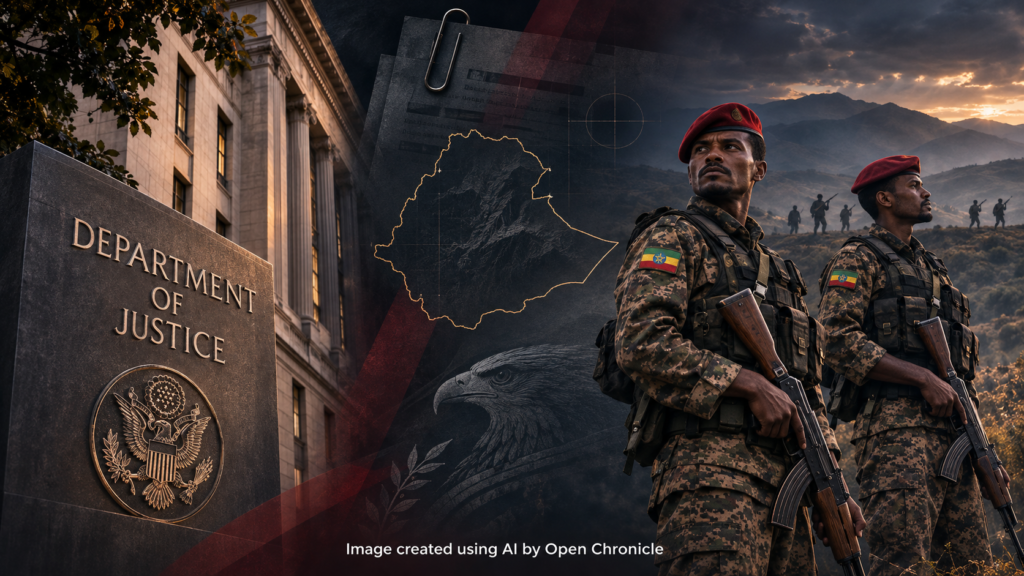
Abraham Teklu Lemma pleaded guilty on 3 November to conspiring to transmit U.S. national defense information to Ethiopia. The former government contractor’s admission brings a case first made public in 2023 into a new judicial phase.
Its significance extends beyond the identity of the receiving state. The case invites closer scrutiny of how technical access can become an intelligence asset, and how secrets collected inside American institutions can acquire immediate value in a distant conflict.
The access behind the operation
According to the Justice Department, Lemma worked as an information technology contractor at the State Department, Justice Department and National Reconnaissance Office. Authorities describe a conspiracy running from 2021 until his arrest in August 2023, involving senior Ethiopian political, military and intelligence officials.
The department says he transmitted dozens of classified documents, notes, photographs and other materials, including information at the Top Secret/Sensitive Compartmented Information level. Much concerned an armed conflict in Ethiopia.
The original FBI affidavit provides a more detailed account of the access involved. It describes a State Department IT role with permission to perform specified transfers between systems. Access to other agencies’ classified portals required a work related request. Investigators alleged that Lemma searched those portals without the required operational justification.
The distinction matters. Technical capability to open a system does not confer permission to read everything it contains. For counterintelligence, the difficult question is whether an institution can distinguish legitimate maintenance from deliberate collection while both occur through an authorised account.
Ordinary tools, classified material
The 2023 affidavit alleged that Lemma copied intelligence into Word documents, removed classification markings and downloaded material onto CDs or DVDs. It also described handwritten notes carried out of a secure facility and information transmitted through an encrypted messaging application.
These were allegations supporting an arrest application, rather than findings delivered after a trial. The subsequent guilty plea establishes his admission to the conspiracy, but should not be used to imply that every detail in the earlier affidavit was separately adjudicated.
As a security lesson, the account points towards an uncomfortable possibility: a serious compromise can depend on familiar office tools and physical removal rather than an elaborate intrusion from outside. Defending the perimeter is only one part of protecting information already accessible inside it.
From collection to military purpose
The Justice Department’s latest account describes Lemma urging Ethiopian contacts to act against paramilitary opponents. A December 2021 exchange reproduced by prosecutors includes a request to send drones.
An FBI official also stated that Ethiopian officials used the information in military operations. That assertion deserves clear attribution. The public material reviewed does not establish a documented chain connecting a particular disclosure to a named strike, casualty or battlefield outcome.
This is the central evidentiary boundary. An admission to espionage, a recipient’s military interest and proof of a specific attack are different propositions. Reporting can establish the first and describe the official account of the second without claiming to have demonstrated the third.
Why the case widens the intelligence map
For Shadow Protocols, the analytical value lies in the relationship between access and demand. A state does not need to compete with Washington across the full spectrum of intelligence capabilities to benefit from a source who can obtain information about one conflict.
This is an inference from the case, rather than evidence of a broader Ethiopian network. A single compromised position may offer a receiving government information that would otherwise be costly or difficult to collect. Its importance depends on what that government needs at a particular moment.
The case therefore offers a reason to examine threats through specific relationships, permissions and requests. It supplies no basis for treating nationality, ancestry or diaspora membership as evidence of disloyalty.
What remains unresolved
Sentencing is scheduled for 14 April 2027. Prosecutors say the plea agreement provides for imprisonment between 120 and 262 months if accepted by the court. That range is not a sentence already imposed.
The public record also leaves important institutional questions unanswered. Which controls detected the activity? Which opportunities to intervene were missed? What damage assessment can eventually be released? The documents reviewed do not support a complete reconstruction of those decisions.
The enduring question is how a trusted technical role became a route for moving intelligence into another government’s conflict. The guilty plea establishes a crucial part of that story. Understanding its consequences will require evidence beyond the announcement of the prosecution’s success.
Sources and Further Reading
This article draws on the following primary documents. The two November statements come from the same prosecution and are not independent corroboration.
1. U.S. Department of Justice | Guilty plea announcement
3 November 2026. Official account of the admission, disclosed conduct and FBI assessment of military use.
2. U.S. Attorney’s Office, District of Columbia | Case update
3 November 2026. Identifies the scheduled sentencing date and conditional imprisonment range.
3. FBI | Affidavit supporting the criminal complaint
2023. Original investigative allegations about access, document handling and communications. This is a probable cause document, not a trial judgment.
Editorial Note
This article distinguishes the guilty plea from prosecutors’ descriptions, earlier investigative allegations and Open Chronicle’s analysis. The full plea agreement and admitted statement of facts were not independently reviewed for this article. No causal link to a specific strike or casualty is asserted. No Ethiopian government response was identified in the primary documents reviewed; that does not establish that no response exists. Information reflects the public record reviewed on 4 November 2026.