
November 4, 2026 | Warfare Journal | Geopolitics & Global Economy
By Open Chronicle
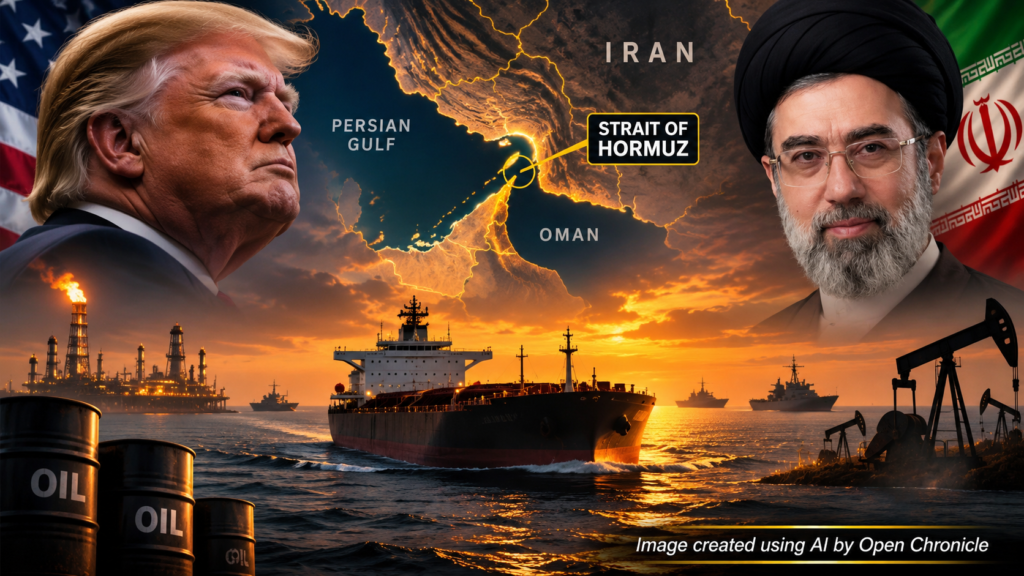
The confrontation between Washington and Tehran is no longer simply a question of military power and regional security. With commercial shipping threatened around the Strait of Hormuz, energy markets are confronting the possibility of prolonged disruption. From American fuel prices to European industry and Asian manufacturing, the economic consequences could extend far beyond the Middle East.
A War That Reaches Beyond the Battlefield
The war involving the United States and Iran has become a test of how quickly a regional military confrontation can transmit economic pressure across the world.
For governments, the immediate concern is the risk of further escalation. For energy traders, shipping companies and manufacturers, it is the possibility that oil and gas supplies could become more expensive, less predictable or temporarily inaccessible.
For ordinary households, the consequences may eventually appear in much more familiar places: petrol stations, electricity bills, airline tickets and supermarket prices.
The Strait of Hormuz lies at the centre of these concerns.
This narrow maritime passage connects the Persian Gulf with the Gulf of Oman and the Arabian Sea. It is one of the world’s most important routes for internationally traded oil and liquefied natural gas.
Any prolonged disruption could affect not only the countries directly involved in the conflict, but also economies that depend on stable energy prices and uninterrupted maritime transport.
Recent reports of attacks on commercial vessels, together with Iranian claims involving naval mines, have intensified concerns about the security of shipping through the region.
Yet the precise circumstances of individual incidents, including claims that four tankers were destroyed, require independent verification.
The distinction between confirmed damage, official military claims and market speculation is essential. Financial markets can react to perceived risks long before the full facts of an incident are established.
Why the Strait of Hormuz Is So Important
The Strait of Hormuz is geographically narrow but economically enormous.
Rounded historical benchmarks from US Energy Information Administration assessments. They are not measurements of actual shipping volumes on November 4, 2026.
Major oil producers, including Saudi Arabia, Iraq, Kuwait, the United Arab Emirates and Iran, depend on Gulf export infrastructure.
Qatar is also a major supplier of liquefied natural gas, making the security of the passage important to global gas markets.
Although some producers have pipelines that can bypass parts of the route, alternative capacity is limited compared with the volumes normally transported through the strait.
That creates a structural vulnerability.
If ships cannot move safely, oil production does not automatically translate into oil available to international buyers.
Export terminals may fill, storage capacity may become constrained and producers may eventually need to adjust output.
The resulting economic disruption can extend well beyond the immediate maritime area.
The Difference Between a Shipping Threat and an Energy Supply Crisis
Not every attack on a tanker produces a global energy shortage.
The consequences depend on several factors: the number of vessels affected, the duration of the disruption, the availability of alternative routes and the willingness of shipping companies to continue operating.
A brief incident may increase insurance costs without materially reducing global supplies.
A sustained campaign involving mines, missiles or drones could have more serious consequences, especially if shipowners decide that the risks are unacceptable.
There is also a difference between a physical blockade and a commercial withdrawal.
A maritime route can remain technically open while becoming economically difficult to use.
If insurance premiums rise sharply, crews refuse dangerous voyages or shipping companies suspend operations, energy exports may slow even without a formally declared blockade.
This is why markets closely monitor statements from maritime security agencies, insurers and shipping operators alongside military developments.
The financial consequences of insecurity can begin before a physical shortage becomes visible.
Oil Prices: How War Becomes Inflation
Energy prices influence almost every modern economy.
Oil is used directly in road transport, aviation, shipping, agriculture and industrial production.
It also affects the cost of producing and transporting many everyday goods.
When crude oil becomes more expensive, the first visible impact often appears in wholesale fuel markets.
Retail petrol and diesel prices may follow, although the timing and scale depend on taxes, refinery margins, inventories and local competition.
Higher transport costs can then spread through supply chains.
Food producers may pay more for agricultural fuel, packaging and distribution.
Airlines may face increased operating expenses.
Manufacturers may encounter higher logistics costs, while consumers have less disposable income after paying for essential transport.
The effect can become self-reinforcing if businesses pass higher costs on to customers and workers seek wage increases to compensate for lost purchasing power.
Central banks then face an uncomfortable problem.
An energy shock can raise inflation while simultaneously weakening economic growth.
Increasing interest rates may help contain inflationary expectations, but it cannot directly create additional oil supplies or reopen an unsafe shipping route.
This combination is one reason geopolitical energy crises remain particularly difficult for economic policymakers.
Europe: Why a Distant Maritime Crisis Matters
Europe’s exposure to a disruption in the Strait of Hormuz is both direct and indirect.
European countries import oil and natural gas from several regions, including the Middle East, North Africa, Norway and the United States.
This diversification provides some protection against the loss of any single supplier.
However, oil is traded in a global market.
If supplies to Asian buyers become constrained, those buyers may compete more aggressively for cargoes from other producing regions.
That competition can raise prices for European importers even when their normal shipments do not pass through Hormuz.
Natural gas presents a related challenge.
Liquefied natural gas can be transported between markets, but shipping capacity, terminal availability and contractual commitments limit how quickly supplies can be redirected.
European utilities may therefore face higher costs when Asian buyers compete for the same cargoes.
The consequences would vary across Europe.
Countries with greater exposure to gas-fired electricity generation could experience stronger wholesale electricity price pressures.
Energy-intensive industries, including chemicals, steel, fertilisers and ceramics, could face higher production costs.
Transport companies and airlines would also be sensitive to changes in fuel prices.
A prolonged energy shock could complicate Europe’s efforts to improve industrial competitiveness while continuing to invest in defence, infrastructure and the energy transition.
Portugal: The Consequences for Fuel, Electricity and Households
Portugal illustrates how a country can make substantial progress in renewable electricity generation while remaining exposed to international energy markets.
Wind, solar and hydroelectric power reduce the amount of fossil fuel needed to generate electricity.
They do not eliminate the country’s dependence on petroleum products for road transport, aviation, shipping and other activities.
Petrol and diesel prices remain sensitive to international crude oil and refined product markets.
For Portuguese households, higher fuel prices can affect commuting expenses and the cost of goods transported by road.
Businesses operating vehicle fleets may face increased costs, particularly in distribution, construction, agriculture and tourism.
The electricity market is more complex.
Renewable generation can help reduce exposure to imported fuels, but Portugal participates in the interconnected Iberian electricity market, where natural gas prices can still influence wholesale prices.
The eventual impact on consumer bills depends on generation conditions, market arrangements, contracts, network charges and government measures.
Consequently, a rise in crude oil prices does not automatically produce an equivalent increase in Portuguese electricity bills.
The wider economic risk is cumulative: higher transport expenses, increased import costs and pressure on household purchasing power.
Asia: The Region Most Directly Exposed
Asian economies are especially vulnerable to disruption in the Strait of Hormuz.
China, India, Japan and South Korea are major destinations for Gulf energy exports.
Their exposure reflects both the scale of their energy consumption and the importance of imported fuels to industrial activity.
China depends on oil and gas to support manufacturing, transport and electricity generation, even as it expands renewable energy and electric vehicle production.
India is sensitive to international oil prices because imported crude is central to its refining and transport sectors.
Japan and South Korea rely heavily on imported energy, making secure maritime supply routes a longstanding national security concern.
An extended disruption could force Asian importers to seek alternative suppliers, draw on strategic reserves or reduce consumption.
These responses would affect international markets.
If Asian manufacturers face higher energy costs, the consequences may eventually appear in the prices of goods exported to Europe and North America.
The impact of the Hormuz crisis therefore extends beyond energy importing countries themselves.
It can also travel through global manufacturing and trade.
The United States: Energy Production Does Not Mean Immunity
The United States is one of the world’s largest oil and natural gas producers.
That position provides important advantages during international energy disruptions.
Domestic production can reduce dependence on foreign suppliers, while American energy companies may benefit from higher market prices.
But the United States is not isolated from global energy markets.
Crude oil and refined petroleum products are traded internationally.
American fuel prices respond to global supply and demand, refinery conditions and regional distribution constraints.
Higher oil prices can benefit producers while increasing costs for consumers and businesses.
This creates a political dilemma.
An administration may support domestic energy production and still face public dissatisfaction over petrol prices.
The economic consequences of the Iran war have become politically important following the November 3 midterm elections, in which Democrats were projected to capture control of both chambers of Congress.
The election results could strengthen congressional scrutiny of military operations, government spending and the administration’s handling of the conflict.
However, congressional control does not automatically determine military strategy or guarantee a diplomatic settlement.
The executive branch retains substantial authority over foreign policy, while Congress possesses important powers relating to funding, legislation and oversight.
The relationship between those institutions will become a central feature of Washington’s political debate.
The Oil Market’s Immediate Reaction
Energy markets were volatile on November 4 as investors assessed the election results and the possibility of further confrontation with Iran.
Reuters reported that Brent crude futures rose to approximately $104.36 a barrel during Wednesday’s trading, while US West Texas Intermediate crude reached around $96.72.
The movements followed a decline in prices during the previous session, when hopes for diplomatic progress had encouraged traders to reassess the risk of prolonged disruption.
The contrasting movements demonstrate the uncertainty surrounding the conflict.
Investors are attempting to balance the possibility of renewed military escalation against diplomatic efforts involving Qatar and other regional actors.
They are also monitoring American oil inventories, demand forecasts and developments in the war between Russia and Ukraine.
The latest price movements do not establish that a new global energy crisis is inevitable.
They show that markets remain highly sensitive to military developments and political signals.
The Economic Importance of Saudi Arabia and Gulf Producers
Saudi Arabia occupies a particularly important position in the global oil market.
It is a major producer and possesses infrastructure that allows some exports to bypass the Strait of Hormuz.
The East-West pipeline transports crude oil towards facilities on the Red Sea, offering an alternative to shipping through the Persian Gulf.
The United Arab Emirates also has pipeline infrastructure capable of moving oil towards the Gulf of Oman.
However, these alternatives cannot fully replace the capacity of the Strait of Hormuz.
The International Energy Agency estimates that available pipeline capacity capable of bypassing the strait is substantially smaller than the oil volumes that normally transit the passage.
The war has also created risks for energy facilities outside the immediate Hormuz area.
Saudi Aramco has continued exporting oil despite attacks and logistical disruption, according to Associated Press reporting.
The company reported third-quarter net profit of $36.3 billion, supported by higher oil prices and proceeds from an asset sale.
Its results illustrate a central contradiction of energy conflicts.
Higher prices can increase revenues for producers that maintain exports, even as the same prices place additional pressure on importing countries and consumers.
What Happens if the Crisis Continues?
The economic outlook depends heavily on the duration and intensity of the conflict.
Three broad scenarios illustrate the possible consequences.
Scenario One: Diplomatic De-escalation
Washington and Tehran reach an agreement that reduces military activity and improves maritime security.
Shipping companies gradually restore normal operations, while insurers reassess the risks.
Energy prices could ease as uncertainty declines, although damaged infrastructure and disrupted contracts might take longer to recover.
This would be the most favourable outcome for consumers and energy-importing economies.
Scenario Two: Prolonged Instability
The conflict continues without a decisive escalation or settlement.
Commercial vessels operate under heightened security measures, with some companies avoiding dangerous areas.
Energy prices remain volatile, and governments must manage persistent uncertainty.
This scenario could produce continuing economic pressure without causing a complete interruption of Gulf exports.
Scenario Three: Severe Maritime Disruption
Attacks, mines or military restrictions prevent substantial volumes of oil and gas from reaching international markets.
Alternative routes prove insufficient, forcing importers to compete for limited supplies.
Governments may need to release strategic petroleum reserves, coordinate emergency measures or introduce temporary demand-management policies.
Such a scenario could create a serious international energy shock.
These are analytical possibilities, not predictions. Their likelihood cannot be established from the currently available reporting.
An Important Distinction: Normal Capacity Is Not Current Traffic
The scale of the disruption is already visible in energy statistics.
According to the US Energy Information Administration, oil flows through the Strait of Hormuz averaged approximately 21.6 million barrels per day in the fourth quarter of 2025.
By the second quarter of 2026, that figure had fallen to approximately 4.9 million barrels per day.
STRAIT OF HORMUZ | OIL TRANSIT VOLUMES
These figures show why the distinction between historical trade volumes and current conditions matters.
The widely cited figure of approximately 20 million barrels per day describes the strait’s importance under more normal trading conditions. It should not be interpreted as evidence that this volume was still moving through the passage in November 2026.
The International Energy Agency has also warned that alternative pipeline routes cannot compensate fully for a major interruption.
This makes the restoration of reliable maritime traffic a central economic objective, regardless of the military or political outcome of the conflict.
The Wider Strategic Question
The war has exposed the continuing vulnerability of the global economy to a relatively small number of strategic transport routes.
Governments can diversify suppliers, build reserves and expand domestic energy production.
They cannot easily eliminate the geographical constraints that shape international trade.
The Strait of Hormuz remains a powerful example.
Its importance comes not simply from the amount of oil and gas that normally passes through it, but from the limited number of alternatives available when shipping becomes unsafe.
The same strategic problem exists elsewhere, including the Suez Canal, the Bab el-Mandeb Strait and other major maritime passages.
A disruption in one location can redirect vessels, increase transport costs and place additional pressure on other routes.
The consequences can accumulate across international supply chains.
For Europe, the lesson is that energy security requires more than securing contracts with reliable suppliers.
It also depends on infrastructure resilience, diversified transport routes, adequate reserves and cooperation between governments.
For the United States, the challenge is to reconcile military objectives with the economic consequences of a prolonged conflict.
For Gulf producers, the priority is maintaining exports while protecting critical infrastructure.
And for importing countries across Asia, the question is how to reduce dependence on maritime passages that can become vulnerable during regional confrontations.
Conclusion: The Economic Cost of Uncertainty
The Iran war has demonstrated that military confrontations can influence economic conditions thousands of kilometres from the battlefield.
A threatened tanker can affect insurance costs.
A disrupted shipping route can influence oil prices.
Higher energy costs can reach factories, transport companies and household budgets.
These effects are not automatic or uniform, but they are interconnected.
Diplomatic progress could ease market pressure and restore confidence. Further military escalation could prolong disruption and increase the economic burden.
The central uncertainty is how long the conflict will continue and whether the countries involved can establish conditions for safer commercial shipping.
For policymakers, businesses and consumers, the most important development may ultimately be neither a battlefield victory nor a political announcement.
It may be the moment when energy can once again move reliably through the Strait of Hormuz.
Sources and Further Reading
The following sources provide the factual foundation for the article. Publication links are kept separate from the editorial body.
1. Reuters | Oil Rises on Iran War Uncertainty After Trump’s Republicans Are Routed in Midterms
November 4, 2026 | Oil Markets and Geopolitics
Reporting on Brent and WTI prices, diplomatic uncertainty, US midterm results and market reactions to the conflict.
2. International Energy Agency | Strait of Hormuz Factsheet
Updated February 2026 | International Energy Security
Official assessment of the strait’s importance to global oil and LNG trade, its geographical constraints and available alternative export routes.
3. US Energy Information Administration | Short-Term Energy Outlook, Global Energy Security
August 2026 | Energy Statistics and Security
Official figures showing the decline in oil and LNG transit volumes through the Strait of Hormuz during the first half of 2026.
4. US Energy Information Administration | World Oil Transit Chokepoints
March 3, 2026 | Global Oil Transportation
Historical oil transit data and analysis of the strategic importance of maritime chokepoints.
5. Associated Press | Higher Oil Prices Boost Saudi Aramco Profits Despite Disruption From Attacks
November 4, 2026 | Saudi Arabia and Energy Markets
Reporting on Saudi Aramco’s financial performance, alternative export routes and the consequences of regional energy disruption.
6. Reuters | Oil Prices Ease to Near Four-Week Low on Hopes for Peace Talks
November 3, 2026 | Oil Prices and Diplomatic Negotiations
Reporting on market expectations, Qatari mediation, US military activity and uncertainty surrounding diplomatic negotiations.
Editorial Note
This article was prepared on November 4, 2026, using reporting from Reuters and Associated Press, together with energy market data published by the International Energy Agency and the US Energy Information Administration.
Historical oil transit volumes are distinguished from more recent measurements. The latest quarterly EIA figures cited in this article cover the second quarter of 2026 and do not represent verified shipping volumes for November 4.
Oil prices reflect reported market observations during trading and should not be interpreted as final daily settlement prices.
The discussion of economic consequences for Europe, Portugal, Asia and the United States, together with the three scenarios for the conflict, represents Open Chronicle’s editorial analysis rather than an official economic forecast.