
November 4, 2026 | World News | Global Affairs
By Open Chronicle
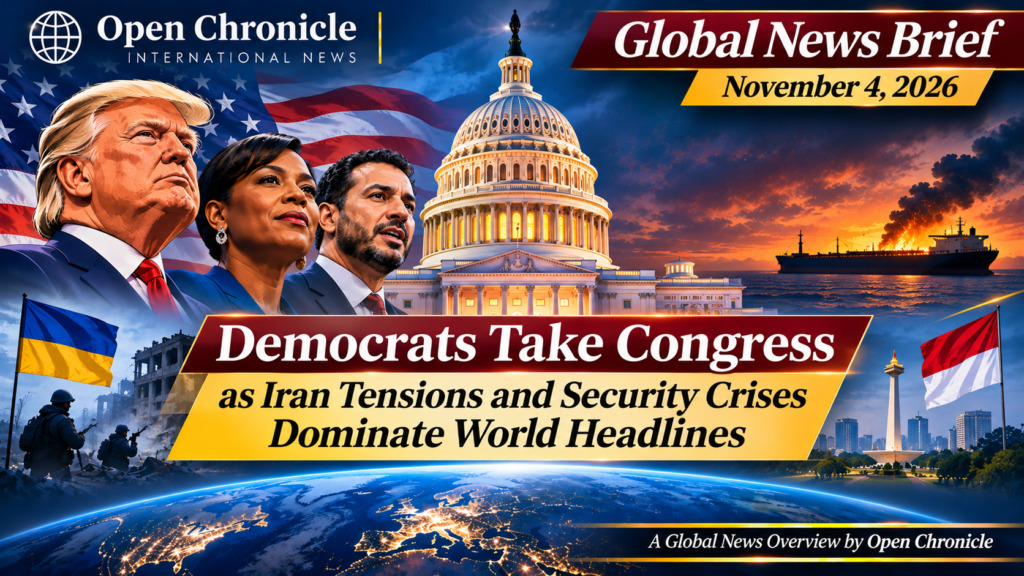
Democrats have emerged from the United States midterm elections with projected control of both chambers of Congress, dealing a major setback to President Donald Trump. Meanwhile, Iranian claims of attacks on oil tankers have raised concerns about maritime security, Indonesia faces a political surveillance scandal, and new developments in Ukraine, Asia and Africa underline the scale of international uncertainty.
United States: Democrats Deliver Major Midterm Defeat to Trump
The United States is entering a new period of divided government after Democrats were projected to win control of both the House of Representatives and the Senate in Tuesday’s midterm elections.
The results represent a significant political setback for President Donald Trump, whose Republican Party entered the elections defending its congressional majorities.
Voter concerns about living costs, healthcare, immigration and the administration’s foreign policy appear to have contributed to the Democratic advance.
The conflict with Iran also emerged as a major election issue, particularly because of its implications for energy prices and American military commitments.
Trump acknowledged in post-election remarks, according to reports circulating on Wednesday, that the war with Iran had played a part in the Republican defeat. He nevertheless argued that his absence from the ballot had disadvantaged his party.
The president also congratulated Democrats and indicated that he would be prepared to cooperate with the new congressional leadership.
Democratic control of Congress would give the opposition greater influence over federal spending, legislative priorities, government appointments and investigations into executive decisions.
The new Congress is due to take office in January 2027. Until then, the existing congressional composition remains in place.
Historic Victories Across the American Political Map
Several races produced results with considerable political and symbolic significance.
In Michigan, Democrat Abdul El-Sayed was reported to have defeated Republican Mike Rogers, becoming the first Muslim elected to the United States Senate.
In Georgia, Democrat Keisha Lance Bottoms was projected to become the first Black woman elected governor of a US state.
Texas also attracted international attention after reports of victories by Democrat James Talarico in the Senate race and Gina Hinojosa in the gubernatorial contest.
In Ohio, Democrat Amy Acton defeated Republican Vivek Ramaswamy, who had received Trump’s endorsement.
Maine Republican Senator Susan Collins was reported to have lost to Democrat Troy Jackson, ending a Senate career that began in 1997.
These developments point to significant changes in the political landscape, although final vote totals, individual race certifications and the precise congressional majorities still require confirmation through official electoral records.
For Democrats, the challenge now moves from winning elections to governing effectively. For Republicans, the results raise questions about electoral strategy and the political costs of the administration’s decisions.
Iran: Revolutionary Guards Claim Four Tankers Destroyed Near Strait of Hormuz
Iran’s Islamic Revolutionary Guard Corps has claimed that four oil tankers were destroyed after striking naval mines near the Strait of Hormuz, according to reports published on Wednesday.
The claims have not been independently verified in the material available for this briefing. The identities of the vessels, their precise locations, casualty figures and the extent of the damage remain unclear.
The Strait of Hormuz is one of the world’s most strategically important maritime passages, connecting the Persian Gulf with international shipping routes.
Any sustained disruption to commercial traffic through the strait could affect energy supplies, insurance costs and global shipping.
Separately, maritime security reporting described a tanker being struck by two projectiles off Oman. It was not immediately clear whether that incident was connected to the Iranian claims.
The developments come amid efforts to prevent further escalation between Washington and Tehran.
Egyptian President Abdel Fattah el-Sisi urged both governments to demonstrate flexibility in negotiations, warning of the consequences of renewed military confrontation.
Trump has reportedly said that the United States has no immediate plans to launch another strike against Iran, while suggesting that diplomatic discussions have produced progress.
However, the continued exchange of threats and reports of maritime attacks demonstrate how fragile the situation remains.
Indonesia: Alleged Presidential Wiretapping Triggers Political Crisis
Indonesia is facing a serious political controversy following allegations that senior security officials were involved in the unlawful surveillance of President Prabowo Subianto.
Reports indicate that several police generals were detained in connection with the allegations and that the president dismissed his chief of staff.
An Indonesian official reportedly described the alleged surveillance as conduct that could amount to treason.
That characterisation is an allegation, not a judicial finding.
The controversy raises questions about the relationship between Indonesia’s political leadership, intelligence services and security institutions.
Reports of additional troop deployments in Jakarta suggest that the authorities are treating the situation as a significant security concern.
The circumstances surrounding the alleged surveillance, the precise responsibilities of those detained and the legal proceedings remain to be established.
Indonesia is Southeast Asia’s largest economy and one of the world’s most populous democracies, making any prolonged political instability a matter of regional importance.
Ukraine: Russian Attacks on Energy Infrastructure Continue Ahead of Diplomatic Talks
Russia’s war against Ukraine continues to produce major military and humanitarian developments despite preparations for another round of negotiations.
Reports on Wednesday described Russian strikes against electricity infrastructure in the Kyiv and Zhytomyr regions.
The attacks underline the vulnerability of Ukraine’s energy system as colder weather approaches.
Ukrainian authorities have repeatedly warned that damage to power generation and distribution facilities can affect hospitals, water systems, transport and civilian heating.
Separately, reports indicated that Ukrainian drones struck a logistics facility associated with the Russian online retailer Ozon in southern Russia.
The extent of the damage and the military significance of the reported strike were not independently established in the information provided.
Diplomatic attention is focused on planned discussions involving the United States, Russia and Ukraine in Abu Dhabi on November 10 and 11.
Ukrainian President Volodymyr Zelenskyy has reportedly expressed interest in advancing the negotiations towards a meeting at leadership level.
Major disagreements remain over territorial control, security guarantees, ceasefire arrangements and the implementation of any settlement.
Germany is also confronting political pressure over continued support for Ukraine, while European governments consider the implications of the Democratic victory in the United States.
Although congressional control could influence American assistance and oversight, it does not automatically determine the administration’s foreign policy.
Europe: NATO Reinforces Air Defence Cooperation as Germany Faces New Security Questions
European governments are reassessing their security priorities amid continuing Russian attacks on Ukraine and uncertainty over future American policy.
NATO air chiefs have reaffirmed their commitment to integrated air and missile defence, reflecting the alliance’s focus on protecting member states against drones, aircraft and missile threats.
The effectiveness of integrated air defence depends on coordination between national armed forces, surveillance systems, command structures and interception capabilities.
Germany is also reportedly considering broader restrictions on Chinese telecommunications equipment, reflecting longstanding concerns about the security of critical digital infrastructure.
Separately, German Chancellor Friedrich Merz faces a difficult political environment as public enthusiasm for continued assistance to Ukraine shows signs of weakening.
The challenge for Berlin is to balance domestic economic pressures with its commitments to European security.
In the Czech Republic, demonstrations in Prague accompanied a dispute over proposed changes to public broadcasting funding, highlighting concerns about media independence and political influence.
Asia-Pacific: China Signals Diplomatic Openings as Regional Tensions Persist
China has indicated that it is prepared to maintain constructive relations with the United States following the American midterm elections.
Beijing has also reportedly discussed the possibility of a meeting involving Chinese President Xi Jinping, Russian President Vladimir Putin and President Trump.
No confirmed timetable or agreement for such a meeting was established in the information provided.
At the same time, tensions remain in the South China Sea.
China has warned the Philippines over its activities in disputed waters, even as the two countries have expressed a willingness to maintain dialogue.
The South China Sea remains strategically important because of its shipping routes, fisheries and contested maritime claims.
In Japan, new demographic figures reportedly show an increase in births for the first time in 11 years.
If confirmed by official statistics, the development would mark a noteworthy change, although a single annual increase would not reverse Japan’s longstanding population decline.
North Korea has also reportedly conducted further missile launches, while leader Kim Jong Un continues to emphasise the expansion of naval capabilities.
The launches add to regional security concerns involving South Korea, Japan and the United States.
Africa: Nigeria Advances Police Reform as Sudan Faces Continuing Famine Risks
Nigeria is moving closer to a potentially significant reform of its security institutions.
According to reports circulating on Wednesday, 28 state legislatures have backed proposals that could enable the creation of state police forces.
Nigeria currently relies heavily on a centrally organised police structure.
Supporters of decentralisation argue that state police could improve responses to local insecurity, including kidnappings, organised crime and communal violence.
Critics have warned that locally controlled police forces could be vulnerable to political interference or abuse.
Any reform would require constitutional and institutional safeguards.
Elsewhere, humanitarian organisations continue to warn about the threat of famine in Sudan.
The country’s prolonged conflict has displaced millions of people, damaged agricultural production and disrupted the delivery of humanitarian assistance.
The crisis remains one of the world’s most serious humanitarian emergencies, despite receiving comparatively limited international attention.
South Africa is also facing an important political test as voters participate in local elections, with the African National Congress seeking to maintain support amid dissatisfaction with public services and economic conditions.
Australia: Government Defends Social Media Restrictions for Children
Australia’s government has defended its restrictions on social media access for children younger than 16 during proceedings before the country’s highest court.
The legal challenge raises questions about children’s online safety, freedom of expression and the responsibilities of technology platforms.
Supporters of the restrictions argue that social media companies have failed to provide sufficient protection against harmful content and online exploitation.
Critics question whether age restrictions can be enforced effectively and whether they may create unintended consequences for young people’s access to information and communication.
The court’s consideration of the legislation could influence debates in other countries considering similar policies.
United Kingdom: King Charles Addresses the Legacy of Slavery
King Charles III has expressed sorrow over Britain’s historical involvement in the transatlantic slave trade during engagements with international leaders in Antigua.
The remarks come amid continuing debate about the responsibilities of former colonial powers and the legacy of slavery across the Caribbean.
Campaigners have called for stronger recognition of historical injustices, including discussions about reparations.
The monarch’s expressions of sorrow have not amounted to a formal apology, according to the reports supplied.
The issue remains politically sensitive because it involves historical responsibility, contemporary inequality and relations between Britain and countries affected by colonial exploitation.
Global Economy: Markets Assess Political Change and Energy Risks
Financial markets are responding to the combination of American political uncertainty and instability in the Middle East.
Reports on Wednesday described a weaker US dollar, pressure on technology shares and renewed interest in gold.
Oil prices also moved higher as traders considered the possibility of further disruption to Gulf energy supplies.
Reuters reported Brent crude trading around $104 a barrel during Wednesday’s session, with investors monitoring both the conflict with Iran and diplomatic efforts to contain it.
reuters.com
The election results could influence expectations for American fiscal policy, trade restrictions and regulatory decisions.
However, short-term market movements cannot necessarily be attributed to a single political development.
Interest rates, corporate earnings, global demand and geopolitical risks remain important influences.
Other Developments to Watch
Several additional stories merit continued monitoring.
In the Indian Himalayas, rescue teams were reportedly searching for six missing trekkers after recovering two bodies.
In Bangladesh, wage negotiations continued amid protests by garment workers seeking improved pay and working conditions.
In France, reports described a cyberattack affecting blood storage facilities, raising questions about the security of healthcare infrastructure.
The International Court of Justice was reported to be preparing a ruling on November 19 in proceedings concerning allegations of genocide against Myanmar’s Rohingya population.
In South Korea, authorities were reportedly preparing to investigate historical civilian killings involving military and police personnel during the Korean War.
These developments cover different regions and subjects, but each raises questions about public safety, institutional accountability or the protection of vulnerable populations.
Further reporting is necessary before treating the initial headlines as complete accounts.
The Global Picture
November 4 has brought an unusual convergence of political, military and economic developments.
The Democratic victory in the United States will reshape the relationship between the White House and Congress, with potential consequences for international diplomacy and American foreign policy.
In the Middle East, reported attacks on commercial shipping underline the risks posed by continued confrontation around the Strait of Hormuz.
Indonesia’s surveillance scandal raises serious questions about political authority and the conduct of security institutions.
Ukraine remains under military pressure as diplomatic efforts continue, while Europe confronts difficult decisions about defence, technology and support for Kyiv.
Across Africa and Asia, political reform, humanitarian emergencies and regional security disputes continue to demand attention.
The defining feature of the day’s news is not a single event, but the interaction between domestic political change, international conflict and the security of institutions on which governments and societies depend.
For the international community, the challenge is to respond to these developments without allowing immediate political pressures to overshadow longer-term risks.
Sources and Further Reading
The principal reporting used to corroborate this briefing includes:
1. Reuters | Democrats Seize Congress in Sweeping Midterm Repudiation of Trump
November 4, 2026 | US Midterm Elections
Reporting on congressional control, state election results and voter concerns.
2. Reuters | Indonesia President Sacks Chief of Staff Over Alleged Wiretap
November 4, 2026 | Indonesia and Political Security
Reporting on the arrests, dismissal and allegations of unlawful surveillance.
Original article URL pending verification.
3. Reuters | Oil Rises on Iran War Uncertainty After US Midterm Elections
November 4, 2026 | Energy Markets and Gulf Security
Reporting on oil markets, Gulf security risks and US diplomatic signals.
Original article URL pending verification.
4. Reuters | Australia Defends Social Media Restrictions for Under-16s in Court
November 4, 2026 | Australia and Digital Regulation
Reporting on the constitutional challenge and the government’s position.
Original article URL pending verification. Referenced through Internazionale.
5. Reuters | Iran’s Revolutionary Guards Claim Four Tankers Hit Naval Mines
November 4, 2026 | Strait of Hormuz and Maritime Security
Reporting on Iranian military claims. The available information does not independently establish the fate of the vessels.
Original article URL pending verification. Referenced through Internazionale.
Additional International Reporting
Additional international developments were drawn from the supplied November 4 news feed. Where original articles or official statements were not available for examination, the briefing uses qualified attribution rather than treating headline claims as independently established facts.
Editorial Note
This Global News Brief was prepared on November 4, 2026, using international reporting and the news headlines supplied for editorial review. Major developments were cross-checked against available Reuters reporting where possible.
The briefing distinguishes confirmed events, election projections, official claims and developing reports. Allegations involving criminal conduct, maritime attacks and military operations should not be interpreted as independently verified findings unless explicitly stated.
Some secondary developments remain provisional and may require correction or expansion as additional information becomes available.
The assessment of political, economic and geopolitical consequences represents Open Chronicle’s editorial analysis.