
November 4, 2026 | Cybersecurity | Threat Intelligence
By Open Chronicle
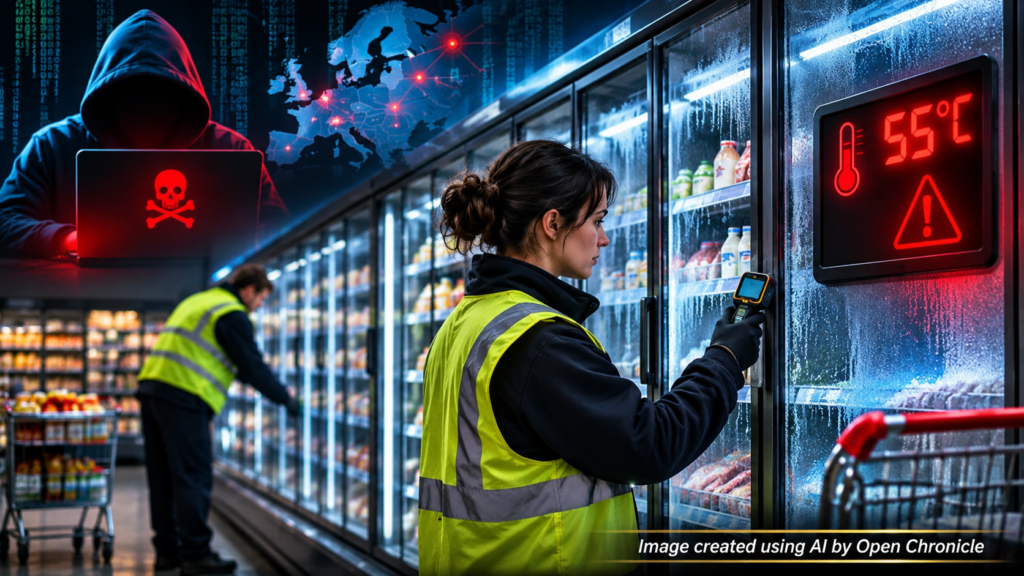
Cyberattacks targeting supermarket refrigeration systems have disrupted retailers across Europe, forcing businesses to discard food and raising concerns about the security of connected industrial equipment. With incidents reported from Sweden to Portugal, the attacks expose a vulnerability in the infrastructure that keeps Europe’s food supply safe.
A Cyberattack That Turned Supermarket Freezers Into a Liability
European supermarkets are confronting an unusual form of cyberattack in which hackers interfere with refrigeration systems rather than conventional business databases or payment networks.
The incidents, reported across multiple European countries in early November, have caused refrigerators and freezers to warm unexpectedly, leaving retailers facing damaged stock, operational disruption and potentially substantial financial losses.
Unlike ransomware attacks that encrypt files or steal sensitive information, these intrusions have targeted equipment responsible for maintaining safe food storage temperatures.
In some cases, refrigeration controllers were reportedly manipulated remotely, causing equipment to enter defrosting cycles or operate at temperatures incompatible with food preservation.
The attacks affected supermarkets, convenience stores and other food businesses, demonstrating how vulnerabilities in connected equipment can produce immediate physical consequences.
The latest incidents follow an earlier wave of attacks against French retailers in October.
According to Reuters, Associated Press and European reporting, the new wave affected businesses across several countries, prompting cybersecurity authorities and equipment suppliers to recommend urgent protective measures.
From Sweden to Portugal: How Far Did the Attacks Spread?
Reports published on November 2 and 3 identified affected or potentially affected businesses in Belgium, Estonia, Finland, Ireland, Italy, Luxembourg, the Netherlands, Portugal and Sweden.
The extent of the disruption varied considerably.
In Belgium, refrigeration problems were reported at stores operated by Carrefour, Delhaize, Intermarché and other retailers.
Carrefour said approximately 15 of its 700 Belgian stores were affected, while maintaining that the disruption was limited and stores could remain open.
In Sweden, ICA and Coop reported problems at a small number of locations.
At one ICA franchise store, staff reported that freezer settings had reached 50 degrees Celsius, making stored products unusable.
Ireland’s Musgrave group reported incidents affecting 13 SuperValu stores.
In Estonia, reports described refrigeration equipment being remotely set to unusually high temperatures.
Finland and the Netherlands also reported suspicious refrigeration failures, although investigations were continuing into the precise causes of some incidents.
Portugal was among the countries affected.
The Mosqueteiros group confirmed incidents at seven Intermarché stores, with initial indications pointing towards an external service provider involved in refrigeration management.
That detail is significant because it suggests that some attacks may exploit connections between retailers and the companies responsible for maintaining their equipment, rather than requiring direct access to a supermarket’s main computer network.
However, the precise technical entry point in each country has not been independently established.
The geographical spread highlights the risks of relying on similar connected technologies across different businesses and national markets.
How Can Hackers Control a Supermarket Freezer?
Modern commercial refrigeration systems increasingly depend on digital controllers.
These devices regulate temperature, monitor equipment performance, manage defrosting cycles and notify maintenance teams when something goes wrong.
Many can be accessed remotely by technicians, allowing companies to identify faults without sending personnel to every store.
This connectivity offers important operational advantages.
Retailers can reduce energy consumption, improve maintenance efficiency and detect equipment failures before products are damaged.
But remote access also introduces cybersecurity risks.
If a controller is accessible through an inadequately protected internet connection, attackers may be able to manipulate its settings.
Security researchers and industry reporting have identified several possible weaknesses associated with connected refrigeration systems, including outdated software, known vulnerabilities, exposed management interfaces and default passwords.
Some of the equipment implicated in the European incidents was supplied by refrigeration technology companies Danfoss and Copeland.
However, the presence of equipment from a particular manufacturer does not establish that every installation was compromised through the same vulnerability.
The full technical details of the attacks remain under investigation.
The broader lesson is that equipment designed primarily for reliability and operational efficiency can become vulnerable when connected to networks without appropriate security protections.
Why the Attacks Are More Serious Than They Appear
At first glance, an attack against supermarket refrigeration may seem less serious than a breach of financial systems or government networks.
In reality, refrigeration is an essential part of the modern food supply chain.
Meat, fish, dairy products, frozen meals, medicines and many other temperature-sensitive goods depend on continuous environmental control.
Even relatively short periods outside safe temperature ranges can make certain products unsuitable for sale.
The financial consequences can extend beyond replacing spoiled food.
Retailers may face equipment inspections, emergency maintenance costs, temporary closures, disrupted deliveries and additional staff expenses.
Smaller independent businesses can be particularly vulnerable because they may lack dedicated cybersecurity teams or sufficient resources to replace outdated equipment.
The incidents also raise questions about consumer confidence.
Customers generally assume that food sold by established retailers has been stored under appropriate conditions.
If attackers can interfere with temperature controls, businesses must be able to demonstrate that affected products were assessed and removed when necessary.
This makes the protection of refrigeration systems both a cybersecurity issue and a food safety concern.
The Hidden Cybersecurity Problem: Operational Technology
The supermarket incidents illustrate a growing challenge involving operational technology, commonly known as OT.
Operational technology includes the hardware and software used to monitor or control physical processes.
It is found in factories, electricity networks, water treatment facilities, transport systems, hospitals and commercial buildings.
Unlike traditional office information technology, OT often controls equipment whose failure can affect the physical world.
A compromised office computer may result in stolen information or interrupted communications.
A compromised industrial controller may affect temperatures, pressure, machinery or other operating conditions.
This distinction changes the consequences of a cyberattack.
Many operational systems were originally designed for environments where external network access was limited.
As businesses introduced remote monitoring and internet connectivity, some older equipment remained in service without modern cybersecurity protections.
Replacing industrial equipment can be expensive, and organisations may delay upgrades because the systems continue to perform their original functions.
That creates a dangerous situation in which reliable machinery becomes increasingly vulnerable to digital intrusion.
The European refrigeration incidents demonstrate that such risks are not confined to major industrial facilities.
They can also affect ordinary retail businesses and the infrastructure consumers encounter every day.
A Warning About Europe’s Food Supply Chain
The European Union has expressed concern about the implications of the attacks for food supply chains.
EU food and agriculture commissioner Christophe Hansen described the incidents as a deliberate attempt to disrupt food distribution and undermine consumer confidence.
That assessment reflects the seriousness with which European officials are treating the disruption.
However, the identity and motivation of the attackers remain unconfirmed.
No publicly established attribution has demonstrated that the incidents were directed by a foreign government, an organised criminal group or another specific actor.
The possibility of coordinated attacks across multiple countries requires investigation, particularly where similar vulnerabilities and equipment configurations were involved.
But geographical scale alone does not establish that a single group controlled every intrusion.
Cybersecurity investigators must distinguish between attacks conducted by the same actors and separate incidents exploiting similar weaknesses.
This distinction matters because the appropriate response depends partly on understanding whether the threat involves opportunistic exploitation, coordinated criminal activity or a more organised campaign.
Could the Same Weaknesses Affect Hospitals, Warehouses and Factories?
The wider concern extends beyond supermarkets.
Refrigeration and environmental control systems are used throughout modern industry.
Hospitals depend on temperature-controlled storage for certain medicines, laboratory materials and biological products.
Food distributors operate refrigerated warehouses and transport facilities.
Manufacturers use industrial controllers to regulate machinery and production environments.
These systems do not necessarily share the same vulnerabilities as supermarket refrigeration equipment.
Nevertheless, they face a common challenge: maintaining secure connections between physical machinery, monitoring software and external networks.
The UK’s National Cyber Security Centre has warned that outdated connected equipment can expose organisations to disruptive cyber incidents.
Its leadership has also raised concerns about the future use of artificial intelligence to make cyberattacks more efficient and scalable.
Importantly, there is currently no established evidence that artificial intelligence was used in the supermarket refrigeration attacks.
The known concerns involve weaknesses that cybersecurity professionals have discussed for years, including exposed equipment, insufficient access controls and obsolete software.
The incidents therefore demonstrate that attackers do not necessarily need sophisticated new technologies to cause significant disruption.
What Retailers and Equipment Suppliers Are Doing
Following the latest incidents, affected businesses began reviewing their refrigeration networks and implementing protective measures.
Some retailers temporarily disconnected refrigeration controllers from external networks while investigating the attacks.
Swedish supermarket group Coop reported that affected stores had resumed operations and that work was under way to modernise network connections.
Equipment suppliers urged customers to review software versions, install available security updates and ensure that controllers were not unnecessarily accessible from the public internet.
However, simply changing the type of mobile connection used by a controller does not automatically make the equipment secure.
Effective protection depends on how access is configured, authenticated, monitored and restricted.
Retailers also need procedures that allow staff to identify dangerous temperature changes even when automated alerts fail.
The incidents underline the importance of coordination between store operators, refrigeration contractors, equipment manufacturers and cybersecurity specialists.
A supermarket may outsource equipment maintenance, but it still needs to understand who can access critical systems and how those connections are protected.
The Five Security Questions Every Retailer Should Be Asking
The attacks expose several practical questions that extend beyond the businesses directly affected.
Which refrigeration controllers can be accessed remotely? Businesses need an accurate inventory of connected equipment and external access arrangements.
Are all systems receiving security updates? Equipment running unsupported software can remain vulnerable even when it functions normally.
Who controls access to refrigeration management systems? External maintenance providers should have appropriately restricted and authenticated access.
Can staff detect unsafe temperatures without relying entirely on networked alerts? Independent monitoring and clear emergency procedures can reduce the consequences of a compromise.
Can refrigeration continue operating safely if remote connections are disabled? Business continuity planning should consider the possibility of losing digital control or monitoring capabilities.
These questions apply to supermarkets, warehouses, food manufacturers and other organisations operating connected physical infrastructure.
They also illustrate why cybersecurity can no longer be treated exclusively as a responsibility of the information technology department.
Portugal’s Exposure Highlights a Wider European Challenge
The reported incidents at seven Intermarché stores in Portugal give the story particular relevance for the Portuguese market.
Portugal’s retail sector, like those elsewhere in Europe, increasingly relies on connected equipment, external service providers and digitally managed logistics.
The reported involvement of a refrigeration service provider in the Portuguese incidents raises questions about how access to equipment is managed across organisational boundaries.
However, the available reporting does not establish that Portugal experienced a broader compromise of supermarket networks or that other national retailers were affected.
The immediate concern is therefore the security of the specific systems involved and the lessons that similar businesses can draw from the incidents.
For Portuguese companies, the European attacks provide an opportunity to review their own equipment before a comparable disruption occurs.
For regulators and cybersecurity authorities, the challenge is to ensure that smaller businesses have access to practical guidance and appropriate technical support.
A New Front in Everyday Cybersecurity
The attacks against European supermarket refrigeration systems demonstrate how digital vulnerabilities can produce consequences far removed from conventional computer networks.
No personal information needs to be stolen for an intrusion to cause financial damage.
No website needs to go offline for a business to lose essential stock.
And no sophisticated artificial intelligence system is required when ordinary connected equipment has been left inadequately protected.
The incidents have exposed a weakness at the intersection of cybersecurity, food safety and industrial infrastructure.
They have also demonstrated that relatively small devices can become points of vulnerability within much larger supply chains.
For European retailers, the immediate priority is restoring affected systems and preventing further disruption.
For equipment manufacturers, it is ensuring that connected products remain secure throughout their operational lives.
For policymakers, the challenge is to strengthen cybersecurity without placing unrealistic technical and financial burdens on smaller businesses.
The central lesson is that the security of Europe’s food supply increasingly depends not only on farms, warehouses and transport networks, but also on the digital systems controlling the temperature of an ordinary supermarket freezer.
Sources and Further Reading
These sources support the principal factual findings of the article. The links are provided separately from the article body, in accordance with the Open Chronicle editorial format.
1. Reuters | European Supermarkets Rush to Patch Vulnerabilities After Region-Wide Fridge Hack
November 3, 2026 | European Cybersecurity
Reporting on the second wave of attacks, retailers’ responses, equipment suppliers and European cybersecurity coordination.
2. Associated Press | European Supermarket Fridges Got Hacked. Again. Here’s What to Know
November 4, 2026 | Cybersecurity and Food Safety
Explanation of the technical vulnerabilities, damage to food stocks and the continuing uncertainty surrounding attribution.
3. Euronews | Which Countries in Europe Have Been Hit by Supermarket Fridge Cyber Incidents?
November 3, 2026 | European Retail and Portugal
Country-by-country reporting, including the confirmation of incidents at seven Intermarché stores in Portugal.
4. BleepingComputer | Hackers Disrupt Refrigeration Systems at European Supermarkets
November 2, 2026 | Cyber Threat Intelligence
Specialist cybersecurity reporting identifying affected retailers, technical disruptions and statements from supermarket operators.
5. Financial Times | What Do We Know About Europe’s Freezer Hacks?
November 4, 2026 | Operational Technology Security
Investigation into operational technology vulnerabilities, the scale of food losses and the difficulty of identifying the attackers.
6. Associated Press | UK Will Face AI Cyberattacks on Critical Infrastructure by 2028, Official Says
November 3, 2026 | AI and Critical Infrastructure
Wider context on operational technology security, outdated connected systems and emerging cyber risks.
Editorial Note
This article was prepared on November 4, 2026, using reporting from Reuters, Associated Press, Euronews, BleepingComputer and the Financial Times.
The reported cyber incidents have affected refrigeration equipment operated by retailers in several European countries. The precise technical methods, number of compromised installations and identity of the perpetrators remain under investigation.
The article distinguishes confirmed retailer statements, suspected cyber incidents and broader assessments of operational technology vulnerabilities. There is no established evidence that artificial intelligence was used in these attacks.
The discussion of supply chain resilience, industrial cybersecurity and potential consequences for other sectors represents Open Chronicle’s editorial analysis.