
November 5, 2026 | International News | Global News Brief
By Open Chronicle
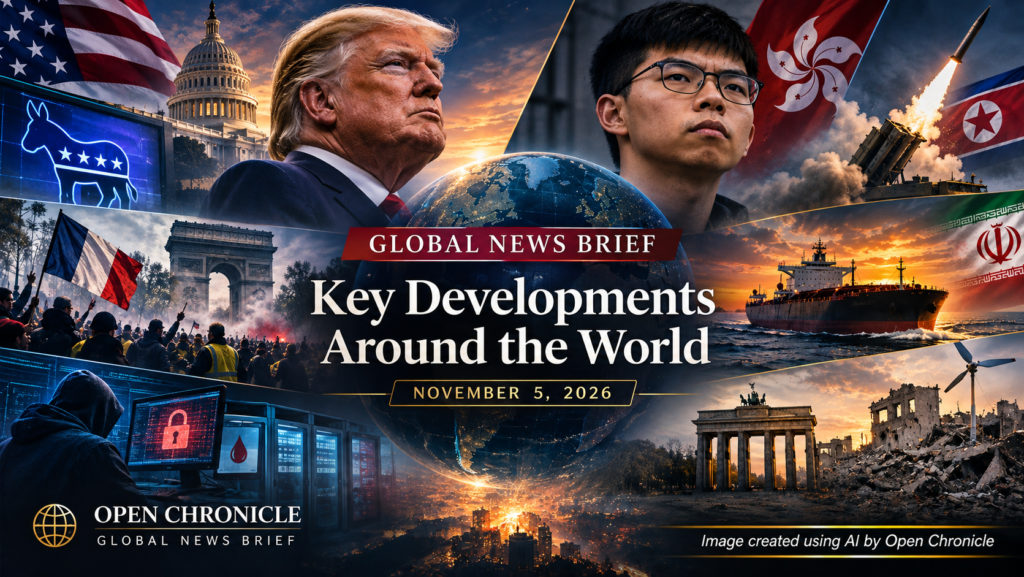
The political consequences of the United States midterm elections are reverberating across Washington and international capitals. Meanwhile, Hong Kong faces renewed scrutiny over national security prosecutions, tensions persist in the Strait of Hormuz, France prepares for fresh demonstrations, and new military and cybersecurity developments raise concerns across Europe and Asia.
Washington Confronts a New Political Reality
President Donald Trump is facing a significantly altered political landscape following the November 3 midterm elections, with Democrats reported to have secured control of both chambers of Congress.
The outcome represents a major setback for the Republican Party and raises immediate questions about the administration’s ability to advance its domestic legislative programme during the remainder of Trump’s presidency.
The election coverage supplied for this briefing describes Democratic gains across traditionally competitive states and several areas previously regarded as Republican strongholds.
Economic dissatisfaction, the cost of living, trade policy and the war involving Iran have emerged as central explanations offered for the Republican defeat.
Trump acknowledged that the Iran conflict contributed to his party’s electoral difficulties, while defending his administration’s broader approach to the confrontation.
The president has also emphasised that he remains in office and retains the constitutional powers of the executive branch.
For Democrats, congressional control would create opportunities to influence federal spending, conduct investigations, challenge administration policies and shape the national political debate ahead of the 2028 presidential election.
However, congressional majorities would not automatically allow Democrats to reverse presidential decisions.
Trump retains the power to veto legislation, and overriding a veto generally requires a two-thirds majority in both chambers.
The administration could therefore face legislative gridlock while continuing to exercise substantial authority over foreign policy, executive appointments and regulatory decisions.
Reports of Republican disagreements over the election results suggest that the party may also face an internal debate about its political direction.
Vice President JD Vance has reportedly criticised aspects of the administration’s handling of the Iran war, although accounts of private disagreements require careful attribution and should not be treated as independently established.
The supplied news feed also highlights renewed scrutiny of Defense Secretary Pete Hegseth, including reports of a proposed impeachment initiative.
Such proposals do not establish that impeachment proceedings have been formally approved or that the secretary is expected to leave office.
The election result has intensified speculation about the future of the Republican Party, but it would be premature to conclude that Trump’s political influence has ended.
Iran Conflict Remains a Major Test for the White House
The war involving the United States and Iran remains one of the most consequential international challenges facing Washington.
The political implications have become more pronounced following the Republican electoral setback.
Some reports suggest that members of the administration favour renewed diplomatic efforts, while others continue to support a more confrontational approach.
The debate is taking place against a background of maritime insecurity in the Persian Gulf.
Iran’s Islamic Revolutionary Guard Corps claimed on November 5 that two oil tankers and a tugboat had caught fire in the Strait of Hormuz.
The reported incidents add to concerns about commercial shipping through one of the world’s most important energy corridors.
However, the Iranian claims do not independently establish the cause of the fires, the extent of the damage or responsibility for any attack.
Independent confirmation from maritime security authorities, vessel operators or other credible sources remains essential.
South Korea is reportedly considering expanding the operational area of its anti-piracy naval unit closer to the Strait of Hormuz.
Such a move would reflect growing concern among Asian energy importers about the security of maritime routes connecting the Persian Gulf with international markets.
The United States has also announced additional sanctions targeting individuals and entities accused of supporting Iranian military procurement and maritime networks.
The measures reportedly include individuals or companies connected to India and Turkey.
The specific allegations and legal designations require examination of the relevant US Treasury announcements before conclusions can be drawn about individual responsibility.
Meanwhile, Egypt and other regional governments continue to explore diplomatic approaches intended to prevent further escalation.
The central question remains whether Washington and Tehran can establish a negotiating framework capable of reducing military activity and restoring confidence in maritime security.
Hong Kong: Joshua Wong Receives Another Prison Sentence
Hong Kong pro-democracy activist Joshua Wong has reportedly been sentenced to 10 years in prison in a second national security case.
The November 5 ruling, as described in the supplied news reports, concerns allegations of collusion with foreign forces.
Wong became internationally known during Hong Kong’s pro-democracy protest movements and has spent much of his adult life involved in political activism and subsequent legal proceedings.
The reported sentence is likely to renew international debate over the application of Hong Kong’s national security legislation.
Chinese and Hong Kong authorities maintain that national security laws are necessary to protect sovereignty, prevent foreign interference and preserve public order.
Critics, including international human rights organisations, argue that the legislation has significantly restricted political opposition, freedom of expression and civil society activity.
The case comes amid broader concerns about Hong Kong’s political environment following the introduction of national security measures in 2020.
The precise charges, sentencing calculation and relationship between the new punishment and Wong’s existing prison terms require confirmation from the court’s published ruling.
Nevertheless, the reported decision represents another important development in the territory’s evolving political and legal landscape.
France Braces for Another Wave of Protests
France is preparing for fresh demonstrations as President Emmanuel Macron seeks to avoid a repeat of the unrest reported in October.
Organisers and media reports suggest that hundreds of thousands of people could participate in protests across the country.
Some estimates in the supplied news feed indicate that as many as 780,000 demonstrators may take part.
That figure is a projection, not a verified attendance total.
French authorities are expected to deploy substantial police resources to maintain public order.
The demonstrations reflect continuing political and social tensions over economic conditions, government policy and public confidence in national institutions.
France has a long tradition of mass demonstrations and industrial action, but the scale and consequences of the latest mobilisation remain uncertain.
The government’s challenge is to manage legitimate public protest while preventing violence and disruption.
For Macron, another period of nationwide unrest could further complicate efforts to maintain political stability and implement economic reforms.
The demonstrations also form part of a wider European debate over living standards, public spending and the relationship between governments and citizens.
Germany: Bavaria’s Deputy Premier Found Dead in Berlin
German authorities have opened an investigation following the death of Hubert Aiwanger, Bavaria’s deputy minister-president and leader of the Free Voters party.
Aiwanger, 55, was found dead in a hotel room in central Berlin on November 4.
Berlin police and prosecutors confirmed that an investigation had been initiated to determine the cause and circumstances of his death.
The authorities said the inquiry would also examine whether any third-party involvement could be excluded.
The opening of such an investigation does not establish that a crime has occurred.
Aiwanger was a prominent figure in Bavarian politics and a member of the state government’s governing coalition.
His death creates an immediate political vacancy and raises questions about the future leadership of his party.
Further conclusions about the circumstances of his death should await the findings of the official investigation.
North Korea Tests Air Defence System and Cruise Missiles
North Korea has announced another series of weapons tests, including a newly developed air defence missile system and a long-range cruise missile exercise.
According to the Korean Central News Agency, the tests were conducted on November 4 to evaluate technical performance, guidance capabilities and target detection.
North Korean authorities said the air defence system demonstrated improvements in tracking and identifying aerial targets.
A separate exercise reportedly involved a strategic cruise missile unit conducting a simulated strike against an airport.
South Korea’s military confirmed detecting missile launches from North Korea’s eastern coastal region.
The tests come amid continuing military tensions on the Korean Peninsula and joint exercises involving South Korea and the United States.
Pyongyang has repeatedly criticised allied military drills, describing them as preparations for aggression.
Seoul and Washington maintain that their exercises are defensive.
The latest launches are likely to reinforce concerns about North Korea’s expanding missile capabilities and its ability to threaten military facilities in the region.
They also complicate the possibility of renewed diplomatic engagement between Pyongyang and Washington.
China Indicts Former Senior Communist Party Official
Chinese authorities have reportedly indicted Ma Xingrui, a former member of the Communist Party’s Politburo, on bribery charges.
The development represents another significant case involving a senior political figure under China’s anti-corruption campaign.
Chinese authorities have pursued numerous investigations into senior officials, military commanders and executives of state-owned enterprises.
The campaign is presented by Beijing as an effort to strengthen discipline and combat corruption within the party and government.
However, observers also examine the political implications of investigations involving prominent officials.
The allegations against Ma should be distinguished from any judicial determination of guilt.
The formal indictment, the alleged conduct and the procedural status of the case require confirmation from official prosecutorial announcements.
Ethiopia and Sudan Face Growing Diplomatic Tensions
Relations between Ethiopia and Sudan have deteriorated further amid allegations of interference in Sudan’s civil war.
Reports indicate that the two countries have closed consular facilities near their shared border following accusations concerning support for armed groups.
Sudan’s conflict has already produced one of the world’s most serious humanitarian emergencies, displacing millions of people and placing severe pressure on neighbouring states.
Ethiopia has its own security concerns, including instability in border regions and the consequences of previous internal conflicts.
Any deterioration in relations between Addis Ababa and Khartoum risks complicating regional diplomacy and humanitarian access.
The competing allegations of support for rebel groups remain politically sensitive and require independent substantiation.
The closure of diplomatic facilities, if maintained, could also affect citizens requiring consular assistance and communities engaged in cross-border trade.
Ukraine and Russia Exchange Strikes Ahead of Diplomatic Talks
Russia and Ukraine have reported further overnight attacks as diplomatic preparations continue for proposed talks in Abu Dhabi.
Russian authorities said their forces targeted Ukrainian logistics and transport infrastructure.
Ukrainian reporting described drone strikes against Russian energy facilities and commercial logistics sites, including a refinery in the Ryazan region.
The competing accounts illustrate the continuing intensity of the conflict despite efforts to establish a negotiating process.
Ukrainian President Volodymyr Zelenskyy has reportedly held discussions with American representatives ahead of a possible trilateral meeting.
Kyiv continues to emphasise the need for credible security guarantees and continued international military assistance.
European officials have also stressed the importance of maintaining support for Ukraine while diplomatic initiatives develop.
Reports concerning casualties, including claims of a major attack on a Ukrainian aid facility, require confirmation from independent observers and emergency authorities.
The existence of planned negotiations does not necessarily indicate that either side is prepared to accept the other’s principal demands.
Territorial questions, security arrangements, sanctions and the future of occupied areas remain substantial obstacles.
Cybersecurity: French Blood Storage Facilities Targeted
France has reported a cyberattack targeting refrigeration systems at three facilities operated by the French Blood Establishment.
The intrusion reportedly involved attempts to raise temperature and defrost settings to dangerous levels.
Monitoring and alarm systems detected the abnormal conditions, allowing personnel to intervene before stored plasma was damaged.
French authorities said no blood products were lost and no health consequences were identified.
Blood collection and distribution services continued operating.
The incident is particularly significant because it follows cyberattacks affecting supermarket refrigeration systems in several European countries.
The cases demonstrate the vulnerability of connected operational technology, particularly equipment that controls physical conditions rather than conventional information systems.
French cybersecurity authorities are investigating the incident.
The available reporting does not establish whether the same perpetrators were responsible for the supermarket and blood storage attacks.
Nevertheless, the incidents raise broader questions about the security of remote maintenance connections, industrial controllers and third-party equipment suppliers.
For hospitals, food distributors and other organisations handling temperature-sensitive products, the consequences of compromised refrigeration systems can extend directly to public safety.
New Zealand Approaches a Closely Contested Election
New Zealand is preparing for an election that could produce a closely divided parliament and complex coalition negotiations.
The supplied reporting describes a competitive race between the country’s main political blocs, with party leaders making final appeals to voters.
Economic conditions, public services, housing and the country’s international relationships are among the issues expected to influence the campaign.
New Zealand’s mixed-member proportional electoral system makes coalition negotiations particularly important when no single party secures an outright parliamentary majority.
The outcome could influence Wellington’s approach to relations with China, the United States and its Pacific neighbours.
The election also comes as regional governments assess the consequences of political change in Washington.
Until official results are available, projections concerning the likely governing coalition should be treated cautiously.
Mass Whale Stranding on New Zealand Coast
New Zealand authorities and wildlife rescue organisations are responding to reports of a mass stranding involving dozens of pilot whales.
The supplied news feed indicates that approximately 50 animals were stranded, with several deaths reported.
Rescue teams have reportedly been attempting to assist surviving whales and assess whether refloating operations are possible.
Pilot whales are particularly vulnerable to mass strandings because of their strong social bonds and tendency to remain close to other members of their groups.
The causes of individual strandings can be difficult to establish.
Possible contributing factors include coastal geography, navigational difficulties, illness and environmental conditions.
However, none of these explanations should be assumed to account for this particular incident without supporting scientific evidence.
The final number of affected animals and the outcome of rescue operations remain subject to confirmation.
Africa: South African Elections and Sudan’s Continuing Crisis
South Africa is assessing early municipal election results amid another test of the African National Congress’s political strength.
Preliminary reporting suggests a closely contested contest between the ANC and the Democratic Alliance in several areas.
Local elections are particularly important because they influence municipal services, infrastructure management and the delivery of basic public utilities.
They also provide an indication of voter confidence in national political parties.
Final results will be necessary before conclusions can be drawn about the overall balance of local political power.
Elsewhere on the continent, Sudan’s humanitarian crisis continues to worsen.
Fighting, displacement and disruptions to essential services have left large sections of the population dependent on emergency assistance.
The deterioration of relations with Ethiopia could further complicate regional efforts to address the conflict.
Middle East: Israel’s Political Negotiations and Gaza’s Humanitarian Emergency
Israel’s president has begun consultations with political parties following recent elections, according to the supplied news reports.
The consultations are intended to determine which political leader is best positioned to form a government.
Coalition negotiations could prove difficult amid divisions over security policy, relations with the Palestinians and the future direction of Israeli politics.
The outcome may also influence Israel’s relationship with Washington following the Democratic electoral victory in the United States.
Meanwhile, reports of continued military operations and civilian casualties in Gaza underline the persistence of the humanitarian crisis.
One particularly striking development concerns residents reportedly constructing improvised wind turbines using materials recovered from damaged buildings.
The initiative reflects attempts to generate electricity in areas where conventional power infrastructure has been severely damaged.
Although such systems cannot replace a functioning electricity network, they illustrate the resourcefulness of communities attempting to maintain essential services under extremely difficult conditions.
The scale, effectiveness and safety of individual installations require further technical reporting.
Climate: Ten Years After the Paris Agreement
The tenth anniversary of the Paris Agreement’s entry into force has prompted renewed examination of global climate policy.
The agreement entered into force on November 4, 2016, establishing a framework for international cooperation on limiting global warming.
Its central objectives include holding the increase in global average temperature well below 2°C above pre-industrial levels and pursuing efforts to limit warming to 1.5°C.
A decade later, governments have expanded renewable energy investment, electric vehicle production and climate-related regulation.
However, global emissions, fossil fuel dependence and the pace of adaptation remain major concerns.
The anniversary raises a fundamental question: whether national climate commitments have produced changes quickly enough to meet the agreement’s long-term objectives.
The answer requires more than examining individual national targets.
It depends on actual emissions trends, implementation of energy policies, financial support for developing countries and the resilience of societies already experiencing climate impacts.
Science and Health: WHO Identifies Ebola Vaccine Candidates for Trials
The World Health Organization has reportedly recommended two additional Ebola vaccine candidates for evaluation in clinical trials.
The development reflects continuing efforts to strengthen preparedness against Ebola outbreaks and improve the range of available medical countermeasures.
Ebola virus disease can cause severe illness and has produced major outbreaks in parts of Africa.
Vaccination, surveillance, contact tracing and effective clinical care are important components of outbreak response.
However, the recommendation of a vaccine candidate for testing does not establish that it is already proven safe and effective.
Clinical trials are required to evaluate safety, immune responses and, where feasible, protection against disease.
The specific vaccine candidates and the WHO’s recommendations should be confirmed against the organisation’s official technical documentation.
Technology and Business: AI, Trade and Corporate Uncertainty
Political change in Washington is also raising questions about technology policy.
Democratic control of Congress could increase scrutiny of the Trump administration’s approach to artificial intelligence, data centres and federal technology regulation.
Legislative proposals concerning AI safety, privacy and industrial policy may face renewed debate.
However, the administration would retain important executive powers, and the passage of new legislation would depend on negotiations between Congress and the White House.
Elsewhere, the supplied news feed reports that Nintendo’s Switch 2 quarterly sales declined by 41%, with higher component costs affecting the company’s outlook.
That figure requires verification against Nintendo’s financial statements, including the comparison period and whether it refers to unit sales or another measure.
Reports also suggest that SpaceX and Qualcomm are exploring cooperation on a terrestrial 5G network in the United States beginning in 2027.
The technical scope, commercial commitments and regulatory implications of the reported partnership remain to be established.
China’s technology sector faces separate pressures involving foreign investment, international trade restrictions and concerns over the transparency of corporate information.
Together, these developments illustrate the increasingly close relationship between technological innovation, geopolitical competition and government regulation.
Asia-Pacific: Trade, Security and Changing Regional Alliances
Governments across the Asia-Pacific region are assessing how the American election results could affect trade, defence cooperation and regional diplomacy.
Japanese businesses are reportedly hoping that the Democratic congressional victory could create opportunities to challenge or moderate American tariffs.
However, Congress cannot necessarily reverse trade measures without overcoming presidential opposition and navigating existing statutory authorities.
Taiwanese officials have expressed expectations that American support for defence cooperation and arms sales will continue despite political changes in Washington.
In Southeast Asia, China is urging countries participating in the Lancang-Mekong cooperation framework to resist what Beijing describes as external interference.
The message reflects China’s broader efforts to strengthen regional economic and diplomatic relationships.
Meanwhile, reports that Australia will assist Indonesia with aerial firefighting operations highlight another dimension of regional cooperation.
Disaster preparedness, maritime security, economic integration and technological competition are increasingly interconnected priorities for governments across the region.
The Global Outlook: Political Change Meets Strategic Uncertainty
The developments of November 5 illustrate how domestic political events can influence international security and economic expectations.
The Democratic victory in the United States has altered the balance of power in Washington, but it has not resolved the country’s foreign policy challenges.
The Iran conflict continues to threaten maritime security and energy markets.
Russia’s war against Ukraine remains active despite diplomatic initiatives.
North Korea is demonstrating additional military capabilities, while Hong Kong’s national security prosecutions continue to attract international criticism.
In Europe, political unrest and cyberattacks against essential infrastructure are exposing different forms of institutional vulnerability.
At the same time, developments involving climate policy, public health and technology demonstrate that global affairs cannot be understood exclusively through military and political crises.
The most important question for the coming days is whether governments can translate political pressure into practical decisions that reduce instability.
In Washington, that means determining how the White House and Congress will operate under divided government.
In the Middle East, it means establishing whether diplomatic efforts can reduce the danger to commercial shipping and civilian populations.
In Europe and Asia, it means strengthening economic and security resilience while responding to rapidly changing international conditions.
The central story of November 5 is therefore not simply the political defeat of one American party, but the growing uncertainty surrounding how governments will respond to a world facing simultaneous political, military, technological and economic pressures.
Sources and Further Reading
The following reporting and official material support selected developments covered in this briefing. Other items originate from the supplied November 5 news feed and remain subject to further verification.
1. Reuters | Hong Kong Court Sentences Activist Joshua Wong to 10 Years on National Security Charge
November 5, 2026 | Reuters
Reporting on Wong’s guilty plea, the sentencing decision and allegations involving foreign collusion.
2. Hong Kong RTHK | Joshua Wong Jailed 10 Years for Foreign Collusion
November 5, 2026 | RTHK
Local reporting on the High Court’s sentencing calculation and the relationship between the new sentence and Wong’s existing imprisonment.
3. Berlin Police | Politician Found Dead in Hotel Room, Investigation Opened
November 4, 2026 | Berlin Police
Official police and prosecution statement confirming Hubert Aiwanger’s death and the investigation into its circumstances.
4. Yonhap News Agency | North Korea Tests New Air Defence Missile System and Conducts Cruise Missile Drill
November 5, 2026 | Yonhap News Agency
Reporting on North Korean state media announcements and South Korean military observations.
5. Associated Press | Cyberattack Hits French Blood Bank Site but No Blood Products Are Compromised
November 4, 2026 | Associated Press
Reporting on the intrusion affecting plasma refrigeration facilities, protective intervention and the investigation.
6. Human Rights Watch | Hong Kong: Joshua Wong Gets Nearly 10 More Years in Prison
November 5, 2026 | Human Rights Watch
Human rights assessment of the sentencing and the broader application of Hong Kong’s national security legislation.
Editorial Note
This Global News Brief was prepared on November 5, 2026, using the international news headlines supplied for editorial review and additional reporting from Reuters, Associated Press, Yonhap News Agency, RTHK and official authorities.
Several major developments, including the sentencing of Joshua Wong, the death of Hubert Aiwanger, North Korea’s missile tests and the cyberattack against French blood storage facilities, were corroborated against identifiable reporting or official statements.
Other developments, including certain military claims, political allegations, election projections and preliminary casualty figures, are presented with qualified attribution because independent confirmation was not established for every item.
The briefing should not be interpreted as confirmation of every headline contained in the original news feed. Some reports may require correction or expansion as additional information becomes available.
The interpretation of political, economic and geopolitical consequences represents Open Chronicle’s editorial analysis.