
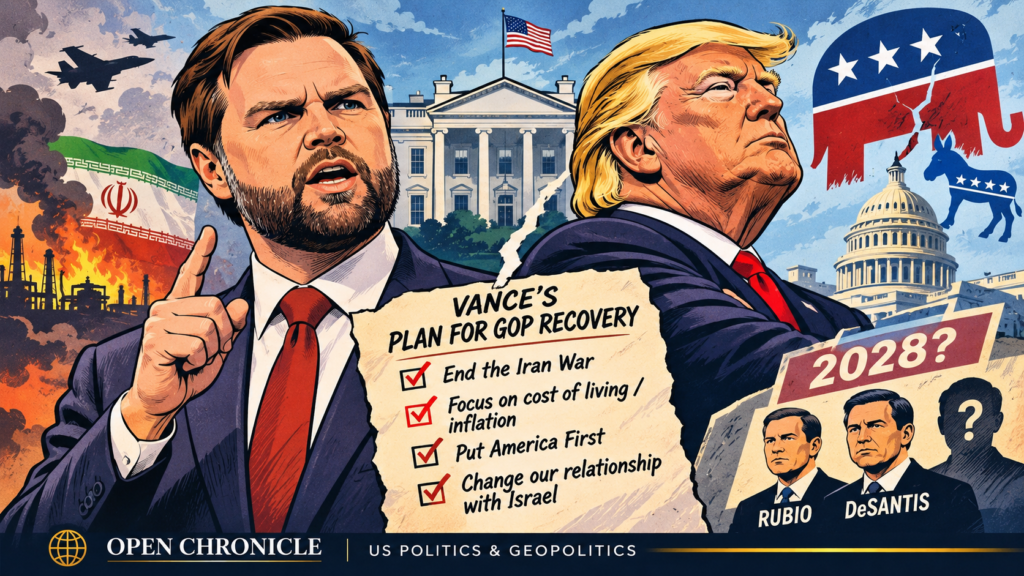
The vice president’s unusually direct criticism of the Iran conflict has exposed tensions within the Republican Party and intensified speculation about the race for the 2028 presidential nomination.
By Open Chronicle | November 5, 2026 | US Politics & Geopolitics
WASHINGTON, November 5, 2026. Vice President JD Vance has delivered one of the most striking public assessments of the Republican Party’s historic midterm election defeat, blaming the war against Iran for the loss of congressional control and calling for a fundamental reassessment of American foreign policy.
Less than 24 hours after Democrats secured majorities in both chambers of Congress, Vance published a lengthy statement on X that placed the unpopular conflict at the centre of the Republican Party’s electoral collapse.
His intervention has opened a new debate inside the administration about the consequences of the war, the future of the Make America Great Again movement and Vance’s own prospects of succeeding President Donald Trump in 2028.
The vice president’s comments were particularly significant because they appeared to challenge the political judgment behind one of Trump’s most consequential foreign policy decisions.
Trump acknowledged that the conflict had contributed to Republican losses but continued to defend his decision to launch military operations against Iran.
The contrast has raised questions about whether Vance is attempting to influence the administration’s next decisions, distance himself from an unpopular war or establish a political identity that could survive beyond Trump’s presidency.
Vance Identifies the Iran War as the Central Cause of Defeat
In his November 4 statement, Vance argued that Republican strategists had underestimated the dissatisfaction of voters who supported Trump in the 2024 presidential election but abandoned Republican candidates two years later.
He described conversations with political analysts who had examined why former Republican supporters were prepared to vote for Democrats.
According to Vance, those voters identified four principal priorities that could persuade them to return to the Republican Party:
End the war in Iran.
Address inflation and the cost of living.
Restore the America First approach to government.
Reconsider the United States’ relationship with Israel.
Vance presented the conflict as the decisive explanation for the electoral defeat.
“The reason we lost is the war,” he wrote.
The statement was unusually explicit for a sitting vice president discussing a military campaign directed by his own administration.
Rather than attributing the result primarily to weak candidates, Democratic mobilisation or campaign strategy, Vance connected Republican losses to a major presidential policy decision.
He also suggested that the political consequences of the war had been foreseeable.
His argument was that the administration had failed to respond adequately to warnings from voters who were increasingly dissatisfied with the conflict and its economic consequences.
The comments were independently reported by Reuters, Associated Press, The Washington Post and other American news organisations.
However, Vance’s explanation remains a political interpretation of the election rather than a definitive statistical account of every Republican defeat.
Voters may have been influenced by several overlapping concerns, including energy prices, inflation, tariffs, immigration policy and dissatisfaction with the administration’s broader performance.
Trump Acknowledges the Political Cost but Defends the War
President Trump has adopted a different position.
While acknowledging that the Iran conflict contributed to the Republican Party’s difficulties, he has continued to argue that military action was necessary to prevent Iran from developing nuclear weapons.
Speaking after the election, Trump said he would make the same decision again if confronted with similar circumstances.
He also suggested that Republican candidates had struggled to reproduce the electoral enthusiasm that helped him win the presidency in 2024.
The president’s response illustrates the distinction between acknowledging the political consequences of a decision and accepting that the decision itself was mistaken.
For Trump, the war remains a matter of national security and presidential judgment.
For Vance, the conflict has become a central explanation for the breakdown of the Republican electoral coalition.
That difference does not necessarily mean the two men are engaged in an open personal confrontation.
Trump described aspects of Vance’s assessment as substantially accurate, according to reporting published after the election.
Nevertheless, the vice president’s decision to emphasise the war so forcefully has created a visible difference in political priorities.
The disagreement comes at a sensitive moment, with Washington considering whether to pursue renewed negotiations with Tehran or resume major military operations.
A Foreign Policy Disagreement That Predates the Election
The tensions between Vance’s approach and the administration’s military strategy did not begin on election night.
Reporting by Axios indicates that Vance had privately encouraged Trump to pursue a diplomatic agreement with Iran and warned that continued military escalation could damage Republican electoral prospects.
The same reporting describes disagreements over Israeli Prime Minister Benjamin Netanyahu’s approach to the conflict.
According to unnamed sources cited by Axios, Vance had privately expressed frustration with Netanyahu’s assessments of Iran.
These accounts offer additional context for the vice president’s public comments, although private conversations cannot be independently established solely from anonymous-source reporting.
Vance has long been associated with a faction of American conservatism sceptical of prolonged overseas military commitments.
His political message has frequently emphasised domestic economic priorities, industrial renewal, immigration restrictions and the need to avoid international commitments that he considers inconsistent with American national interests.
The Iran conflict has tested that political identity.
As vice president, Vance remains a senior member of an administration responsible for the military campaign.
His public criticism therefore creates a difficult distinction between his personal policy preferences and the collective decisions of the government he serves.
That distinction could become increasingly important if he seeks the Republican presidential nomination in 2028.
The Israel Question Exposes a Broader Republican Debate
One of the most consequential elements of Vance’s statement concerned relations between Washington and Israel.
By identifying dissatisfaction with the American relationship with Israel as an electoral issue, the vice president entered a debate that has become increasingly prominent across the American political spectrum.
Support for Israel has historically enjoyed strong bipartisan backing in Congress.
However, the war involving Iran, the conflict in Gaza and disagreements over American military assistance have generated growing scrutiny of that relationship.
Some Republicans have questioned whether Washington’s regional commitments are compatible with an America First foreign policy.
Among Democrats, particularly within the party’s progressive wing, criticism of Israeli government policies has also become more pronounced.
Reuters reported on November 4 that the new Democratic congressional majorities could increase scrutiny of American assistance to Israel, although Trump’s presidential veto would remain a significant obstacle to major legislative changes.
Vance’s intervention suggests that the debate is no longer confined to opposition politicians or figures outside government.
It has reached the highest levels of the Republican administration.
Nevertheless, his statement did not provide a detailed alternative framework for American relations with Israel.
Changing that relationship could involve several different policies, including reassessing military assistance, altering diplomatic priorities, establishing new conditions for cooperation or reducing American involvement in regional conflicts.
The political significance of Vance’s remarks is therefore clearer than their immediate practical consequences.
Ohio Delivers a Particularly Difficult Result for Vance
The election results in Ohio have added another dimension to the vice president’s political difficulties.
Vance represented Ohio in the United States Senate before becoming vice president in January 2025.
The state has been an important part of his political identity, particularly because of his background in working-class communities and his bestselling memoir, Hillbilly Elegy.
Yet Ohio produced two significant Democratic victories in the November 3 elections.
Former state health director Amy Acton defeated Republican entrepreneur Vivek Ramaswamy in the gubernatorial race.
Acton became the state’s first woman elected governor and the first Democrat to win the office in two decades.
Her campaign emphasised affordability, healthcare and a less confrontational approach to politics.
Ramaswamy, who received support from Trump and Vance, had campaigned as a prominent representative of the Republican movement associated with the president.
The campaign also became embroiled in controversy over an advertisement involving deeply personal allegations connected to Acton’s childhood.
The advertisement drew criticism across party lines and was withdrawn before the election.
The Republican defeat therefore reflected more than dissatisfaction with national policy. It also raised questions about campaign judgment, candidate selection and the effectiveness of confrontational political messaging.
In Ohio’s Senate contest, Democrat Sherrod Brown defeated Republican Jon Husted, who had been appointed to the seat previously held by Vance.
Brown’s return to the Senate was another important Democratic gain in a state that Republicans had increasingly regarded as favourable territory.
These results do not prove that Vance personally caused the Republican defeats.
However, they weaken the argument that his political appeal can reliably deliver electoral success in his home state.
For a potential presidential candidate, that represents a significant challenge.
Michigan Produces Another Symbolic Republican Defeat
Michigan provided another notable result.
Democrat Abdul El-Sayed won the state’s Senate election, becoming the first Muslim elected to represent Michigan in the United States Senate.
El-Sayed’s victory has attracted national attention because of his progressive political identity and his criticism of aspects of Republican policy.
His election also carries a constitutional connection to Vance.
As vice president, Vance serves as president of the Senate and may administer the oath to newly elected senators.
El-Sayed reportedly highlighted the irony of potentially being sworn into office by a vice president whose political movement he had opposed.
The episode illustrates how the election has altered the political atmosphere in Washington.
Republicans who entered the campaign expecting to defend their congressional majorities are now confronting a Democratic Party with renewed influence and a larger group of emerging political figures.
For Vance, the challenge extends beyond a single election result.
He must now demonstrate that his political message can appeal to voters who rejected Republican candidates in states central to the party’s electoral strategy.
Is Vance Really a Lame Duck Vice President?
The description of Vance as a lame duck has become part of the political commentary surrounding his intervention.
However, it is important to distinguish political vulnerability from constitutional authority.
A vice president does not possess the same independent executive powers as the president.
The office’s principal constitutional responsibilities include presiding over the Senate, casting tie-breaking votes and assuming the presidency if required under the Constitution.
Vice presidents can also exercise considerable political influence through their relationships with the president, congressional leaders and senior administration officials.
That influence depends heavily on presidential confidence and access to decision-making.
Vance’s public disagreement with Trump could therefore have consequences if it damages their working relationship.
But it would be premature to conclude that he has lost the president’s confidence or become politically irrelevant.
Trump cannot simply dismiss an elected vice president in the same manner as a cabinet secretary.
Vance remains in office unless he resigns, is removed through the constitutional impeachment process or his term expires.
His political future is a separate question.
The midterm defeat may have weakened his position as a potential presidential successor, but the Republican nomination for 2028 remains undecided.
The more relevant issue is whether Vance can maintain influence within the administration while developing a political platform sufficiently distinct from Trump’s to attract voters seeking a change of direction.
Rubio, DeSantis and the Emerging Republican Succession Debate
The election has accelerated speculation about alternative Republican presidential candidates.
Secretary of State Marco Rubio and Florida Governor Ron DeSantis are among the figures mentioned in discussions about the party’s future.
Rubio represents a different tradition within Republican foreign policy.
He has historically supported a more assertive American international role, particularly regarding China, Iran and national security.
Vance’s emphasis on reducing foreign military commitments could create a substantive distinction between their approaches.
However, it would be misleading to assume that Rubio has already launched a campaign or that a direct contest between the two men is inevitable.
DeSantis presents another potential alternative.
The Florida governor challenged Trump during the 2024 Republican presidential nomination contest and retains a national political profile.
Following the 2026 election, he described the Republican losses in unusually severe terms, according to the supplied commentary.
His political prospects may depend on whether Republican voters seek continuity with Trump’s agenda or a different style of leadership.
Other Republicans could also enter the contest.
The Associated Press has identified several potential contenders as the party begins assessing its options after the midterms.
At this stage, there is insufficient evidence to determine which candidate will emerge as the favourite.
Vance retains the advantages of national visibility, executive experience and established relationships within the Republican movement.
His rivals may argue that the party requires a candidate less closely associated with the administration’s unpopular decisions.
That competition is likely to become one of the defining political developments of the next two years.
The Role of Conservative Media and Technology Donors
The debate over the Republican Party’s future also involves influential figures outside elected office.
Technology investors, conservative broadcasters and major political donors have played increasingly prominent roles in shaping Republican policy discussions.
Elon Musk and Peter Thiel are frequently associated with different parts of the conservative political and technological ecosystem.
Vance’s earlier professional relationship with Thiel is well documented.
However, the suggestion that his November 4 statement was specifically designed to secure support from particular technology donors remains an interpretation rather than an established fact.
Similarly, his criticism of the American relationship with Israel may appeal to commentators who have challenged traditional Republican foreign policy positions.
But agreement on one issue does not necessarily establish a political alliance.
The influence of wealthy donors and media personalities also has limits.
The 2026 election demonstrated that substantial campaign expenditure and national visibility do not guarantee electoral success.
Voters can reject candidates despite significant financial support and prominent endorsements.
For Republicans, the larger strategic question is whether the party should continue relying on highly personalised political campaigns or place greater emphasis on economic policy, institutional credibility and local concerns.
Vance’s statement suggests that he recognises at least part of that challenge.
Whether he can provide an effective response remains uncertain.
Democrats Gain New Leverage Over the Iran War
The Republican Party’s internal debate is taking place as Democrats prepare to assume control of Congress in January 2027.
Their electoral victory could significantly alter the administration’s ability to secure funding, pass legislation and avoid congressional investigations.
Democratic lawmakers have already indicated that they intend to examine the Iran conflict and the administration’s justification for military operations.
Congress possesses important constitutional powers over federal spending, oversight and legislation relating to national security.
However, presidential authority over military operations and foreign policy remains substantial.
The division of powers could produce disputes over military funding, sanctions, congressional authorisation and the conditions for diplomatic negotiations.
Vance’s criticism of the war may complicate those debates.
Democrats could cite the vice president’s remarks as evidence that concerns about the conflict extend beyond their own party.
Republican lawmakers may also face pressure from voters who believe the war has become too costly.
Nevertheless, Vance’s statement does not automatically translate into a congressional majority favouring a particular policy.
The administration’s next decisions will depend on military assessments, diplomatic developments, presidential priorities and the positions of congressional leaders.
The central uncertainty is whether the election will accelerate efforts to negotiate an end to the conflict or produce a period of confrontation between the White House and the new Congress.
The Economic Dimension: Why the War Became an Electoral Liability
The Iran conflict has also become closely connected to the American cost-of-living debate.
Disruption to shipping through the Strait of Hormuz has affected international energy markets, increasing concern about the price of crude oil, petrol and other petroleum products.
Although the United States is a major oil producer, domestic consumers remain exposed to international price movements.
Higher energy costs can affect transport, manufacturing, food distribution and household spending.
The political consequences are particularly significant when voters are already concerned about inflation.
Polling reported by Stars and Stripes indicated that 74% of respondents in a Fox News survey considered the Iran war a major or crucial factor in their congressional vote.
That finding suggests substantial public concern, although it does not establish that the war was the decisive issue for every voter.
Economic dissatisfaction may also reflect factors unrelated to Iran, including housing costs, trade tariffs and broader concerns about purchasing power.
This distinction matters because ending the conflict would not necessarily resolve every economic problem confronting the administration.
Vance’s four priorities acknowledge that reality by combining foreign policy with domestic affordability.
His challenge is to explain how those objectives could be translated into specific government policies.
Three Possible Paths for Vance
The vice president’s political future may depend on how the administration responds to the election and whether the Iran conflict moves towards a negotiated settlement.
Scenario 1: Diplomatic influence
Vance helps persuade the administration to pursue negotiations with Iran. A credible diplomatic breakthrough could strengthen his argument that Republicans should prioritise economic stability and avoid prolonged military commitments.
Scenario 2: Managed political disagreement
Vance maintains his position on the war while continuing to support the administration’s broader programme. This could preserve his relationship with Trump, but risks leaving voters uncertain about his independence.
Scenario 3: A Republican succession contest
Disagreements over Iran and the party’s electoral strategy deepen. Vance faces competition from Republicans offering alternative approaches to foreign policy, economic management and the political legacy of the Trump administration.
These are analytical scenarios, not predictions of established future events.
A Vice President Facing His Most Important Political Test
JD Vance’s response to the Republican midterm defeat has transformed an election postmortem into a debate about the future direction of American conservatism.
His criticism of the Iran war was unusually direct, particularly for a vice president serving under the president who authorised the conflict.
Yet the significance of his intervention extends beyond a disagreement over military policy.
Vance has identified a broader problem confronting the Republican Party: the difficulty of maintaining a political coalition when voters believe that the government’s priorities no longer reflect their economic concerns or expectations about foreign policy.
The Democratic victories in Ohio, Michigan and other competitive states have demonstrated the scale of that challenge.
For Trump, the immediate task is governing with an opposition-controlled Congress while deciding how to proceed in Iran.
For Vance, the challenge is more personal.
He must determine whether his political future depends on defending the administration’s record, persuading Trump to change direction or presenting himself as the candidate best equipped to lead Republicans beyond the current presidency.
His November 4 statement may eventually be remembered as an early attempt to redefine the party’s agenda.
It could also expose him to criticism from Republicans who believe a vice president should defend the administration’s decisions rather than publicly question their political consequences.
What is already clear is that Vance has entered the debate over the Republican Party’s future earlier, and more openly, than many observers expected.
Whether that decision strengthens his position or accelerates the search for an alternative presidential candidate remains one of the central questions emerging from the 2026 midterm elections.
Sources and Further Reading
The following sources were consulted to expand and verify the reporting. They include independent news coverage, election results and analysis of the political implications.
1. Reuters | Vance Repudiates Iran War After US Electoral Defeat
November 4, 2026 | Reuters
Reporting by Phil Stewart on Vance’s statement, the Republican defeat, the Iran conflict and possible consequences for the administration.
2. Associated Press | The 2028 Election Season Begins as Both Parties Navigate Midterm Fallout
November 5, 2026 | Associated Press
Examination of potential presidential contenders, Vance’s political position and the developing Republican succession debate.
3. Axios | After Midterm Defeat, Trump Faces Mostly Bad Options in Iran
November 5, 2026 | Axios
Reporting on the administration’s diplomatic and military options, including accounts of Vance’s private concerns about the conflict.
4. Associated Press | Democrat Amy Acton Defeats Vivek Ramaswamy in Ohio Governor’s Race
November 3, 2026 | Associated Press
Coverage of the Ohio gubernatorial election, the candidates’ campaigns and the political significance of Acton’s victory.
5. WOSU Public Media | Examining Ohio’s Midterm Election Results
November 4, 2026 | WOSU Public Media
Local reporting on Amy Acton’s victory and Sherrod Brown’s return to the Senate.
6. Reuters | Democratic Congress Could Test Decades of US Support for Israel
November 4, 2026 | Reuters
Analysis of how the Democratic congressional victory and changing attitudes within both parties could influence American policy towards Israel.
7. The i Paper | Vance Is a Lame Duck VP, So He’s Dropped a Bombshell
November 2026 | Opinion | The i Paper
The original commentary supplied for this article, presenting a critical interpretation of Vance’s political position following the Republican defeat.
Editorial Note
This article was prepared on November 5, 2026, using the supplied political commentary and additional reporting from Reuters, Associated Press, Axios, WOSU Public Media and other identifiable news organisations.
The article distinguishes Vance’s public statements from interpretations of his political intentions. Claims concerning private disagreements within the administration are attributed to the publications reporting them.
The description of Vance as a lame duck is a political characterisation, not a constitutional determination. The scenarios concerning his political future and the 2028 Republican presidential nomination represent Open Chronicle’s editorial analysis.
Election results are based on reporting available at the time of preparation and may remain subject to official certification.