
OPEN CHRONICLE | GLOBAL NEWS BRIEF | WORLD AFFAIRS
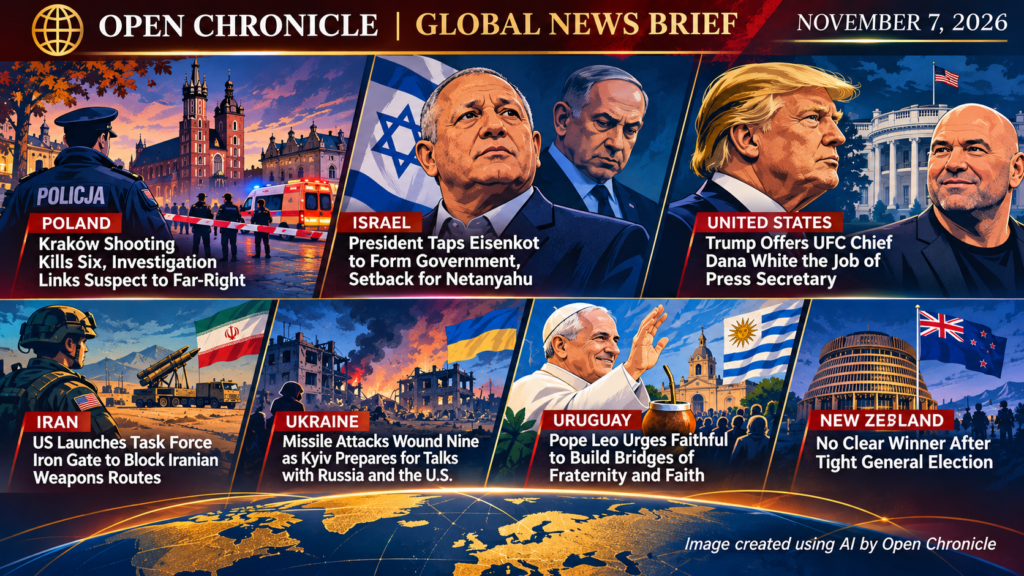
Six people are killed in a mass shooting in Poland, Israel’s president gives Netanyahu’s rival a chance to form a government, Washington expands pressure on Iran, and New Zealand faces coalition uncertainty after a closely contested election. Meanwhile, Ukraine comes under renewed missile attack, Paraguay confronts a political and banking crisis, and China prepares to welcome its first foreign astronaut.
By Open Chronicle News Desk
November 7, 2026 | International News | World Affairs
The international news agenda on Saturday, November 7, was dominated by deadly violence in Europe, major political developments in Israel and South America, and fresh military and diplomatic tensions across the Middle East.
In Poland, a gunman opened fire in the historic centre of Kraków, killing six people and injuring 15. Investigators are examining the attacker’s background after officials reported indications of far-right ideological sympathies.
In Israel, President Isaac Herzog selected opposition leader Gadi Eisenkot to attempt to form a government, delivering a significant political setback to Benjamin Netanyahu while leaving the country’s future leadership uncertain.
The United States announced a new military coordination initiative intended to restrict Iranian weapons movements across land borders and the Caspian Sea. The announcement came amid continued regional instability and reports of explosions in southern Iran.
Elsewhere, preliminary election results in New Zealand left the country’s political parties facing difficult coalition negotiations, while Paraguay’s former president Santiago Peña appeared before prosecutors following his removal from office.
The day also brought important developments in science and religion. China announced plans for a Pakistani astronaut to visit its Tiangong space station, while Pope Leo XIV celebrated Mass in Uruguay and called for greater solidarity across divided communities.
This edition examines the principal developments by region and subject, with particular attention to their international consequences.
1. Europe | Deadly Violence, Public Unrest and Security Concerns
Poland: Six killed and 15 injured in Kraków shooting
A mass shooting in Kraków’s historic centre left six people dead and 15 injured, according to Polish authorities.
The attack took place on Saturday afternoon near the city’s Main Market Square, one of Poland’s most recognisable tourist destinations.
Police reported that a man drove into the area and opened fire from his vehicle, targeting people in public spaces.
Officers confronted the attacker, who was wounded and detained before being taken to hospital.
The confirmed victims included four women and two men. Police officers were among those injured.
Poland’s interior minister indicated that investigators had identified signs of the suspect’s fascination with far-right ideology.
However, investigators had not established a definitive motive, and ideological sympathies alone do not prove that an attack was organised or directed by an extremist network.
Prime Minister Donald Tusk said authorities were examining the circumstances of the shooting.
The attack has shocked Poland, where mass shootings of this scale are relatively uncommon.
The tragedy also raises broader questions about public-space security, extremist violence and the challenges of identifying individuals who may be preparing attacks.
France: Tens of thousands of security personnel deployed amid protests
French authorities deployed approximately 70,000 security personnel amid renewed nationwide demonstrations against rising living costs and deteriorating public services, according to reports monitored on Saturday.
Protests centred on economic grievances, including wages, purchasing power and the cost of essential services.
Paris experienced particular tensions as demonstrators challenged restrictions on certain gatherings.
The mobilisation reflects a wider political problem facing France: public dissatisfaction with economic conditions and declining confidence in political institutions.
The government faces the difficult task of protecting public safety while preserving the right to peaceful protest.
The precise turnout and the number of arrests require confirmation through final police and organiser reports.
European bomb threats raise concerns about hybrid interference
Investigators continued examining a wave of threatening communications directed at aviation services and other institutions across Europe.
French prosecutors were reported to be investigating whether some threats could be connected to foreign actors.
The incidents have prompted renewed discussion about hybrid warfare, a term covering hostile activities that may combine intimidation, disinformation, cyber operations and disruption of civilian infrastructure.
However, the existence of threats across several countries does not establish that a foreign government coordinated them.
Determining responsibility requires technical evidence, intelligence assessments and criminal investigation.
Italy: Foreign minister reports personal data leak
Italy’s foreign minister reported that hackers had obtained and disclosed personal information relating to him.
The incident highlights the cybersecurity risks facing senior government officials, whose communications and personal data may be targeted for intelligence gathering, intimidation or reputational damage.
The available reporting does not, by itself, establish the identity or motivation of the attackers.
Italian authorities are expected to assess the extent of the exposure and whether any sensitive government information was compromised.
2. Russia and Ukraine | Missile Strikes Ahead of Diplomatic Talks
Russian attacks wound civilians as negotiations approach
Russian missile attacks wounded at least nine people in Ukraine, according to reports published on Saturday.
The strikes came as Ukraine prepared for diplomatic discussions involving Russia and the United States.
Ukrainian President Volodymyr Zelenskyy accused Moscow of intensifying attacks on civilian and energy infrastructure ahead of negotiations.
He also said Russian forces had used North Korean ballistic missiles during attacks on Ukraine’s electricity network.
The precise weapons employed and the full extent of the damage require independent verification.
The strikes underline the difficulty of pursuing negotiations while military operations continue.
For Ukraine, the protection of electricity generation and distribution remains a critical priority as winter approaches.
European leaders demand a role in peace negotiations
European governments reiterated that any agreement affecting Ukraine’s future security must include European participation.
The position reflects concern that negotiations conducted primarily between Washington and Moscow could produce arrangements with major implications for European defence.
European leaders have emphasised that Ukraine must retain a central role in decisions affecting its sovereignty and territorial integrity.
Security guarantees, military assistance and the enforcement of any future settlement remain unresolved questions.
Starlink restrictions become the subject of renewed allegations
Polish Foreign Minister Radosław Sikorski reportedly alleged that Elon Musk had restricted Starlink connectivity during a Ukrainian offensive.
The allegation highlights the growing dependence of modern military operations on commercial satellite infrastructure.
Starlink has played an important role in Ukrainian communications, but decisions concerning service availability and operational restrictions can have significant military consequences.
The specific allegation requires corroboration and an opportunity for the companies and individuals concerned to respond.
It should not be treated as an independently established finding solely on the basis of the minister’s reported remarks.
3. Middle East | Israel’s Political Transition and New Pressure on Iran
Israel: Herzog selects Eisenkot to attempt government formation
Israeli President Isaac Herzog announced that opposition leader Gadi Eisenkot would receive the opportunity to form a new government following the country’s October parliamentary election.
Eisenkot, a former military chief and a prominent rival of Benjamin Netanyahu, secured more recommendations from lawmakers than the outgoing prime minister.
According to reporting on the consultations, parties representing 67 members of the Knesset recommended Eisenkot, while 46 supported Netanyahu.
However, recommendations to the president are not equivalent to a confirmed governing majority.
Eisenkot faces difficult negotiations involving centrist, right-wing, religious and Arab political parties.
Disagreements over military conscription, national security and the participation of Arab parties could complicate coalition formation.
The decision represents a political setback for Netanyahu but does not guarantee that Eisenkot will become prime minister.
If coalition talks fail, Israel could face another round of political negotiations or further elections.
United States establishes Task Force Iron Gate
The United States announced the establishment of Task Force Iron Gate, a new initiative intended to restrict Iran’s ability to transport weapons and sanctioned materials through overland routes.
US Central Command said the task force would coordinate with other government agencies to monitor movements across Iran’s land borders and the Caspian Sea.
The initiative extends American pressure beyond the maritime restrictions already imposed on Iranian ports.
According to US military officials, the task force will focus on advanced weapons systems, technologies with both civilian and military applications, sanctioned materials and revenue streams associated with prohibited activities.
The approximately 20-person team will operate from Tampa, Florida.
Washington argues that restricting these routes will reduce Iran’s ability to rebuild military capabilities and support armed groups.
The announcement does not establish that all Iranian cross-border commerce is prohibited, nor does it independently verify the financial impact claimed by US authorities.
Reports of explosions in southern Iran
Iranian media reported explosions near Qeshm Island and the port of Jask.
Both locations are strategically significant because of their proximity to maritime routes and infrastructure associated with the Persian Gulf and Gulf of Oman.
The cause of the reported explosions, the extent of any damage and possible casualties remained unclear in the material available for this edition.
Without independent confirmation, it would be premature to attribute the incidents to a particular military force.
Yemen: Competing claims deepen uncertainty
Yemen’s conflict generated several conflicting reports on Saturday.
Houthi representatives alleged that airstrikes near Sanaa had caused dozens of casualties.
Other reports described Houthi attacks targeting Saudi infrastructure.
Meanwhile, Yemen’s internationally recognised authorities accused Iran and Hezbollah of providing military assistance to the Houthis.
Syria denied reports that it had deployed troops to Yemen, while acknowledging military cooperation with Saudi Arabia focused on training.
These claims require separate verification.
The competing accounts demonstrate the complexity of the regional conflict, where military developments, diplomatic interests and information warfare frequently overlap.
Gaza: Heavy rainfall worsens conditions for displaced families
Heavy rain damaged temporary shelters housing displaced Palestinians in Gaza.
Reports described flooding, collapsed tents and injuries as families struggled to protect themselves from worsening weather.
The situation adds to existing humanitarian challenges involving housing, sanitation, medical care and access to essential supplies.
For families living in makeshift shelters, winter conditions can create serious risks even in the absence of immediate military activity.
Humanitarian organisations continue to face substantial difficulties delivering assistance at the scale required.
4. North America | White House Changes and Political Uncertainty
Washington: Stephen Miller appointment divides political opinion
The appointment of Stephen Miller to a senior White House leadership position continued to generate strong reactions in Washington.
Supporters regard Miller as an experienced political strategist with close ties to President Donald Trump and a clear understanding of the administration’s priorities.
Critics have raised concerns about his hard-line approach to immigration and the possibility of increased political confrontation.
The appointment comes amid a difficult period for the administration following Republican setbacks in the midterm elections.
The extent of Miller’s influence will depend on his formal responsibilities and his working relationship with the president and other senior officials.
Trump publicly suggests Dana White for press secretary
President Trump publicly suggested that UFC chief Dana White should take the position of White House press secretary.
The remarks attracted attention because of White’s longstanding association with Trump and his prominence in the world of mixed martial arts.
However, a public offer or suggestion does not constitute a formal appointment.
There was no independently established confirmation in the supplied material that White had accepted the position or that the White House had completed an official personnel change.
The episode nevertheless illustrates the unconventional political relationships surrounding the administration.
United States: Midterm election consequences continue
The results of the November midterm elections continued to reshape political calculations in Washington.
Democratic gains have strengthened congressional scrutiny of the administration and increased speculation about the 2028 presidential election.
Republican politicians are reassessing campaign strategy, while potential future presidential candidates are positioning themselves for the next electoral cycle.
The consequences could extend into foreign policy, government spending and the administration’s ability to advance legislation.
5. Latin America | Paraguay’s Political Crisis and Institutional Accountability
Paraguay: Former president appears before prosecutors
Former Paraguayan President Santiago Peña appeared before prosecutors following his removal from office in an impeachment process connected to a major banking scandal.
The crisis emerged after the collapse of digital lender ueno, which disrupted access to accounts and triggered public protests.
Lawmakers accused Peña of conflicts of interest and failures of financial oversight.
The former president has denied wrongdoing.
His removal brought Vice President Pedro Alliana to power.
The investigation raises questions about banking regulation, the relationship between political leaders and financial institutions, and the protection of depositors.
The allegations against Peña remain subject to judicial proceedings and must not be presented as established criminal guilt.
The case has become a major test of Paraguay’s political institutions and financial stability.
Guatemala: Lawmaker and police officers killed
Reports from Guatemala described an armed attack that killed a legislator and three police officers.
The incident raised concerns about political violence and the security environment confronting public officials.
The circumstances and motive require confirmation through the authorities’ investigation.
The attack highlights the continuing challenges faced by countries attempting to strengthen public security and the rule of law.
6. Asia and the Pacific | New Zealand Election and China’s Space Programme
New Zealand: Election leaves coalition outcome uncertain
New Zealand’s general election produced no immediately clear governing majority.
Preliminary results showed the National Party and Labour Party receiving nearly identical shares of the party vote.
The Electoral Commission reported that Labour received approximately 29.36% of the party vote, compared with 29.21% for National.
The projected parliamentary distribution gave National 42 seats and Labour 36, reflecting the country’s mixed-member proportional electoral system and the importance of electorate results.
Smaller parties, including the Greens, ACT, New Zealand First, the Opportunity Party and Te Pāti Māori, could play decisive roles in coalition negotiations.
Approximately 399,000 special votes remained to be processed, according to the Electoral Commission’s initial estimate.
Official results are scheduled for November 27.
The final distribution of seats and the political agreements reached after the election will determine the country’s next government.
Pakistan prepares historic astronaut mission to China’s space station
China announced that a Pakistani astronaut would participate in the Shenzhou-24 mission to the Tiangong space station.
The astronaut is expected to serve as a payload specialist and undertake a short stay in orbit.
The mission would mark the first visit by a foreign national to China’s space station.
Pakistani candidates have been undergoing training in Beijing, although Chinese authorities had not publicly confirmed the identity of the selected astronaut in the reporting available on Saturday.
The mission reflects expanding scientific and strategic cooperation between China and Pakistan.
It also demonstrates Beijing’s growing interest in international partnerships within its crewed space programme.
The development has broader implications for space diplomacy as China seeks to expand its scientific presence and compete in advanced space exploration.
China expands legal tools against overseas economic fugitives
China introduced legislation expanding its ability to pursue individuals accused of economic crimes and recover assets located abroad, according to reports monitored on Saturday.
The measure reflects Beijing’s continuing anti-corruption campaign and efforts to strengthen cross-border enforcement.
However, such initiatives raise questions about jurisdiction, due process and the protection of individuals living outside China.
International cooperation in criminal investigations requires legal safeguards and respect for the sovereignty of other countries.
The practical impact of the legislation will depend on how Chinese authorities implement it and how foreign governments respond.
7. Religion and Society | Pope Leo XIV Calls for Fraternity in Uruguay
Pope Leo celebrates Mass and urges communities to build bridges
Pope Leo XIV continued his South American journey with a major religious gathering in Uruguay.
The pontiff celebrated Mass in Paysandú, where local authorities estimated that approximately 40,000 people attended.
His message emphasised fraternity, faith and the importance of overcoming social divisions.
The visit also highlighted the cultural significance of mate, a traditional drink widely associated with everyday social life in Uruguay and neighbouring countries.
The pope used the occasion to encourage communities to strengthen relationships and promote solidarity.
The journey forms part of a wider visit to Uruguay, Argentina and Peru.
Beyond its religious importance, the trip provides an opportunity for the Catholic Church to address questions concerning social inequality, healthcare, political polarisation and regional cooperation.
8. Science, Technology and the Environment
European protests challenge the expansion of AI data centres
Protests against new data centre developments took place in several European countries, including France and Finland.
Campaigners raised concerns about electricity demand, environmental impacts and the pressure large computing facilities place on local infrastructure.
The demonstrations come amid a broader debate over the financial sustainability of artificial intelligence investment.
Technology companies argue that additional computing capacity is necessary to support digital services, scientific research and economic competitiveness.
Critics question whether local communities receive sufficient benefits from projects that can consume substantial amounts of energy and water.
The debate is likely to become increasingly important as governments attempt to balance technological growth with environmental commitments.
Britain launches military satellite for space monitoring
Britain announced the successful launch of a military satellite named Titania, intended to support the monitoring of threats in space.
The development reflects growing concern about the vulnerability of satellites to interference, hostile operations and orbital hazards.
Space-based infrastructure supports communications, navigation, intelligence and numerous civilian services.
Protecting these systems has become an increasingly important element of national defence planning.
United Nations warns of critical moment for climate action
United Nations Secretary-General António Guterres warned that the international community faces a decisive moment in efforts to limit global warming.
The remarks came ahead of an international climate summit.
Governments remain under pressure to accelerate emissions reductions, support adaptation and address the financial needs of countries most vulnerable to climate change.
The central challenge is translating political commitments into measurable changes in energy systems, industrial activity and environmental protection.
9. Global Outlook | What to Watch Next
Several developments could shape the international agenda in the coming days.
Poland: Investigators are expected to clarify the background and motive of the Kraków attacker, while authorities review security arrangements following the mass shooting.
Israel: Gadi Eisenkot will begin the difficult process of assembling a governing coalition. His success depends on reconciling parties with sharply different political priorities.
Iran: The implementation of Task Force Iron Gate could increase tensions over regional transport routes, sanctions enforcement and military activity.
Ukraine: Diplomatic discussions will take place against the backdrop of continuing Russian attacks and unresolved questions about security guarantees.
New Zealand: Coalition negotiations and the counting of special votes will determine whether the preliminary election balance changes.
Paraguay: Prosecutors will continue examining allegations associated with the banking crisis, while the new government attempts to restore public confidence.
Space exploration: China’s planned mission involving a Pakistani astronaut could become an important milestone in international crewed spaceflight cooperation.
Conclusion | Political Transitions and Security Crises Define November 7
The events of November 7 illustrate a global environment marked by political uncertainty, military pressure and institutional challenges.
The tragedy in Kraków has raised urgent questions about public safety and extremist violence.
Israel’s political transition could influence the country’s domestic priorities and regional relationships.
Washington’s decision to expand restrictions on Iranian supply routes demonstrates that economic and military pressure remain central elements of American policy in the Middle East.
In Europe, Ukraine’s security continues to dominate diplomatic discussions, while protests and infrastructure concerns reveal growing domestic pressures.
Elsewhere, the political crisis in Paraguay and the uncertain election outcome in New Zealand underline the importance of constitutional procedures and coalition-building.
At the same time, China’s expanding space programme and Pope Leo XIV’s message of fraternity offer contrasting examples of international cooperation and dialogue.
The defining feature of the day’s news is the growing connection between domestic political decisions, international security and the institutions responsible for managing change.
Open Chronicle will continue following these developments through its international news coverage and specialist editorial desks.
Sources and Further Reading
1. City of Kraków | Official Shooting Updates
Official confirmation of six fatalities, fifteen injuries, police intervention and the continuing investigation.
2. Associated Press | Israel’s Government Formation
Reporting on President Herzog’s decision to give Gadi Eisenkot the opportunity to form a governing coalition.
3. Reuters | Paraguay’s Political and Banking Crisis
Reporting on Santiago Peña’s removal, the banking investigation and his appearance before prosecutors.
4. Electoral Commission New Zealand | 2026 Preliminary Results
Official election-night vote totals, projected parliamentary seats and the timetable for final results.
5. US Central Command | Task Force Iron Gate
Reporting on the establishment, stated objectives and operational scope of the new US military coordination initiative.
6. Vatican Press Office | Pope Leo XIV in Uruguay
Official documentation of the pontiff’s November 7 visit to Paysandú, including the Mass and attendance estimate.
7. Reuters | Pakistan’s Historic Space Mission
Reporting on China’s Shenzhou-24 mission and plans for the first foreign astronaut aboard Tiangong.
Editorial Note
This Global News Brief was prepared using reporting and official information available on November 7, 2026. Confirmed events are distinguished from allegations, preliminary figures and developing investigations.
Some secondary developments originate from news monitoring reports and require additional source-level verification before publication. Casualty figures, military claims and ongoing legal proceedings may change as new information becomes available.