
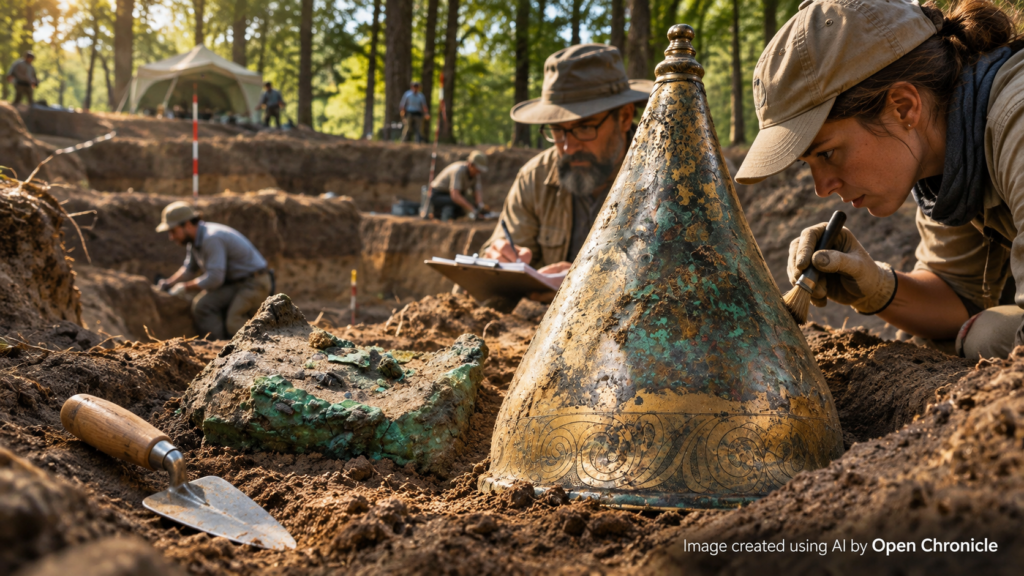
Archaeologists investigating a fortified Iron Age settlement in northeastern Poland have uncovered evidence that could transform our understanding of Celtic connections with the Baltic world. A deliberately damaged bronze helmet, ancient metalworking remains and traces of amber exchange suggest that distant communities were more closely connected than previously believed.
By Open Chronicle History Desk
ARCHAEOLOGY | IRON AGE EUROPE | POLAND | 8 NOVEMBER 2026
A warrior’s helmet far from home
Around 2,400 years ago, someone at a fortified settlement in what is now northeastern Poland placed a remarkable collection of objects into a pit.
Among them was a bronze helmet associated with the warrior elite of Celtic Europe.
The helmet had been crushed and broken into fragments. Beside it lay iron tools, including four adzes and a scythe. Charred remains surrounded the deposit.
The objects remained buried until archaeologists returned to investigate the ancient settlement of Łysa Góra, near Chorzele in Poland’s Masovian region.
The discovery raises a compelling question.
How did an object associated with prestigious warriors from Celtic communities farther south and west reach this part of Europe?
A scientific study published in the journal Antiquity on 14 October 2026 suggests that the answer may involve more than occasional trade.
Researchers from the State Archaeological Museum in Warsaw and the University of Warsaw believe the site may have been an important centre of production, exchange and ritual activity connected with the ancient amber trade.
The helmet, together with ornaments, metalworking evidence and defensive structures, raises the possibility that individuals from Celtic cultural communities were physically present at the settlement.
If confirmed, that interpretation would provide valuable new insight into the movement of people and goods across Iron Age Europe.
The findings also challenge the idea that communities living beyond the traditional geographical heartlands of Celtic culture were relatively isolated.
Instead, Łysa Góra may have formed part of a complex network connecting the Baltic region with Central Europe.
An archaeological site rediscovered
Łysa Góra was not an entirely unknown archaeological location.
The site had been identified in 1957 and investigated intermittently between 1971 and 1992.
Earlier excavations revealed evidence of settlement and objects associated with the Early Iron Age.
Some discoveries suggested contact with the La Tène cultural world, a broad archaeological tradition associated with Celtic communities across parts of Europe.
However, the site’s wider significance remained insufficiently understood.
Many of the earlier findings had not been comprehensively analysed or published, limiting the conclusions researchers could draw.
That changed in 2024, when the State Archaeological Museum in Warsaw and the Faculty of Archaeology at the University of Warsaw resumed investigations.
The new project sought to reassess the chronology, organisation and functions of the settlement.
Researchers examined its defensive structures, archaeological deposits and material remains.
The results have substantially expanded the picture.
Rather than representing a relatively minor settlement with occasional imported objects, Łysa Góra now appears to have served several important functions.
It was fortified, supported craft production, participated in exchange networks and contained areas associated with ritual activity.
These characteristics suggest a community whose importance extended beyond its immediate surroundings.
The significance of a Berru-type helmet
The most striking object recovered from the site is a bronze helmet belonging to the Berru type.
This form is associated with the early La Tène period, particularly the fourth century BC.
Comparable helmets are known from regions including France and Austria.
They were not ordinary pieces of equipment.
In Celtic cultural contexts, elaborate bronze helmets could communicate social standing, martial identity and membership of a warrior elite.
Their significance was therefore not limited to practical protection during combat.
A prestigious helmet could also serve as a visible symbol of authority.
The example from Łysa Góra is especially important because it was found far from the regions where comparable objects are most commonly documented.
Its presence suggests a connection with communities whose material culture differed from that of the local population.
But the helmet alone cannot reveal the precise nature of that relationship.
It could have reached the settlement through exchange, diplomatic contact, movement of individuals or other processes.
The researchers consider direct contact with Celtic groups a plausible explanation, especially when the helmet is examined alongside the other discoveries.
Nevertheless, the distinction between an imported object and evidence of a migrant community remains central to the investigation.
An artefact can travel farther than the person who originally owned it.
The challenge is determining whether the helmet arrived as a traded possession or accompanied individuals who lived or operated at Łysa Góra.
Why was the helmet deliberately destroyed?
The circumstances in which the helmet was deposited are particularly intriguing.
Archaeologists recovered it from a pit containing charred material and several iron implements.
The helmet had been crushed and fragmented.
The associated tools included a scythe and four adzes, implements connected with agricultural or woodworking activities.
This combination has led researchers to interpret the deposit as possible evidence of ritual behaviour.
In Iron Age Europe, the deliberate destruction or deposition of valuable objects could form part of ceremonial practices.
Weapons, ornaments and tools were sometimes placed in locations where their arrangement suggests meanings beyond ordinary disposal.
A valuable helmet rendered unusable before burial may have possessed symbolic significance.
However, the precise sequence of events at Łysa Góra remains uncertain.
The archaeological evidence does not establish who damaged the helmet, whether it was destroyed during a ceremony or what beliefs motivated the deposition.
The charred material also does not independently prove that the helmet was burned as part of a ritual.
The researchers interpret the deposit within the broader context of ritual activity identified at the site.
This is an important distinction.
The objects provide physical evidence of deliberate deposition and damage, while the religious meaning of those actions remains a matter of archaeological interpretation.
The settlement and the Amber Route
One of the strongest explanations for the importance of Łysa Góra lies in its geographical position.
The settlement stood near the Orzyc River, within a region connected to routes leading towards the Baltic world.
Nearby areas, including Kurpie and the Sambian Peninsula farther north, were associated with amber resources and their circulation.
Amber is fossilised tree resin, valued for its appearance and its ability to be worked into ornaments.
In antiquity, amber from northern Europe travelled considerable distances.
It reached communities in Central and Southern Europe, where it could be fashioned into jewellery and other prestigious objects.
The expression Amber Route refers to a network of exchange connections rather than a single permanently established road.
Goods could move through several intermediaries and along changing regional routes.
Communities situated near important waterways or transport corridors could benefit from controlling access to those networks.
Łysa Góra appears well positioned to have participated in such exchanges.
Archaeologists recovered amber beads and an unfinished amber ring.
The unfinished object is especially interesting because it suggests that amber was not necessarily passing through the settlement only as a completed luxury product.
Some material may have been worked or prepared locally.
This raises the possibility that Łysa Góra served as both a trading centre and a production location.
The presence of Celtic-style objects may reflect the role of southern communities in organising or maintaining these long-distance connections.
Yet the precise mechanisms of trade remain uncertain.
Researchers cannot currently reconstruct a complete route linking the helmet’s place of manufacture with the settlement.
Future studies of the artefacts’ materials may help clarify those connections.
Nearly 350 metal artefacts
The helmet was not an isolated discovery.
The renewed excavations uncovered nearly 350 metal artefacts, including ornaments, weapons and evidence of bronze-working.
Among the finds were fragments of bronze jewellery, iron brooches and ring ornaments associated with the La Tène cultural tradition.
The researchers identified 31 mostly fragmentary Early La Tène brooches and ring ornaments, dating approximately to the middle of the fourth century BC.
Their presence is significant because they represent a broader collection of objects associated with Celtic material culture.
A single imported helmet could be explained through exceptional circumstances.
A larger assemblage of related objects suggests more sustained interaction.
Some bronze ornaments had been broken into portions and grouped together.
The researchers interpret these compact bundles as material that may have been prepared for remelting.
Earlier investigations also documented ceramic crucibles associated with metal casting.
Together, these discoveries suggest that metalworking formed part of the settlement’s activities.
Craft production could have served local needs while also supporting exchange with distant communities.
Metal objects were valuable not only because of their finished forms but also because bronze and iron could be reworked.
Fragments of broken ornaments might therefore retain economic value as raw material.
The archaeological evidence suggests a settlement involved in the circulation, transformation and use of metals.
This is important because it places Łysa Góra within a wider economic system rather than portraying it simply as a remote fortified community.
A settlement built for defence
The new research also examined the settlement’s fortifications.
Łysa Góra occupied a naturally elevated location, offering advantages for defence and observation.
Archaeologists identified defensive structures constructed using earth and timber.
These included ramparts, ditches and evidence of wooden elements.
The precise organisation of the fortifications varied across different parts of the site.
Such structures required considerable labour.
Their construction suggests that the community invested resources in protecting the settlement or controlling access to it.
The need for defence may have been connected with several factors.
Stored goods, valuable materials and participation in exchange networks could make a settlement strategically important.
Defensive structures might also express political authority or mark a boundary between a community and the surrounding landscape.
However, the existence of fortifications does not prove that Łysa Góra was frequently attacked.
Archaeologists must distinguish between evidence of defensive preparation and evidence of actual conflict.
The available findings support the interpretation of a fortified settlement with economic and ritual functions.
They do not establish a specific military history.
Did Celtic people actually live there?
This is perhaps the most important question raised by the research.
Celtic communities were present in parts of Central Europe during the Iron Age, and La Tène material culture spread across a wide geographical area.
Yet the distribution of objects does not always correspond neatly to the movement of populations.
Trade, imitation, marriage networks and the adoption of foreign fashions can all spread material culture.
The researchers therefore examine several possible explanations for the Celtic objects found at Łysa Góra.
One possibility is that local inhabitants acquired them through exchange.
Another is that individuals associated with La Tène communities travelled to the settlement and participated directly in its activities.
The prestigious nature of the helmet makes the second interpretation particularly interesting.
The researchers note that comparable helmets were closely associated with warrior elites and were uncommon outside the La Tène cultural area during the fourth century BC.
This raises the possibility that a person of elevated status from a southern community reached Łysa Góra.
The broader collection of ornaments may also suggest more sustained contact than a single visit.
However, direct Celtic settlement has not been conclusively demonstrated.
No chemical analysis can identify a person’s cultural identity simply by examining a helmet.
The researchers propose further investigations to understand the origins of the artefacts and the relationships between the communities involved.
The evidence currently supports a strong case for long-distance cultural connections, while the precise nature of population movement remains open.
The possibility of a ritual centre
Łysa Góra’s significance extends beyond its defensive and economic features.
The researchers identified additional deposits interpreted as possible evidence of ritual activity.
Some objects were found in contexts that suggest deliberate placement rather than accidental loss.
One example involved bronze ornaments associated with a deposit near the settlement’s defensive structures.
Such discoveries raise questions about the relationship between economic exchange and religious practices.
In ancient societies, trade and ritual were not necessarily separate activities.
Valuable objects could circulate as commercial goods, diplomatic gifts or offerings.
The same material might acquire different meanings depending on the circumstances in which it was used.
Amber itself could possess both ornamental and symbolic value.
The deposition of metal objects may similarly have involved social or religious significance.
At Łysa Góra, the damaged helmet and associated tools form part of this wider pattern.
Nevertheless, researchers cannot identify the specific deities, ceremonies or beliefs associated with these deposits.
The evidence supports the possibility of ritual activity, but it does not permit a detailed reconstruction of the ceremonies.
A wider European story
The discovery contributes to a changing understanding of Iron Age Europe.
Older interpretations sometimes divided the continent into relatively distinct cultural regions.
The La Tène world was associated with Celtic communities in Central and Western Europe, while other cultural traditions occupied areas farther north and east.
Archaeological discoveries increasingly reveal that these regions were connected through movement, exchange and the circulation of ideas.
Łysa Góra offers a particularly interesting example.
A fortified settlement in northeastern Poland contained objects associated with distant Celtic communities, evidence of local production and material linked to amber exchange.
These findings suggest that geographical distance did not necessarily prevent sustained interaction.
People could travel across considerable distances, while goods and technologies moved through overlapping networks.
The settlement may have functioned as a meeting point between different cultural traditions.
If further research confirms the physical presence of Celtic individuals, Łysa Góra could become an important case study in the movement of people across Iron Age Europe.
Even without that confirmation, the material evidence demonstrates substantial cultural and economic connections.
What future research may reveal
The archaeologists plan further studies of the metal artefacts and the settlement’s wider archaeological context.
One important approach involves lead isotope analysis.
This technique can help researchers investigate the possible geological origins of metals by comparing isotopic signatures with known ore sources.
Such analysis may provide clues about where some of the bronze objects originated.
However, the method has limitations.
Metals can be recycled, mixed and transported through several stages before being used in a finished object.
A chemical signature therefore does not necessarily identify the workshop where an artefact was manufactured.
The researchers also intend to compare materials from Łysa Góra with finds from other parts of Central Europe, including Bohemia.
Further archaeological surveys may clarify the settlement’s organisation and its relationship with surrounding routes.
Studies of the site’s production evidence could help determine whether metalworking was primarily intended for local use or connected with wider exchange.
The combined results may eventually reveal more about the people who lived there and the communities with which they interacted.
For now, the helmet remains one of the most striking clues.
A forgotten crossroads of ancient Europe
The bronze helmet recovered from Łysa Góra represents far more than an unusual archaeological object.
Its discovery points towards a world in which distant communities were connected by trade, technology, social relationships and possibly religious practices.
The helmet’s deliberate damage and deposition suggest that it possessed a significance extending beyond its practical function.
Its presence alongside iron tools raises questions about ceremonies whose meanings have not survived in written records.
The wider settlement reveals evidence of fortification, metalworking and participation in networks associated with the amber trade.
Together, these discoveries suggest that northeastern Poland occupied a more important place in Iron Age exchange systems than previously recognised.
The findings do not yet prove exactly who brought the helmet to Łysa Góra or why it was placed in the ground.
But they demonstrate that the region was not isolated from the cultural transformations taking place elsewhere in Europe.
Nearly 2,400 years after the helmet was buried, its fragments are helping archaeologists reconstruct connections that once linked communities separated by hundreds of kilometres.
The object was broken in antiquity.
Today, it is helping piece together a forgotten chapter of European history.
Historical Sources and Further Reading
Original archaeological research and institutional reporting documenting the Celtic helmet, Iron Age settlement and ancient exchange networks at Łysa Góra in Poland.
Antiquity | Cambridge University Press
Łysa Góra in north-eastern Poland: a key Early Iron Age site on the ‘Amber Route’
14 October 2026. Research by Bartłomiej Kaczyński and colleagues examining the fortified settlement, the Berru-type bronze helmet, La Tène artefacts, production evidence and the site’s potential role in long-distance amber exchange.
University of Warsaw
The Mysteries of a 2,500-Year-Old Celtic Helmet: A Spectacular Archaeological Discovery in Northern Mazovia
Institutional reporting on the archaeological investigations undertaken in 2024 and 2025, the discovery of the Celtic helmet and the wider historical significance of the settlement.
Science in Poland | Polish Press Agency
Ancient Coin and 2,500-Year-Old House Discovered at Łysa Góra
9 September 2026. Reporting on the continuing excavations, settlement structures, additional artefacts and the interpretation of Łysa Góra as a centre of long-distance cultural and economic contacts.
Archaeology Magazine
Celts May Have Lived at Iron Age Settlement in Poland
3 November 2026. Specialist coverage of the crushed bronze helmet, its association with iron tools and the hypothesis that Celtic individuals may have lived at the fortified settlement.
This article is based primarily on archaeological research published in Antiquity on 14 October 2026, supported by reporting from the University of Warsaw, the Polish Press Agency and Archaeology Magazine. The bronze helmet was recovered during excavations that resumed in 2024; the 2026 publication presents the broader scholarly interpretation of the settlement. The helmet’s association with Celtic La Tène material culture is supported by archaeological comparison. However, the presence of Celtic individuals at Łysa Góra, the precise purpose of the helmet’s deposition and the organisation of ancient trade networks remain subjects of investigation. Open Chronicle distinguishes documented archaeological evidence from interpretations and hypotheses requiring further research.