
OPEN CHRONICLE | TECHNOLOGY & ECONOMY | MARKET ANALYSIS
An extraordinary selloff in technology shares has exposed growing concerns about the economics of artificial intelligence. As political opposition threatens data centre expansion and investors question enormous infrastructure spending, the world’s most influential technology companies face a new test: turning the AI revolution into sustainable profits.
By Open Chronicle News Desk
November 6, 2026 | Open Chronicle Magazine | Technology, Business & Industry
NEW YORK, November 6, 2026. Global financial markets have been shaken by a dramatic selloff in artificial intelligence-related stocks, raising fresh questions about whether the enormous investment boom surrounding AI has created a financial bubble.
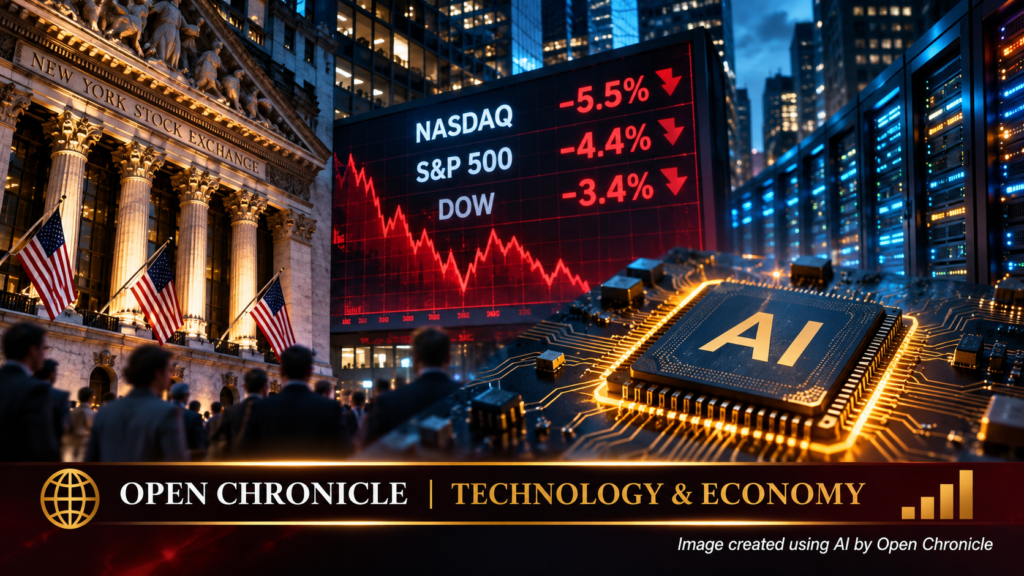
The technology-heavy Nasdaq Composite plunged 5.5% on Thursday, November 5, its sharpest daily decline in approximately 19 months.
The broader S&P 500 fell 4.4%, while the Dow Jones Industrial Average lost more than 1,800 points.
The declines erased nearly $3 trillion in market value from companies in the S&P 500, according to market estimates reported by Reuters.
Semiconductor manufacturers, data centre infrastructure providers and companies supplying equipment for AI systems suffered particularly severe losses.
The selloff spread into Asian markets on Friday, sending major indices sharply lower in Japan, South Korea and Taiwan.
By Friday’s US trading session, however, technology shares were recovering part of their losses.
The rebound provided some relief, but it did not resolve the deeper questions behind the market turmoil.
After years of extraordinary enthusiasm, investors are increasingly asking whether the financial returns from artificial intelligence will justify the unprecedented sums being spent to develop it.
A Historic Selloff Hits Wall Street
Market Snapshot
November 5, 2026 | Wall Street Selloff
Figures refer to the US stock market session of November 5, 2026. The estimated $3 trillion decline represents a reduction in the market capitalisation of S&P 500 companies, not an equivalent amount of cash withdrawn from financial markets or realised investor losses.
OPEN CHRONICLE | TECHNOLOGY & ECONOMY
Financial Market Analysis | November 2026
Thursday’s market declines, based on Associated Press and Reuters reporting. The estimated market-value loss is not a direct cash outflow from the economy.
The scale of the selloff reflected more than a routine decline in technology shares.
For several years, artificial intelligence had been one of the principal drivers of rising stock market valuations.
Investors had rewarded companies involved in semiconductor manufacturing, cloud computing, data centre construction and AI software with increasingly ambitious expectations of future growth.
The assumption was that demand for computing power would continue expanding rapidly as businesses adopted generative AI, automated workflows and increasingly sophisticated machine learning systems.
That expectation helped propel many technology stocks to record levels.
But it also created a vulnerability.
When valuations depend heavily on future growth, even a modest reduction in expectations can produce substantial changes in share prices.
Thursday’s decline demonstrated how quickly confidence can deteriorate when investors begin questioning the assumptions supporting an investment boom.
The Philadelphia Semiconductor Index suffered an especially severe fall, reflecting the importance of chipmakers to the AI investment cycle.
Nvidia declined approximately 9.3%, while Advanced Micro Devices fell around 17.3%.
The losses were not limited to semiconductor companies.
Businesses supplying servers, electrical equipment, cooling systems and other infrastructure for data centres were also affected.
The selloff demonstrated how deeply the AI investment narrative has become embedded across multiple industries.
Why the US Midterm Elections Triggered Market Anxiety
One of the immediate catalysts was the outcome of the November 3 US midterm elections.
Democratic victories raised expectations that Congress and several state governments could adopt a more restrictive approach to artificial intelligence development and data centre construction.
The political debate has increasingly focused on electricity consumption, water use, environmental effects and the economic consequences of large computing facilities.
Communities in several American states have questioned whether the benefits of new data centres justify their demands on local infrastructure.
These concerns became particularly important because a substantial proportion of planned US data centre capacity is concentrated in a relatively small number of states.
According to analysis published by Axios, more than half of planned capacity is located in Ohio, Georgia and Texas.
Democratic victories in those states intensified investor concerns about possible delays to future projects.
However, an important distinction must be made.
The election results did not automatically cancel existing data centre projects.
Nor did they establish that Congress would impose a nationwide prohibition on AI infrastructure.
Some proposed restrictions are limited in scope, while others would require lengthy legislative or regulatory processes.
Nevertheless, financial markets respond not only to enacted policies but also to expectations about future conditions.
The possibility of slower infrastructure development was sufficient to prompt investors to reassess the growth prospects of companies dependent on AI spending.
The Central Question: Who Will Pay for the AI Revolution?
Artificial intelligence requires enormous computing resources.
Training advanced models involves specialised processors, large volumes of data, sophisticated networking equipment and substantial electricity consumption.
Operating those systems at commercial scale creates additional costs.
Technology companies have responded by investing heavily in data centres and the equipment needed to support them.
Microsoft, Amazon, Alphabet, Meta and other major corporations have committed substantial resources to expanding AI infrastructure.
The investments are intended to support future demand for cloud services, AI applications and increasingly powerful models.
But infrastructure spending creates a financial challenge.
Companies must pay for equipment, buildings, electricity and maintenance before they can fully establish the revenues those investments will generate.
In some cases, the expected returns may take years to materialise.
Investors therefore need to assess whether future customer demand will be sufficient to justify current expenditure.
The question is not whether artificial intelligence has practical applications.
It clearly does.
The question is whether the commercial value generated by those applications will be large enough, and arrive quickly enough, to support the industry’s current investment expectations.
Nvidia and the Semiconductor Industry Face a New Reality
The semiconductor industry has been among the greatest beneficiaries of the AI expansion.
Advanced processors are essential for training and operating large AI models.
Demand for high-performance computing has supported extraordinary growth in the market for specialised chips.
Nvidia became one of the most closely watched companies in the global economy because of its central position in this market.
Other semiconductor manufacturers, including AMD and memory suppliers, also benefited from rising investment in computing infrastructure.
However, the industry faces a particular form of risk.
Chip demand depends partly on the pace at which technology companies build new computing capacity.
If data centre projects are delayed, suppliers may experience slower order growth.
This could become especially important for businesses whose valuations assume sustained expansion over several years.
The market reaction on November 5 reflected precisely that concern.
Shares in semiconductor and infrastructure companies declined sharply as investors reconsidered future demand.
Nevertheless, falling share prices do not establish that demand for AI computing has collapsed.
On November 6, several chipmakers recovered part of their losses.
AMD, Intel, Micron and Nvidia all participated in the rebound.
The recovery suggested that some investors continued to see long-term value in the sector despite the political and financial uncertainty.
The Hidden Infrastructure Behind Artificial Intelligence
The AI boom is often discussed in terms of software applications and advanced language models.
Yet the physical infrastructure supporting these systems is becoming one of the most consequential elements of the technology economy.
Modern data centres require electricity, cooling systems, network connections, land and specialised construction.
Their expansion affects industries far beyond software development.
Electrical equipment manufacturers, construction companies, energy providers and industrial engineering businesses have all become increasingly exposed to AI-related investment.
That creates opportunities, but also risks.
When data centre construction accelerates, suppliers may experience rapid growth in orders.
If construction slows, the same companies can face reduced demand.
Thursday’s selloff illustrated this dependence.
Companies providing equipment for data centres suffered significant share-price declines as investors questioned whether the pace of construction could be sustained.
The effects could eventually extend into the wider economy.
Major data centre projects can support employment, construction activity and investment in regional infrastructure.
But they can also place pressure on electricity networks, water resources and local housing markets.
The debate over artificial intelligence is therefore becoming inseparable from broader questions about energy, infrastructure and economic development.
Is This Another Dot-Com Bubble?
Comparisons with the technology boom of the late 1990s have become increasingly common.
During that period, investors poured money into internet-related businesses, often valuing companies according to their expected future growth rather than established profitability.
When confidence collapsed in 2000, many companies failed and technology shares suffered enormous losses.
The internet itself did not disappear.
Instead, the financial crash separated businesses with sustainable commercial models from those unable to justify their valuations.
Artificial intelligence could experience a similar distinction between technological progress and investment performance.
A technology can transform society while still producing disappointing returns for investors who paid excessive prices for the companies developing it.
However, important differences exist between the two periods.
Several of today’s largest AI investors are established corporations with substantial revenues, existing customers and diversified businesses.
Microsoft, Alphabet and Amazon, for example, operate profitable businesses extending well beyond artificial intelligence.
This makes the present situation different from the speculative environment surrounding many early internet companies.
Yet smaller AI infrastructure businesses may face greater financial risks, particularly when their expansion depends on borrowing or continued access to capital markets.
A prolonged decline in investor confidence could make financing more expensive and delay projects.
The appropriate question may therefore be less about whether artificial intelligence is a bubble in its entirety and more about which parts of the investment ecosystem are most vulnerable to unrealistic expectations.
The Risk of Debt-Financed AI Expansion
Another concern involves the increasing use of debt to finance computing infrastructure.
Building advanced data centres requires substantial upfront expenditure.
Some companies can finance that investment through existing cash flow.
Others depend more heavily on external financing.
This creates different levels of financial vulnerability.
A company with strong earnings and substantial cash reserves may be able to continue investing during a market downturn.
A smaller infrastructure provider with significant borrowing requirements may face greater difficulties.
Higher interest rates can intensify those pressures by increasing financing costs.
The situation is particularly challenging when projects depend on revenues expected several years into the future.
If investors begin questioning those projections, lenders may demand more favourable terms or reduce their willingness to finance expansion.
This can create a feedback effect.
Falling confidence makes financing more difficult, which can delay projects and weaken the growth assumptions that originally supported company valuations.
However, the existence of debt does not automatically indicate financial instability.
The risks depend on borrowing terms, cash flow, customer contracts and the commercial viability of individual projects.
A Global Shock: Asia Feels the Consequences
The selloff quickly spread beyond the United States.
On November 6, Japan’s Nikkei index fell approximately 6%, its steepest daily decline since April 2025.
South Korea’s Kospi also suffered substantial losses, while Taiwan’s stock market declined sharply.
These markets are particularly exposed to the global semiconductor and electronics industries.
South Korean companies play major roles in memory production, while Taiwan is central to advanced chip manufacturing.
Japanese businesses supply semiconductor equipment, industrial components and other technologies used throughout the computing industry.
A reduction in expected AI infrastructure investment could therefore affect companies across several countries.
The market reaction illustrates the international nature of the technology supply chain.
Although many leading AI developers are based in the United States, the equipment supporting their operations is manufactured through complex global networks.
The consequences of a slowdown in American data centre construction would not necessarily remain confined to American markets.
Why Technology Stocks Rebounded on November 6
After Thursday’s sharp decline, technology shares recovered some ground during Friday’s trading session.
Reuters reported that the Nasdaq and S&P 500 were moving higher, with semiconductor stocks among the leading gainers.
The recovery reflected several factors.
Some investors considered the previous day’s selling excessive.
Others questioned whether political opposition would actually result in widespread restrictions on AI infrastructure.
There was also recognition that demand for computing power remained substantial, even if the pace of expansion became less predictable.
The rebound did not establish that the correction had ended.
Financial markets frequently experience sharp recoveries during periods of elevated volatility.
Such movements can reflect short-term positioning, changing expectations or investors purchasing shares after significant declines.
The longer-term direction will depend on corporate earnings, investment plans, financing conditions and the regulatory environment.
Could Slower AI Investment Actually Be Healthy?
Not every reduction in infrastructure spending would necessarily be negative.
Periods of rapid technological investment can create inefficiencies.
Companies may build capacity before demand is fully established, purchase equipment at elevated prices or compete aggressively for limited resources.
A more measured pace of expansion could allow businesses to reassess their priorities.
It could also reduce pressure on electricity networks and construction supply chains.
From an economic perspective, slower investment is not necessarily equivalent to technological failure.
The important distinction is between a controlled adjustment and a disorderly collapse in financing.
If companies reduce spending while maintaining viable projects and strong customer demand, the industry could emerge with a more sustainable financial structure.
If investment falls abruptly because financing becomes unavailable, the consequences could be considerably more disruptive.
Both possibilities remain open.
Three Possible Paths for the AI Economy
Three Possible Paths for the AI Economy
Exploring how financial markets, technology investment and infrastructure development could evolve after the November 2026 selloff.
A Healthy Market Correction
Technology shares stabilise as investors distinguish profitable AI businesses from speculative investments. Infrastructure development continues at a more sustainable pace, supported by growing commercial demand.
Slower Growth and Consolidation
Regulatory uncertainty, higher financing costs and infrastructure constraints reduce the pace of expansion. Larger technology companies maintain investment while smaller providers face consolidation and tighter financial conditions.
A Broader AI Investment Collapse
Disappointing revenues and declining confidence trigger project cancellations, financial difficulties and further market losses. The effects spread beyond technology into construction, energy, lending and the wider economy.
These scenarios are Open Chronicle editorial assessments, not predictions of confirmed future outcomes.
OPEN CHRONICLE | TECHNOLOGY & ECONOMY
Market Analysis | November 2026
What Investors and Businesses Should Watch Next
The next phase of the AI investment cycle will depend on several measurable developments.
Corporate earnings will provide evidence of whether AI-related revenue is growing sufficiently to justify expenditure.
Capital investment plans will indicate whether major technology companies intend to maintain, accelerate or reduce infrastructure spending.
Regulatory developments in the United States will help clarify whether political opposition translates into significant restrictions.
Financing conditions will also be important, particularly for smaller companies dependent on external capital.
Another critical factor is the adoption of AI applications by businesses and consumers.
Strong demand for computing infrastructure ultimately needs to be supported by economic activity that creates sustainable revenues.
The distinction between enthusiasm for artificial intelligence and the profitability of the companies developing it will become increasingly important.
The Wider Economic Stakes
The AI investment boom has become a significant influence on financial markets and economic expectations.
Major technology companies account for a substantial share of leading American stock indices.
This means that changes in their valuations can affect retirement funds, investment portfolios and broader market sentiment.
Large infrastructure projects also influence employment, energy demand and industrial investment.
A prolonged downturn could therefore have consequences extending beyond technology shareholders.
However, the scale of those consequences remains uncertain.
The market declines of November 5 were substantial, but a single trading session cannot establish the beginning of a prolonged financial crisis.
The partial recovery on November 6 demonstrates that investor expectations remain fluid.
The central challenge is determining whether the industry is experiencing a temporary reassessment or a more fundamental change in its growth prospects.
Conclusion | The AI Revolution Faces Its Financial Test
Artificial intelligence remains one of the most important technological developments of the modern era.
Its potential applications extend across healthcare, scientific research, manufacturing, education, communications and countless other sectors.
But technological importance does not guarantee unlimited financial returns.
The market turmoil of November 2026 has exposed a growing tension between the extraordinary promises surrounding artificial intelligence and the enormous costs required to fulfil them.
Investors are beginning to demand clearer evidence that the infrastructure being constructed today will generate sustainable profits tomorrow.
The political environment has added another layer of uncertainty, particularly as governments and communities reconsider the consequences of rapid data centre expansion.
The recovery in technology shares on November 6 suggests that confidence has not disappeared.
Nevertheless, the questions raised by the selloff are unlikely to vanish quickly.
The AI revolution may continue transforming the world, even if the financial expectations surrounding it undergo a painful correction.
The coming months will help determine whether November’s market turbulence represents a temporary adjustment, a turning point in the investment cycle or the beginning of a much deeper reassessment of the economics of artificial intelligence.
Sources and Further Reading
1. Reuters | Stocks Tumble as AI Panic Sweeps Markets
International market reporting on the technology selloff, its spread into Asian markets and concerns about artificial intelligence regulation and data centre investment.
2. Associated Press | A Brutal Selloff for AI Stocks Sends Wall Street Reeling
Detailed coverage of the November 5 market decline, including the Nasdaq, S&P 500, Dow Jones and individual technology stocks.
3. Axios | It’s Going to Be Tough to Tap the Brakes on the AI Race
Analysis of the political pressures affecting AI infrastructure, the concentration of planned data centre capacity and historical comparisons with investment booms.
4. Reuters | Wall Street Stocks in Relief Rally After Heavy AI-Related Selloff
Reporting on the partial recovery of US technology stocks following Thursday’s market decline, including movements in semiconductor shares.
Editorial Note
This article was prepared on November 6, 2026, using financial market reporting and published analysis available on that date.
Market percentage changes refer to specified trading sessions. Estimates of market capitalisation losses describe changes in the market value of listed companies, not equivalent cash withdrawals or realised investor losses.
Discussion of an AI investment bubble, possible regulatory consequences and future economic scenarios constitutes editorial analysis. The existence of a financial bubble or a sustained market collapse has not been established.