
OPEN CHRONICLE | INTERNATIONAL NEWS | MIDDLE EAST
Saudi-led coalition forces report intercepting a series of missiles launched towards the kingdom, including ballistic missiles targeting the capital and the strategically important Eastern Province. The latest attacks raise concerns about regional security, critical energy infrastructure and aviation operations.
By Open Chronicle News Desk
November 8, 2026 | Riyadh, Saudi Arabia
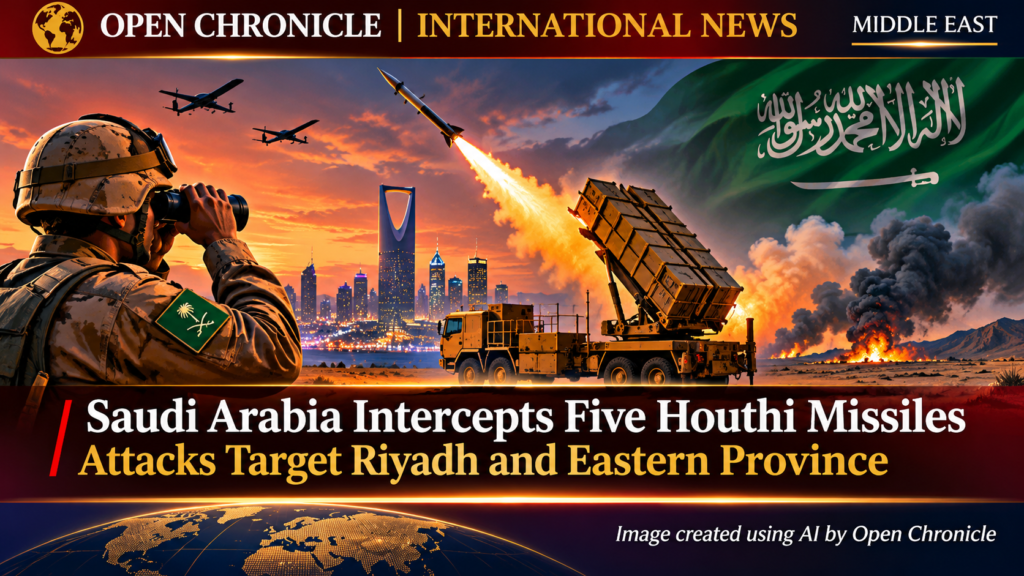
Saudi Arabia’s air defence forces intercepted and destroyed five missiles launched towards several locations across the kingdom on Sunday, according to the Coalition to Support Legitimacy in Yemen, as a new wave of reported attacks heightened security concerns across the Arabian Peninsula.
The Saudi-led coalition said the missiles were detected during successive strikes that began in the early hours of November 8, with Riyadh and the Eastern Province among the areas targeted.
Brigadier General Turki Al-Maliki, the coalition’s official spokesperson, announced that Saudi air defence systems had intercepted two ballistic missiles heading towards Riyadh, preventing them from reaching their intended targets.
An earlier coalition statement reported the interception of another ballistic missile directed towards the Eastern Province, home to some of Saudi Arabia’s most important oil production, refining and industrial facilities.
The coalition reported five successful interceptions in total. However, the information supplied for this report identifies the destinations of three missiles and does not establish the precise targets of the remaining two.
Saudi authorities subsequently indicated that the immediate danger had passed following the activation of early warning systems in Riyadh and the southern Najran region.
The Houthis had not formally claimed responsibility for Sunday’s reported missile launches at the time of the initial announcements.
Riyadh and Eastern Province targeted in successive attacks
The reported strikes underline the continuing threat posed by long-range missile attacks against Saudi Arabia.
According to the coalition, the Royal Saudi Air Force and air defence units detected two ballistic missiles travelling towards Riyadh and destroyed them before impact.
The capital is the kingdom’s political and administrative centre, housing major government institutions, diplomatic missions, commercial districts and critical infrastructure.
A successful missile strike on Riyadh could have consequences extending beyond immediate physical damage, potentially disrupting government operations, commercial activity and public confidence.
The Eastern Province represents an equally sensitive target because of its economic significance.
The coalition said another ballistic missile was intercepted while approaching the region, although the intended target was not publicly identified in the information provided.
Saudi officials described the interceptions as evidence of the effectiveness of the country’s defensive systems.
Nevertheless, the latest incidents illustrate the continuing challenge of protecting large geographical areas against repeated missile and drone attacks.
Why Saudi Arabia’s Eastern Province matters
The Eastern Province is one of the most economically important regions in the Middle East.
Stretching along Saudi Arabia’s Gulf coastline, it contains major population centres, industrial complexes, ports and energy infrastructure.
Dammam serves as an important administrative and commercial centre, while Jubail is home to extensive petrochemical and industrial operations.
Al-Ahsa, Qatif and Hafar Al-Batin are also strategically significant communities within the wider region.
The province’s importance extends well beyond Saudi Arabia’s borders.
Saudi energy production and processing facilities are closely connected to international oil markets, making the security of the region a matter of global economic concern.
Even unsuccessful attacks can generate uncertainty among shipping operators, investors, insurers and companies dependent on regional energy supplies.
However, the reported missile interceptions do not establish that oil installations were damaged or that production was disrupted.
No such damage was confirmed in the material supplied for this article.
Houthi claims of earlier large-scale operations
Although the Houthi movement had not issued a direct claim of responsibility for Sunday’s reported attacks, it announced on Saturday that it had conducted six major military operations against Saudi targets.
According to the group’s statements, the operations involved ballistic missiles, cruise missiles and unmanned aerial vehicles.
Houthi representatives claimed to have targeted military bases, oil facilities and other strategically important locations deep inside Saudi territory.
Those claims have not been independently verified in the information available for this report.
The distinction is important because statements issued by parties involved in armed conflict may describe intended targets, claimed successes or operational objectives without providing independently verifiable evidence of the results.
The reported sequence of attacks nevertheless suggests continued pressure on Saudi defensive capabilities.
The combination of ballistic missiles, cruise missiles and drones presents different detection and interception challenges.
Ballistic missiles can travel at high speeds and follow steep trajectories, while cruise missiles may operate at lower altitudes. Drones can also be employed in larger numbers or from multiple directions.
Defending against such threats requires integrated surveillance, early warning systems and several layers of air defence.
Aviation concerns at King Fahd International Airport
Reports circulating through news platforms and social media suggested that air traffic at King Fahd International Airport in Dammam had been temporarily suspended.
The claims reportedly originated from observations of aircraft movements on Flightradar24, a commercial flight tracking platform.
However, no official statement from the airport operator or Saudi aviation authorities was included in the information available for this article.
Consequently, the reported suspension cannot be treated as confirmed.
Changes visible on flight tracking platforms may result from several factors, including temporary airspace restrictions, operational decisions, weather conditions or limitations in tracking data.
Confirmation would require an announcement from the relevant aviation authorities or airport management.
The reports nevertheless illustrate how missile alerts can affect perceptions of aviation safety, even when defensive systems successfully intercept incoming threats.
King Fahd International Airport is an important gateway for the Eastern Province and serves domestic and international passenger traffic.
Any prolonged disruption could affect regional business activity, passenger travel and logistical operations.
A wider regional security challenge
The reported attacks come amid heightened tensions involving Iran, the United States, Saudi Arabia and armed groups operating across the Middle East.
The Houthis have developed missile and drone capabilities that allow them to threaten targets beyond Yemen’s borders.
Their military activities have also contributed to concerns about maritime security and the vulnerability of strategic infrastructure.
For Saudi Arabia, the immediate priority is protecting population centres, industrial facilities and essential services.
Repeated missile alerts also create a broader security challenge.
Even when missiles are intercepted, defensive operations consume resources and can require temporary restrictions on aviation, transportation and other activities.
The economic consequences depend on the frequency of attacks, the effectiveness of defensive systems and whether critical infrastructure sustains damage.
The reported interceptions on November 8 therefore represent more than an isolated military incident.
They form part of a wider regional confrontation in which missiles, drones, maritime restrictions and economic pressure are increasingly interconnected.
Can air defences prevent further escalation?
Saudi Arabia has invested extensively in air defence capabilities to protect major cities, military facilities and energy infrastructure.
The coalition’s account of Sunday’s operations indicates that defensive systems successfully intercepted the missiles it reported.
However, individual interception announcements do not provide a complete assessment of national air defence readiness.
Important unanswered questions include the types of missiles used, their launch locations, intended targets and whether additional projectiles were detected.
The coalition’s initial statements also do not establish whether the latest attacks caused secondary damage or operational disruption.
A more complete assessment will depend on further official information and independent evidence.
The immediate security concern is whether successive attacks will continue and whether the confrontation could expand to include additional military or economic targets.
Conclusion | Successful interceptions, continuing uncertainty
Saudi Arabia’s reported interception of five missiles on November 8 demonstrates the continuing importance of air defence in protecting the kingdom’s cities and strategic infrastructure.
According to the Saudi-led coalition, two ballistic missiles were destroyed while approaching Riyadh, with another intercepted towards the Eastern Province.
The reported activation of warning systems in Riyadh and Najran highlights the geographical scope of the security response.
Although the Houthis had not directly claimed Sunday’s launches, their announcement of earlier missile and drone operations provides important context for the latest developments.
Questions remain about the intended targets of all five missiles, the operational consequences of the alerts and reports of possible aviation disruption in Dammam.
For Saudi Arabia, the central challenge is maintaining effective protection against repeated attacks while limiting the risks of wider regional escalation.
For international markets and neighbouring countries, the security of Saudi energy infrastructure and major transport routes remains a critical concern.
Open Chronicle will continue monitoring developments in Saudi Arabia, Yemen and the wider Middle East as additional information becomes available.
Atualização da verificação editorial
A pesquisa confirmou os cinco mísseis intercetados e permitiu identificar os dois que faltavam no texto inicial: três mísseis balísticos e dois mísseis de cruzeiro. Os alvos comunicados foram Riade, a Província Oriental e a região sul da Arábia Saudita.
Há ainda uma informação importante para acrescentar ao artigo antes da publicação.
Additional development | Aramco building damaged by falling debris
Saudi Arabia’s Energy Ministry reported that falling debris from an attempted attack damaged an administrative building belonging to state oil company Saudi Aramco in Riyadh.
According to the ministry, the damage was limited and no fatalities or injuries were reported.
The incident demonstrates that even successfully intercepted missiles can create risks on the ground when fragments fall over populated or commercially important areas.
The reported damage concerned an administrative building in Riyadh. It should not be confused with a confirmed attack on oil production facilities in the Eastern Province.
The latest escalation also follows Saudi-led airstrikes near Sanaa. Yemen’s Houthi-run health ministry reported at least 33 deaths, a figure that has not been independently verified. Saudi authorities said they were investigating the reported strikes.
Sources and Further Reading
1. Qatar News Agency | Saudi Missile Interceptions
November 8, 2026. Official coalition statements confirming the interception of ballistic and cruise missiles targeting Riyadh, the Eastern Province and southern Saudi Arabia.
2. Reuters | Saudi Civil Defence Alerts
November 8, 2026. Reporting on emergency warnings and subsequent all-clear notifications across Saudi Arabia’s Eastern Province.
3. Reuters | Aramco Building Damaged in Riyadh
November 8, 2026. Reporting on limited damage caused by falling debris at an Aramco administrative building, with no casualties reported.
4. Al Jazeera | Yemen Conflict and Regional Escalation
November 8, 2026. Coverage of the missile interceptions, Houthi military claims and reported casualties following coalition strikes near Sanaa.
Editorial Note
This article is based on statements from the Saudi-led coalition and reporting published on November 8, 2026. The five reported interceptions comprise three ballistic missiles and two cruise missiles.
Missile interception claims are attributed to Saudi authorities. Reported Houthi operations and casualty figures from Yemen are separately attributed and have not all been independently verified.
Reports of disruption at King Fahd International Airport remain unconfirmed in the sources reviewed. Limited damage to an Aramco administrative building in Riyadh was subsequently reported by Saudi authorities.