
OPEN CHRONICLE | US NEWS | ECONOMY & POLITICS
After a midterm election shaped by frustration over inflation, both parties face pressure to make everyday life more affordable. But lowering inflation is not the same as reversing years of rising prices, and the economic choices ahead could prove more difficult than the campaign promises.
By Open Chronicle News Desk
November 8, 2026 | Washington, D.C.
For millions of Americans, the message of the 2026 midterm elections was not complicated: everyday life has become too expensive.
From supermarket aisles and gas stations to monthly rent payments, health insurance and electricity bills, households have been confronting financial pressures that economic statistics alone cannot fully capture.
The November 3 elections handed Democrats control of Congress, according to the latest election reporting, creating a new political balance in Washington and placing both parties under pressure to address the cost of living.
Yet the central question is whether either party can deliver the financial relief voters are demanding.
President Donald Trump has indicated a willingness to cooperate with Democrats on certain economic issues, while also making clear that he will oppose legislation he considers unacceptable.
Democratic leaders, meanwhile, must demonstrate that their congressional victories can produce tangible improvements for households rather than another period of political confrontation.
The challenge is considerable.
Inflation remains above the Federal Reserve’s long-term target, energy prices have risen sharply, and the federal government continues to operate with substantial budget deficits.
Even if inflation slows, many of the price increases Americans have experienced over recent years are unlikely to disappear.
That distinction could determine whether voters eventually feel that Washington has delivered on its promises.
The election was about more than politics
The 2026 midterms were shaped by dissatisfaction with the country’s economic direction.
According to the Associated Press Voter Poll, approximately nine in ten voters described the cost of living as a crucial or major factor in their congressional vote.
Among those voters, roughly six in ten supported Democratic candidates in their local House races.
The survey, involving more than 100,000 voters, also found widespread concern about the economic consequences of the administration’s policies.
Approximately two-thirds of respondents attributed at least some of the inflationary pressure to President Trump’s policies.
These findings reflect voter perceptions rather than a complete economic assessment of the causes of inflation.
Nevertheless, they help explain why economic issues played such a prominent role in the election.
The results indicate that many voters were evaluating political leadership through their personal financial circumstances.
A family struggling to pay rent may be less interested in stock market performance than in whether its monthly housing costs are manageable.
A worker commuting long distances may judge the economy primarily through gasoline prices.
A retired couple may be more concerned about healthcare expenses, utility bills and the purchasing power of fixed income.
For these households, national economic growth does not necessarily translate into financial security.
Inflation is still running above the Federal Reserve’s target
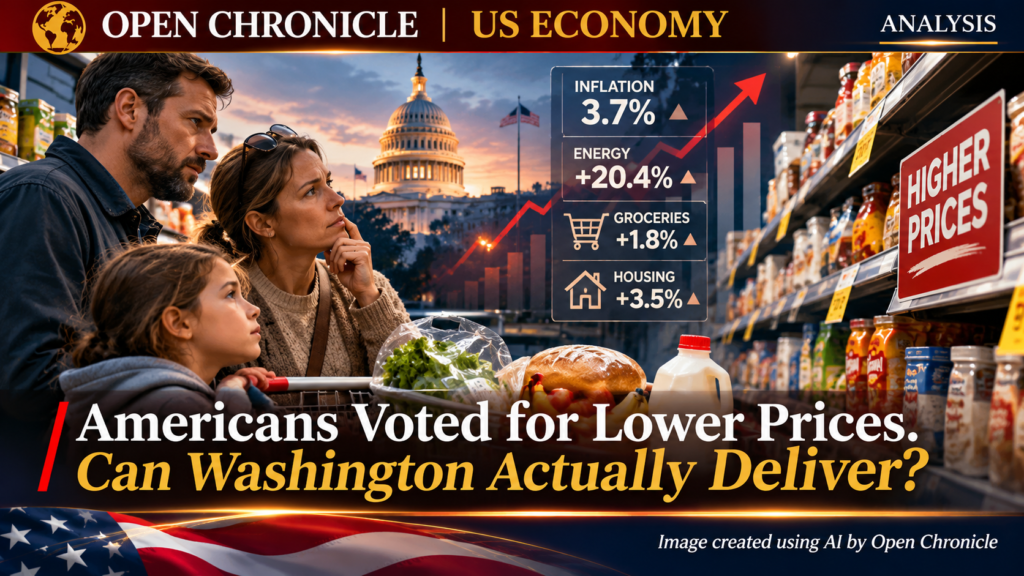
The latest available official figures show that US consumer prices rose 3.7% over the twelve months ending in September 2026.
That was an acceleration from the 3.4% annual rate recorded in August.
On a monthly basis, the Consumer Price Index increased 0.6% in September after seasonal adjustment.
The figures illustrate the persistence of inflationary pressure despite previous efforts to stabilise prices.
Energy was a particularly important contributor.
The energy price index increased 20.4% over the year, while gasoline prices rose 34.2%.
Food prices increased more moderately, although households continued to face higher costs across several essential categories.
The index for food purchased at grocery stores rose 1.8% annually, while restaurant food prices increased 3.5%.
Shelter costs also remained an important component of inflation.
The Federal Reserve’s long-term inflation objective is 2%, measured using the Personal Consumption Expenditures price index rather than the Consumer Price Index.
The distinction matters because the two indicators use different methodologies and do not always move at the same rate.
Nevertheless, the September CPI figures demonstrate that price stability has not yet been fully restored.
The October inflation report is scheduled for November 10 and could provide further evidence about whether price pressures are easing or intensifying.
Why lower inflation does not mean lower prices
One of the greatest challenges facing policymakers is the difference between reducing inflation and actually reducing prices.
Inflation measures the rate at which prices increase.
When inflation falls from 4% to 2%, prices are generally still rising, but more slowly.
For households hoping to see supermarket bills return to previous levels, that distinction can be frustrating.
Consider a simple illustration.
ILLUSTRATIVE HOUSEHOLD COST
Starting bill
$100
After 10% inflation
$110
Then 2% inflation
$112.20
Hypothetical example, not a measurement of actual US household spending.
The inflation rate has fallen substantially in this example, but the final bill is still higher than before.
To reverse an earlier price increase, prices would have to decline.
Economists describe a broad decline in the overall price level as deflation.
Although falling prices may sound attractive to consumers, sustained economy-wide deflation can create serious problems, particularly if it leads businesses to reduce investment, cut wages or postpone hiring.
Consequently, the usual objective of monetary policy is not to restore every price to its previous level.
It is to achieve low and stable inflation while allowing wages and incomes to grow.
For Americans, meaningful relief may therefore depend as much on stronger purchasing power as on slower price increases.
Energy prices are complicating the recovery
Energy has become one of the most significant sources of inflationary pressure in the United States.
The September increase in gasoline prices was particularly sharp.
According to the Bureau of Labor Statistics, gasoline rose 9.1% during the month and 34.2% over the previous twelve months.
These increases have consequences beyond the amount motorists pay at the pump.
Fuel costs affect freight transportation, agricultural production, airline operations and the distribution of consumer goods.
Businesses may absorb some of those costs, but others can be passed on to customers.
The conflict involving Iran has added uncertainty to global energy markets, creating concerns about oil production, shipping routes and regional infrastructure.
However, international oil prices are influenced by multiple factors, including supply decisions, inventories, demand expectations and geopolitical risks.
It would therefore be misleading to attribute every increase in American gasoline prices to a single political decision or military event.
For policymakers, the challenge is that global energy markets cannot be controlled entirely from Washington.
Domestic production, strategic reserves and energy infrastructure can influence supply conditions, but international developments continue to affect prices.
Tariffs and the cost of imported goods
Trade policy has become another major point of economic disagreement.
President Trump has defended tariffs as a means of protecting American industry, encouraging domestic production and strengthening the country’s negotiating position.
Supporters argue that tariffs can help counter unfair trade practices and reduce dependence on foreign suppliers.
Critics warn that import duties can increase costs for American businesses and consumers.
A tariff is generally paid by the importer, although its ultimate economic burden may be distributed among importers, foreign suppliers, retailers and consumers.
The extent to which prices rise depends on market conditions, competition, exchange rates and the availability of alternative suppliers.
Tariffs can also create uncertainty for companies planning investment or managing international supply chains.
For consumers, the consequences may appear in the prices of clothing, electronics, vehicles, machinery and other goods.
The central policy question is whether the potential industrial benefits justify the additional costs.
There is no single answer applicable to every industry.
The effects depend on the products involved, the structure of supply chains and the duration of the measures.
Can Congress actually make life cheaper?
The election has changed the political balance in Washington, but it has not removed the institutional constraints on economic policymaking.
Congress can influence taxation, public spending, trade legislation, healthcare policy and investment incentives.
The president retains significant executive powers and the ability to veto legislation.
The Federal Reserve, meanwhile, operates independently in setting monetary policy.
This division of responsibility means that no single institution can guarantee lower consumer prices.
Several policy approaches are likely to remain central to the debate.
Reducing the federal deficit
The United States continues to borrow heavily to finance federal operations.
According to the Associated Press, annual federal borrowing is approximately $2 trillion, while interest costs on government debt have exceeded $1 trillion.
Large deficits can contribute to inflationary pressure under certain economic conditions, particularly when government demand adds to an economy already facing supply constraints.
Reducing deficits could help improve long-term fiscal sustainability.
However, deficit reduction usually requires difficult choices involving spending, taxation or both.
Cuts to public programmes can affect household finances, while tax increases may reduce disposable income or investment incentives.
The economic consequences depend on how measures are designed and when they are introduced.
Making healthcare more affordable
Healthcare remains a major financial concern for American households.
Insurance premiums, deductibles, prescription drugs and out-of-pocket medical expenses can place substantial pressure on family budgets.
Congress could consider changes to insurance subsidies, pharmaceutical pricing, competition and healthcare delivery.
Some reforms might reduce costs for patients while shifting expenses to government budgets, insurers or providers.
Others could generate efficiency gains over time.
The challenge is designing policies that improve affordability without undermining access to care or creating unsustainable fiscal commitments.
Increasing housing supply
Housing affordability is closely connected to construction costs, local regulations, mortgage rates and the availability of homes.
Federal policies can influence financing and incentives, but zoning decisions and land-use rules are often controlled by state and local governments.
Increasing housing supply may help moderate rent and home price growth over time.
However, construction takes years, and additional supply does not necessarily produce immediate reductions in housing costs.
For many families, the affordability problem also depends on whether wages grow quickly enough to keep pace with housing expenses.
Supporting productivity and wage growth
Long-term improvements in living standards depend partly on productivity.
When workers and businesses can produce more goods and services efficiently, the economy may support higher real wages without generating equivalent inflationary pressure.
Investment in infrastructure, education, technology and workforce training can contribute to productivity growth.
Yet the benefits may take years to materialise and may not be distributed evenly.
For voters expecting immediate relief, long-term economic strategies can be politically difficult to communicate.
The Federal Reserve faces a difficult balancing act
The Federal Reserve has an important role in determining how quickly inflation returns towards its target.
Higher interest rates can reduce inflationary pressure by making borrowing more expensive and moderating demand.
But restrictive monetary policy also has consequences.
Businesses may postpone investment, homebuyers may struggle with mortgage payments, and consumers may reduce spending.
If economic activity slows too sharply, unemployment could increase.
The latest employment report showed that the US economy added 165,000 jobs in October, while the unemployment rate stood at 4.1%.
Those figures suggest that the labour market continues to generate employment, although they do not eliminate concerns about uneven economic conditions.
For the Federal Reserve, the challenge is achieving price stability without causing an unnecessary economic downturn.
Political pressure may intensify if voters demand immediate reductions in borrowing costs.
However, lowering interest rates before inflation is sufficiently contained could risk renewed price increases.
That tension makes the central bank an important institution in the debate over affordability.
Why Americans may not feel better even when economic indicators improve
The American economy is not experienced equally across households.
A homeowner with a fixed-rate mortgage may be relatively protected from changes in housing financing costs.
A first-time buyer, by contrast, may face high property prices and expensive borrowing.
Higher-income households may benefit from financial market gains, while families with limited savings may remain vulnerable to increases in essential expenses.
Geography also matters.
Housing costs, state taxes, transportation expenses and wages vary substantially between metropolitan areas and rural communities.
The national inflation rate therefore cannot fully describe the financial pressures experienced by every household.
There is also a difference between nominal wages and real wages.
Nominal wages represent the amount workers receive.
Real wages measure their purchasing power after accounting for inflation.
If wages increase by 3% while consumer prices rise by 4%, workers experience a decline in real purchasing power.
Conversely, wages rising faster than inflation can improve affordability even when prices continue to increase.
This is why economic recovery cannot be judged solely through the Consumer Price Index.
Employment, wages, household debt, housing costs and access to essential services all matter.
The political challenge for Republicans and Democrats
The election results have created a new test for both major parties.
Republicans must respond to voters’ concerns about inflation while defending the economic policies pursued by the administration.
Democrats must demonstrate that their congressional majority can contribute to practical solutions.
The two parties differ on taxation, trade, public spending, regulation and the role of government.
Those differences could make bipartisan legislation difficult.
Nevertheless, some areas may offer opportunities for cooperation, particularly where proposals address widely shared concerns about healthcare, infrastructure or economic competitiveness.
The risk is that political negotiations become focused on assigning responsibility for inflation rather than identifying workable solutions.
Voters may judge both parties by the results.
But those results will also depend on economic conditions that neither party can fully control, including global energy markets, technological change and monetary policy.
What Americans should watch next
US ECONOMIC WATCH | NOVEMBER 2026
November 10
October Consumer Price Index release
Federal Reserve
Inflation outlook, interest rates and labour market developments
Congress and White House
Budget negotiations, tax policy, healthcare and trade proposals
Household purchasing power
Real wages, energy bills, housing costs and consumer spending
The October inflation report will be particularly important because it will provide the first new national CPI reading following the midterm elections.
However, a single monthly report cannot establish a lasting change in the inflation trend.
A sustained improvement would require several months of evidence showing that price pressures are easing while employment and household incomes remain resilient.
Conclusion | The real test begins after the election
Americans have delivered a clear message about their financial concerns.
The cost of living remains central to how many voters assess the economy and the political leadership responsible for managing it.
But the expectation of lower prices presents a difficult challenge.
Inflation can slow without reversing earlier price increases. Energy costs remain vulnerable to international events. Housing affordability depends on long-term supply constraints, while healthcare and federal spending involve difficult political choices.
Neither party can resolve all these pressures through a single law or executive order.
The most meaningful improvements may come from a combination of stable inflation, rising real wages, greater housing availability, more efficient public services and sustainable economic growth.
For Washington, the challenge is converting electoral promises into measurable economic results.
For American households, the question is simpler.
Will the next trip to the supermarket, the next electricity bill or the next monthly mortgage payment finally become easier to afford?
That is the test against which many voters are likely to measure the country’s economic progress.
Open Chronicle will continue examining the economic consequences of the 2026 midterm elections, with particular attention to inflation, household purchasing power, federal policy and the financial pressures facing American families.
Sources and Further Reading
1. Associated Press | Voters Demanded Economic Relief
November 8, 2026. Analysis of the economic choices facing President Trump and the Democratic-controlled Congress, including inflation, federal deficits, healthcare and Social Security.
2. US Bureau of Labor Statistics | September 2026 CPI
Official Consumer Price Index release documenting annual inflation of 3.7%, energy inflation of 20.4% and gasoline inflation of 34.2%.
3. Associated Press | Midterm Voter Poll
November 5, 2026. Analysis of voter attitudes towards inflation, tariffs, household finances and the economic policies of the Trump administration.
4. US Bureau of Labor Statistics | Employment and Economic Indicators
Official releases covering employment, unemployment, wages, productivity and the broader economic environment in October and November 2026.
Editorial Note
This article combines official US economic statistics, election survey findings and independent economic analysis available as of November 8, 2026.
Survey findings represent the responses of participating voters and should not be interpreted as definitive proof of the causes of inflation. Economic policy effects are discussed with reference to established mechanisms and relevant uncertainty.
The October 2026 Consumer Price Index had not yet been released at the time of publication. The next official report is scheduled for November 10, 2026.