
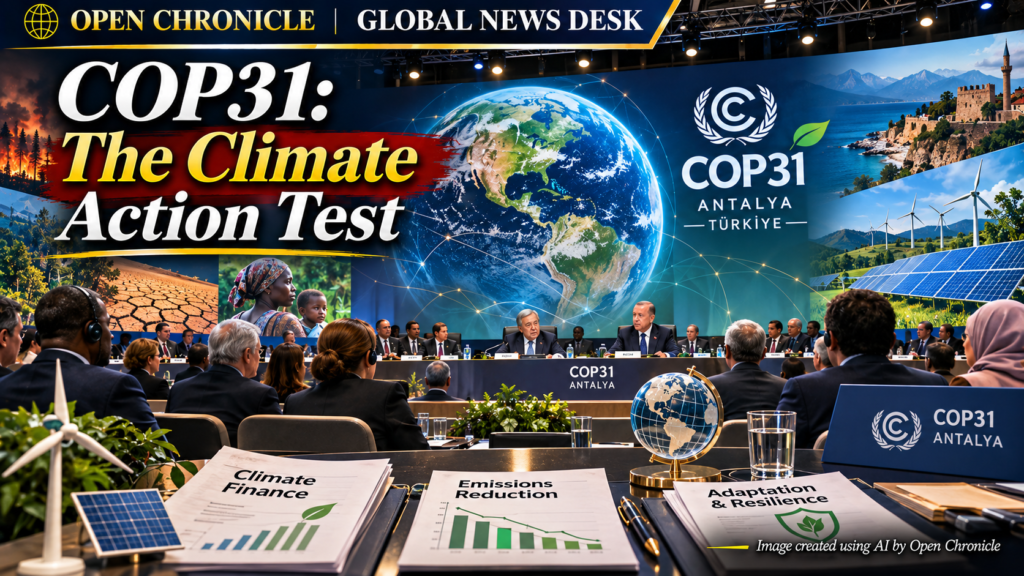
OPEN CHRONICLE | GLOBAL NEWS DESK | CLIMATE & ENVIRONMENT
The United Nations climate summit enters a decisive phase as governments confront the widening gap between climate promises and implementation. Financing adaptation, protecting vulnerable countries and accelerating the energy transition are at the center of the debate.
By Open Chronicle News Desk
November 12, 2026 | Special Report
Introduction | A climate summit confronting the limits of political promises
World leaders gathering in Antalya, Türkiye, for the United Nations COP31 climate conference face an increasingly difficult question: can international climate diplomacy still deliver meaningful progress when global action is failing to keep pace with the accelerating consequences of climate change?
The summit, taking place from November 9 to 20, brings governments, international organizations, financial institutions and civil society representatives together to negotiate the next phase of global climate cooperation.
But the political atmosphere is markedly different from the optimism that accompanied the adoption of the Paris Agreement in 2015.
Eleven years later, the international community is confronting persistent greenhouse gas emissions, intensifying climate impacts and growing disagreements over who should finance the transition.
The challenge is no longer simply convincing governments to announce ambitious targets.
It is ensuring that those targets translate into investments, infrastructure, legislation and measurable emissions reductions.
The Antalya negotiations are taking place against a troubling scientific backdrop.
A new assessment by Climate Action Tracker indicates that global climate action has made little progress over the past five years. Even if current national commitments are fully implemented, the world could still experience approximately 2.6°C of warming by the end of the century.
For countries already facing devastating storms, droughts, coastal erosion and extreme heat, such projections are not abstract warnings about the distant future.
They represent threats to infrastructure, food security, economic stability and, in some cases, national survival.
COP31 is therefore becoming a test of whether the international climate system can move from promises to implementation.
1. Antalya becomes the center of global climate diplomacy
Türkiye is hosting COP31 in the Mediterranean city of Antalya, with Australia presiding over the negotiations under the conference’s unusual shared leadership arrangement.
The Antalya Leaders’ Summit is being held on November 11 and 12 under the theme Towards a Sustainable, Resilient and Equitable Future.
The opening brought together national leaders and senior international representatives, including Turkish President Recep Tayyip Erdoğan and United Nations Secretary General António Guterres.
The second day of the leaders’ summit includes national statements, bilateral meetings and discussions on climate finance, energy infrastructure and adaptation.
Among the official sessions scheduled for November 12 are discussions on the second decade of the Paris Agreement, access to climate finance, urban resilience, clean cooking in Africa and the security of electricity grids.
These subjects reveal an important shift in international climate diplomacy.
The debate is increasingly focused on the practical requirements of decarbonization.
Countries need electricity networks capable of supporting renewable energy.
Cities need infrastructure resilient to extreme weather.
Farmers need access to water management technologies.
Developing economies need investment without becoming trapped in unsustainable debt.
And governments need credible mechanisms for measuring whether their climate policies are producing results.
The summit’s political significance will depend on whether these discussions generate concrete commitments rather than another collection of declarations.
2. The Paris Agreement enters its second decade
The Paris Agreement established the international objective of holding global warming well below 2°C above preindustrial levels while pursuing efforts to limit the increase to 1.5°C.
Its central mechanism requires countries to submit and progressively strengthen national climate plans, known as Nationally Determined Contributions.
These plans describe how governments intend to reduce emissions and respond to climate impacts.
The system depends heavily on national implementation.
There is no single global authority capable of compelling every country to meet its emissions commitments.
Instead, the agreement relies on transparency, periodic assessments, international cooperation and political pressure to encourage stronger action.
This structure has allowed nearly universal participation.
But it also creates a fundamental weakness.
A government can announce ambitious targets without necessarily adopting policies sufficient to achieve them.
Long-term commitments may extend far beyond the political terms of the leaders who announce them.
Economic crises, energy security concerns and changes in government can disrupt implementation.
As COP31 examines the next decade of the Paris Agreement, the central question is whether the existing framework can generate faster emissions reductions.
The challenge is especially urgent because cumulative greenhouse gas emissions determine the extent of future warming.
Delaying reductions increases the difficulty and cost of meeting long-term temperature goals.
3. Climate finance emerges as the summit’s defining dispute
Financing is one of the most politically sensitive issues in Antalya.
Developing countries argue that they cannot be expected to accelerate decarbonization and adapt to climate impacts without substantially greater international financial support.
Many face competing demands on limited public budgets.
They must finance healthcare, education, infrastructure and economic development while simultaneously confronting droughts, floods, rising temperatures and increasingly destructive storms.
Climate investment is often particularly difficult to mobilize in countries with high borrowing costs or limited access to international capital markets.
Private investors may hesitate to finance projects where political, currency or regulatory risks are considered significant.
Public finance can help reduce those risks, but the available resources remain insufficient.
The negotiations therefore involve several interconnected questions.
How much additional finance should be mobilized?
Which countries should contribute?
How much support should come through grants rather than loans?
How should funds be divided between emissions reduction and adaptation?
And how can governments demonstrate that promised financing has actually reached the communities that need it?
The Organisation for Economic Co-operation and Development has identified finance as one of the central negotiating tracks at COP31, alongside mitigation, adaptation, just transition and the next global stocktake.
A particularly sensitive issue concerns the call to at least triple adaptation finance by 2035.
Countries remain divided over how that objective should be advanced and monitored.
The debate is not simply about the total amount of money announced.
It concerns the quality, accessibility and effectiveness of the financing provided.
4. Vulnerable nations warn that climate change threatens their survival
For small island states and highly exposed developing countries, climate change is already a question of national security.
At COP31, leaders from vulnerable countries have warned that rising seas, extreme weather and environmental degradation threaten homes, infrastructure, food supplies and economic livelihoods.
Island states face particularly difficult choices.
They contribute relatively little to historical global greenhouse gas emissions but can experience disproportionately severe consequences.
Coastal communities may require expensive protective infrastructure.
Freshwater supplies can become increasingly vulnerable to saltwater intrusion.
Tourism and fisheries, important sources of national income, may be disrupted.
In extreme cases, rising sea levels create questions about the long-term habitability of inhabited islands.
Representatives of countries including Seychelles, Niue and the Marshall Islands have called for stronger financial support and more ambitious emissions reductions.
Their arguments extend beyond conventional development assistance.
They emphasize that countries suffering severe climate damage should not automatically be forced to take on additional debt to respond to a crisis they did relatively little to create.
This issue is closely connected to international discussions about loss and damage.
Adaptation seeks to reduce vulnerability to climate impacts.
Loss and damage addresses consequences that cannot be fully avoided through adaptation.
Both require financing, but they respond to different dimensions of the climate crisis.
For vulnerable states, meaningful progress at COP31 would involve clearer access to resources, stronger commitments and mechanisms capable of delivering assistance without excessive administrative barriers.
5. A warning that the 1.5°C objective is slipping further away
The scientific context surrounding COP31 is increasingly difficult.
Climate Action Tracker’s latest assessment indicates that global climate policy has stagnated over recent years.
The analysis suggests that current national commitments remain insufficient to keep warming within the Paris Agreement’s most ambitious temperature objective.
The projected warming level of approximately 2.6°C by 2100, assuming current pledges are fulfilled, illustrates the scale of the remaining gap.
That figure is a modeled projection, not a prediction that the future is predetermined.
Different assumptions about policies, technology, economic development and emissions pathways can produce different outcomes.
Nevertheless, the assessment reinforces a consistent conclusion from climate research.
Existing commitments do not yet add up to the emissions reductions required to meet the Paris temperature goals.
The distinction between 1.5°C and higher levels of warming is consequential.
Additional warming increases risks associated with extreme heat, heavy precipitation, drought, biodiversity loss and coastal flooding.
Some climate impacts may become more difficult or impossible to reverse.
The challenge is not simply reaching a long-term net-zero target.
It is reducing emissions sufficiently during the coming years to limit the total amount of greenhouse gases entering the atmosphere.
For negotiators in Antalya, this creates an uncomfortable reality.
The international climate framework remains in place, but the pace of implementation is still inadequate.
6. Adaptation becomes a central measure of climate progress
For many countries, adaptation is no longer a secondary climate policy.
It is a fundamental requirement for protecting economic development and human lives.
Adaptation includes strengthening infrastructure against floods, improving drought management, protecting coastlines, preparing healthcare systems for extreme heat and developing agricultural practices suited to changing environmental conditions.
These measures can reduce losses, but they require substantial investment.
A major difficulty is that adaptation projects do not always generate the predictable financial returns that private investors seek.
A flood barrier may prevent billions of dollars in damage, yet it does not necessarily create a direct revenue stream.
Similarly, investments in early warning systems can save lives without producing conventional commercial profits.
This creates a strong case for public investment and international support.
At COP31, negotiators are examining how adaptation progress should be measured and how national adaptation plans can become more effective.
The discussions include technical questions concerning indicators, reporting arrangements and the assessment of results.
These issues may appear bureaucratic, but they have practical consequences.
Without credible measurement, governments may struggle to determine whether adaptation financing is reaching vulnerable populations or producing meaningful improvements.
The negotiations also reveal differences between developed and developing countries over institutional responsibilities and timelines.
The challenge is to establish a framework that provides useful information without imposing reporting requirements that overwhelm countries with limited administrative capacity.
7. Cities are emerging as the front line of climate resilience
One of the most significant developments at COP31 is the growing attention given to cities.
Urban areas concentrate populations, economic activity, infrastructure and essential public services.
They are also highly exposed to climate risks.
Extreme heat can become more dangerous in densely built environments.
Heavy rainfall can overwhelm drainage systems.
Coastal flooding threatens housing, transport networks and industrial facilities.
Water scarcity can disrupt households and businesses.
The COP31 Presidency and UN-Habitat have organized a high-level dialogue on urban resilience and adaptation for November 12.
The discussion is intended to connect national climate priorities with practical investment in cities and human settlements.
UN-Habitat has reported that 80% of a sample of 142 national climate plans contain well-developed urban components.
This indicates that governments increasingly recognize the importance of cities in climate policy.
However, including cities in national plans is only the beginning.
Local authorities need financing, technical expertise, reliable climate data and institutional support.
They also need coordination with national governments, which often control the most important fiscal and regulatory instruments.
The central challenge is transforming national commitments into projects that improve daily life.
A climate-resilient city requires more than ambitious planning documents.
It needs functioning infrastructure, effective public services and investment that reaches vulnerable neighborhoods.
8. Türkiye announces a major climate financing agreement
The host country has also presented a concrete financing development during the summit.
On November 12, the Asian Infrastructure Investment Bank announced a $1.6 billion climate policy financing package for Türkiye.
The agreement is designed to support reforms, attract investment and strengthen the country’s ability to meet its climate objectives.
Türkiye estimates that it requires approximately $68 billion in additional climate investment by 2030, with roughly half expected to come from private sources.
The financing programme supports implementation of the country’s climate legislation and emissions strategy.
Its objectives include developing the emerging emissions trading system, expanding renewable energy capacity and improving climate resilience.
The programme also includes measures intended to support farmers in water-stressed regions and strengthen the management of climate-related environmental risks.
Among the planned milestones are the licensing of 1,800 megawatts of wind and solar capacity by early 2027 and support for 225,000 farmers adopting less water-intensive crops.
These figures represent programme objectives rather than completed achievements.
The agreement demonstrates how international development finance can support climate policy through a combination of regulatory reform and investment.
However, it also illustrates the scale of the financing challenge.
Even a multibillion-dollar package covers only a fraction of the investment Türkiye estimates it will need.
The larger question is whether public financing can successfully mobilize additional private capital while delivering measurable environmental and social benefits.
9. Energy transition requires more than renewable generation
The global energy transition is frequently discussed in terms of expanding solar and wind power.
But generating renewable electricity is only one part of the challenge.
Countries also need electricity networks capable of transporting power from generation sites to homes, businesses and industrial facilities.
Grid infrastructure must accommodate more variable electricity production, new storage technologies and changing patterns of consumption.
Without sufficient investment in transmission and distribution networks, renewable projects can face delays or restrictions.
Electricity systems also need to remain reliable during periods of high demand and adverse weather.
At the Antalya Leaders’ Summit, the United Nations has scheduled a high-level discussion on accelerating global electricity grids.
The subject reflects a growing recognition that energy infrastructure can become a bottleneck in decarbonization.
Financing is particularly important for developing economies, where electricity demand may increase rapidly as populations grow and industrial activity expands.
The transition must also address affordability.
Governments need to expand access to reliable energy while reducing dependence on high-emission technologies.
This is not simply an environmental challenge.
It is also a question of economic competitiveness, industrial policy and social development.
10. Clean cooking in Africa highlights the human dimension of energy policy
Another important subject at COP31 is access to clean cooking technologies.
Millions of households worldwide continue to rely on polluting fuels and traditional cooking methods.
These practices can contribute to household air pollution, environmental degradation and substantial burdens on families.
Women and children are often disproportionately affected by exposure to smoke and the time required to collect traditional fuels.
Expanding access to cleaner cooking solutions can therefore deliver benefits across several policy areas.
It can improve public health.
It can reduce environmental pressures.
It can create economic opportunities.
And it can support broader energy access objectives.
The Antalya programme includes a leaders’ roundtable dedicated to clean cooking in Africa.
The discussion is significant because it connects climate policy with development priorities that directly affect households.
For many communities, the energy transition will be judged not by international declarations but by whether cleaner, safer and more affordable technologies become available.
The challenge is ensuring that financing reaches households and local markets rather than remaining concentrated in large infrastructure projects.
11. The United Kingdom links climate change to national security
The relationship between climate change and security is also receiving greater attention.
At COP31, the United Kingdom announced the appointment of Madeleine Alessandri as its first special representative for climate security.
The initiative reflects concern that climate impacts can intensify existing political, economic and humanitarian pressures.
Extreme weather can damage agricultural production.
Water scarcity can increase competition for resources.
Disasters can force populations to move.
Damage to infrastructure can weaken economic stability.
These pressures may contribute to insecurity, particularly in countries already experiencing conflict or institutional fragility.
However, climate change should not be presented as a simple or automatic cause of war.
Armed conflicts emerge from complex political, historical, economic and social conditions.
Climate impacts can act as additional stress factors within those environments.
The growing attention to climate security suggests that governments increasingly view environmental policy as connected to foreign affairs, development assistance and national resilience.
For European countries, the implications extend to migration policy, humanitarian assistance, food supply chains and international security partnerships.
12. Why COP31 negotiations remain politically difficult
Despite broad agreement that climate change requires international cooperation, countries continue to disagree over how responsibilities should be distributed.
Industrialized economies have historically contributed a large share of cumulative greenhouse gas emissions.
Developing countries argue that this history creates obligations to provide financial and technological support.
Wealthier governments, meanwhile, face domestic political pressures concerning public spending, energy costs and economic competitiveness.
Major emerging economies must balance industrial development with emissions reduction.
Fossil fuel producers confront questions about the future of industries that generate substantial national revenue.
These differences shape negotiations over finance, mitigation and energy transition policies.
The disagreements are also institutional.
At the beginning of COP31, negotiators avoided a wider dispute over the conference agenda, but proposals concerning the tripling of adaptation finance and climate-related trade measures did not secure consensus for inclusion as separate agenda items.
Those subjects may still be discussed through other negotiating channels.
The episode demonstrates how even the structure of climate negotiations can become politically sensitive.
Countries do not merely disagree about the solutions.
They also disagree about which issues should receive formal negotiating priority.
13. What would constitute a successful COP31?
A successful summit should be measured through outcomes that can be implemented and evaluated.
Progress on climate finance would require clearer commitments concerning the scale, accessibility and delivery of support.
Progress on adaptation would involve stronger measurement frameworks and more effective assistance for vulnerable communities.
Progress on mitigation would require credible steps to accelerate emissions reductions.
A successful energy transition would also depend on investment in electricity grids, industrial modernization and affordable clean technologies.
For developing countries, progress should include financing arrangements that do not create unsustainable debt burdens.
For cities, it should mean better access to resources for climate-resilient infrastructure.
And for vulnerable island states, it should mean stronger protection against climate impacts that threaten their long-term security.
Not every objective can be achieved during a single conference.
International negotiations frequently produce incremental results.
But those results should contribute to a clear direction of travel.
The risk is that governments continue to announce long-term ambitions while postponing the decisions required to meet them.
The value of COP31 will ultimately depend on whether the Antalya negotiations narrow the distance between political commitments and practical action.
14. The decisions to watch before November 20
The conference is scheduled to continue until November 20.
Several issues will deserve particular attention during the remaining negotiations.
The first is the future of the mitigation work programme, whose current mandate reaches an important decision point in 2026.
The second is progress on adaptation finance, including how governments intend to advance the objective of substantially increasing financial support.
The third is the development of mechanisms for assessing adaptation effectiveness.
The fourth is the treatment of just transition policies, particularly the economic and social consequences of moving away from high-emission activities.
The fifth is preparation for the next global stocktake, through which countries collectively assess progress toward the Paris Agreement’s objectives.
The outcome of these discussions may appear technical.
However, the rules and institutions established through them will influence climate policy for years.
They will help determine how progress is measured, how financing is organized and how governments are expected to strengthen their commitments.
For journalists and the public, the central task is distinguishing between announced ambitions and decisions that create real implementation mechanisms.
Conclusion | The world needs climate results, not another decade of promises
COP31 has arrived at a moment when international climate diplomacy faces a growing credibility challenge.
The Paris Agreement remains the foundation of global cooperation.
Countries continue to negotiate, invest and develop policies intended to reduce emissions and strengthen resilience.
Yet the overall pace of action remains insufficient.
The consequences are already visible in communities facing extreme heat, flooding, drought and coastal erosion.
The Antalya summit offers an opportunity to address the practical barriers that have slowed progress.
Financing must become more accessible.
Adaptation must receive greater attention.
Electricity infrastructure must expand.
Developing countries need credible support.
And governments must translate long-term targets into policies that produce measurable results.
The $1.6 billion financing agreement announced for Türkiye demonstrates that concrete investment arrangements are possible.
But the scale of global climate needs is far greater than any individual agreement.
For vulnerable countries, the stakes involve livelihoods, economic security and sometimes the survival of communities.
For major economies, they involve industrial transformation, energy security and long-term competitiveness.
For the international community, the question is whether cooperation can deliver results quickly enough to reduce the risks ahead.
The success of COP31 will not be determined by the number of leaders who speak in Antalya, but by the decisions that continue to matter after they return home.
Open Chronicle will continue monitoring the COP31 negotiations, climate finance commitments, adaptation measures and the final decisions expected before the conference concludes on November 20.
Sources and Further Reading
Official conference documentation, independent climate policy analysis and international reporting on COP31 in Antalya, November 2026.
United Nations Climate Change Conference COP31
Official conference information, negotiating documents, participation details and the programme for November 9 to 20 in Antalya.
Antalya Leaders’ Summit
Official agenda covering national statements, climate finance, adaptation, urban resilience, clean cooking and energy infrastructure.
What to Watch for at COP31
Analysis of the five major negotiation tracks: mitigation, adaptation, finance, just transition and the global stocktake.
Türkiye and AIIB Agree $1.6 Billion Climate Package
Reporting on the financing agreement, Türkiye’s investment requirements, emissions trading reforms, renewable energy and climate resilience.
Island Nations Warn of Climate Security Threats
Coverage of vulnerable nations’ appeals for stronger climate finance, the United Kingdom’s climate security appointment and the latest warming projections.
COP31 Leaders to Address Urban Climate Resilience
United Nations analysis of the gap between national urban climate commitments and the investment required to protect cities.
COP31 Daily Negotiations Report
Independent documentation of negotiations concerning adaptation communications, institutional responsibilities and disagreements among negotiating groups.
UNEP at COP31
Programme covering transport, forests, methane, buildings, climate finance, resilient cities and the circular economy.
This report was prepared on November 12, 2026, during the COP31 Leaders’ Summit. Announced financing agreements are distinguished from funds already disbursed. Programme targets are not presented as completed achievements. Climate projections are scenario-based assessments rather than certain predictions. The final negotiated outcomes of COP31 remain pending.