
OPEN CHRONICLE | GLOBAL NEWS DESK | ASIA & GEOPOLITICS
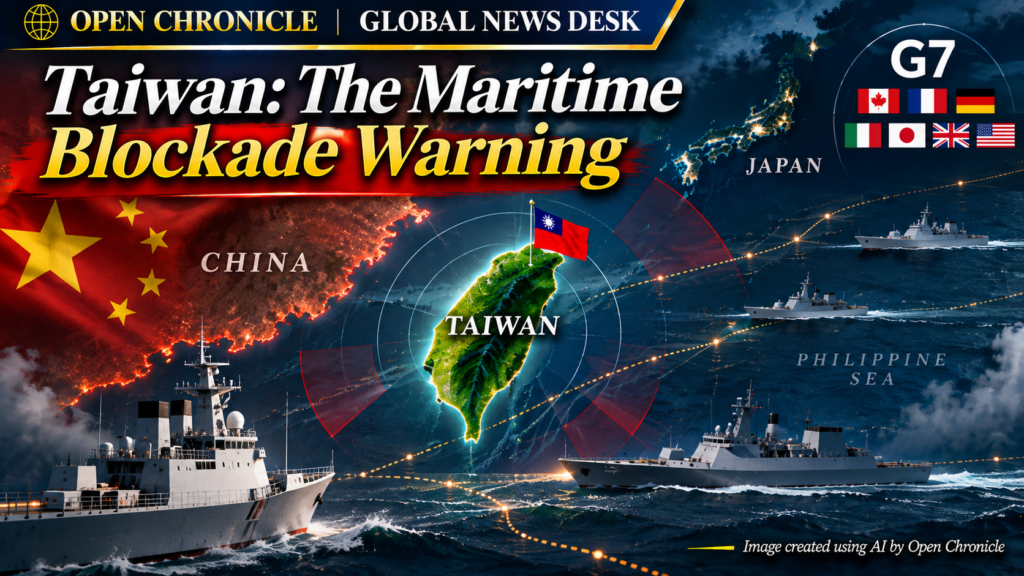
Foreign ministers from the world’s leading industrialized democracies warn that China’s expanding maritime operations east of Taiwan threaten regional stability and international shipping. Taipei is strengthening its defenses as the strategic competition in the Western Pacific enters a more dangerous phase.
By Open Chronicle News Desk
November 12, 2026 | Special Report
Introduction | A new warning over one of the world’s most dangerous flashpoints
The Group of Seven has issued a collective warning over China’s increasingly assertive maritime activities around Taiwan, raising concerns that Beijing could be developing the operational capabilities required to isolate the island during a future crisis.
In a joint declaration following their November 9 and 10 meeting in Paris, G7 foreign ministers expressed concern about Chinese operations in waters east of Taiwan, an area considered strategically important for international shipping and potential military support routes.
The statement, published on November 11, represents one of the clearest collective warnings from the G7 about Beijing’s growing presence on Taiwan’s eastern maritime approaches.
The ministers emphasized the importance of peace and stability across the Taiwan Strait, rejected attempts to change the status quo through force or coercion, and encouraged a peaceful resolution through dialogue.
Taiwan welcomed the declaration on November 12.
Its Presidential Office pledged to continue strengthening the island’s defense capabilities and broader societal resilience while cooperating with international partners.
For Beijing, Taiwan remains a central question of sovereignty and national reunification. The Chinese government claims the self-governing island as part of its territory and has never renounced the possibility of using force to bring it under its control.
Taiwan’s government rejects Beijing’s sovereignty claims and maintains that the island’s future must be determined by its people.
The latest confrontation is therefore about considerably more than the movement of military vessels.
It concerns the future of Taiwan, the credibility of international security commitments, freedom of navigation and the balance of power across the Indo-Pacific.
Most importantly, it raises a question increasingly discussed by military planners: could China attempt to force Taiwan into submission through maritime isolation without immediately launching a full-scale invasion?
1. What the G7 actually said
The declaration was issued by the foreign ministers of Canada, France, Germany, Italy, Japan, the United Kingdom and the United States, together with the European Union’s High Representative for Foreign Affairs and Security Policy.
The ministers identified Chinese activities east of Taiwan as a growing threat to regional stability, navigation rights and commercial shipping.
They reaffirmed opposition to unilateral changes to the status quo, particularly through military force or coercion.
The statement also supported Taiwan’s meaningful participation in international organizations and called for peaceful dialogue.
The geographical emphasis is significant.
International attention often concentrates on the Taiwan Strait, the narrow body of water separating Taiwan from mainland China.
But the G7 explicitly highlighted activities on the island’s eastern side.
This suggests that concerns are expanding beyond the possibility of a conventional military confrontation across the strait.
The focus increasingly includes China’s ability to operate around Taiwan, restrict access to its ports and potentially interfere with maritime routes linking the island to the wider Pacific.
The declaration did not announce new sanctions, a military operation or a collective defense commitment to Taiwan.
It was a diplomatic warning.
Nevertheless, its significance lies in the collective position adopted by governments with substantial economic, technological and security interests in the region.
The official statement and Reuters reporting confirm that this concern is now being expressed collectively rather than only through separate national declarations.
2. Why Taiwan’s eastern waters matter
Taiwan’s geography is central to its strategic importance.
The island lies off China’s southeastern coast, separated from the mainland by the Taiwan Strait.
To the east, Taiwan faces the Philippine Sea and the wider Pacific Ocean.
These eastern maritime approaches are particularly important because they provide potential access routes for supplies and assistance from international partners during a crisis.
They also offer operational space for naval forces seeking to monitor or counter Chinese military movements.
For many years, discussions about a possible Chinese attack focused heavily on the difficulties of crossing the Taiwan Strait and conducting an amphibious invasion.
That remains an extraordinarily demanding military operation.
However, military planners increasingly consider alternative forms of coercion.
A blockade or quarantine could seek to restrict commercial shipping, energy imports or access to key ports without immediately requiring a major amphibious landing.
Control over Taiwan’s eastern approaches would be relevant to such a strategy.
If Chinese forces could operate effectively around both sides of the island, Taiwan might face greater difficulty maintaining maritime connections with international partners.
This does not mean that China has decided to impose a blockade.
Nor does it establish that current patrols are necessarily preparations for an imminent attack.
It means that the geographical pattern of Chinese activity has implications for potential future military scenarios.
Taiwanese officials have specifically raised concerns that China’s coast guard and military operations could be rehearsing elements of maritime isolation.
Those assessments should be understood as Taiwan’s security interpretation of the activities, not proof of a finalized Chinese operational plan.
3. Chinese coast guard patrols have increased since June
According to reporting published on November 12, Chinese coast guard activity off Taiwan’s eastern coast has increased since June 2026.
Taiwanese authorities say the patrols have become more frequent and assertive.
The concern is not limited to the presence of individual vessels.
It involves the possibility that different Chinese organizations could operate together during a crisis.
China possesses a substantial coast guard, a large navy and a range of maritime law enforcement and civilian maritime capabilities.
These forces perform different functions under normal circumstances.
However, their activities could overlap during an operation intended to restrict maritime traffic.
Taiwanese officials have expressed concern about a potential combination of military, paramilitary and civilian assets.
Such an approach could complicate the response of other countries.
A conventional naval blockade would be widely recognized as a military operation.
A campaign presented as maritime law enforcement might create greater uncertainty about the appropriate international response.
For example, vessels could be subjected to inspections, warnings or attempts to redirect shipping under disputed claims of jurisdiction.
The legal status and political implications of those measures would depend on their precise nature, location and effects.
The distinction matters because maritime coercion can involve actions below the threshold of open warfare.
A government might seek to exert pressure while avoiding the immediate political consequences of a declared military blockade.
Taiwan has accused Chinese vessels of harassing shipping and asserting jurisdiction that Taipei rejects.
China maintains its sovereignty claim over Taiwan, but the competing legal and political positions do not establish a right to interfere indiscriminately with international navigation.
The latest G7 statement reflects concern about the risks created by these increasingly contested maritime activities.
4. A blockade could be more complicated than an invasion
A full-scale amphibious invasion of Taiwan would require China to conduct one of the most complex forms of military operation.
Such an operation would involve transporting troops and equipment across the Taiwan Strait, securing landing areas, sustaining supply lines and confronting Taiwan’s defenses.
A maritime blockade would involve a different set of challenges.
Rather than immediately attempting to occupy the island, Beijing could seek to restrict Taiwan’s access to international trade and essential imports.
The strategic objective might be to create economic pressure and political uncertainty.
A blockade could potentially affect energy supplies, industrial production, maritime insurance, commercial transport and public confidence.
However, imposing and sustaining an effective blockade would also be difficult.
China would need to monitor extensive maritime areas, manage the response of commercial vessels and consider possible intervention by other military powers.
The operation could disrupt regional trade, including commerce involving China itself.
It could also generate a serious international crisis.
The United States and other countries might respond through diplomatic, economic or military measures.
The danger is that a coercive operation intended to avoid a full-scale war could nevertheless trigger escalation.
An encounter between naval vessels, an attempt to intercept a commercial ship or a misinterpreted military maneuver could produce consequences far beyond the original operation.
For this reason, blockade scenarios are often considered especially sensitive.
They combine economic pressure, military risk and legal uncertainty.
The G7 warning suggests that these concerns are increasingly influencing international diplomatic assessments.
5. China’s military is also operating farther into the Western Pacific
The maritime developments are taking place alongside broader Chinese military activity in the Western Pacific.
Taiwan’s defense minister, Wellington Koo, said this week that China was conducting operations involving an aircraft carrier and other naval formations.
He described the activity as involving area denial.
In military terminology, area denial refers to efforts to make it difficult or dangerous for an opposing force to operate within a particular region.
Such capabilities can involve aircraft, surface vessels, submarines, missiles, surveillance systems and other military assets.
For China, extending military operations beyond its immediate coastline supports broader objectives of maritime security and regional power projection.
For Taiwan and its partners, those activities raise questions about access to the waters surrounding the island during a crisis.
An effective area denial strategy could complicate attempts by external forces to operate near Taiwan.
It might also increase the risks faced by commercial shipping.
However, military exercises do not automatically demonstrate an intention to initiate hostilities.
Countries conduct exercises for training, deterrence, readiness and political signaling.
The challenge for observers is distinguishing routine military preparation from activity that could indicate a significant change in operational intentions.
That requires sustained monitoring rather than conclusions based on a single exercise.
The concern expressed by the G7 reflects the cumulative pattern of activity rather than an independently confirmed decision by Beijing to launch an attack.
6. Taiwan promises stronger defense and national resilience
Taiwan’s government responded positively to the G7 declaration.
On November 12, Presidential Office spokesperson Karen Kuo said Taiwan would continue strengthening its defensive capabilities and working with international partners.
The response emphasized two related priorities.
The first is military readiness.
Taiwan must maintain the capacity to deter aggression and respond to potential threats involving its airspace, territorial approaches and critical infrastructure.
The second is broader national resilience.
This includes the ability of essential services, businesses, local communities and public institutions to continue functioning during emergencies.
In a potential blockade scenario, resilience could become as important as conventional military strength.
Energy reserves, communications infrastructure, emergency supplies, cybersecurity and transport systems would all influence Taiwan’s ability to withstand sustained pressure.
A society capable of maintaining essential services during disruption may be more difficult to coerce.
Taiwan’s emphasis on resilience therefore reflects an understanding that modern security threats extend beyond direct military attacks.
The island also relies on international partnerships.
Although most countries do not maintain formal diplomatic relations with Taipei, many have extensive economic, technological and unofficial political connections with Taiwan.
Those relationships can support cooperation in areas such as supply chain security, disaster preparedness and economic resilience.
The G7 statement offers diplomatic support, but it does not create a new binding military guarantee.
That distinction remains important when evaluating the practical implications of the declaration.
7. Beijing’s position: Sovereignty and opposition to foreign interference
China’s government considers Taiwan an inseparable part of Chinese territory.
Beijing argues that the Taiwan question is an internal matter and opposes foreign involvement that it believes challenges Chinese sovereignty.
President Xi Jinping has repeatedly presented reunification as a major national objective.
Chinese officials maintain that peaceful reunification is their preferred outcome, while refusing to rule out the use of force.
From Beijing’s perspective, foreign military activity and political support for Taiwan can be interpreted as attempts to constrain China’s sovereignty claims.
The G7, by contrast, emphasizes the importance of preserving regional stability and preventing unilateral changes through coercion.
These positions reflect a fundamental disagreement.
China regards the question as one of territorial sovereignty.
Taiwan’s elected government rejects Beijing’s authority over the island.
The G7 focuses on the consequences of coercive action for international security, navigation and peaceful dispute resolution.
Recognizing these different positions is necessary to understand the dispute.
It does not mean that all claims have equivalent legal or political standing.
The historical, diplomatic and legal status of Taiwan is complex, and different governments maintain distinct policies regarding recognition and cross-strait relations.
What is clear is that any attempt to resolve the dispute through military force would carry enormous risks for the region.
The latest declaration calls for dialogue rather than coercion.
Whether Beijing and Taipei can establish meaningful channels for reducing tensions remains uncertain.
8. Why Japan has particular reasons to be concerned
Japan is one of the countries most directly affected by security developments around Taiwan.
The southwestern Japanese island chain lies close to Taiwan and the surrounding maritime routes.
Japanese security planners must therefore consider how a confrontation could affect nearby islands, commercial shipping and the operation of American forces stationed in Japan.
The implications are both military and economic.
Japan depends heavily on maritime trade and imported energy.
Disruption in the waters surrounding Taiwan could affect transport routes and supply chains linking Japan to other Asian economies.
A wider military confrontation could also create difficult questions concerning Japan’s alliance with the United States.
However, the precise nature of any Japanese response would depend on the circumstances, domestic law and decisions made by its government.
The G7 declaration should not be interpreted as committing Japan to a specific military action.
Instead, it demonstrates that Taiwan’s security is increasingly viewed as connected to the broader stability of the Indo-Pacific.
Japan’s participation in the collective warning reinforces the importance of preventing escalation before a crisis develops.
9. The United States faces a difficult deterrence challenge
The United States remains a central actor in the security balance surrounding Taiwan.
Washington maintains extensive unofficial relations with Taipei and provides support for Taiwan’s defensive capabilities.
At the same time, the United States maintains diplomatic relations with Beijing under its longstanding one-China policy.
American policy has historically sought to discourage both a unilateral use of force by Beijing and unilateral actions that could destabilize the cross-strait status quo.
The challenge is maintaining deterrence without accelerating confrontation.
If Washington appears unwilling to respond to coercive activity, Beijing might conclude that pressure could succeed.
If American military activity becomes more confrontational, the risk of dangerous encounters could increase.
The emergence of possible maritime quarantine or blockade scenarios makes that balance more complicated.
An amphibious invasion would be a major military operation with relatively clear indicators.
A campaign involving coast guard patrols, inspections or selective interference with shipping could develop more gradually.
The United States and its partners would need to determine which activities require diplomatic protest, economic measures or other responses.
Those decisions could become especially difficult if Beijing framed its actions as domestic maritime enforcement.
For Washington, the strategic objective is to preserve stability while avoiding commitments or actions that inadvertently increase the risk of conflict.
The G7 declaration provides a collective diplomatic position, but it does not resolve the operational questions that a real crisis would present.
10. Europe’s growing stake in Indo-Pacific security
Although Taiwan is geographically distant from Europe, its security has become increasingly relevant to European governments.
The European Union has substantial economic relationships with both China and Taiwan.
European manufacturers depend on international shipping, electronics, machinery and complex supply chains extending across East Asia.
Taiwan also plays an exceptionally important role in advanced semiconductor manufacturing.
A major disruption could therefore affect European industries ranging from automotive production to telecommunications and industrial equipment.
European governments have additional concerns about freedom of navigation and the rules governing international trade.
If coercive maritime practices became normalized in one strategically important region, they could have implications elsewhere.
For France, Germany, Italy and the United Kingdom, participation in the G7 declaration signals concern about those wider consequences.
However, Europe faces a difficult balancing act.
China is a major trading partner and an important participant in global industrial supply chains.
European governments are seeking to reduce strategic dependencies while avoiding unnecessary economic confrontation.
The Taiwan question illustrates the tension between those objectives.
A European strategy based on economic resilience, diplomatic engagement and respect for international law may be more sustainable than treating every regional dispute primarily as a military question.
Nevertheless, the growing risks around Taiwan are likely to reinforce European discussions about supply chain diversification and strategic autonomy.
11. The semiconductor industry makes Taiwan a global economic concern
Taiwan occupies a critical position in the global semiconductor industry.
Its manufacturers produce advanced chips used in artificial intelligence, smartphones, computers, telecommunications equipment and other technologies.
Taiwan Semiconductor Manufacturing Company, commonly known as TSMC, is particularly important in advanced contract chip manufacturing.
A serious disruption to Taiwan’s industrial output or international transport connections could therefore have consequences across multiple continents.
The potential effects would not be limited to the technology sector.
Automotive manufacturers require semiconductors for electronic control systems.
Hospitals depend on medical equipment containing sophisticated electronics.
Telecommunications networks require specialized chips.
Defense industries also rely on advanced components.
A blockade that disrupted Taiwan’s ports or energy supplies could affect industrial production even without direct damage to semiconductor factories.
However, the magnitude of any disruption would depend on the duration, geographical scope and severity of the crisis.
It would be misleading to assume that every Chinese military exercise immediately threatens global chip supplies.
The economic concern arises from the possibility of sustained disruption during a major confrontation.
That possibility gives governments and companies strong incentives to strengthen supply chain resilience.
It also helps explain why Taiwan’s security has become a matter of global economic policy.
12. The legal challenge of maritime coercion
The law of the sea provides an important framework for understanding the dispute.
International maritime law establishes rights and obligations concerning navigation, maritime zones and the use of the oceans.
The United Nations Convention on the Law of the Sea is a central part of that framework.
The precise legality of maritime enforcement measures depends on where they occur, which vessels are involved and what authority is being asserted.
A coastal state does not possess unlimited powers over all shipping in nearby international waters.
Nor can sovereignty claims automatically justify interference with navigation beyond the limits established by applicable international law.
In a crisis around Taiwan, disagreements over jurisdiction could become especially dangerous.
Chinese authorities might assert powers that Taiwan and other governments reject.
Commercial vessels could face conflicting instructions.
Naval forces could be deployed to protect shipping or monitor maritime operations.
The resulting encounters could increase the risk of escalation.
This is one reason the G7 declaration emphasizes freedom of navigation and international shipping safety.
The concern is not simply that military vessels are operating near Taiwan.
It is that coercive measures affecting commercial traffic could undermine established maritime practices and create wider security consequences.
13. The danger of miscalculation
One of the greatest risks surrounding Taiwan is that confrontation could emerge from a sequence of decisions rather than a single deliberate choice to begin a war.
A coast guard vessel might attempt to stop a commercial ship.
Taiwanese authorities might intervene.
Chinese military units could increase their presence.
External naval forces might move closer to monitor the situation.
Each participant could interpret its own actions as defensive while regarding the movements of others as threatening.
Such dynamics can create dangerous escalation.
Communication failures, inaccurate intelligence and domestic political pressure may make the situation more difficult to control.
This risk is particularly serious when military and civilian vessels operate in close proximity.
The presence of multiple organizations with different command structures can complicate coordination.
For this reason, crisis communication mechanisms are important.
Military contacts, diplomatic channels and established procedures for encounters at sea can reduce the possibility of unintended escalation.
They cannot eliminate strategic disagreements.
But they can help prevent individual incidents from becoming wider confrontations.
The G7’s emphasis on dialogue reflects the importance of managing these risks before a crisis develops.
14. What should the international community watch next?
Several developments will help determine whether the situation around Taiwan becomes more stable or more dangerous.
The first is the frequency and location of Chinese coast guard patrols east of the island.
A sustained increase in activity could indicate an effort to establish a more permanent operational presence.
The second is coordination between coast guard vessels and Chinese military formations.
Closer integration could be relevant to assessments of potential blockade capabilities.
The third is the nature of interactions with commercial shipping.
Warnings, inspections or attempts to redirect vessels would raise different concerns from ordinary military transit.
The fourth is the response of Taiwan and its international partners.
New defensive measures, diplomatic initiatives or military exercises could influence the regional security environment.
The fifth is communication between Beijing, Taipei and Washington.
Even limited dialogue could reduce uncertainty and help manage incidents.
Finally, analysts should distinguish military capability from political intention.
China’s ability to conduct more extensive maritime operations does not establish that it has decided to impose a blockade.
Equally, the absence of immediate hostilities does not mean that growing coercive capabilities are strategically insignificant.
A careful assessment requires attention to both developments.
Conclusion | Taiwan’s security is becoming a global maritime question
The G7’s latest warning reflects a changing understanding of the risks surrounding Taiwan.
The possibility of a Chinese amphibious invasion remains an important security concern.
But the growing focus on maritime operations east of the island suggests that international attention is expanding to other forms of coercion.
A blockade or quarantine could threaten Taiwan’s economy, international shipping and the stability of the wider Indo-Pacific.
It could also create difficult decisions for the United States, Japan and European governments.
China maintains its sovereignty claims and opposes foreign interference.
Taiwan rejects Beijing’s authority and is strengthening its defenses.
The G7 has called for peaceful dialogue and opposition to unilateral changes through force or coercion.
Those positions remain deeply difficult to reconcile.
Yet the risks of confrontation make diplomacy essential.
For the international community, the priority should be preventing military and maritime pressure from escalating into a crisis that neither side can easily control.
For Taiwan, the challenge is maintaining security, economic resilience and international connections.
For China, the question is whether its regional objectives can be pursued without increasing the danger of confrontation.
And for the G7, the test is whether collective diplomatic warnings can contribute to stability rather than becoming another stage in an escalating strategic rivalry.
The future of Taiwan will be shaped not only by what happens in the Taiwan Strait, but increasingly by what happens in the waters beyond it.
Open Chronicle will continue monitoring Chinese maritime operations, Taiwan’s defense measures, the G7 response and developments affecting freedom of navigation in the Western Pacific.
Sources and Further Reading
Official diplomatic statements, independent reporting and Taiwanese coverage of the security developments around Taiwan and the Western Pacific.
Joint Declaration Following the G7 Foreign Ministers’ Meeting
Official statement expressing concern over Chinese maritime activity east of Taiwan, freedom of navigation and regional security.
G7 Foreign Ministers’ Joint Statement
Official publication covering Taiwan, maritime security, international law and the wider Indo-Pacific.
G7 Warns China’s Actions East of Taiwan Threaten Stability
Reporting on Chinese coast guard patrols, possible blockade preparations, naval exercises and international reactions.
Presidential Office Vows Stronger Self-Defense After G7 Statement
Taiwan’s official response, including commitments to defense readiness, societal resilience and international cooperation.
Chinese Maritime Activity and Taiwan’s Eastern Approaches
Regional reporting on Taiwan’s concerns about shipping routes, coast guard activity and Chinese naval exercises.
United Nations Convention on the Law of the Sea
Legal framework for maritime zones, navigation rights and obligations concerning the use of the oceans.
This article was prepared on November 12, 2026. Chinese maritime activities and the G7 declaration are documented developments. Assessments concerning a possible blockade are attributed to Taiwanese authorities or presented as strategic scenarios. No decision by China to impose a blockade has been independently established. The article distinguishes official positions, reported facts and editorial analysis.
Explore International Relations
Discover more reporting and analysis on diplomacy, international security, global governance and the changing balance of power.
Return to International Relations →