
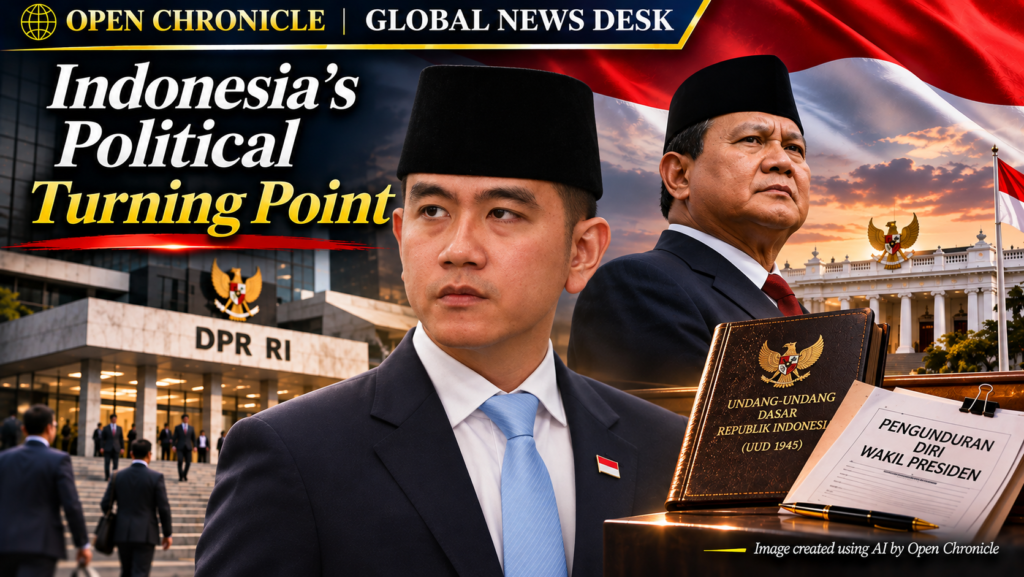
The reported resignation of Gibran Rakabuming Raka amid controversy over his educational qualifications raises questions about constitutional succession, political legitimacy and the future of Indonesia’s governing alliance.
By Open Chronicle News Desk
November 12, 2026 | Special Report
Introduction | An unexpected crisis at the top of Southeast Asia’s largest economy
Indonesia is confronting a potentially significant political transition following reports that Vice President Gibran Rakabuming Raka has submitted his resignation amid renewed scrutiny of his educational qualifications.
The development, reported by several news outlets on November 12, places President Prabowo Subianto in a difficult political position and raises questions about the stability of the governing arrangement established after Indonesia’s 2024 presidential election.
Gibran’s rise to national office was controversial from the beginning.
The son of former President Joko Widodo, widely known as Jokowi, became Prabowo’s running mate following a Constitutional Court ruling that created an exception to the minimum age requirement for presidential and vice-presidential candidates.
That decision generated accusations of political favoritism and concerns about the independence of Indonesia’s institutions.
Now, allegations involving Gibran’s academic qualifications have brought his eligibility back into the political spotlight.
The immediate issue is constitutional succession. If the resignation is formally accepted, Indonesia must follow the legal procedure for selecting a new vice president.
But the implications extend further.
The controversy touches on the relationship between Prabowo and Jokowi, the credibility of Indonesia’s electoral institutions, and the balance of power within the country’s political establishment.
For a nation of more than 280 million people and one of Asia’s most important emerging economies, the outcome could influence both domestic governance and international perceptions of political stability.
1. What has happened?
Reports published on November 12 indicate that Gibran Rakabuming Raka has submitted his resignation following controversy over whether his educational credentials satisfy Indonesia’s legal requirements for national office.
The dispute has reportedly involved judicial proceedings, parliamentary scrutiny and growing political pressure.
However, several important distinctions must be maintained.
A reported submission of resignation is not necessarily equivalent to the completion of the constitutional process.
The exact legal findings concerning Gibran’s qualifications, the formal status of his resignation and the timetable for selecting a successor require confirmation through authoritative Indonesian institutional records.
The initial reports indicate a major political development, but they do not, by themselves, establish that every procedural stage has been completed.
This distinction is particularly important because Indonesia’s constitutional system provides a specific mechanism for filling a vice-presidential vacancy.
The coming decisions of the country’s political institutions will determine how the transition proceeds.
2. Who is Gibran Rakabuming Raka?
Gibran entered national politics carrying one of Indonesia’s most recognizable political names.
Born in 1987, he is the eldest son of Joko Widodo, who served as Indonesia’s president from 2014 to 2024.
Before entering national office, Gibran developed business interests and subsequently became mayor of Surakarta, also known as Solo, a city closely associated with his father’s political career.
His rise was unusually rapid.
After a relatively short period in local government, he was selected as Prabowo Subianto’s running mate in the 2024 presidential election.
The partnership brought together two important political forces.
Prabowo, a former military commander and longstanding national political figure, provided experience, party organization and a strong electoral profile.
Gibran brought an association with Jokowi’s political legacy, particularly the former president’s popularity and emphasis on infrastructure, economic development and administrative modernization.
The alliance helped Prabowo secure a decisive election victory.
But it also created questions about political succession and the growing influence of family networks within Indonesia’s democracy.
Those questions have returned with greater intensity following the latest controversy.
3. The 2024 election controversy that never disappeared
The dispute surrounding Gibran’s eligibility cannot be understood without examining the Constitutional Court decision that preceded his candidacy.
Indonesia’s electoral rules established a minimum age of 40 for presidential and vice-presidential candidates.
In October 2023, the Constitutional Court ruled that candidates younger than 40 could qualify if they had previously held elected regional office.
The decision allowed Gibran, then 36 and serving as mayor of Surakarta, to stand in the 2024 election.
The ruling was controversial for several reasons.
The court’s chief justice at the time, Anwar Usman, was related to the presidential family through marriage.
The relationship raised concerns about conflicts of interest and the independence of judicial decision-making.
Anwar was subsequently removed from his position as chief justice following an ethics ruling, although the underlying Constitutional Court decision remained in effect.
Critics argued that the episode demonstrated how institutional rules could be shaped by powerful political interests.
Supporters of Gibran’s candidacy maintained that the ruling established a lawful eligibility pathway.
The controversy became an important issue during the election campaign.
Prabowo and Gibran nevertheless won the presidency and vice presidency.
The present dispute over educational credentials is legally distinct from the earlier age controversy.
Politically, however, both episodes concern the same underlying question: whether the rules governing access to Indonesia’s highest offices have been applied consistently and transparently.
4. The educational qualifications dispute
The immediate controversy concerns Gibran’s academic background and whether the documentation associated with his education satisfies applicable Indonesian legal requirements.
Questions about his overseas education and the equivalence of qualifications have circulated for some time.
The new reports suggest that judicial and parliamentary developments have increased the pressure on the vice president.
A responsible assessment must distinguish between three separate issues.
First, there is the factual question of which qualifications Gibran obtained and how those qualifications were documented.
Second, there is the legal question of whether those qualifications satisfy the requirements applicable to candidates for national office.
Third, there is the political question of whether any irregularities would justify resignation or other institutional action.
These questions should not be treated as interchangeable.
An allegation about academic documentation is not automatically proof of a legal violation.
Likewise, a political decision to resign does not necessarily establish that every allegation made against an officeholder is true.
The exact content of any judicial ruling, including the court’s jurisdiction and the legal consequences of its decision, is essential to understanding the case.
Until those documents are fully examined, conclusions about misconduct or legal invalidity should remain carefully qualified.
5. What Indonesia’s Constitution says about replacing a vice president
Indonesia’s Constitution provides a mechanism for filling a vacancy in the vice presidency.
Under Article 8, paragraph 2, if the vice-presidential office becomes vacant, the People’s Consultative Assembly, known as the MPR, must convene within 60 days to elect a replacement.
The president nominates two candidates.
The MPR then selects one of them to serve for the remainder of the term.
This arrangement differs from systems in which a vice president is automatically replaced by a cabinet minister or where a new nationwide election is required.
The president therefore plays a central role in determining the available candidates.
However, the final selection is made through the constitutional parliamentary mechanism.
For Prabowo, the process could become an important political test.
His choice of nominees would signal which parties, political networks and governing priorities he intends to strengthen.
A candidate closely associated with Jokowi could preserve elements of the existing alliance.
A candidate from Prabowo’s own political base could indicate a shift toward greater presidential independence.
A figure acceptable to several coalition parties might instead be selected to maintain parliamentary stability.
The constitutional process is clear in broad terms.
The political negotiations surrounding it may prove considerably more complicated.
6. Prabowo faces a difficult political choice
For President Prabowo Subianto, Gibran’s departure creates both an immediate challenge and a potential opportunity.
The challenge is maintaining stability within a governing coalition built partly around the political influence of former President Jokowi.
Prabowo’s 2024 victory benefited from the support of Jokowi’s political network, which helped connect the incoming administration with voters who favored continuity.
Gibran’s appointment as vice president was an important symbol of that relationship.
His departure weakens one of its most visible connections.
Yet it could also allow Prabowo to consolidate authority independently of his predecessor.
The choice of a new vice president will therefore be closely watched for indications of how the president intends to manage the balance between established coalition partners and his own political priorities.
The decision could also influence preparations for future elections.
A replacement with strong party support might strengthen parliamentary coordination.
A technocratic candidate could signal an emphasis on economic management and administrative credibility.
A politician associated with Jokowi could demonstrate that the governing alliance remains intact despite Gibran’s departure.
None of these outcomes is inevitable.
The eventual choice will depend on negotiations among the president, parliamentary leaders and coalition parties.
7. Jokowi’s political legacy comes under renewed scrutiny
The resignation also places former President Joko Widodo in an uncomfortable position.
Jokowi left office in 2024 after a decade during which he became one of Indonesia’s most influential political figures.
His presidency was associated with major infrastructure projects, investment initiatives and efforts to strengthen Indonesia’s position as a regional economic power.
But his final years in office also generated criticism concerning democratic institutions, political patronage and the growing prominence of his family.
Gibran’s vice presidency became central to that debate.
Critics saw his rapid advancement as evidence that political dynasties were becoming more influential.
Supporters argued that his electoral success reflected legitimate voter preferences.
Following the resignation, Jokowi publicly reaffirmed his support for Prabowo’s administration, signaling that he did not wish to turn the controversy into an open confrontation.
Whether that statement is sufficient to preserve the relationship remains uncertain.
Political cooperation may continue even if the personal and institutional ties between the two camps weaken.
The larger question is whether Jokowi can retain his political influence without a family member occupying one of Indonesia’s highest offices.
8. Parliamentary pressure accelerated the crisis
The resignation followed growing pressure from members of Indonesia’s House of Representatives.
On November 11, 120 lawmakers representing eight parliamentary factions supported a proposal that could have initiated proceedings against Gibran.
The parliamentary initiative was linked to the controversy surrounding his educational qualifications.
The following day, Gibran submitted his resignation to the People’s Consultative Assembly.
Indonesia’s Antara news agency reported that a plenary session intended to consider the parliamentary initiative was subsequently canceled.
The sequence suggests that resignation provided a political alternative to a potentially prolonged institutional confrontation.
However, it does not establish that every allegation raised during the controversy has been resolved.
The courts’ findings concerning the educational documents and the political circumstances of Gibran’s resignation remain distinct matters.
The parliamentary response also demonstrates that the controversy had moved beyond public criticism into formal institutional action.
For Indonesia’s democratic system, the way these proceedings are handled will be an important measure of transparency and constitutional accountability.
ANTARA News+1
9. Economic confidence adds urgency to the transition
Indonesia’s political crisis comes at a sensitive economic moment.
The country is Southeast Asia’s largest economy and a major participant in international markets for nickel, coal, palm oil and manufactured products.
Its economic ambitions depend partly on sustained investment, industrial development and confidence in public institutions.
Political uncertainty can complicate those objectives.
Investors may become more cautious when questions arise about government stability, fiscal policy or the reliability of institutional decision-making.
Recent reporting has highlighted concerns over the government’s economic management, the weakening rupiah and investor confidence.
Gibran’s resignation does not automatically imply an economic crisis.
However, it adds another source of uncertainty at a time when the administration is already facing scrutiny over its policy priorities.
A swift and transparent constitutional transition could help reassure investors.
A prolonged dispute over succession or a broader confrontation between political factions could have the opposite effect.
The economic implications will therefore depend less on the resignation itself than on how the government manages the transition.
10. A separate surveillance investigation complicates the political environment
Another controversy is developing alongside the vice-presidential resignation.
Indonesian authorities are investigating allegations of unauthorized surveillance involving President Prabowo and other public figures.
The inquiry reportedly concerns suspected wiretapping and possible involvement by individuals connected to senior security institutions.
Police have indicated that they possess initial evidence supporting further investigation of several suspects.
The allegations remain subject to investigation and have not been established through final judicial findings.
Importantly, there is no demonstrated connection between the educational qualifications dispute and the surveillance investigation.
Nevertheless, the simultaneous controversies contribute to a broader atmosphere of political mistrust.
They also raise questions about institutional oversight and the relationship between political authorities and security services.
For Prabowo, maintaining public confidence will require credible procedures in both cases.
11. Why the resignation matters beyond Indonesia
Indonesia occupies a distinctive position in international affairs.
It is a member of the G20, a leading country within ASEAN and an important economic partner for China, the United States, Japan, Australia and the European Union.
Its geographic position gives it strategic importance along major maritime trade routes connecting the Indian and Pacific oceans.
Indonesia has traditionally sought to preserve flexibility in its international relationships rather than align exclusively with one major power.
Political stability in Jakarta is therefore important to governments and investors across the region.
The vice-presidential resignation is primarily a domestic constitutional matter.
It does not necessarily indicate an immediate change in Indonesia’s foreign policy.
Prabowo remains president, and the country’s diplomatic institutions continue to operate.
However, changes within the governing coalition could influence domestic priorities, cabinet relationships and the administration’s political capacity to pursue international initiatives.
Foreign partners will be watching for evidence of continuity in economic policy, regional diplomacy and defense cooperation.
12. What happens next?
Several developments will determine the direction of Indonesia’s political transition.
The People’s Consultative Assembly must complete the relevant formal procedures concerning the resignation.
The constitutional process for filling the vacancy will then require President Prabowo to nominate two candidates.
The Assembly must elect a replacement within the prescribed 60-day period.
The selection will be an important indication of the president’s political priorities.
It will also test the willingness of coalition parties to cooperate after a controversy that has exposed divisions within Indonesia’s political establishment.
Meanwhile, the public debate over Gibran’s qualifications is unlikely to disappear immediately.
The court rulings, the parliamentary response and the political circumstances of the resignation may continue to shape discussions about electoral eligibility and institutional accountability.
For Indonesia, the challenge is to ensure that the transition strengthens confidence in constitutional procedures rather than deepening public mistrust.
Conclusion | A resignation that tests Indonesia’s democratic institutions
Gibran Rakabuming Raka’s resignation represents a major political development in Indonesia.
It ends a vice presidency that began amid controversy and concludes another chapter in the debate over the political influence of former President Joko Widodo’s family.
The immediate cause was renewed scrutiny of educational qualifications, intensified by judicial findings and parliamentary pressure.
But the broader implications concern the balance of power within President Prabowo Subianto’s government.
The resignation could weaken the alliance that helped bring Prabowo to office.
It could also give the president an opportunity to redefine his administration’s political identity.
The constitutional succession process will now provide an important test of Indonesia’s institutions.
A transparent selection of a new vice president could help restore political confidence.
A contested or opaque process could prolong uncertainty.
The central question is no longer simply why Gibran resigned. It is how Indonesia’s political system responds, and whether the transition reinforces the constitutional principles on which its democracy depends.
Open Chronicle will continue monitoring the parliamentary process, President Prabowo’s nominations and developments affecting Indonesia’s political stability.
Sources and Further Reading
Independent reporting and Indonesian news coverage documenting the vice president’s resignation, the educational qualifications controversy and the constitutional succession process.
Indonesia’s Vice President Submits His Resignation
Reporting on Gibran’s resignation, the response from former President Joko Widodo and political pressures affecting the Prabowo administration.
Resignation Amid Questions About Electoral Eligibility
Background on the judicial findings, the parliamentary initiative and Indonesia’s constitutional procedure for replacing a vice president.
Gibran Formally Submits His Resignation Letter
Detailed reporting from Jakarta on the parliamentary meeting, educational credentials, political demonstrations and succession timetable.
Gibran Delivers Resignation to Assembly Leaders
Indonesian national news agency coverage of the vice president’s arrival at the parliamentary complex and meeting with MPR leaders.
Parliament Responds to the Vice President’s Departure
Local reporting on the resignation, parliamentary pressure, court decisions and the relationship between Prabowo and Jokowi.
Parliament Cancels Impeachment Discussion
Reporting on the cancellation of a parliamentary plenary session following the submission of Gibran’s resignation.
This report was prepared on November 12, 2026. The submission of Gibran Rakabuming Raka’s resignation has been confirmed by multiple news organizations. Formal parliamentary procedures and the selection of a replacement remain separate stages. Political interpretations concerning the relationship between President Prabowo Subianto and former President Joko Widodo are presented as analysis, not established evidence of a definitive political rupture.