
OPEN CHRONICLE | GLOBAL NEWS DESK | MIDDLE EAST & HUMANITARIAN AFFAIRS
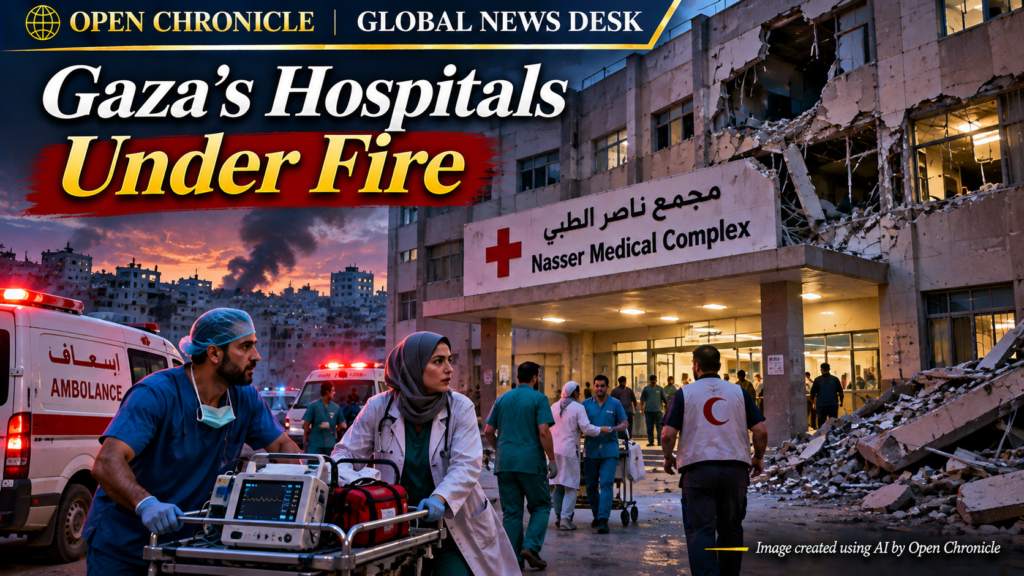
An Israeli strike on the Nasser Medical Complex in Khan Younis has reportedly killed six people, including a medical professional. The incident raises urgent questions about civilian protection, military operations near hospitals and the fragile security situation in Gaza.
By Open Chronicle News Desk
November 12, 2026 | Special Report
Introduction | A hospital at the center of another deadly incident
The Nasser Medical Complex in Khan Younis, southern Gaza, has once again become the focus of international concern after an Israeli military strike reportedly killed six people and injured others.
According to Palestinian health authorities and civil defense officials, the attack affected an area of the hospital complex and caused casualties that included a medical professional.
The Israeli military has said that the operation targeted Hamas operatives. That account has not been independently established in the information available for this report.
The incident comes amid continuing insecurity in Gaza, where medical facilities have faced repeated damage, severe shortages and extraordinary pressure since the beginning of the war.
For patients, doctors and humanitarian organizations, the consequences of attacks affecting hospitals extend beyond the immediate casualties.
A hospital is not simply another building within a conflict zone. It is a vital part of the civilian survival system, providing emergency treatment, surgery, intensive care and essential medical services.
When its operations are disrupted, the consequences can affect thousands of people who were never directly involved in the incident.
The attack on Nasser Hospital therefore raises a broader question: how can medical facilities remain protected when military operations continue in densely populated areas?
1. What is known about the attack
Initial reports from Gaza indicate that six people were killed in an Israeli strike affecting the Nasser Medical Complex.
Palestinian health and civil defense officials reported damage to medical facilities and additional injuries.
Among the reported victims was a medical professional.
The Israeli military acknowledged conducting an operation and stated that it had targeted Hamas personnel.
However, several important questions remained unresolved at the time of publication.
The precise circumstances leading to the strike, the identity and status of all those killed, and the evidence supporting the Israeli military’s stated target identification had not been independently established.
These distinctions matter.
Casualty figures attributed to local health authorities should be identified as such, while military claims about the intended targets require separate verification.
The existence of a military explanation does not, by itself, establish that an attack complied with international humanitarian law.
Equally, the reported presence of casualties at a medical facility does not alone establish every legal element required to determine whether a war crime occurred.
A credible assessment requires evidence concerning the intended target, the intelligence available before the operation, the precautions taken and the foreseeable effects on civilians.
2. Why Nasser Hospital is strategically important for civilian healthcare
Nasser Medical Complex is one of the principal medical institutions serving southern Gaza.
Its importance extends well beyond Khan Younis.
The facility has provided emergency treatment, surgical services and care for patients affected by the wider humanitarian crisis.
Throughout the war, Gaza’s healthcare system has operated under extreme pressure.
Hospitals have faced shortages of medicines, surgical supplies, fuel, electricity, medical equipment and qualified personnel.
The displacement of civilians has further increased demand for emergency services.
Facilities that remain operational may be required to treat patients transferred from damaged or inaccessible hospitals.
This creates a dangerous concentration of medical needs.
When one major hospital loses capacity, surrounding facilities must absorb additional patients, even when they are already struggling.
An attack affecting a hospital’s surgical or emergency services can therefore produce consequences that continue long after the immediate incident.
Operations may be delayed.
Patients requiring intensive care may face interruptions in treatment.
Medical teams may be forced to relocate patients under unsafe conditions.
And civilians may lose confidence that they can reach medical assistance without entering another area of danger.
The significance of Nasser Hospital lies in its role within a healthcare system whose capacity has already been severely weakened.
3. The Israeli military’s explanation and the need for verification
The Israeli military has stated that the strike targeted Hamas operatives.
Israel has repeatedly accused Hamas and other armed groups of using civilian infrastructure for military purposes.
Hamas has disputed Israeli allegations concerning the military use of medical facilities.
These competing accounts cannot be resolved through statements alone.
Independent verification would require information about the specific individuals allegedly targeted, their activities, the intelligence supporting the operation and the circumstances in which the strike was authorized.
Such information may not be immediately available.
Military authorities sometimes withhold operational intelligence, while investigators may face significant obstacles accessing conflict zones.
Nevertheless, the absence of publicly available evidence limits the conclusions that can responsibly be drawn.
For the purposes of this report, the Israeli explanation is presented as a military claim rather than an independently verified finding.
The central question is not only whether an armed group had a presence near a medical facility.
It is whether the specific operation complied with the rules governing distinction, proportionality and precautions in attack.
Those requirements remain relevant even when military personnel or objectives are alleged to be present in civilian surroundings.
4. What international humanitarian law says about hospitals
International humanitarian law provides special protection to medical facilities, medical personnel, patients and the wounded.
Hospitals must be respected and protected during armed conflict.
Their protection reflects a fundamental principle: medical care must remain available to those who need it, regardless of the circumstances of the fighting.
However, the legal framework is more detailed than a simple prohibition on all military activity near hospitals.
A medical facility can lose its special protection if it is used, outside its humanitarian function, to commit acts harmful to the enemy.
Even then, the loss of special protection is subject to strict legal conditions.
Where applicable, a warning must be given, including a reasonable time limit, and that warning must remain unheeded before an attack can proceed.
Any attack must also comply with other applicable rules of international humanitarian law.
These include distinguishing military objectives from civilians and civilian objects, avoiding attacks expected to cause excessive incidental civilian harm in relation to the anticipated concrete and direct military advantage, and taking feasible precautions to minimize civilian casualties.
The presence of wounded combatants receiving treatment does not, by itself, justify attacking a hospital.
Nor does the presence of medical staff treating members of an armed group automatically transform a medical facility into a legitimate military target.
Determining whether the Nasser Hospital strike complied with these rules would require a fact-specific investigation.
The available initial reports do not permit a definitive legal conclusion.
5. The immediate consequences for patients and medical personnel
For healthcare workers in Gaza, an attack affecting a hospital creates several simultaneous emergencies.
The first is the treatment of casualties from the strike itself.
Medical personnel may need to perform emergency surgery, stabilize critically injured patients and manage severe trauma.
The second is the disruption of existing care.
Patients already undergoing treatment may require evacuation or transfer.
Operating rooms, intensive care units and diagnostic facilities may become unavailable.
The third is the psychological impact on medical teams and patients.
Healthcare workers operating in conflict zones already face exhaustion, repeated exposure to traumatic injuries and uncertainty about their own safety.
An incident affecting their workplace can intensify these pressures.
Patients may also become reluctant to seek treatment if they believe hospitals are unsafe.
That hesitation can have serious consequences for people with chronic illnesses, pregnancy complications, infectious diseases and injuries requiring urgent attention.
The impact of a hospital strike should therefore be assessed not only through the number of people killed or injured.
It must also be measured through the loss of medical capacity and the additional risks imposed on the civilian population.
6. The ceasefire has not ended the violence
The attack took place more than a year after a ceasefire agreement came into effect in October 2025.
Although the agreement reduced the intensity of large-scale fighting, it has not brought a complete end to deadly incidents.
Israeli and Hamas representatives continue to accuse one another of violating the arrangement.
According to Gaza’s health authorities, more than 1,600 Palestinians have been killed in Israeli attacks since the ceasefire began. Israeli authorities have also reported military fatalities during the same period.
These figures reflect accounts from the respective authorities and should not be interpreted as independent legal findings about individual incidents.
The continued violence illustrates a fundamental weakness in the ceasefire framework.
An agreement can formally remain in place while repeated military operations, accusations and retaliatory actions undermine its effectiveness.
For civilians, the distinction between a ceasefire and renewed war may offer little reassurance if attacks continue near homes, shelters and hospitals.
The Nasser Hospital strike is therefore significant not only as an individual military incident but also as a measure of the continuing fragility of the wider agreement.
investing.com+1
7. A hospital repeatedly exposed to the conflict
Nasser Hospital has previously been affected by Israeli military operations.
In 2025, an Israeli strike at the complex killed five journalists, including an Associated Press contributor.
That earlier incident attracted international scrutiny concerning the protection of journalists and medical facilities.
The recurrence of attacks affecting the same hospital raises questions about the cumulative impact on its ability to provide medical care.
Repeated damage can weaken a facility even when individual sections are subsequently repaired.
Equipment may be destroyed or rendered unusable.
Medical workers may leave because of injury, displacement or insecurity.
Patients may be transferred to facilities that lack sufficient capacity.
Reconstruction efforts may be interrupted before damaged departments become fully operational.
For hospitals operating under prolonged conflict conditions, these effects can accumulate into a sustained reduction in available healthcare.
The latest strike must therefore be understood against the broader deterioration of Gaza’s medical infrastructure.
apnews.com
8. The international community faces a difficult accountability question
The incident creates an immediate need for a transparent assessment of the circumstances.
A credible investigation would need to examine several issues.
First, investigators would need to establish the precise location and nature of the intended military target.
Second, they would need to assess the evidence available to Israeli commanders before the strike.
Third, they would need to determine what precautions were taken to protect patients, medical personnel and other civilians.
Fourth, the investigation would need to consider whether the expected military advantage justified the foreseeable incidental civilian harm under the applicable legal rules.
Finally, investigators would need to establish whether the hospital’s special protection remained in effect and whether the legal requirements concerning warnings were satisfied.
These questions are not answered simply by identifying the number of casualties or repeating the military’s explanation.
They require evidence.
Independent humanitarian organizations, international investigators and relevant legal institutions may all have roles in documenting the incident.
However, access to the site, the preservation of physical evidence and the availability of operational records will influence the reliability of any eventual findings.
The broader issue is accountability.
Without credible investigations, allegations concerning attacks on protected facilities can remain unresolved, further weakening confidence in the application of international humanitarian law.
9. Why the protection of healthcare matters beyond Gaza
The legal and humanitarian questions raised by the Nasser Hospital strike are not unique to Gaza.
Medical facilities have been attacked or damaged in numerous contemporary conflicts.
The consequences extend beyond individual incidents because hospitals perform a function essential to civilian survival.
Protecting healthcare is therefore a central requirement of the international humanitarian system.
The principle applies regardless of which armed force is conducting an operation or which population depends on the medical facility.
Medical neutrality is not a political endorsement of any party to a conflict.
It is a commitment to preserving treatment for wounded and sick people.
When hospitals become recurring locations of military violence, the consequences can undermine public confidence in the possibility of receiving impartial medical care.
They can also place humanitarian organizations in increasingly difficult operational positions.
For Gaza, where healthcare capacity is already severely constrained, the stakes are especially high.
10. What needs to happen next
The immediate priority is ensuring that patients and medical personnel at Nasser Hospital can receive treatment safely.
That includes assessing structural damage, restoring essential services and providing additional medical supplies where required.
The second priority is establishing a reliable account of the strike.
The Israeli military’s explanation should be examined alongside evidence collected by medical personnel, witnesses, independent journalists and investigators.
The third priority is preventing further attacks affecting medical facilities.
All parties to the conflict remain bound by applicable international humanitarian law.
The fourth priority is strengthening the implementation of the ceasefire.
Without credible mechanisms to address violations and reduce military escalation, the agreement risks becoming increasingly fragile.
Finally, the international community must confront the wider deterioration of Gaza’s healthcare system.
Emergency assistance remains essential, but sustained recovery requires security, reliable access to supplies, functioning infrastructure and conditions that allow medical professionals to work without fear.
Conclusion | The cost of insecurity inside a hospital
The strike on Nasser Hospital has left six people dead, including a surgeon, according to Gaza’s health authorities, and caused further damage to one of the territory’s remaining major medical facilities.
Israel says it targeted Hamas operatives. That explanation requires independent scrutiny, particularly given the special protections afforded to hospitals under international humanitarian law.
The incident exposes the continuing gap between the existence of a ceasefire and the reality experienced by civilians.
For patients in Gaza, the consequences of that gap are immediate.
Medical care becomes more difficult to obtain.
Healthcare workers face greater danger.
Already damaged facilities lose further capacity.
And the possibility of rebuilding a functioning civilian healthcare system becomes more remote.
The central issue is not whether hospitals can ever be relevant to military operations. International humanitarian law addresses that question through specific rules and exceptional circumstances.
The issue is whether those rules are being respected, whether civilians are being protected and whether allegations of violations are investigated credibly.
A hospital must remain a place where the wounded and sick can seek treatment, not another location where the consequences of war place their lives in danger.
Open Chronicle will continue monitoring the investigation, the condition of Nasser Hospital and developments affecting the ceasefire in Gaza.
Sources and Further Reading
Independent reporting, military statements and international humanitarian law documentation concerning the November 12 attack on Nasser Hospital.
Israeli Strike on Gaza Hospital Kills Six
Reporting on casualties, damage to the surgical department, the death of a doctor and the Israeli military’s explanation.
Israeli Strike on Southern Gaza Hospital
Eyewitness reporting and footage documenting destruction inside the medical complex, the emergency response and reported casualties.
Israeli Military Explains Its Claimed Targets
Reporting on the joint Israeli military and Shin Bet statement alleging the presence of Hamas operatives inside the hospital complex.
The Protection of Hospitals During Armed Conflict
Explanation of the special legal protections afforded to hospitals, medical personnel, patients and healthcare facilities.
When Civilian Hospitals May Lose Special Protection
The ICRC’s 2025 legal commentary addressing acts harmful to the enemy, warning requirements and the continued protection of patients.
This article was prepared on November 12, 2026. Casualty figures are attributed to Gaza’s health and civil defense authorities. The Israeli military’s statements concerning alleged Hamas activity are identified as
claims rather than independently established findings. The legal analysis explains applicable principles and does not constitute a judicial determination concerning this specific incident.