
OPEN CHRONICLE | GLOBAL NEWS DESK | DIPLOMACY & GEOPOLITICS
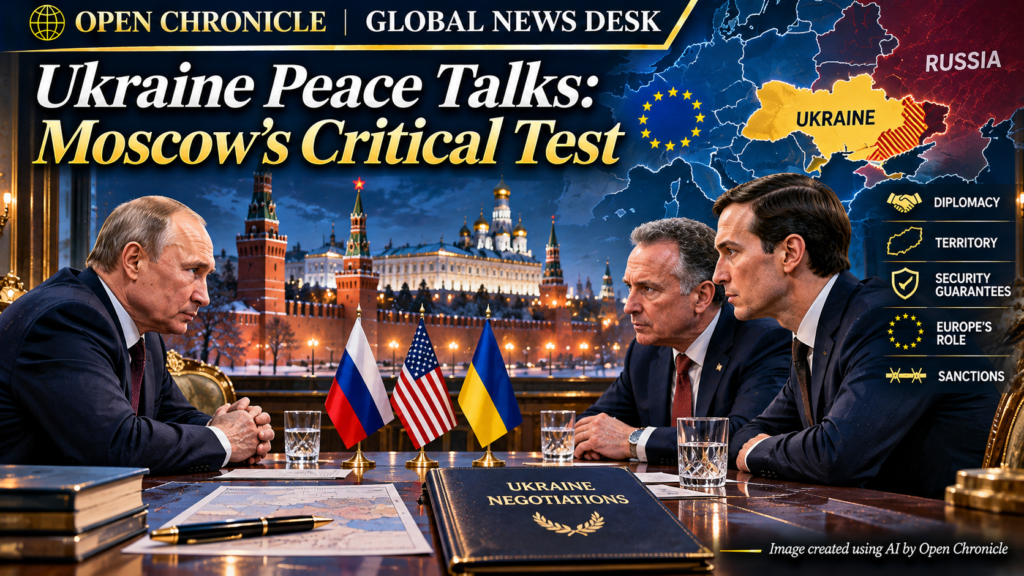
Steve Witkoff and Jared Kushner travel to the Kremlin following negotiations in Abu Dhabi. Washington is seeking a breakthrough in the war, but territorial disputes, security guarantees and Europe’s role in any settlement remain major obstacles.
By Open Chronicle News Desk
November 12, 2026 | Special Report
Introduction | A diplomatic mission with consequences far beyond Ukraine
The latest American diplomatic initiative to end the war between Russia and Ukraine has reached Moscow, where President Vladimir Putin is expected to meet two of Donald Trump’s closest representatives.
Steve Witkoff and Jared Kushner arrived in the Russian capital on November 12 following negotiations in Abu Dhabi involving American, Russian and Ukrainian representatives.
Their visit marks another attempt to move a conflict defined by military attrition, territorial disputes and deep political mistrust toward a negotiated settlement.
The stakes extend well beyond the battlefield.
Any agreement could reshape European security, influence the future of sanctions against Moscow, determine the conditions under which Ukraine might rebuild and test the credibility of American commitments to European allies.
Yet the obstacles remain formidable.
Russia and Ukraine continue to disagree over territorial control, the meaning of acceptable security guarantees and the political conditions required for a durable peace.
For Washington, the immediate challenge is to determine whether Moscow is prepared to negotiate substantive compromises.
For Kyiv, the priority is to ensure that diplomatic pressure does not translate into concessions that compromise Ukrainian sovereignty.
And for Europe, the central concern is whether decisions affecting the continent’s security will be made with European governments at the negotiating table.
1. Why the American envoys are in Moscow
The Moscow visit follows talks in Abu Dhabi intended to explore possible conditions for ending the war.
Those discussions brought representatives of the United States, Russia and Ukraine into a diplomatic process that has so far struggled to overcome fundamental disagreements.
The American delegation is led by Witkoff, Trump’s special envoy, and Kushner, the president’s son-in-law and a prominent figure in his diplomatic initiatives.
Their immediate objective is to present the results of the Abu Dhabi discussions to Putin and assess whether the Russian leadership is prepared to advance negotiations.
The diplomatic sequence is important.
Washington is attempting to maintain communication with both sides while identifying possible areas of agreement.
However, the presence of American representatives in Moscow does not establish that a peace settlement is imminent.
The outcome will depend on whether the parties can move beyond procedural discussions and address the issues that have repeatedly prevented progress.
At the time of this report, the visit was under way, and no final agreement resulting from the Moscow meeting had been established.
2. Abu Dhabi: Progress without a decisive breakthrough
The Abu Dhabi negotiations provided an opportunity for direct exchanges between the parties.
Reports from the discussions indicate that another prisoner exchange emerged as a potential area of agreement.
Humanitarian arrangements can be significant even when wider political negotiations remain deadlocked.
Prisoner exchanges allow governments to secure tangible results without necessarily resolving disputes over borders or political recognition.
They can also create limited opportunities to build confidence between adversaries.
Nevertheless, humanitarian progress should not be confused with agreement on the future of the war.
The central disputes remain unresolved.
The parties have not publicly established a mutually accepted framework for territorial arrangements, security guarantees or the conditions of a comprehensive ceasefire.
This distinction is essential when assessing the significance of the American diplomatic initiative.
A successful exchange of prisoners would represent a meaningful humanitarian development.
It would not, by itself, constitute a peace agreement.
3. The territorial question remains the greatest obstacle
Territory continues to be one of the most difficult issues in negotiations.
Russia has sought political and territorial outcomes that Ukraine regards as incompatible with its sovereignty and internationally recognized borders.
The Donbas region remains particularly sensitive.
Moscow’s position is shaped by its military objectives and its claims concerning territories it has occupied or sought to control.
Kyiv, meanwhile, faces profound political and constitutional constraints on accepting territorial concessions.
Any arrangement involving territory would also carry long-term implications for international law.
European governments have repeatedly emphasized the principle that borders must not be changed through military force.
For Ukraine, an agreement that rewards territorial aggression could create incentives for future attacks.
For Russia, an arrangement that does not satisfy its stated strategic demands may be considered unacceptable.
This creates a negotiating problem that cannot be resolved simply through diplomatic language.
A ceasefire might reduce immediate violence, but the political status of disputed territory would still require an agreed framework.
Without one, a suspension of hostilities could become a temporary military pause rather than a durable settlement.
4. Security guarantees: What would protect Ukraine after a deal?
Even if territorial disagreements could be reduced, another major question would remain.
What would prevent the war from restarting?
Ukraine has consistently sought credible security arrangements capable of deterring future Russian military action.
The form of those guarantees is central to the negotiations.
Possible arrangements could involve military assistance, defense cooperation, monitoring mechanisms, international commitments or other forms of security support.
But these options differ considerably in their credibility and political implications.
A diplomatic assurance is not necessarily equivalent to a binding defense commitment.
Nor would the presence of international observers automatically prevent renewed military action.
The effectiveness of any settlement would depend on whether violations could be detected, whether consequences were clearly established and whether participating governments were prepared to act.
The United States would therefore need to define the nature of its future commitments.
European governments would also have to determine what responsibilities they were willing and able to assume.
The issue is particularly sensitive because European states would live with the consequences of any security arrangement long after the immediate negotiations concluded.
5. Russia’s military campaign continues during diplomacy
The diplomatic initiative is taking place while the war continues.
Russian strikes have repeatedly targeted Ukrainian energy infrastructure, placing pressure on electricity generation, transmission networks and civilian services.
As winter approaches, the consequences of damage to power systems become increasingly severe.
Interruptions to electricity can affect heating, hospitals, water distribution, telecommunications and industrial production.
They also increase the burden on emergency services and local authorities.
The continuation of military operations during negotiations illustrates the difference between diplomatic engagement and a ceasefire.
The parties may continue fighting while attempting to improve their negotiating positions.
For Ukraine, attacks on civilian infrastructure reinforce the argument that any settlement must include credible protection against renewed aggression.
For Russia, military pressure may remain part of its broader strategy while talks continue.
The humanitarian consequences are immediate regardless of the diplomatic calculations involved.
A sustainable settlement would ultimately need to address not only military deployments and political arrangements but also the protection and reconstruction of essential civilian infrastructure.
6. Europe’s absence could become a problem for any agreement
One of the most consequential aspects of the current diplomatic process is the debate over who should participate.
Washington has taken the lead in mediating between Moscow and Kyiv.
But European governments would be directly affected by decisions concerning sanctions, military deployments, reconstruction and the future security architecture of the continent.
Russia has resisted European participation in the negotiations, while American representatives have acknowledged that Europe would need to play a role in implementing a lasting settlement.
The distinction between negotiating an agreement and implementing it is particularly important.
The European Union controls its own sanctions regime against Russia.
European institutions and governments would also be central to decisions concerning Ukraine’s reconstruction, financial assistance and possible integration into European structures.
On November 6, EU foreign policy chief Kaja Kallas emphasized that Europe could not be expected to implement arrangements negotiated without its participation.
Her position reflects a broader concern that the European Union should not simply be informed of decisions after they have been made.
The negotiations have therefore become a test of Europe’s ability to act collectively on matters affecting its own security.
A divided European response could weaken its influence.
A coordinated position could strengthen its ability to shape the eventual agreement.
7. Moscow wants to discuss Europe’s wider security architecture
The Russian position extends beyond the immediate military situation in Ukraine.
A senior Russian diplomat has raised the possibility of nonaggression agreements involving NATO member states as part of a broader European security framework.
This proposal introduces another layer of complexity.
For Moscow, discussions about European security could provide an opportunity to address its longstanding objections to NATO’s military presence and influence.
For European governments, however, such negotiations raise concerns about the possibility of granting Russia influence over the security decisions of sovereign states.
The historical implications are significant.
Europe’s postwar security institutions were developed around principles including sovereign equality, territorial integrity and the right of states to determine their own international relationships.
An agreement that appeared to establish spheres of influence would be controversial.
It could also create divisions among European countries, particularly those closest to Russia.
The Baltic states, Poland and other eastern European governments are especially sensitive to arrangements that might weaken their security guarantees.
This explains why some European officials oppose negotiating a new continental security framework before meaningful progress has been achieved toward ending the war in Ukraine.
The danger is that a process intended to stop one conflict could reopen fundamental disputes about the structure of European security.
8. Sanctions and frozen Russian assets remain European bargaining instruments
Economic pressure is another important component of the diplomatic equation.
The European Union has adopted successive sanctions packages targeting Russian financial institutions, trade, technology access and other economic activities.
The bloc also plays a central role in decisions concerning immobilized Russian sovereign assets held within European jurisdictions.
These measures are not controlled by the United States.
Washington may adjust its own sanctions policy, but it cannot independently terminate restrictions imposed under European Union law.
That distinction creates both leverage and complexity.
Russia may seek sanctions relief as part of a wider settlement.
But any arrangement involving European sanctions would require the relevant EU institutions and member states to make their own decisions.
Frozen Russian assets also raise difficult legal and political questions.
European governments must consider how those assets might be used to support Ukraine, how financial risks would be distributed and what conditions could justify changing existing restrictions.
For Kyiv, sanctions relief granted too early could reduce pressure on Moscow before an agreement has been fully implemented.
For European governments, maintaining sanctions indefinitely without a clear diplomatic strategy would also create political and economic challenges.
A credible settlement would therefore need to establish how economic measures relate to Russian compliance with agreed commitments.
9. What Washington is trying to achieve
The Trump administration is attempting to translate direct engagement with Moscow and Kyiv into an agreement that could end the war.
Its strategy involves maintaining communication with both sides, exploring areas of possible compromise and identifying decisions that may ultimately require the involvement of national leaders.
The approach offers potential advantages.
Direct communication can clarify positions, reduce misunderstandings and identify arrangements that may not emerge through public statements.
The proposed prisoner exchange demonstrates that practical agreements remain possible even amid deep political disagreement.
However, the strategy also carries risks.
A negotiation process that emphasizes rapid results may create pressure to accept arrangements that are difficult to sustain.
A settlement reached without adequate enforcement mechanisms could leave Ukraine exposed to renewed aggression.
An agreement perceived as imposed by external powers could face serious legitimacy problems.
Washington must therefore balance the desire for diplomatic progress with the need for an outcome that the parties can realistically implement.
The question is not simply whether a document can be signed.
It is whether the commitments contained in that document would survive the political and military pressures that follow.
10. Why the next stop in Dublin matters
Following the Moscow discussions, Witkoff and Kushner are expected to travel to Dublin to brief Ukrainian President Volodymyr Zelenskyy.
The Irish capital is also hosting European diplomatic meetings, providing an opportunity for further consultations.
The sequence of visits is politically important.
The American envoys will have heard directly from Russian negotiators and Putin before returning to discussions with Ukraine.
Kyiv will need to evaluate any proposals emerging from Moscow and determine whether they are compatible with its national interests.
European governments will also be watching for indications that Washington intends to include them in subsequent negotiations.
The Dublin discussions could therefore become an important test of diplomatic coordination.
If the American delegation presents proposals that Kyiv and European governments consider credible, the process could advance toward another negotiating round.
If Moscow’s demands remain incompatible with Ukraine’s position, the talks may expose the limits of the current initiative.
Either outcome would provide important information about the prospects for a settlement.
11. Four possible outcomes from the Moscow meeting
The diplomatic process could develop in several directions.
Scenario one: Limited humanitarian progress
The parties could confirm arrangements for a prisoner exchange while postponing the most difficult political questions.
This would represent a concrete humanitarian result without changing the wider strategic situation.
Scenario two: Agreement on further negotiations
Moscow could accept another round of discussions involving Ukraine, the United States and potentially European representatives.
Such an outcome would keep the diplomatic process alive but would not guarantee a ceasefire.
Scenario three: Movement toward a partial ceasefire
Negotiators could explore limited arrangements covering specific military activities or infrastructure.
For example, discussions might focus on reducing attacks against energy facilities or establishing mechanisms for monitoring particular areas.
Any such agreement would require clear verification and enforcement procedures.
Scenario four: Continued diplomatic deadlock
Putin could maintain demands that Ukraine considers unacceptable.
Washington might then face a choice between continuing negotiations, increasing pressure or adjusting its diplomatic approach.
At this stage, none of these scenarios should be presented as a confirmed outcome.
They are possible developments against which the results of the Moscow meeting can be assessed.
12. The larger question: Can diplomacy overcome the absence of trust?
One of the most important conclusions emerging from the Abu Dhabi negotiations is that communication has resumed without resolving the underlying lack of trust.
American mediators have acknowledged the difficulty of bridging the parties’ positions.
Russia and Ukraine have profoundly different interpretations of the war, its causes and the conditions necessary for peace.
That disagreement affects almost every element of a potential settlement.
Territorial arrangements require political acceptance.
Security guarantees require credible commitments.
Ceasefires require monitoring.
Reconstruction requires financing.
Sanctions relief requires agreement on compliance.
And any lasting security framework requires the participation of governments expected to implement it.
Diplomacy can create the mechanisms through which these problems are addressed.
It cannot eliminate them through declarations of optimism.
The durability of a future settlement would depend on whether political commitments are supported by practical arrangements capable of surviving renewed tensions.
Conclusion | A meeting that could clarify the direction of the war
The arrival of Steve Witkoff and Jared Kushner in Moscow represents another significant moment in the effort to end Russia’s war against Ukraine.
The diplomatic initiative has already produced a potential humanitarian achievement through an agreement on a major prisoner exchange.
But the fundamental questions remain unresolved.
Russia and Ukraine continue to disagree over territory.
Kyiv demands credible protection against future aggression.
European governments insist that decisions affecting their security cannot be made without them.
And Washington must determine whether direct engagement with Putin can produce meaningful concessions rather than another round of inconclusive negotiations.
The Moscow meeting may help clarify those positions.
It may also reveal how far apart the parties remain.
For Ukraine, the ultimate measure of success will not be the number of diplomatic meetings or the language of political statements.
It will be whether negotiations produce an agreement that protects the country’s sovereignty, reduces the danger of renewed war and provides a credible foundation for reconstruction.
For Europe, the stakes are equally substantial.
The outcome could influence the continent’s security arrangements for years to come.
The central test is whether diplomacy can move beyond managing the conflict and begin establishing the conditions for a durable peace.
Open Chronicle will continue monitoring the Moscow discussions, the subsequent consultations with Ukraine and European governments, and any confirmed developments concerning a ceasefire, prisoner exchanges or security guarantees.
Sources and Further Reading
Independent reporting, diplomatic coverage and analysis of the negotiations between the United States, Russia and Ukraine.
US Envoys Arrive in Moscow for Talks With Putin
Reporting on the arrival of Steve Witkoff and Jared Kushner, the planned Kremlin meeting and unresolved territorial disputes.
US Envoys in Moscow Following Abu Dhabi Talks
Coverage of the diplomatic mission, the prisoner exchange agreement and the continuing disagreements over peace.
Witkoff and Kushner Arrive in Moscow
Ukrainian reporting on the American diplomatic mission and plans to brief President Zelenskyy in Ireland.
Abu Dhabi Talks Advance Diplomacy, Not Peace
Analysis of the humanitarian agreement, the absence of a ceasefire breakthrough and Russia’s wider European security demands.
Peace Talks and the Question of Europe’s Representation
European diplomatic reporting on the negotiations, the planned Dublin meetings and disagreements over who should speak for Europe.
Where the Peace Talks Stand After Abu Dhabi
Expert assessments of the negotiations, territorial disagreements, security guarantees and European participation.
Kaja Kallas Calls for a United European Position
Reporting on the EU’s position concerning sanctions, frozen Russian assets and European participation in peace negotiations.
This report reflects information available on November 12, 2026, while the American diplomatic mission to Moscow was under way. The prisoner exchange agreement announced after the Abu Dhabi talks should not be
confused with a ceasefire or a comprehensive peace settlement. The scenarios discussed in this article are editorial assessments, not confirmed negotiating outcomes.
Explore International Relations
Discover more reporting and analysis on diplomacy, international security, global governance and the changing balance of power.
Return to International Relations →