
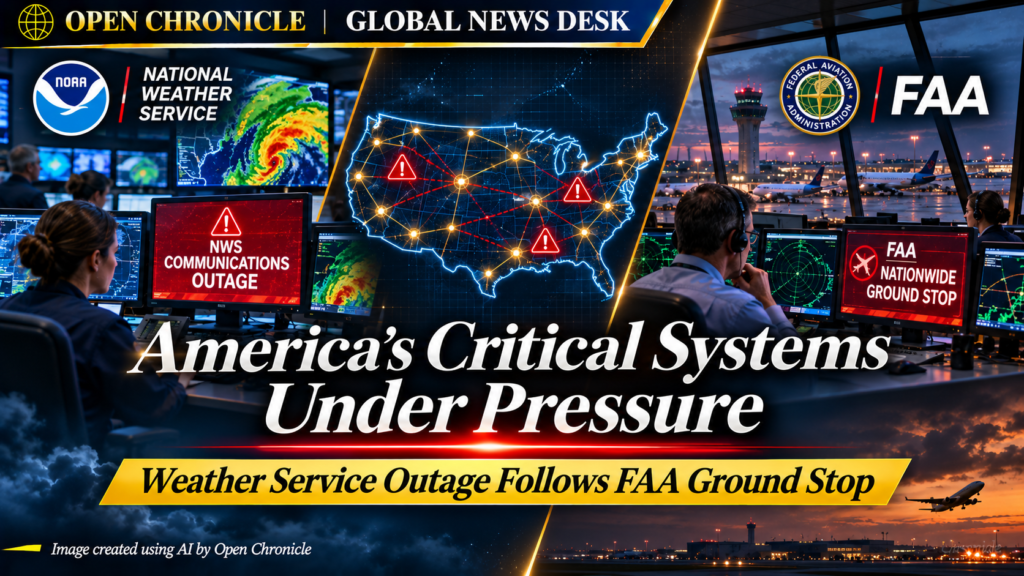
Hours after a major communications breakdown forced the Federal Aviation Administration to halt departures across the United States, the National Weather Service reported nationwide internet and communications problems affecting access to weather forecasts and warnings. The two disruptions have raised urgent questions about the resilience of America’s essential information systems, although no connection between the incidents has been established.
By Open Chronicle News Desk
November 13, 2026 | Breaking News & Analysis
Introduction | Two critical American services disrupted in one day
The United States is confronting a second major communications disruption after the National Weather Service (NWS) reported widespread problems affecting its internet connectivity and the availability of weather information across the country.
The announcement came on Friday evening, November 13, only hours after the Federal Aviation Administration (FAA) imposed a nationwide ground stop because of communications failures affecting air traffic control operations.
In a notice published on its official website, the NWS acknowledged that its services were experiencing nationwide internet and communications difficulties.
The agency warned that users might be unable to access weather products through its websites or could encounter information that had not been updated.
Technicians were working to resolve the disruption, but the agency did not provide an estimated restoration time.
Crucially, local National Weather Service offices continued issuing forecasts and warnings, meaning the disruption did not amount to a complete suspension of American meteorological operations.
The simultaneous difficulties affecting aviation and meteorological information have nevertheless raised broader questions about the reliability of critical public infrastructure.
Both services play essential roles in protecting lives, supporting transportation and helping communities prepare for emergencies.
However, there is currently no verified evidence that the FAA and NWS disruptions share a common technical cause, resulted from a cyberattack or were deliberately coordinated.
Their proximity in time warrants investigation, not premature conclusions.
1. What the National Weather Service announced
The NWS issued a public notice acknowledging nationwide internet and communications problems.
According to the agency’s statement, users could experience difficulties accessing information published through its online platforms.
Some weather products might also appear outdated.
This distinction is important because weather information is time-sensitive.
Forecasts, severe weather warnings, radar products and other meteorological data are regularly updated to reflect changing atmospheric conditions.
When an online platform fails to publish the latest information, users may encounter forecasts or warnings that no longer reflect the most recent observations.
The NWS said its technical teams were actively working to restore normal service.
The agency apologized for the disruption but did not announce a timetable for full recovery.
At the time of the initial report, officials had not publicly identified the technical origin of the failure.
The absence of a confirmed explanation means it is not yet possible to determine whether the problem involved internet connectivity, internal networking, telecommunications infrastructure, publishing systems or another technical component.
The incident therefore remains a developing operational issue.
2. Local weather offices continued issuing forecasts and alerts
One of the most significant details in the NWS announcement is that local forecast offices remained operational.
The United States maintains a decentralized meteorological network in which regional and local offices provide weather forecasts, warnings and specialized information.
These offices support communities facing hurricanes, tornadoes, severe thunderstorms, winter storms, flooding and extreme temperatures.
Although the national communications disruption affected access to some online products, the agency indicated that local offices continued producing forecasts and warnings.
Some information also remained available through external platforms.
This means the disruption should not be described as a complete shutdown of the National Weather Service.
The difference between generating meteorological information and distributing that information to the public is essential.
A weather forecast may exist within an operational system even when a website or distribution channel is unavailable.
However, a failure affecting public access can still create serious difficulties.
Residents, emergency managers, journalists and businesses may depend on timely information from official sources.
If those sources become unavailable or outdated, users must find reliable alternative channels while avoiding inaccurate or obsolete information.
3. Why the interruption matters for public safety
The National Weather Service is not simply a forecasting organization.
It forms part of the United States’ emergency preparedness infrastructure.
Its information helps authorities issue warnings, coordinate evacuations, prepare for severe weather and protect vulnerable communities.
Accurate and timely meteorological information is also essential for agriculture, transportation, energy production and emergency response.
A communications failure can therefore have consequences even when the underlying forecasting operations continue.
The immediate risks depend on which services are affected, how long the disruption lasts and whether alternative information channels remain available.
For example, an outdated forecast on a website may create confusion during rapidly changing weather conditions.
A delayed warning could also affect decisions by people traveling or working outdoors.
However, there is no basis in the supplied information to conclude that a particular emergency warning failed to reach the public or that the incident caused injuries.
Those outcomes would require separate confirmation.
The key concern is the reliability of the systems used to distribute potentially life-saving information.
4. The FAA crisis that preceded the weather service outage
Earlier on Friday, the FAA ordered a nationwide suspension of departing flights following communications problems affecting its network of 22 regional air traffic control centers.
The centers coordinate aircraft traveling between airports and play an essential role in managing the national airspace.
Transportation Secretary Sean Duffy said FAA technicians were investigating the malfunction.
The ground stop was imposed as a safety precaution, while aircraft already airborne continued to be managed under applicable air traffic procedures.
International flights were to be assessed individually.
The Associated Press confirmed the nationwide ground stop and the investigation into the communications failure.
The incident was particularly serious because a nationwide suspension of departures is exceptionally rare.
The previous nationwide ground stop occurred in January 2023, following a malfunction involving the FAA’s Notice to Air Missions system.
Before that, the most notable comparable national shutdown occurred after the terrorist attacks of September 11, 2001.
Friday’s disruption therefore represents a significant operational event for American aviation.
The fact that the National Weather Service subsequently reported communications difficulties adds to concerns about the reliability of essential public information systems.
But the sequence of events does not establish a technical connection.
5. Are the FAA and NWS failures connected?
This is the central question raised by the two incidents.
Both agencies reported communications problems affecting services with nationwide importance.
Both depend on complex digital and telecommunications infrastructure.
Both provide information essential to transportation and public safety.
Nevertheless, these similarities are not sufficient to demonstrate that the failures originated from the same network, supplier or technical malfunction.
The FAA and NWS operate different systems with distinct responsibilities and infrastructure arrangements.
It is possible for unrelated technical failures to occur on the same day.
Establishing a connection would require technical evidence identifying a shared component, service provider or underlying event.
At the time of the reports reviewed, no such connection had been established.
The same caution applies to suggestions of cyberattacks or sabotage.
Homeland Security Secretary Markwayne Mullin said there was no indication of malicious activity behind the FAA telecommunications outage, although the investigation remained ongoing.
No verified information establishes that the NWS disruption resulted from malicious interference.
The correct conclusion is that two nationally important American services reported communications problems on the same day, while the relationship between those problems remains unknown.
6. Could weather information disruption affect aviation?
The National Weather Service and the Federal Aviation Administration perform different functions, but aviation relies heavily on meteorological information.
Pilots, airlines, airport operators and air traffic controllers need accurate weather data to make operational decisions.
Conditions such as thunderstorms, strong winds, icing, turbulence, low visibility and severe winter weather can affect aircraft operations.
Specialized aviation weather products support flight planning and safety decisions.
A disruption affecting the distribution of meteorological information could therefore create additional operational difficulties if aviation users cannot obtain the data they need.
However, the supplied reporting does not establish that the NWS outage caused any particular aviation delay or contributed to the FAA’s communications failure.
Those possibilities should not be presented as facts.
The significance lies in the potential interaction between two essential systems.
Aviation depends on reliable communications and reliable weather information.
Failures affecting either can complicate operational decisions.
If both services experience disruptions close together, maintaining alternative information channels becomes particularly important.
7. A broader question about American critical infrastructure
The incidents have brought renewed attention to the resilience of the systems supporting essential public services.
Modern infrastructure depends increasingly on digital networks, telecommunications equipment, software platforms and interconnected services.
This dependence can improve efficiency and expand access to information.
It can also create vulnerabilities when important systems become unavailable.
In the aviation sector, communications failures can lead to flight restrictions.
In meteorology, distribution failures can prevent users from accessing current forecasts and warnings.
Similar concerns exist in healthcare, energy, water management and emergency communications.
The challenge is not simply preventing every technical malfunction, an unrealistic objective for any complex infrastructure network.
It is ensuring that failures can be contained and that essential services continue operating through alternative arrangements.
That requires redundancy, regular testing, clear incident procedures and investment in infrastructure maintenance.
The events of November 13 provide a reason to examine these safeguards, even if the two failures ultimately prove unrelated.
8. Why backup communications matter
Critical public services cannot rely entirely on a single method of distributing information.
Alternative channels are important when websites, network connections or internal communications systems experience problems.
For weather information, these may include authorized partner services, emergency broadcasting systems and other established warning channels.
For aviation, contingency procedures are designed to maintain safety when normal operations are interrupted.
The effectiveness of these arrangements depends on whether they remain available during the specific failure.
A backup system that depends on the same failed infrastructure may offer limited protection.
That is why technical resilience requires attention to shared dependencies as well as individual equipment.
The NWS statement that local offices continued issuing forecasts and warnings suggests that at least some operational capabilities remained available.
However, the precise extent of the distribution disruption has not been independently established.
9. What authorities still need to clarify
Several questions remain unanswered.
The National Weather Service has not provided a confirmed technical explanation for the nationwide communications problems described in its notice.
It has also not established a public timetable for restoring normal access to its online products.
Authorities will need to clarify which systems were affected, whether warning dissemination experienced delays and which alternative services remained available.
The FAA investigation must separately determine the cause of the air traffic control communications failure.
It will also be important to establish whether any shared infrastructure or external telecommunications provider was involved in both incidents.
Such a connection cannot be assumed.
Further official updates will be necessary to determine the full operational consequences and whether additional measures are required to prevent similar failures.
10. The challenge for federal infrastructure modernization
The aviation incident occurred during a major federal effort to modernize America’s air traffic control systems.
Congress approved $12.5 billion for modernization in 2025.
Transportation Secretary Sean Duffy has said that an additional $30 billion will be required to complete the work.
The program includes replacing aging copper communications lines with fiber optic infrastructure and upgrading older radio equipment.
These investments are intended to improve reliability and operational performance.
The NWS disruption raises a separate but related policy question: whether other critical federal information systems have sufficient resources, redundancy and technical resilience.
No evidence currently establishes that outdated NWS equipment caused the reported failure.
Nevertheless, the broader discussion about infrastructure investment is likely to extend beyond aviation.
The reliability of essential government services depends not only on technological innovation but also on maintenance, system architecture, cybersecurity and the capacity to recover from unexpected disruptions.
Conclusion | Two failures, one urgent question
The United States experienced two significant communications disruptions on November 13, 2026.
The FAA suspended departures nationwide after problems affected air traffic control communications.
Hours later, the National Weather Service reported nationwide internet and communications difficulties that could leave online weather information unavailable or outdated.
Local meteorological offices continued issuing forecasts and warnings, while technicians worked to restore normal access.
Neither agency had established a publicly confirmed technical cause in the initial reporting reviewed.
There is also no verified evidence linking the incidents to each other or to a coordinated cyberattack.
The immediate priorities are restoring services, identifying the causes and ensuring that essential information remains accessible.
The broader issue is the resilience of the digital and telecommunications infrastructure on which modern public safety depends.
When aviation communications and weather information systems experience serious disruptions on the same day, the question is not whether the incidents appear connected. It is whether America’s critical infrastructure has sufficient safeguards to keep essential services operating when technology fails.
Open Chronicle will continue monitoring official updates from the National Weather Service, the Federal Aviation Administration and other relevant federal authorities.
Sources and Further Reading
Reporting and official resources concerning the November 13, 2026 communications disruptions affecting US weather information services and the national aviation system.
US National Weather Service Reports Nationwide Problems
Reporting on the National Weather Service notice concerning internet and communications problems, potentially unavailable or outdated weather products, and continuing local forecast operations.
FAA Orders Nationwide Ground Stop
Independent reporting on the communications failure affecting the FAA’s regional air traffic control centers and the nationwide suspension of departures.
National Weather Service
Official US weather forecasts, warnings, regional forecast office information and public meteorological resources. This is a general official resource, not an archived incident statement.
NWS Administrative and Operational Messages
Official operational messages from the National Weather Service’s central forecasting and administrative systems. These provide context for operational monitoring but do not independently establish the cause of the outage.
National Airspace System Status
Official operational information about air traffic restrictions, ground stops, airport delays and other disruptions affecting US aviation.
This report was prepared on November 13, 2026, using the National Weather Service statement reproduced by UOL, Associated Press reporting and official US government resources. The NWS disruption affected access to some weather information, while local offices continued issuing forecasts and warnings. No verified technical evidence available at publication established a common cause linking the NWS and FAA communications failures. No confirmed finding attributed either incident to a coordinated cyberattack. Service availability and technical findings may change as investigations progress.