
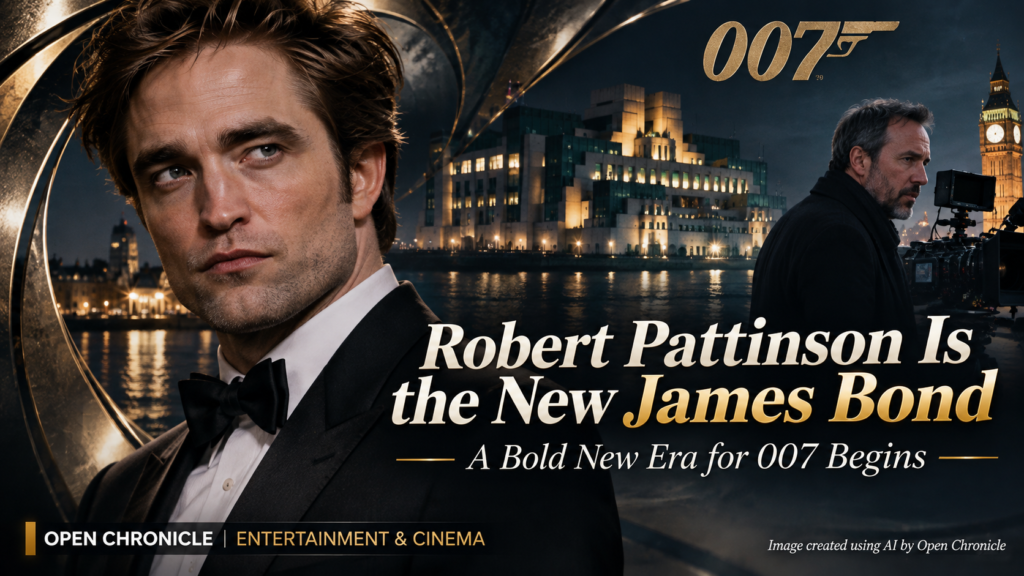
OPEN CHRONICLE | ENTERTAINMENT & CINEMA
After five years of speculation, Amazon MGM Studios has officially named Robert Pattinson as Daniel Craig’s successor. With Denis Villeneuve directing and Steven Knight writing the screenplay, the 26th James Bond film promises a major creative reinvention of cinema’s most famous secret agent.
By Open Chronicle Entertainment Desk
November 16, 2026 | Cinema | Entertainment
1. The Name Is Pattinson. Robert Pattinson.
The speculation is finally over.
After more than five years of rumours, casting debates and competing predictions, Amazon MGM Studios has officially confirmed that British actor Robert Pattinson will become the next James Bond.
The announcement, made on November 16, 2026, brings an end to one of Hollywood’s longest and most closely watched casting searches.
Pattinson, 40, succeeds Daniel Craig, whose five-film tenure concluded with No Time to Die in 2021.
He becomes the seventh actor to portray Bond in the official theatrical film series, following Sean Connery, George Lazenby, Roger Moore, Timothy Dalton, Pierce Brosnan and Craig.
But this is more than the announcement of a new leading man.
It marks the beginning of a new chapter for a franchise that has defined cinematic espionage for more than six decades.
The forthcoming film, currently referred to as Bond 26, will be directed by Denis Villeneuve and written by Peaky Blinders creator Steven Knight.
The combination of Pattinson’s unconventional career, Villeneuve’s distinctive visual storytelling and Knight’s experience with morally complex characters suggests that the next Bond could represent one of the franchise’s most ambitious creative transformations.
Amazon MGM Studios has confirmed the casting and principal creative team in an official announcement.
2. Why Robert Pattinson Is Such an Unexpected Choice
For years, speculation about Daniel Craig’s successor focused on actors considered more conventional candidates for the role.
Jack Lowden, Callum Turner, Josh O’Connor and Nicholas Hoult were among the names repeatedly associated with the search.
Each represented a different interpretation of Bond.
Some appeared well suited to the character’s traditional combination of British elegance, physical confidence and emotional restraint.
Pattinson, however, emerged as a more unpredictable possibility.
His career has been defined by an unusual willingness to move between major studio productions and challenging independent cinema.
He became an international star through the Twilight franchise, but subsequently pursued roles that frequently challenged his established screen image.
Rather than concentrating exclusively on commercial blockbusters, Pattinson worked with directors known for unconventional narratives, psychological intensity and experimental filmmaking.
That decision transformed his reputation.
He became an actor recognised not simply for celebrity appeal, but for his willingness to take creative risks.
For James Bond, that distinction matters.
The franchise has always depended on a balance between continuity and reinvention.
Pattinson offers the possibility of maintaining the character’s recognisable identity while exploring a different emotional and psychological interpretation.
3. From Twilight to The Batman: The Making of a Different Leading Man
His early appearance in Harry Potter and the Goblet of Fire introduced him to international audiences before Twilight transformed him into a global celebrity.
Rather than remain associated with a single type of character, he gradually built a filmography defined by artistic variety.
His work in Good Time, The Lighthouse and The Rover demonstrated his ability to portray unstable, isolated and morally ambiguous individuals.
Christopher Nolan’s Tenet placed him within a large-scale espionage thriller, providing an early demonstration of his ability to combine sophisticated dialogue, physical action and understated charisma.
Then came The Batman.
Released in 2022, the film presented Pattinson as a darker, more introspective Bruce Wayne.
His interpretation emphasised psychological isolation, obsession and the consequences of violence.
Those qualities could prove particularly relevant to James Bond.
Craig’s interpretation had already moved the franchise toward a more vulnerable and emotionally complex protagonist.
Pattinson could continue that evolution while introducing a different kind of intensity.
His ability to portray characters who conceal emotional turmoil beneath controlled outward behaviour may be especially valuable in a story about a professional intelligence operative.
The actor’s recent and forthcoming projects also demonstrate his continuing appeal to major filmmakers.
His credits include Mickey 17, Die, My Love, Primetime, Christopher Nolan’s The Odyssey and Villeneuve’s forthcoming Dune: Part Three.
4. Denis Villeneuve: A Director Who Could Transform the Franchise
The decision to appoint Denis Villeneuve is arguably as significant as the casting of Pattinson.
Villeneuve has established himself as one of contemporary cinema’s most distinctive directors.
His filmography includes Prisoners, Sicario, Arrival, Blade Runner 2049 and the Dune films.
Across these projects, several recurring characteristics emerge.
His films frequently explore power, moral ambiguity, institutional authority and the psychological consequences of violence.
They also demonstrate an unusual commitment to atmosphere.
Villeneuve often allows silence, composition and visual detail to carry dramatic meaning.
This approach could be particularly effective in a James Bond film.
The franchise is traditionally associated with spectacular action sequences, exotic locations, elaborate technology and memorable villains.
Villeneuve has demonstrated that large-scale spectacle can coexist with psychological tension and philosophical questions.
A Different Kind of Espionage Thriller
A Bond film directed by Villeneuve could potentially place greater emphasis on intelligence operations, surveillance, political manipulation and the human consequences of clandestine violence.
Such an approach would not necessarily require abandoning the franchise’s established attractions.
Instead, it could create a more grounded context for its familiar elements.
A chase sequence could become more than a display of technical virtuosity.
An encounter with an adversary could carry deeper political significance.
And Bond himself could be presented not simply as an exceptionally capable operative, but as someone navigating institutions whose motives are not always transparent.
These possibilities remain editorial interpretations.
Amazon MGM Studios has not yet disclosed the film’s plot or confirmed its narrative direction.
Nevertheless, Villeneuve’s previous work provides a compelling indication of the creative possibilities available to the production.
5. Steven Knight Brings a Different Kind of British Drama
The screenplay will be written by Steven Knight, the creator of Peaky Blinders.
Knight’s involvement adds another intriguing dimension to the project.
His writing frequently explores the intersection of violence, political influence, criminal networks and personal ambition.
In Peaky Blinders, the character of Tommy Shelby operates within a world where power is negotiated through loyalty, intimidation, intelligence and strategic calculation.
These themes are not entirely unfamiliar to the Bond universe.
James Bond is an operative whose professional responsibilities regularly place him in conflict with criminal organisations, foreign intelligence services and powerful individuals.
Knight’s experience with morally complicated protagonists could help develop a version of Bond whose motivations extend beyond the traditional requirements of the mission.
His dialogue also tends to emphasise tension, confrontation and the strategic use of language.
That sensibility could complement Villeneuve’s restrained visual style.
Together, the writer and director represent a creative partnership with the potential to deliver a more psychologically sophisticated espionage thriller.
6. Amazon’s First Bond: A Historic Change Behind the Camera
The next James Bond film will also mark a major transition in the franchise’s production history.
For decades, the series was closely associated with the Broccoli family, whose stewardship helped maintain continuity across successive generations of actors and filmmakers.
Barbara Broccoli and Michael G. Wilson played central roles in overseeing the modern franchise.
That arrangement changed in 2025.
Following Amazon’s acquisition of MGM in 2022, Amazon MGM Studios entered into a new joint venture with the longtime Bond rights holders.
The agreement gave Amazon MGM creative control over the James Bond intellectual property.
This makes the forthcoming film the first Bond production developed under the studio’s new creative leadership.
Amy Pascal and David Heyman will produce the film, with Tanya Lapointe serving as executive producer.
The transition has generated considerable debate.
Some observers have expressed concern that a major technology and entertainment corporation could place excessive emphasis on expanding Bond into a broader commercial franchise.
Others argue that new financial resources and creative leadership could allow the series to evolve.
The appointment of Villeneuve and the casting of Pattinson suggest that Amazon is seeking to establish credibility through a high-profile filmmaking team.
However, the ultimate test will be the film itself.
A prestigious director and accomplished actor do not automatically guarantee artistic success.
The challenge will be to produce a compelling James Bond story while preserving the distinctive qualities that have sustained the franchise for more than 60 years.
7. What Happens to Bond After Daniel Craig?
Daniel Craig’s final appearance in No Time to Die presented an unusually definitive conclusion to his version of James Bond.
The film brought his character’s personal story to an end, creating a narrative challenge for any successor.
The franchise has reinvented Bond before, but the Craig era was distinguished by a relatively continuous storyline.
Beginning with Casino Royale, the films developed a more emotionally vulnerable interpretation of the character.
Relationships, personal losses and the consequences of Bond’s decisions became increasingly central to the narrative.
The new production must determine how to approach that legacy.
It could establish an entirely new continuity, presenting Pattinson’s Bond without direct connections to Craig’s story.
Alternatively, it could retain certain familiar institutions and supporting characters while introducing a different interpretation of the protagonist.
A third possibility would involve a contemporary reinvention of Bond’s origins, although no such approach has been announced.
At present, Amazon MGM Studios has not confirmed how the film will address continuity.
The question is important because Bond’s cinematic identity has always depended on a delicate relationship between familiarity and change.
Audiences expect the character to evolve, but they also expect him to remain recognisably James Bond.
8. Can Pattinson Preserve the Essential Bond Identity?
Every actor who has portrayed James Bond has brought something different to the role.
Sean Connery established the character’s combination of confidence, sophistication and danger.
Roger Moore emphasised charm and humour.
Timothy Dalton explored a more serious and occasionally ruthless interpretation.
Pierce Brosnan combined traditional elegance with the increasingly spectacular action style of the 1990s.
Daniel Craig introduced a physically intense and emotionally vulnerable Bond.
Pattinson now faces the challenge of creating an identity that feels both original and connected to that history.
He possesses several qualities that could support the transition.
His screen presence can be restrained and enigmatic.
He has demonstrated an ability to perform action sequences without losing emotional complexity.
And he is comfortable portraying characters whose intentions are difficult to interpret.
Yet Bond is not simply a psychologically complicated protagonist.
The character also requires charisma, humour, confidence and an ability to command the screen.
Pattinson’s performance will need to balance these qualities.
The result could be a Bond who is less overtly self-assured than some predecessors, but no less compelling.
9. The Next Bond Film: What Is Confirmed?
BOND 26 | PRODUCTION FILE
| James Bond | Robert Pattinson |
| Director | Denis Villeneuve |
| Screenwriter | Steven Knight |
| Producers | Amy Pascal and David Heyman |
| Executive producer | Tanya Lapointe |
| Studio | Amazon MGM Studios |
| Film | 26th official Bond film |
| Official title | Not announced |
| Release date | Not officially announced |
| Additional cast | Not yet announced |
Production information confirmed by Amazon MGM Studios on November 16, 2026.
Industry reporting suggests production could begin in 2027, with a possible theatrical release in 2028.
Those dates remain provisional.
Amazon MGM Studios has not announced an official release date or filming schedule.
10. Who Will Join Pattinson in the New Bond Universe?
One of the biggest unanswered questions concerns the supporting cast.
The identity of the next principal female characters remains unknown.
The same applies to the principal villain, Bond’s intelligence colleagues and the potential return of familiar figures such as M, Q and Moneypenny.
The casting decisions will provide important clues about the production’s intended direction.
Villeneuve’s films often feature strong ensemble performances, with supporting characters playing essential roles in developing the story’s political and emotional dimensions.
Knight’s writing similarly tends to give considerable importance to secondary characters and competing centres of power.
The new Bond could therefore benefit from a supporting cast whose motivations and relationships are developed more extensively than in some earlier instalments.
However, there have been no official announcements identifying the actors who will fill these roles.
Any casting speculation should be treated as such until confirmed by the studio.
11. Could This Be the Most Ambitious Bond Film in Decades?
The combination of Pattinson, Villeneuve and Knight has generated considerable expectations.
Each brings a distinctive set of strengths.
Pattinson offers unpredictability and emotional complexity.
Villeneuve brings visual ambition and an established ability to construct immersive cinematic worlds.
Knight contributes experience writing morally ambiguous characters and stories involving power, loyalty and institutional conflict.
Together, they could produce a film that combines traditional Bond spectacle with a more sophisticated exploration of contemporary espionage.
But expectations also create risks.
A darker or more introspective interpretation could alienate viewers who associate Bond with humour, glamour and escapism.
An excessively conventional approach, meanwhile, could fail to take advantage of the creative team’s strengths.
The most successful outcome may lie between these extremes.
Bond does not need to abandon his identity to become relevant to a new generation.
He needs a story that understands why the character has endured while recognising how the world around him has changed.
12. What the Next James Bond Must Get Right
01
Preserve Bond’s identity
Maintain the character’s intelligence, confidence, wit and distinctive screen presence while allowing Pattinson to develop an original interpretation.
02
Build a compelling espionage story
Give the film a strong narrative involving intelligence, deception and political stakes rather than relying exclusively on spectacle.
03
Create a memorable antagonist
Develop a villain whose motivations and capabilities present a credible challenge to Bond.
04
Balance spectacle and atmosphere
Combine the franchise’s established action traditions with Villeneuve’s visual storytelling and sense of tension.
05
Establish a sustainable new era
Deliver a satisfying standalone film while leaving room for future stories without making franchise expansion more important than the narrative.
Open Chronicle editorial assessment of the creative challenges facing Bond 26.
13. A New Era for One of Cinema’s Most Enduring Characters
James Bond first appeared in Ian Fleming’s 1953 novel Casino Royale.
The cinematic franchise began in 1962 with Dr. No, starring Sean Connery.
Over the following decades, the character became one of the most recognisable figures in international popular culture.
The films helped establish conventions that continue to influence action cinema, from elaborate opening sequences and distinctive musical themes to sophisticated villains and spectacular locations.
Yet Bond has survived precisely because the franchise has repeatedly adapted.
The Cold War gave way to new geopolitical tensions.
Espionage became increasingly shaped by technology, surveillance and cyber capabilities.
And changing cultural expectations influenced the way the character’s relationships, behaviour and personal vulnerabilities were portrayed.
Pattinson’s casting represents another opportunity for reinvention.
At 40, he brings both the experience of a long international career and the potential to establish a new cinematic identity for the character.
With Villeneuve directing, the franchise has an opportunity to combine its historical legacy with an ambitious contemporary filmmaking approach.
Whether the result becomes a defining Bond film will depend on choices that have yet to be revealed.
But the creative possibilities are considerable.
Conclusion | The Next James Bond Could Be the Most Interesting Yet
Robert Pattinson’s appointment as James Bond ends one of the longest periods of uncertainty in the franchise’s history.
It also begins a more important conversation about the future of 007.
Amazon MGM Studios has chosen an actor known for challenging expectations rather than simply reproducing established formulas.
The decision to pair him with Denis Villeneuve and Steven Knight suggests an ambition to give the franchise a distinctive new creative identity.
The next Bond film will still need the essential ingredients that have sustained the character for generations.
But it also has an opportunity to explore espionage, power and personal identity through a different cinematic perspective.
The question is no longer who will become James Bond. It is what kind of James Bond Robert Pattinson will create.
And with Villeneuve behind the camera, that question has become one of the most intriguing prospects in contemporary cinema.
Sources and Further Reading
Amazon MGM Studios | Robert Pattinson Is the New James Bond
November 16, 2026. Official confirmation of Pattinson’s casting, Denis Villeneuve as director, Steven Knight as screenwriter, and the production team led by Amy Pascal and David Heyman.
Reuters | British Actor Robert Pattinson Named as New James Bond
November 16, 2026. Independent reporting on Pattinson’s appointment, the history of the Bond franchise and Amazon MGM Studios’ assumption of creative control.
The Guardian | Robert Pattinson Announced as the New James Bond
November 16, 2026. Coverage of the casting process, Pattinson’s career, Daniel Craig’s legacy and the creative transition of the franchise.
Los Angeles Times | Robert Pattinson Will Be the Next James Bond
November 16, 2026. Reporting on the audition process, competing candidates and the selection of Pattinson for the forthcoming Bond production.
Amazon MGM Studios | Next James Bond Film: Everything You Need to Know
Updated November 16, 2026. Official production information, including the confirmed creative team and the status of the forthcoming film.
ITV News | Robert Pattinson Unveiled as James Bond
November 16, 2026. Reporting on the official announcement, Pattinson’s reaction and the expected production timetable. No definitive release date has been announced.
This article is based on the official announcement issued by Amazon MGM Studios on November 16, 2026, and reporting from established international news and entertainment organisations. Robert Pattinson’s casting and the principal creative team have been officially confirmed. The film’s title, release date, storyline and additional casting remain unannounced. Interpretations of Pattinson’s acting style, Denis Villeneuve’s potential creative direction and the future of the James Bond franchise represent Open Chronicle editorial analysis rather than confirmed production details.