
OPEN CHRONICLE | TECHNOLOGY & SCIENCE | 16 NOVEMBER 2026
Forty-eight artificial intelligence agents, NASA laser mapping data and an ancient Maya settlement hidden beneath tropical forest. The ingredients seemed to promise a remarkable archaeological discovery. But the site had already been documented by researchers. The episode reveals a growing problem in AI-assisted science: recognising a pattern is not the same as producing new knowledge.
By Open Chronicle Technology & Science Desk
Artificial Intelligence | Archaeology | Scientific Discovery | Digital Research
The Story at a Glance
AI agents used in the experiment
Reported time from idea to official response
Year of the earlier archaeological publication
SOURCES:
Pietro Miotti’s project account and subsequent correction;
The Verge, 12 November 2026.
A discovery that seemed to come from nowhere
Deep beneath the tropical forest of Mexico, traces of ancient Maya settlements remain hidden from ordinary view.
Stone platforms, ceremonial structures, plazas and abandoned residential complexes can disappear beneath centuries of vegetation.
To an observer looking at conventional satellite imagery, the landscape may appear to be an uninterrupted expanse of green.
But laser mapping can reveal a different world.
By measuring the terrain beneath the forest canopy, researchers can identify subtle geometric patterns that may indicate ancient human activity.
In November 2026, a personal experiment conducted by Google researcher Pietro Miotti appeared to demonstrate just how dramatically artificial intelligence could accelerate that process.
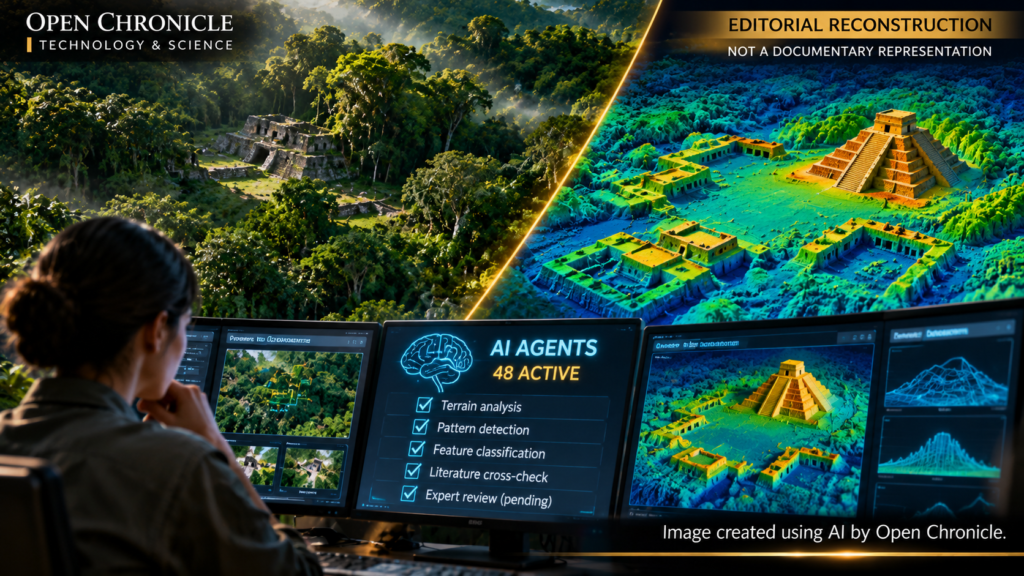
Miotti assembled a system of 48 AI agents to analyse publicly available lidar data associated with NASA research.
The agents searched terrain images for features that resembled archaeological structures.
Among the locations flagged was a hilltop area containing patterns interpreted as a possible Maya settlement, including a plaza, platforms and a pyramid-like structure.
The experiment appeared to have produced a striking result.
Within approximately 72 hours, according to Miotti’s account, an idea conceived while travelling had developed into a report submitted to Mexico’s National Institute of Anthropology and History, known as INAH.
The institute reportedly responded that it had no registered archaeological site at the specified location.
The apparent discovery attracted attention online.
It suggested that a relatively small, independently organised AI workflow might identify previously unknown archaeological sites with extraordinary speed.
There was, however, a crucial problem.
The site was not previously unknown to archaeological research.
It had already been mapped and documented in a scientific publication from 2025.
The distinction transformed the story.
What initially appeared to be evidence of AI making a major archaeological discovery became a case study in the limits of automated scientific investigation.
theverge.com+1
The experiment: 48 agents searching beneath the jungle
Miotti’s project began with a relatively simple question.
Could contemporary AI agents use existing remote-sensing data to identify archaeological features that researchers might have overlooked?
The idea was not to build a new satellite or conduct an expedition.
Instead, the project relied on data already collected through lidar, a technology that has become increasingly important in archaeology.
Lidar, short for Light Detection and Ranging, uses laser pulses to measure distances.
When deployed from aircraft, lidar systems can produce detailed three-dimensional measurements of the landscape.
Some laser returns penetrate gaps in vegetation and reach the ground.
Researchers can then process the measurements to create digital terrain models that reduce the visual obstruction caused by forest cover.
This does not mean lidar literally sees through every tree or reveals buried objects.
It provides measurements from which the shape of the terrain can be reconstructed.
That distinction matters because archaeological interpretation still requires expertise.
A raised platform might be an ancient building foundation.
It might also be a natural landform, a modern disturbance or an unrelated feature.
Miotti’s approach involved distributing the examination of terrain imagery among multiple AI agents.
Rather than asking a single system to analyse an entire region, he used agents to inspect portions of the available data and identify promising patterns.
The workflow reportedly examined approximately 1,200 square kilometres of lidar coverage.
According to his account, the agents highlighted numerous locations containing potentially interesting geometric features.
One site attracted particular attention because its arrangement appeared consistent with an ancient settlement.
The system had identified a plausible archaeological candidate.
That was a meaningful technical demonstration.
But the experiment also required a second task.
The researcher needed to determine whether the location had already been documented.
It was at this stage that the process failed.
The moment an unregistered site became an alleged discovery
After identifying the candidate location, Miotti contacted INAH.
The purpose was to determine whether the apparent settlement was already known to the Mexican authorities.
According to his account, the institute reported that it had no registered archaeological site at the supplied coordinates.
That response appeared to support the possibility that the location was previously undocumented.
But it did not establish that conclusion.
An official archaeological register is not necessarily a complete catalogue of every location described in scientific literature.
Researchers may have mapped a site without its coordinates appearing in a particular administrative database.
Some discoveries are documented in regional surveys, academic papers or unpublished fieldwork.
Others may be known to local communities even when they are absent from formal records.
Consequently, the statement that a site is not registered does not mean that nobody has previously identified or studied it.
This distinction became central to the controversy.
Miotti had treated the absence of a registration record as encouraging evidence of novelty.
But establishing a new scientific discovery requires a much broader review of existing knowledge.
It is not enough to demonstrate that an AI system has identified something.
The researcher must also establish what that finding contributes beyond what is already known.
The 2025 paper the agents missed
The turning point came when archaeologists recognised that the supposed discovery had already appeared in earlier research.
The relevant publication was a 2025 study by Francisco Estrada-Belli, Marcello A. Canuto, Ivan Šprajc and Juan Carlos Fernández-Díaz.
The study examined Classic Maya population density and settlement distribution through airborne lidar mapping.
It formed part of a wider body of archaeological work demonstrating how remote sensing can reveal ancient settlement patterns across the Maya region.
The location flagged by Miotti’s agents had already been mapped in that research.
On 11 November, Miotti updated his account to acknowledge the earlier publication and credit the archaeologists.
He also acknowledged that his agents had failed to recognise the overlap with existing scholarship.
The correction was significant.
It changed the status of the result from a claimed new discovery to a rediscovery of a previously documented location.
The experiment had not necessarily failed at identifying archaeological features.
Instead, it had failed at verifying whether those features represented new knowledge.
This is an important distinction because the two tasks require different capabilities.
Recognising a possible ancient structure in terrain imagery is primarily a pattern-detection problem.
Establishing that the structure has not already been documented is a research-verification problem.
The second requires careful engagement with academic literature, maps, figures, archaeological catalogues and regional expertise.
An AI agent may be able to search thousands of pages of text while still missing information embedded in a map or illustration.
In archaeology, that information can be decisive.
A settlement may not be described under a name that matches the search query.
Its position may appear only as a symbol on a regional map.
Its coordinates may be deliberately withheld to protect the site.
The absence of a straightforward text match therefore does not establish that a location is unknown.
Miotti’s experiment exposed precisely this limitation.
Why archaeologists were not impressed
The initial enthusiasm surrounding the project was met with criticism from professional archaeologists.
Their objections were not simply expressions of hostility toward artificial intelligence.
Many archaeologists have been using advanced digital mapping, remote sensing and computational analysis for years.
Lidar has already transformed research into Maya settlement patterns.
The technology has revealed extensive networks of structures, agricultural modifications, roads and other features that conventional surveys could not easily identify across large areas.
The concern was therefore not that AI had entered an unfamiliar scientific field.
It was that a claim of discovery had been made without sufficient attention to the field’s existing knowledge.
Archaeologist Sarah Parcak, a professor at the University of Alabama at Birmingham, emphasised the importance of reviewing previous research and understanding the difference between administrative records and scientific documentation.
Ivan Šprajc, one of the authors of the 2025 study, explained that identifying a possible archaeological feature does not automatically contribute substantial new knowledge.
Elizabeth Graham, a professor of Mesoamerican archaeology at University College London, highlighted another issue.
Archaeologists already know of many sites that have not been fully excavated, surveyed or studied.
The limiting factor is often not the ability to identify additional locations.
It is the availability of funding, personnel and resources to investigate them properly.
These observations challenge a popular narrative about artificial intelligence.
Finding more potential sites is not necessarily the same as advancing archaeological understanding.
A discovery becomes scientifically valuable when researchers can establish its context, chronology, significance and relationship to existing knowledge.
theverge.com
The technology behind the controversy
The Maya episode is particularly interesting because it involved two distinct technologies that are sometimes confused in public discussion.
The first was lidar.
The second was artificial intelligence.
Lidar provided the underlying terrain measurements.
AI agents helped inspect the processed data.
Neither technology independently established that the identified location represented a new archaeological discovery.
Understanding this distinction is essential.
Lidar has been used in archaeological research for decades.
Its application in tropical environments has expanded the scale at which researchers can investigate ancient landscapes.
The Maya region has been especially important in demonstrating its potential.
Large-scale surveys have identified settlement systems extending across areas previously difficult to examine from the ground.
Such work has challenged older assumptions about population distribution, urban development and the organisation of ancient societies.
Artificial intelligence can potentially accelerate the examination of these datasets.
Computer vision systems may help identify recurring shapes.
Automated workflows can prioritise areas for expert review.
Language models can assist with organising reports, searching literature and preparing research summaries.
But each function introduces different risks.
An image-analysis system may misclassify a natural formation.
A language model may misunderstand a technical description.
A literature-search agent may overlook relevant publications.
An automated report may present uncertain interpretations with excessive confidence.
When these components are combined, errors can propagate through the workflow.
The final report may appear comprehensive even when one of its most important conclusions is unsupported.
The Maya case illustrates that danger.
The system generated a plausible candidate location, but the novelty assessment was incomplete.
The difference between detecting and discovering
Scientific discovery is not merely the identification of an object or pattern.
It involves establishing something that meaningfully extends existing knowledge.
In archaeology, that process can include several stages.
From Detection to Scientific Discovery
Identifying a potential archaeological site is only the beginning. Reliable scientific discovery requires verification, historical research, expert interpretation and evidence-based conclusions.
Detection
A remote-sensing system identifies a feature that may be archaeological.
Verification
Researchers determine whether the feature is real, relevant and distinguishable from natural or modern formations.
Literature Review
Existing publications, maps, catalogues and local knowledge are examined to establish whether the location has already been documented.
Archaeological Interpretation
Specialists investigate the site’s chronology, function, cultural context and relationship to surrounding settlements.
Scientific Contribution
Findings are documented, evaluated and communicated with appropriate evidence, attribution and uncertainty.
This framework provides an editorial explanation of the archaeological research process. It is not intended as a mandatory universal scientific protocol. The sequence illustrates why automated detection alone cannot establish a verified archaeological discovery.
This is an editorial explanation of the research process, not a mandatory universal archaeological protocol.
AI may contribute to several of these stages.
But success at one stage does not establish success at all the others.
A system can correctly identify a previously mapped structure.
It can also incorrectly classify a natural feature as archaeological.
Or it can locate something genuinely unknown while failing to interpret its significance.
These outcomes should not be treated as equivalent.
In the Miotti experiment, the central problem was not that the agents necessarily imagined a settlement.
It was that the research process failed to establish novelty before the result attracted public attention.
The forgotten role of local knowledge
The controversy also raises a deeper question about the language of discovery.
When an archaeological site is described as newly discovered, who is being considered?
A location may be unknown to an international research team while remaining familiar to nearby communities.
People living in a region may have encountered ancient structures, landscape modifications or traditional place names long before those features appear in a scientific database.
The history of archaeology contains many examples in which outside researchers received public recognition for places already known locally.
This creates an important responsibility when using automated discovery systems.
A site absent from a particular dataset is not necessarily unknown.
A site absent from an academic publication is not necessarily unknown to the people who live nearby.
AI systems trained to search formal records may reproduce the limitations of those records.
They can overlook oral histories, local terminology and knowledge that has never been digitised.
The issue is especially relevant in regions with complex relationships between archaeological institutions, Indigenous communities and international research organisations.
The Maya civilisation is not simply a vanished historical culture.
Maya communities continue to live across parts of Mexico and Central America.
Their histories, languages and relationships with cultural heritage are essential to responsible archaeological practice.
Technological innovation should not erase that context.
If AI is used to identify potential sites, meaningful engagement with local expertise remains important.
A new problem: AI can accelerate claims faster than verification
One of the most significant implications of the incident concerns the speed of scientific communication.
Miotti’s workflow reportedly progressed from an initial idea to contact with Mexican authorities in less than three days.
That speed is impressive.
It also demonstrates how quickly automated systems can generate claims requiring specialist verification.
Traditional archaeological research may involve years of fieldwork, data processing, literature review and collaboration.
AI-assisted workflows can dramatically shorten some analytical stages.
But they do not automatically shorten every stage required for reliable scientific conclusions.
This creates a potential imbalance.
The production of candidate discoveries may become extremely inexpensive.
The work needed to verify them may remain costly and time-consuming.
An archaeologist could receive dozens of automated reports identifying possible sites.
Each report might require checking original datasets, reviewing publications, comparing maps and evaluating archaeological context.
If the reports are inaccurate or repetitive, they can consume scarce research resources.
Šprajc expressed concern about the possibility of specialists being overwhelmed by messages from people using AI to claim archaeological discoveries.
The issue extends beyond archaeology.
Similar problems could emerge in astronomy, biology, medicine and other scientific fields.
AI systems can generate hypotheses at scale.
But verifying those hypotheses still requires appropriate evidence and domain expertise.
The result could be a growing gap between the speed of automated claims and the capacity of scientific institutions to evaluate them.
The danger of publishing archaeological coordinates
Another concern involves the protection of archaeological heritage.
Publicising the precise location of a previously undocumented site can attract unwanted attention.
Looting remains a serious problem in many archaeological regions.
Uncontrolled visits can also damage fragile structures or disturb contexts that have not been properly investigated.
This is one reason archaeological publications do not always disclose exact coordinates.
The practice complicates automated literature searches.
A system attempting to determine whether a location is already known may not find a direct coordinate match.
But that limitation exists for a legitimate reason.
Protecting cultural heritage may require withholding sensitive geographical information.
The Maya episode therefore illustrates a conflict between two objectives.
AI systems benefit from extensive, accessible data.
Archaeological conservation sometimes requires restricting access to particular information.
Responsible research must balance those needs.
Automated discovery tools should not assume that publishing every detected location is scientifically or ethically desirable.
What the experiment actually demonstrated
Despite the criticism, the project should not be dismissed as entirely worthless.
Its value lies in demonstrating both the potential and the limitations of AI-assisted archaeological analysis.
The agents reportedly identified terrain patterns consistent with a location that had already been recognised by specialists.
That suggests automated workflows may be useful for screening large lidar datasets and prioritising candidate areas.
The experiment also showed how AI can assist with organising research tasks and preparing communications.
However, several important claims remain unproven.
The publicly described workflow does not establish that the system can reliably identify previously unknown Maya sites.
It does not demonstrate a validated archaeological discovery rate.
It does not establish that the agents outperform established remote-sensing methods.
And it does not replace expert interpretation or field verification.
Those questions would require systematic testing.
For example, researchers could compare AI-generated candidate lists with independently verified archaeological maps.
They could measure false positives, missed sites and the time required for expert review.
They could also assess whether AI systems can reliably recognise prior research when relevant information appears in maps rather than searchable text.
Such evaluations would provide a stronger basis for judging the technology’s scientific usefulness.
The lesson is not that AI has no place in archaeology.
It is that technical demonstrations and scientific breakthroughs are different things.
What this means for the future of AI-assisted science
The incident arrives at a moment when AI agents are being promoted as tools capable of performing increasingly complex research tasks.
Unlike a conventional chatbot responding to a single question, an agentic workflow may involve multiple steps.
A system can retrieve information, inspect datasets, generate reports, use software tools and revise its outputs.
Several agents may also divide a larger problem into smaller tasks.
These capabilities can be useful.
But scientific reliability depends on more than the number of agents involved.
Forty-eight systems can repeat the same mistaken assumption.
They can rely on incomplete databases.
They can miss a relevant publication.
They can also reinforce one another’s conclusions without introducing genuinely independent evidence.
Increasing the number of automated components does not necessarily improve verification.
The essential question is whether the workflow contains effective mechanisms for detecting mistakes.
In the Maya case, the agents’ ability to identify a candidate location was not matched by an equally reliable process for establishing whether the location was new to archaeology.
Future research systems will need stronger methods for handling uncertainty, provenance and prior scholarship.
They should distinguish between a promising candidate and a verified finding.
They should make clear which sources have been examined.
They should identify what remains unknown.
And they should preserve the role of specialists in evaluating claims that require domain expertise.
The most promising future may not involve AI replacing scientists.
It may involve systems that help researchers process more information while making the boundaries of automated analysis easier to understand.
The larger archaeological story the headlines missed
There is another irony in this episode.
The 2025 archaeological study that the agents overlooked contained findings far more substantial than the apparent rediscovery of one settlement.
Published in the Journal of Archaeological Science: Reports, the research examined population density and settlement distribution across the Central Maya Lowlands.
The authors combined multiple lidar datasets to study ancient urban and rural landscapes on a regional scale.
Their analysis produced an estimated Late Classic population of approximately 9.5 million to 16 million people across a study region of roughly 95,000 square kilometres.
These were model-based estimates, not a direct census of the ancient population.
The study also described a complex settlement landscape in which residential areas, agricultural land and ceremonial centres were closely connected.
Its findings contributed to a broader reassessment of Maya urbanism, suggesting that extensive settlement networks were more widespread and densely populated than earlier models had indicated.
That is the kind of scientific contribution that can emerge from careful archaeological research.
It combines data processing, methodological decisions, specialist interpretation and comparisons with existing scholarship.
The contrast is revealing.
An AI-assisted project gained attention for apparently identifying a single unknown site.
The earlier research had already used sophisticated mapping to investigate the structure of an entire ancient settlement system.
The problem was not that artificial intelligence had made archaeology obsolete.
It was that the excitement surrounding an automated result briefly obscured the work archaeologists had already completed.
Conclusion: AI can find patterns, but science must establish meaning
The story of the 48 AI agents and the Maya settlement is neither a triumph nor a complete failure.
It is a useful demonstration of what contemporary artificial intelligence can do, and what it still cannot reliably establish.
The agents helped identify terrain features consistent with an archaeological location.
The researcher organised the results and contacted the appropriate national institution.
The process moved quickly.
But the claim of novelty did not survive comparison with existing scientific literature.
The site had already been documented.
Miotti subsequently acknowledged the oversight and credited the earlier researchers.
That correction is an important part of the story.
Scientific progress depends not on avoiding every error, but on recognising mistakes, correcting the record and improving methods.
The deeper lesson concerns the meaning of discovery.
A machine may identify a shape.
It may recognise a pattern.
It may produce a persuasive report.
But scientific knowledge requires context, verification and a clear understanding of what is already known.
As artificial intelligence becomes more deeply integrated into research, those distinctions will become increasingly important.
The next generation of AI tools may help archaeologists identify thousands of potential sites.
Whether those systems transform our understanding of ancient civilisations will depend on something more demanding than detection.
They will need to help researchers distinguish between finding something and actually discovering something new.
Sources and Further Reading
Original project documentation, independent reporting and peer-reviewed archaeological research.
My AI Agents (Re)discovered a Maya Site in 72 Hours
First-person account of the experiment involving 48 AI agents, lidar data and correspondence with Mexico’s National Institute of Anthropology and History. Includes the author’s correction acknowledging that archaeologists had already mapped the location.
No, AI Agents Did Not Discover a Previously Unknown Maya Site
Reporting by Robert Hart examining the disputed discovery claim, the earlier archaeological publication and the reactions of professional archaeologists, including concerns about verification, scientific attribution and heritage protection.
New Regional-Scale Classic Maya Population Density Estimates and Settlement Distribution Models Through Airborne Lidar Scanning
Peer-reviewed research by Francisco Estrada-Belli, Marcello A. Canuto, Ivan Šprajc and Juan Carlos Fernández-Díaz. Published in volume 66, article 105288. The study documents regional Maya settlement patterns and provides the earlier research context overlooked in the AI experiment.
This article examines a publicly documented AI-assisted archaeological experiment and its subsequent correction. The original claim of a previously unknown Maya site was not substantiated because the location had already been mapped in a 2025 scientific publication. The analysis distinguishes automated pattern recognition from verified archaeological discovery. Statements concerning the experimental workflow are attributed to the project’s author, while the scientific context is grounded in published archaeological research and independent reporting. No archaeological coordinates are reproduced.