
OPEN CHRONICLE | TECHNOLOGY & ECONOMY | NOVEMBER 19, 2026
The artificial intelligence company behind Claude has completed the largest initial public offering in stock market history, raising more than $81 billion and briefly reaching a market valuation of $2 trillion during its Nasdaq debut. The extraordinary listing highlights Wall Street’s appetite for AI, but also exposes growing concerns over profitability, infrastructure spending and the sustainability of the industry’s valuations.
By Open Chronicle Technology Desk
Figures from Anthropic’s official IPO announcement and Reuters reporting on the first trading session.
1. A historic moment for the artificial intelligence industry
NEW YORK, November 19, 2026. Anthropic has entered the public markets in one of the most consequential financial events in the history of artificial intelligence.
The San Francisco company, founded by former OpenAI researchers and best known for its Claude family of AI models, began trading on the Nasdaq Global Select Market under the ticker ANT.
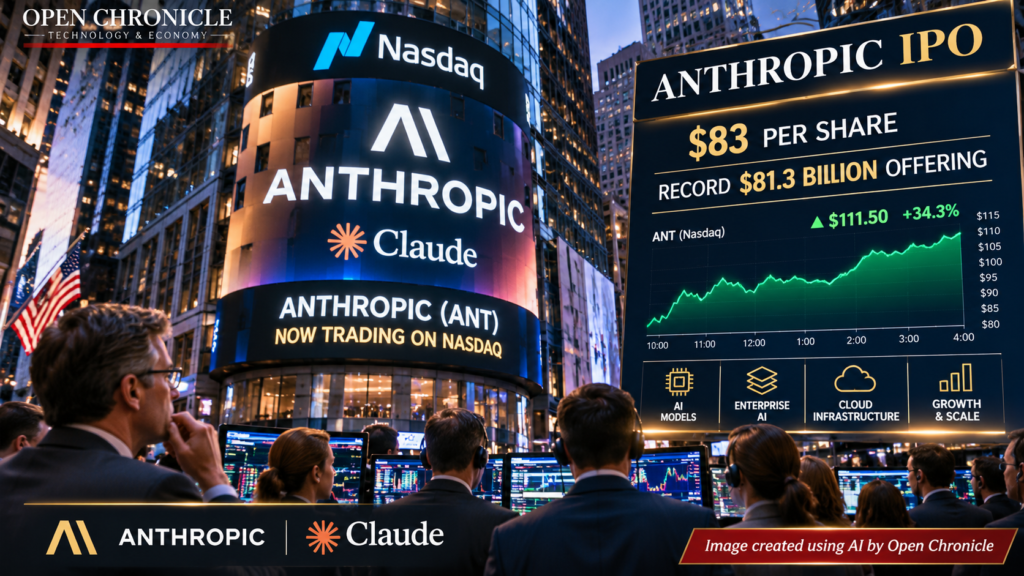
Anthropic priced its initial public offering at $83 per share on November 18, above the previously indicated range of $70 to $78.
The company offered 980 million shares, generating approximately $81.34 billion in gross IPO proceeds, including shares sold by existing shareholders.
The listing surpassed the record established by SpaceX earlier in 2026, becoming the largest IPO ever by the value of shares sold.
But the most striking development occurred when trading began.
Anthropic shares opened at $111.50, approximately 34.3% above the offering price, briefly giving the company an implied valuation of around $2 trillion.
The shares subsequently retreated from their opening levels, illustrating the considerable volatility surrounding the debut. Reuters reported a price around $99 later in the session.
The scale of the transaction demonstrates how artificial intelligence has moved beyond a venture capital investment theme to become one of the defining forces in global equity markets.
2. The largest IPO in history
Anthropic’s flotation was remarkable not only for its valuation but also for the amount of capital involved.
The company’s initial prospectus envisaged the sale of 825 million shares at a price between $70 and $78.
Strong investor demand allowed the offering to expand to 980 million shares, with the final price rising to $83.
Of those shares, 956,351,354 were sold by Anthropic itself, while 23,648,646 were sold by existing shareholders.
This distinction matters.
The proceeds from shares sold by Anthropic provide capital to the company, before underwriting fees and expenses. Proceeds from existing shareholders’ sales go to those shareholders rather than to Anthropic.
The company also arranged a separate $26 billion private placement, bringing the combined transaction value to approximately $107.3 billion.
How Anthropic’s IPO compares
$81.34B
$75B
Gross IPO proceeds, approximate. Private placement excluded.
Reuters and Associated Press identify Anthropic as having surpassed SpaceX’s June 2026 IPO record.
The IPO’s success is especially significant because it occurred during a period of growing uncertainty about technology valuations, higher financing costs and the enormous capital requirements of advanced AI development.
Investors were effectively being asked to assess whether Anthropic could convert its technological capabilities and rapid commercial expansion into sustainable long term profits.
3. Why investors are paying such extraordinary valuations
Anthropic occupies an important position in the rapidly expanding market for advanced artificial intelligence.
Its Claude models compete in areas including reasoning, software development, enterprise automation, document analysis and AI assisted research.
The company’s commercial strategy is particularly focused on businesses and developers that integrate AI into existing products and workflows.
This market has become strategically important because AI is increasingly being embedded into corporate software, cybersecurity operations, financial services, customer support and software engineering.
Investors see the possibility that advanced AI models could become foundational infrastructure for a substantial portion of the digital economy.
However, that possibility is not the same as guaranteed profitability.
The central investment question is whether the value generated by AI services will eventually exceed the cost of developing, operating and continuously improving the underlying models.
4. Anthropic’s financial performance: Explosive growth, enormous costs
One of the most important aspects of Anthropic’s IPO is the financial information disclosed during the listing process.
According to Reuters, Anthropic’s annualised revenue run rate reached approximately $81 billion by October 2026.
That figure reflects the pace of recent revenue generation projected over a full year. It should not be confused with actual revenue earned during a completed financial year.
The company reported approximately $16.96 billion in revenue during the third quarter of 2026, but continued to record operating losses.
Reported financial figures from Reuters. The categories cover different periods and accounting concepts and should not be added together.
The challenge of AI infrastructure
Developing advanced AI models requires access to exceptionally powerful computing systems.
These systems depend on specialised processors, high speed networking, large data centres, electricity, cooling and sophisticated software infrastructure.
Reuters reported that Anthropic spent nearly $9 billion on computing infrastructure during the first half of 2026, followed by approximately $5 billion in the third quarter.
The company also faces reported commitments approaching $900 billion for future computing capacity.
These commitments do not mean Anthropic has already spent that amount or that the entire sum is immediately payable.
Nevertheless, they illustrate the scale of its long term infrastructure ambitions.
The financial challenge is substantial: Anthropic must generate enough profitable demand to justify increasingly expensive computing resources.
Its future performance will depend partly on whether model efficiency improves faster than the cost of serving a rapidly growing customer base.
5. The importance of Amazon, Google, Microsoft and Nvidia
Anthropic’s development is closely connected to some of the world’s most influential technology companies.
Its commercial and infrastructure ecosystem includes major cloud providers, semiconductor manufacturers and strategic investors.
These relationships are essential because advanced AI companies require access to computing capacity that few organisations can build independently.
The IPO also involved a $26 billion private placement supported by major technology companies, with reporting identifying participants including AMD, Broadcom, Google, Microsoft and Nvidia.
This creates an unusual relationship between the AI industry and financial markets.
Technology companies invest in AI developers, supply them with computing infrastructure and potentially benefit from the resulting demand for processors, cloud services and enterprise software.
Such relationships can accelerate innovation and commercial adoption.
However, they also raise questions about financial concentration, commercial dependencies and the extent to which investment flows and infrastructure spending reinforce one another.
A new industrial ecosystem
Anthropic’s listing illustrates that the AI economy is no longer confined to software companies.
It increasingly involves semiconductor manufacturers, electricity suppliers, data centre operators, telecommunications networks, cloud infrastructure providers and enterprise software businesses.
The economic consequences extend well beyond Anthropic itself.
If AI demand continues expanding, these industries could benefit from sustained investment.
If growth disappoints, the effects could spread across companies that have committed substantial capital to AI infrastructure.
6. Anthropic versus OpenAI: A new chapter in the AI rivalry
Anthropic’s public listing creates a new competitive dynamic with OpenAI.
Both organisations develop advanced AI models, but their business strategies, products, partnerships and governance structures differ.
Anthropic has placed particular emphasis on enterprise AI, developer tools and AI safety research.
OpenAI competes across consumer applications, business services, developer platforms and advanced model development.
The companies are also challenged by Google’s Gemini ecosystem, Meta’s open model strategy, emerging international competitors and businesses developing specialised AI systems internally.
Reuters reported that OpenAI could pursue its own public listing as early as 2027, although no such transaction should be treated as confirmed until formally announced.
Anthropic’s performance may influence how investors assess future AI offerings.
If its shares maintain strong valuations while revenue grows, other AI companies could find a receptive market.
If its valuation contracts sharply, investors may demand stronger evidence of profitability before supporting comparable listings.
The IPO therefore has implications for the entire industry.
7. An unusual corporate structure: AI safety meets shareholder expectations
Anthropic is incorporated as a Delaware public benefit corporation.
This structure reflects its stated commitment to developing AI systems responsibly while pursuing commercial objectives.
The company’s prospectus describes a distinctive governance framework designed to accommodate its public benefit mission.
Public ownership introduces additional scrutiny.
Investors will expect financial disclosures, explanations of business performance and evidence that management can allocate capital effectively.
At the same time, Anthropic must continue addressing concerns about AI reliability, misuse, cybersecurity, model behaviour and the broader social consequences of increasingly capable systems.
This creates a potentially difficult balance.
Safety research and responsible deployment can require additional expenditure or restrictions on commercial activity.
Shareholders may simultaneously expect faster growth, improved margins and stronger returns.
How Anthropic manages these competing pressures could become an important test of whether a frontier AI developer can maintain its safety commitments while operating as a publicly traded company.
8. Wall Street’s reaction: Enthusiasm meets volatility
Anthropic’s first trading session demonstrated both the strength and the fragility of investor enthusiasm.
The shares opened at $111.50, far above their $83 IPO price.
But early gains narrowed considerably as trading continued.
Reuters reported that the broader Nasdaq and S&P 500 indexes also retreated during the session, amid concerns about interest rates, semiconductor companies and technology sector valuations.
Anthropic’s first trading session
$83.00
$111.50
$99.00
Illustrative comparison of reported price points on November 19, 2026. The later price is not presented as an official closing price.
A successful IPO does not guarantee that the shares will continue appreciating.
The offering price reflects an agreement reached before public trading begins. Once the stock enters the market, its price is determined by buyers and sellers responding to expectations, liquidity and new information.
Anthropic’s valuation will therefore remain sensitive to financial results, competitive developments, financing conditions and changes in expectations for AI adoption.
9. Five major risks facing Anthropic
Five Major Risks Facing Anthropic
Anthropic’s historic stock market debut reflects strong investor expectations for artificial intelligence. However, the company’s long term financial performance will depend on its ability to manage substantial infrastructure costs, competitive pressures, regulatory obligations and strategic dependencies.
Valuation risk
A valuation approaching $2 trillion requires extraordinary expectations about future growth. Even strong business performance may not justify the price if investors revise those expectations downward.
Infrastructure costs
Computing commitments, energy requirements and data centre investments could constrain profitability and cash generation.
Competitive pressure
OpenAI, Google, Meta and other developers could reduce Anthropic’s pricing power or challenge its technological position.
Regulation and safety
Government restrictions, data protection requirements, copyright disputes and AI safety obligations could increase costs or limit certain applications.
Dependence on major technology partners
Anthropic’s reliance on cloud capacity, advanced processors and strategic commercial relationships creates exposure to supplier concentration and changes in partnership terms.
Anthropic’s long term success will depend not only on technological innovation and revenue growth, but also on its ability to convert expanding demand into sustainable profitability. Infrastructure efficiency, customer retention, regulatory compliance and financial discipline will be essential indicators of whether the company’s market valuation can be supported by its underlying business performance.
10. What Anthropic’s IPO means for the global economy
Anthropic’s listing represents a major change in the financing of artificial intelligence.
Until recently, the most advanced AI laboratories relied heavily on private investors, strategic technology partnerships and venture capital.
Public market participation introduces a different environment.
Financial performance will become more visible, valuations will fluctuate continuously and investors will be able to compare Anthropic’s results with those of other publicly traded technology companies.
This may also affect the wider financing of AI infrastructure.
The IPO demonstrates that substantial amounts of capital remain available for companies perceived as leaders in advanced AI.
However, the ability to raise capital does not establish that the industry’s current investment trajectory is sustainable.
Implications for Europe and international markets
Anthropic’s public listing could influence investment decisions well beyond the United States.
European technology companies, cloud providers and AI developers operate in a market increasingly shaped by American computing infrastructure and model providers.
The growth of large AI platforms also raises questions about technological sovereignty, access to advanced computing resources and the competitive position of smaller developers.
For European policymakers, the development reinforces the importance of balancing innovation, competition, data protection and strategic autonomy.
For global investors, Anthropic provides a new publicly traded company through which to assess the commercial economics of frontier AI.
11. Five developments to watch next
| Development | What matters |
|---|---|
| 01. First public financial results | Revenue growth, operating losses, margins and cash flow |
| 02. Enterprise AI adoption | Whether business customers increase spending and remain loyal to Claude |
| 03. Computing infrastructure | The cost, financing and delivery of future capacity |
| 04. Competitive developments | New models, pricing pressure and potential rival IPOs |
| 05. Share price performance | Whether the market sustains its initial valuation after the excitement surrounding the debut |
The Big Picture | The AI Industry Enters a New Financial Era
Anthropic’s historic IPO is more than a financial milestone for a single technology company.
It represents a major test of the economic foundations of the artificial intelligence industry.
The company has demonstrated an extraordinary ability to attract investment and expand commercial activity.
Its stock market debut also reveals the scale of expectations surrounding the next generation of AI systems.
Yet the fundamental questions remain unresolved.
Can frontier AI developers become sustainably profitable? Will enterprise demand continue expanding at its present pace? Can improvements in computing efficiency offset the enormous cost of increasingly advanced models?
And perhaps most importantly, will the economic value created by AI justify the unprecedented capital being committed to its development?
The answers will influence not only Anthropic’s future, but also the direction of technology investment, corporate innovation and financial markets worldwide.
Anthropic has made stock market history. Its next challenge is to demonstrate that the financial economics of advanced artificial intelligence can support the extraordinary expectations reflected in its valuation.
Sources and Further Reading
The following sources support the financial figures, listing details and industry analysis presented in this article.
Anthropic
Anthropic Prices Initial Public Offering
November 18, 2026. Official offering price, share count, Nasdaq ticker and transaction arrangements.
Reuters | Investing.com
Anthropic Valued at $1.5 Trillion as IPO Raises Record $81 Billion
November 18 and 19, 2026. IPO pricing, investor demand and transaction size.
Reuters | Euronext
Anthropic Tops SpaceX With Record $2 Trillion Nasdaq Debut
November 19, 2026. Opening share price, valuation and first session volatility.
Associated Press
Anthropic Pulled Off the Biggest IPO Ever
November 19, 2026. Record offering, market valuation and comparisons with SpaceX.
Anthropic | IPO Prospectus
Initial Public Offering Prospectus
November 2026. Corporate governance, offering structure, business operations and risk disclosures.
US Securities and Exchange Commission
Anthropic Listing Registration
November 18, 2026. Nasdaq listing approval and registration of Class A shares.
Reuters | Investing.com
Anthropic’s IPO Prospectus Shows Sweeping AI Vision, Surging Costs
September 28, 2026. Computing infrastructure requirements, financial losses and investment commitments.
European Central Bank
Financial Stability Review, November 2026
AI company valuations, IPO market conditions and financial stability considerations.
These references combine official company announcements, regulatory documents, financial journalism and institutional research. Offering proceeds, share prices, market capitalisation, revenue figures and future investment commitments refer to different financial measures and reporting periods. Intraday valuations should not be interpreted as confirmed closing market capitalisations, while projections concerning artificial intelligence demand and profitability remain subject to uncertainty.
This article was prepared by Open Chronicle using Anthropic’s official IPO announcement, securities filings, Reuters and Associated Press reporting, and additional financial and technology industry analysis available on November 19, 2026. Financial figures are distinguished according to their reporting periods and accounting definitions. The article separates the IPO offering price from subsequent market trading prices and does not present an intraday valuation as a confirmed closing market capitalisation. Assessments concerning profitability, competitive positioning, artificial intelligence infrastructure and future market performance represent independent editorial analysis.