
OPEN CHRONICLE | POLITICS & GEOPOLITICS
The leaders of the United States, China and Russia have agreed to pursue dialogue on nuclear risks and international security following an unprecedented meeting in Shenzhen. Their declaration signals diplomatic engagement, but leaves major questions over nuclear arsenals, Ukraine, Iran and strategic competition unresolved.
By Open Chronicle Politics & Geopolitics Desk
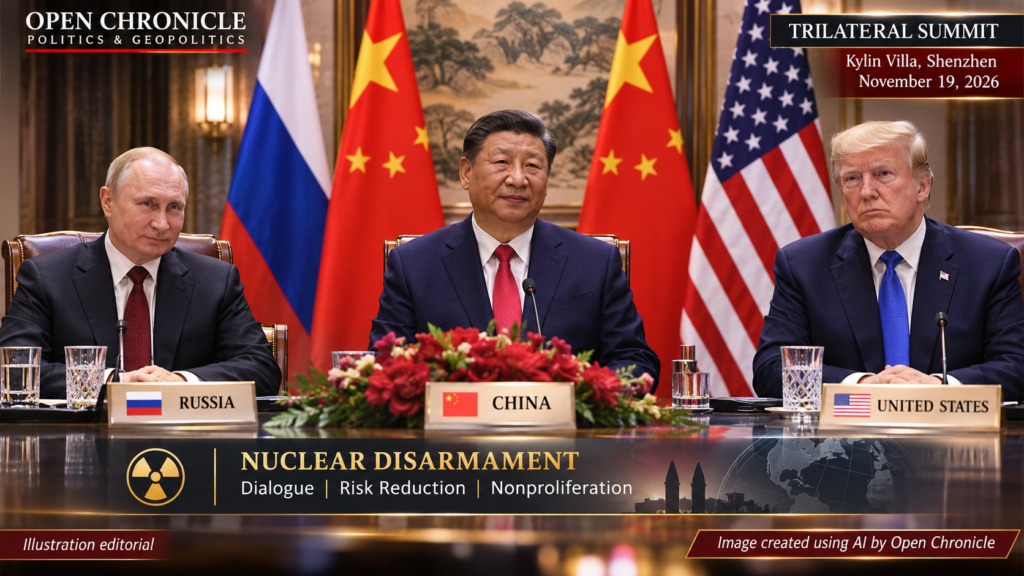
SHENZHEN, China, November 19, 2026. US President Donald Trump, Chinese President Xi Jinping and Russian President Vladimir Putin have concluded an unprecedented trilateral summit, agreeing to continue discussions on reducing nuclear risks and preventing proliferation while stopping short of announcing binding commitments to reduce their arsenals.
The meeting, held at Kylin Villa in the southern Chinese city of Shenzhen on the sidelines of the Asia Pacific Economic Cooperation summit, brought together the leaders of three nuclear powers at a moment of profound international uncertainty.
In a joint declaration issued following the talks, the three governments affirmed that nuclear war must never be fought and committed themselves to further dialogue on nuclear risk reduction and nonproliferation.
However, the declaration contained no numerical weapons limits, verification arrangements or timetable for a new arms control treaty.
The distinction between political commitments and enforceable agreements is central to understanding the outcome.
The summit represents a significant diplomatic opening, but not a breakthrough in nuclear disarmament.
1. Trump calls for nuclear reductions and guarantees against nuclear war
Trump placed nuclear arms control at the centre of his opening remarks, arguing that Washington, Beijing and Moscow have a special responsibility to prevent the use of weapons capable of causing catastrophic destruction.
The American president called for discussions on reducing nuclear stockpiles and strengthening international safeguards against their use.
He also acknowledged the political and strategic difficulties associated with persuading nuclear powers to surrender weapons they regard as essential to national security.
For governments that maintain nuclear arsenals, the problem is not simply one of political willingness. Nuclear weapons are embedded in military doctrines, deterrence strategies, alliance commitments and perceptions of national survival.
A credible disarmament process would therefore require more than a declaration of intent.
It would need negotiated limits, transparency measures, verification arrangements and assurances that reductions would not leave one participant strategically disadvantaged.
Trump’s intervention reflected that fundamental tension between the aspiration to reduce nuclear dangers and the reluctance of governments to abandon their deterrent capabilities.
Preventing further nuclear proliferation
Trump also called for cooperation to prevent additional countries from acquiring nuclear weapons.
Iran featured prominently in his remarks.
The American president reaffirmed Washington’s opposition to an Iranian nuclear weapons capability and presented international cooperation as an essential instrument for preventing further proliferation.
The issue is particularly sensitive because tensions involving Iran and the United States have already destabilised the wider Middle East.
For Washington, preventing Iranian nuclear armament remains a major security objective.
For Beijing and Moscow, any coordinated approach would have to be reconciled with their respective diplomatic relationships, regional interests and positions on international sanctions.
The summit did not establish a new common enforcement mechanism concerning Iran.
2. Xi Jinping presents cooperation as a condition for global stability
Xi Jinping, who hosted and chaired the meeting, emphasised the responsibility of major powers to manage their differences and contribute to international stability.
His opening intervention framed cooperation among the United States, China and Russia as an important condition for preventing global confrontation.
Xi’s central argument was that competition between powerful states should not be allowed to develop into uncontrolled conflict.
The Chinese leader advocated dialogue based on mutual respect, equality and recognition of national interests.
His message reflected a broader Chinese diplomatic position: strategic stability requires communication between rival powers, even when substantial disagreements remain.
Beijing has repeatedly argued that confrontation, economic decoupling and the division of international relations into opposing blocs can increase instability.
At Shenzhen, Xi sought to present China as a diplomatic actor capable of convening Washington and Moscow while promoting a more cooperative international environment.
China’s nuclear dilemma
Despite this language of cooperation, China’s position on nuclear arms control remains different from those of the United States and Russia.
Beijing has traditionally resisted joining negotiations that would impose equivalent numerical restrictions on all three countries.
Its argument is that the Chinese arsenal remains considerably smaller than the American and Russian stockpiles.
China’s nuclear expansion has nevertheless intensified concerns in Washington about the future strategic balance.
Research published ahead of the summit by Harvard University’s Belfer Center estimated China’s arsenal at approximately 620 nuclear warheads, while noting projections of further growth.
This asymmetry complicates the prospect of a trilateral agreement.
Washington may seek to bring China into a comprehensive framework, while Beijing may insist that the United States and Russia undertake deeper reductions first.
Reconciling these positions will be among the principal challenges of any future negotiating process.
3. Putin invokes historical responsibility and cooperation on regional conflicts
Putin also emphasised the shared responsibility of Russia, China and the United States for maintaining international security.
The Russian president referred to the historical role of the three countries during the Second World War and argued that their cooperation could contribute to the settlement of contemporary conflicts.
He specifically identified Ukraine as an area in which the three governments have overlapping interests in seeking a resolution.
That statement was politically significant.
Russia’s invasion of Ukraine has produced one of the most serious confrontations between Moscow and Western governments in decades.
The war has also damaged the wider framework of European security and contributed to growing uncertainty surrounding nuclear deterrence.
Putin’s participation in the Shenzhen meeting therefore offered Moscow an opportunity to engage directly with Washington and Beijing while presenting Russia as an indispensable participant in discussions about international security.
However, diplomatic recognition of Russia’s role does not resolve the central disagreements surrounding Ukraine’s territorial sovereignty, security guarantees and the conditions for ending the conflict.
4. The Shenzhen declaration: What was actually agreed?
SHENZHEN SUMMIT | NOVEMBER 19, 2026
Diplomatic Outcomes
| Nuclear war | Joint reaffirmation that nuclear war must never be fought |
| Nuclear risk reduction | Commitment to continued dialogue |
| Nonproliferation | Agreement to discuss preventing the spread of nuclear weapons |
| Binding arsenal reductions | No announced numerical limits or treaty |
| Verification and deadlines | No announced verification system or implementation timetable |
Based on reporting of the joint declaration and the summit’s immediate outcome.
The leaders’ agreement to continue dialogue is diplomatically relevant, particularly following the deterioration of arms control arrangements between Washington and Moscow.
Yet a commitment to discussions is not equivalent to a negotiated reduction in nuclear weapons.
A substantive agreement would require decisions on the types of weapons covered, stockpile ceilings, inspection rights and compliance mechanisms.
None of these elements emerged as a binding outcome of the Shenzhen meeting.
5. The end of New START creates a dangerous strategic vacuum
The summit took place against the background of the expiration of the New START treaty in February 2026.
The agreement had been the last major bilateral treaty limiting deployed strategic nuclear weapons held by the United States and Russia.
Its expiration removed an important legal framework for managing the world’s two largest nuclear arsenals.
The consequences extend beyond numerical limits.
Arms control agreements can also provide transparency, predictability and mechanisms for reducing misunderstandings between military establishments.
Without effective arrangements, governments may face greater uncertainty about the intentions and capabilities of their strategic competitors.
That uncertainty can encourage further investment in nuclear forces and increase the risk of miscalculation during international crises.
The Shenzhen summit offers a potential opportunity to begin rebuilding some of those safeguards.
However, the inclusion of China makes the negotiating environment more complex than the traditional bilateral framework between Washington and Moscow.
6. Ukraine remains central to the diplomatic equation
Although nuclear disarmament dominated the opening statements, the war in Ukraine remained an important subject of the meeting.
Putin referred directly to the conflict, while Trump has repeatedly presented negotiations as a possible route toward ending the war.
The discussions took place as Ukrainian and Russian forces continued military operations, including renewed attacks against strategic infrastructure.
The central diplomatic challenge is that the three leaders cannot independently determine a legitimate and durable settlement for Ukraine.
Kyiv remains a sovereign participant whose consent and security interests are essential to any negotiated agreement.
European governments also have substantial interests in the future security architecture of the continent.
Any process that excludes those directly affected risks producing arrangements that lack legitimacy or practical durability.
The summit may influence the diplomatic environment surrounding the conflict, but it does not replace negotiations involving Ukraine.
7. Iran and the wider Middle East
Iran represented another major area of discussion.
Trump’s remarks connected nuclear nonproliferation with Washington’s determination to prevent Tehran from obtaining nuclear weapons.
The wider regional conflict has increased the importance of diplomatic coordination among major powers.
Energy security, maritime navigation, military escalation and regional alliances are all affected by instability in the Middle East.
China has substantial economic interests in regional energy supplies.
Russia maintains its own strategic relationships across the region.
The United States continues to exercise considerable military and diplomatic influence.
These overlapping interests create potential areas for cooperation, but also important disagreements over the use of force, sanctions and the political future of regional conflicts.
No comprehensive settlement concerning Iran emerged from the summit.
8. The limits of great power diplomacy
The meeting in Shenzhen has also revived a wider debate about the role of major powers in shaping the international order.
Direct dialogue between Washington, Beijing and Moscow can help reduce tensions and improve crisis communication.
Yet international security cannot be defined exclusively by the preferences of three governments.
Ukraine, European states, countries in the Middle East and other nations affected by great power competition retain their own interests and sovereign rights.
The challenge is to ensure that cooperation among powerful states strengthens international institutions rather than bypassing them.
The summit’s broader political discussions also reportedly included institutional reform and international governance, although the positions expressed did not amount to comprehensive agreements.
This distinction matters because a stable international order depends not only on communication among major powers, but also on rules that apply consistently to all states.
9. Five developments to watch after Shenzhen
Five Developments to Watch After Shenzhen
Following the historic trilateral meeting between Donald Trump, Xi Jinping and Vladimir Putin, five developments will help determine whether the Shenzhen summit produces meaningful progress on nuclear arms control, international security and diplomatic cooperation.
A formal nuclear negotiating framework
Whether the three governments appoint negotiators, establish working groups or agree on a timetable for further discussions.
China’s participation in arms control
Whether Beijing accepts negotiations on transparency, nuclear risk reduction or eventual limits on its arsenal.
Diplomatic progress on Ukraine
Whether summit discussions produce proposals that include Kyiv and address European security concerns.
Cooperation over Iran
Whether Washington, Beijing and Moscow identify practical measures to prevent further escalation and nuclear proliferation.
The future of trilateral diplomacy
Whether the Shenzhen summit becomes the foundation of a continuing dialogue or remains primarily a symbolic diplomatic event.
The long term significance of the Shenzhen summit will depend on whether diplomatic declarations evolve into structured negotiations, verifiable security commitments and practical measures to reduce international tensions. Continued engagement among the three powers could strengthen crisis management, but meaningful progress will require addressing conflicting national interests and the security concerns of countries directly affected by ongoing conflicts.
The Big Picture | A Historic Meeting, but Not Yet a Strategic Breakthrough
The unprecedented summit between Trump, Xi and Putin has demonstrated that direct dialogue remains possible even during periods of intense geopolitical rivalry.
The three leaders have acknowledged their responsibility to reduce nuclear risks and prevent the spread of nuclear weapons.
That shared recognition is significant.
But the differences between diplomatic language and concrete security commitments remain substantial.
The expiration of New START, China’s expanding nuclear capabilities, the war in Ukraine and continuing instability in the Middle East create a negotiating environment in which trust is limited and national interests frequently conflict.
The summit’s declaration may become the starting point for a more structured approach to international security.
Equally, it may remain a largely symbolic expression of political intentions.
The defining measure of Shenzhen’s success will not be the historic nature of the meeting itself, but whether its commitments lead to verifiable arms control, effective crisis management and meaningful progress toward resolving international conflicts.
Sources and Further Reading
The following sources provide reporting, official statements, diplomatic context and independent analysis concerning the November 19, 2026 trilateral summit between the United States, China and Russia in Shenzhen.
Reuters
Trump, Xi and Putin begin historic meeting with Ukraine war on agenda
November 19, 2026. Opening statements, nuclear arms control and Ukraine.
Reuters | GV Wire
Trump, Xi and Putin release peace declaration
November 19, 2026. Joint declaration and limits of the summit’s immediate achievements.
Associated Press
Trump, Xi and Putin hold rare three way talks on nuclear risks but deliver no breakthroughs
November 19, 2026. Diplomatic outcomes and strategic disagreements.
Yonhap News Agency
Trump, Xi, Putin agree to hold dialogue on nuclear risks
November 19, 2026. Joint declaration and nonproliferation commitments.
Roll Call Factba.se
Remarks at the trilateral meeting
November 19, 2026. Transcript of opening statements by the three leaders.
Harvard Belfer Center
What Xi, Trump, and Putin Should Agree on in Shenzhen
November 18, 2026. Nuclear arsenal asymmetries and potential arms control mechanisms.
These references combine international news reporting, a transcript of the leaders’ remarks and independent academic analysis. Statements concerning nuclear risk reduction, diplomatic cooperation and international security should be distinguished from legally binding agreements, verified implementation measures and future negotiating outcomes.
This article was prepared by Open Chronicle using the supplied account of the November 19, 2026 trilateral summit, independently retrieved reporting from Reuters, Associated Press and Yonhap News Agency, a transcript of the leaders’ opening remarks and additional arms control analysis. Statements concerning diplomatic intentions are distinguished from the commitments contained in the joint declaration. No binding nuclear arsenal reductions, verification arrangements or formal settlement of the wars in Ukraine and Iran are presented as outcomes of the summit. Assessments concerning strategic stability, great power relations and future negotiations represent independent editorial analysis.