
OPEN CHRONICLE | WORLD NEWS | GLOBAL NEWS BRIEF
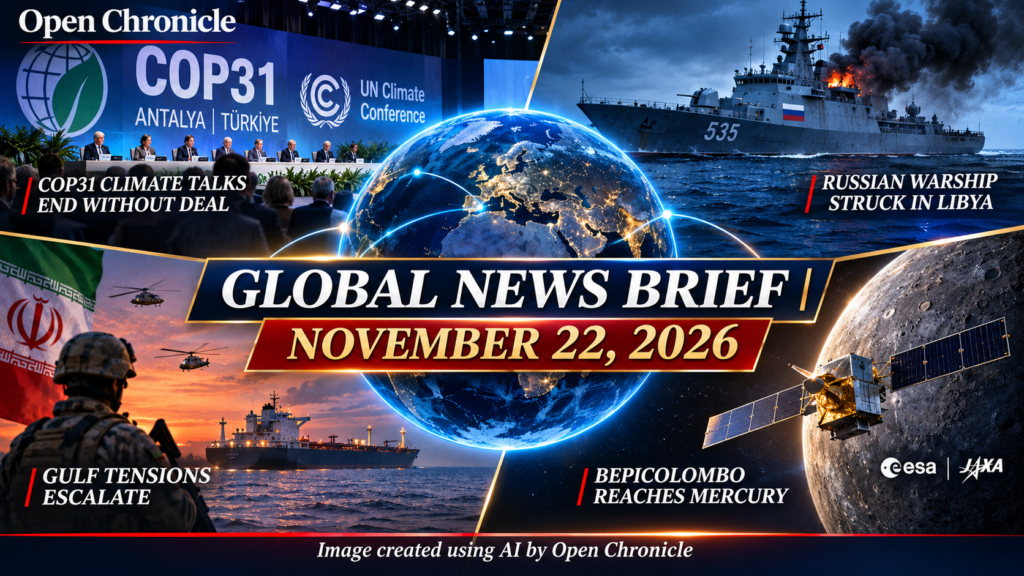
Climate negotiations collapse in Turkey, suspected Ukrainian naval drones strike a Russian warship in Libya, and tensions across the Middle East add to an increasingly volatile international landscape.
By Open Chronicle News Desk | November 22, 2026
The international news agenda on Sunday, November 22, 2026, was dominated by a series of developments exposing the growing pressures on diplomacy, international security and global governance.
In Turkey, the COP31 climate summit ended without an overarching agreement after governments failed to resolve fundamental differences over fossil fuels and climate finance. The outcome raised fresh questions about the effectiveness of multilateral negotiations at a time of accelerating environmental challenges.
In North Africa, Libyan military officials reported that suspected Ukrainian maritime drones had struck a Russian naval vessel at the port of Benghazi, potentially extending the operational geography of the war between Russia and Ukraine.
Across the Middle East, renewed concerns over Iran, maritime security, Gaza and the occupied West Bank highlighted the fragility of regional stability.
Meanwhile, European governments faced questions about their economic and security relationships, while developments in artificial intelligence, space exploration and digital privacy illustrated the accelerating pace of technological change.
This edition of the Open Chronicle Global News Brief brings together the day’s most consequential developments, distinguishing confirmed reporting from allegations, preliminary assessments and emerging political claims.
01 | Climate Diplomacy
COP31 ends without major agreement as divisions over fossil fuels deepen
The COP31 United Nations climate conference ended in Antalya, Turkey, on Sunday without an overarching agreement after nearly 200 countries failed to reach consensus on the future of international climate action.
The negotiations continued for approximately two days beyond their scheduled conclusion, with divisions over fossil fuels becoming the central obstacle to a final agreement.
The European Union, the United Kingdom and several climate-vulnerable countries rejected a proposed text that did not explicitly address the fossil fuels responsible for the majority of global greenhouse gas emissions.
Disagreements over climate finance and the responsibilities of wealthier countries added to the diplomatic impasse.
UN Secretary-General António Guterres described the outcome as deeply disappointing.
Although some narrower decisions were adopted, the summit failed to produce the broad political agreement sought by negotiators.
Why it matters: The collapse exposes the widening divide between countries seeking faster reductions in fossil fuel dependence and governments prioritizing energy security, economic development or continued hydrocarbon production.
The failure also places additional pressure on the next round of international climate negotiations, where unresolved questions over emissions reductions and financial support will return.
02 | Russia and Ukraine
Suspected Ukrainian sea drones strike Russian warship at Libyan naval base
A Russian naval vessel was reportedly struck by suspected Ukrainian maritime drones while docked at the Benghazi Naval Base in eastern Libya, according to Libyan military officials.
The vessel, identified as the Russian corvette Merkury, sustained serious damage, while a fire was reported at the naval facility.
Libyan officials said an initial investigation indicated that six maritime drones had been deployed, with four intercepted and two striking the ship.
The officials attributed the operation to Ukrainian forces, but neither Kyiv nor Moscow immediately confirmed responsibility in the initial reporting.
Satellite imagery subsequently appeared to show extensive damage to the vessel.
The incident is particularly significant because it occurred far beyond the Black Sea, where Ukraine has previously used unmanned maritime systems against Russian naval assets.
Why it matters: If Ukrainian involvement is established, the operation would demonstrate an expanded ability to threaten Russian maritime assets outside the traditional theater of war.
It would also raise difficult questions for Libya, whose divided political and security institutions already face considerable challenges.
The reported attack illustrates how the Russia–Ukraine conflict can generate consequences across the Mediterranean and beyond.
03 | Middle East Security
Iran, Bahrain and the Gulf of Oman remain at the center of regional tensions
The security situation across the Persian Gulf remained tense as Bahrain reported an Iranian attack on a civilian industrial facility, while maritime authorities monitored a separate incident involving a tanker and military forces in the Gulf of Oman.
Bahraini authorities said the strike on the industrial facility in Sitra caused a fire. Iran’s Islamic Revolutionary Guard Corps claimed its attacks were directed at American Patriot air defense systems.
The competing accounts highlight the difficulty of establishing the precise targets and consequences of military operations in a region where several governments are engaged in direct or indirect confrontation.
Separately, the United Kingdom Maritime Trade Operations agency reported an incident involving a tanker and military forces in the Gulf of Oman. Initial information did not establish the full circumstances of the encounter.
The latest developments come amid stalled negotiations between Washington and Tehran and continued military tensions affecting regional shipping.
Why it matters: The Gulf is one of the world’s most strategically important energy corridors. Military incidents involving shipping, coastal infrastructure or air defense systems can increase insurance costs, disrupt commercial traffic and heighten fears of broader escalation.
The principal concern is that a localized incident could provoke a chain of retaliatory actions involving several regional powers.
04 | Israel and the Palestinian Territories
Eisenkot condemns West Bank settler attacks as coalition uncertainty continues
Israeli opposition leader Gadi Eisenkot strongly condemned suspected attacks by Israeli settlers against Palestinian communities in the occupied West Bank.
Residents reported that vehicles had been set on fire and racist graffiti painted on buildings in several villages.
Eisenkot characterized the attacks as “Jewish terrorism” and called for stronger action against those responsible.
The incidents occurred amid political uncertainty in Israel following an inconclusive parliamentary election.
Eisenkot has been tasked with attempting to form a new government, but negotiations with political parties, including Prime Minister Benjamin Netanyahu’s Likud, have yet to produce a governing agreement.
The violence in the West Bank has consequently become part of a wider domestic debate about public security, the rule of law and the direction of Israeli policy toward the Palestinian territories.
Why it matters: The incidents could complicate coalition negotiations by intensifying disagreements over security policy, settlements and relations with Palestinian communities.
They also illustrate how developments in the occupied West Bank can influence Israel’s internal political balance.
05 | Europe and the United Kingdom
Britain and the European Union seek closer ties in a major post-Brexit agreement
The United Kingdom and the European Union are entering a new phase of cooperation following agreements announced at a Brussels summit on November 20.
British Prime Minister Andy Burnham and European leaders agreed on measures intended to reduce trade barriers, facilitate youth mobility and strengthen cooperation on environmental and security issues.
The package includes arrangements to simplify trade in food, agricultural products and plants, along with a framework linking carbon emissions trading systems.
A reciprocal youth mobility program would allow eligible young adults to live, study, work and travel across the UK and EU for limited periods.
The British government estimates that the package could contribute up to £17 billion annually to the UK economy by 2040. This is a government projection rather than a realized economic benefit.
Disagreements remain over university tuition arrangements and the longer-term scope of regulatory alignment.
Why it matters: The agreement reflects a changing strategic environment in which Britain and its European neighbors increasingly recognize the importance of cooperation on trade, defense, energy and economic resilience.
It does not reverse Brexit, but it represents a significant effort to reduce some of the economic and administrative barriers that emerged after Britain’s departure from the European Union.
06 | Artificial Intelligence and Global Security
UN discussions on autonomous weapons end without binding international rules
United Nations-backed negotiations on lethal autonomous weapons concluded in Geneva without a firm commitment to establish legally binding restrictions.
Governments agreed to continue discussions for another two years, with the possibility of developing an agreement by 2028.
However, proposals to begin formal negotiations on binding international rules failed to secure the necessary consensus.
The debate centers on the extent to which machines should be permitted to identify, select and attack targets without direct human intervention.
Supporters of stronger regulation argue that meaningful human control is essential to maintaining accountability under international humanitarian law.
Other governments have resisted committing to binding restrictions, citing security considerations and disagreements over definitions and enforcement.
The International Committee of the Red Cross has warned about the potential unpredictability of autonomous weapons and the importance of retaining human control over the use of force.
Why it matters: Artificial intelligence is becoming increasingly relevant to military operations, but international rules are struggling to keep pace.
The absence of binding commitments creates uncertainty over responsibility, escalation risks and the protection of civilians as military technology advances.
07 | Technology and Digital Privacy
Signal moves to prevent AI assistants from accessing private conversations
Encrypted messaging service Signal has introduced new protections intended to limit the ability of artificial intelligence assistants to capture private conversations displayed on mobile devices.
The company announced measures designed to restrict screenshots and screen access by AI systems operating at the device level.
Signal warned that the integration of AI agents into smartphones could undermine privacy protections by allowing operating systems or digital assistants to access information that users expected to remain confidential.
The company acknowledged that its safeguards are incomplete and called on major operating system developers to provide stronger controls over access to sensitive application data.
Why it matters: The development highlights an emerging conflict between increasingly capable personal AI assistants and the confidentiality of private communications.
Encryption protects messages during transmission, but information displayed on a device may still be vulnerable if other software is permitted to read or capture the screen.
As AI agents gain greater access to operating systems, the boundaries between user convenience, automation and privacy are becoming a central issue for technology companies and regulators.
08 | Space and Scientific Exploration
BepiColombo reaches Mercury after an eight-year journey
The European and Japanese BepiColombo mission has reached orbit around Mercury following an eight-year journey through the inner Solar System.
The spacecraft, launched in 2018, was developed through cooperation between the European Space Agency and the Japan Aerospace Exploration Agency.
The mission consists of two scientific orbiters designed to investigate Mercury’s surface, internal structure, magnetic environment and interaction with the solar wind.
The European Space Agency confirmed orbital insertion but reported a software issue that caused a planned engine maneuver to end earlier than expected.
Mission controllers said the spacecraft remained safe while engineers investigated the issue.
The two orbiters are expected to separate in December, with routine scientific operations scheduled to begin in April 2027.
Why it matters: Mercury remains one of the least extensively explored terrestrial planets.
Studying its geology, composition and magnetic field could provide important insights into the formation and evolution of rocky planets, including Earth.
The mission also demonstrates the importance of international scientific partnerships in undertaking complex deep-space exploration.
09 | Mexico and Organized Crime
Capture of El Chapo Isidro underscores the continuing security crisis in Sinaloa
Mexico is dealing with the aftermath of a major operation against organized crime following the capture of Fausto Isidro Meza Flores, known as El Chapo Isidro.
The wanted trafficking figure was detained in Guasave, Sinaloa, after an operation that triggered intense armed confrontations.
According to Mexican authorities cited by the Associated Press in the reporting supplied for this briefing, seven suspected cartel gunmen and four Mexican soldiers were killed.
The violence involved burning vehicles, roadblocks and armed resistance that disrupted the city.
Meza Flores was wanted by US authorities and had longstanding connections to criminal networks associated with the Beltrán Leyva organization and the Sinaloa Cartel.
His capture represents a significant operational achievement for Mexican security forces.
However, analysts warn that removing senior cartel leaders can create opportunities for rival factions to compete for control, potentially triggering further violence.
Why it matters: Mexico’s security challenge extends beyond capturing prominent criminal figures.
Long-term stability depends on dismantling financial networks, preventing retaliation, strengthening local institutions and protecting communities affected by organized crime.
The Global Picture | What Connects These Developments?
OPEN CHRONICLE | GLOBAL STRATEGIC ASSESSMENT
Four trends shaping the international agenda
The Global Picture
Four Trends Shaping the International Agenda
Multilateral Institutions Face Growing Pressure
The failure of COP31 and the limited outcome of negotiations on autonomous weapons reveal the difficulty of reaching international agreements when national interests diverge.
Conflicts Increasingly Cross Geographical Boundaries
The suspected attack on a Russian warship in Libya and continuing tensions in the Gulf illustrate how military confrontations can extend beyond their original theaters.
Economic and Security Partnerships Are Being Reassessed
Closer cooperation between Britain and the European Union reflects efforts to strengthen regional resilience amid a more uncertain international environment.
Technology Is Advancing Faster Than Governance
Developments in AI surveillance, autonomous weapons and space exploration highlight the growing importance of international rules, scientific cooperation and technological accountability.
EDITORIAL CONTEXT
These four trends represent an editorial synthesis of the international developments covered in this briefing. They are intended to highlight broader strategic patterns rather than establish direct causal relationships between individual events.
Conclusion | A World of Competing Priorities
November 22, 2026, illustrated the complexity of a world in which governments must respond simultaneously to military confrontation, economic uncertainty, environmental challenges and rapid technological transformation.
The collapse of COP31 demonstrated the limitations of international consensus. The reported strike against a Russian warship in Libya showed how regional conflicts can develop global dimensions. Tensions in the Middle East reinforced concerns about escalation, while political developments in Europe and Israel revealed the domestic pressures shaping foreign policy.
At the same time, the BepiColombo mission offered a reminder that international cooperation can still deliver major scientific achievements.
The defining challenge is not simply the number of crises confronting the international system, but the ability of governments and institutions to manage their consequences before they develop into wider instability.
For Open Chronicle, the day’s developments point toward a central conclusion: the international order is being reshaped by the interaction of security competition, political fragmentation, economic realignment and technological change.
Sources and Further Reading
Selected sources supporting the principal developments covered in this briefing.
COP31 Ends Without Climate Pact
November 22, 2026
Official UN reporting on the collapse of climate negotiations and the response of Secretary-General António Guterres.
Suspected Ukrainian Sea Drones Hit Russian Warship in Libya
November 22, 2026
Reporting on the Benghazi naval incident, damage to the Russian corvette and statements from Libyan officials.
Iran and Gulf Security Developments
November 22, 2026
Updates concerning Bahrain, Iranian military claims, maritime security and US–Iran tensions.
Eisenkot Condemns West Bank Attacks
November 22, 2026
Reporting on suspected settler violence and developments in the wider Middle East.
New Agreements with the European Union
November 20, 2026
Official details of the agreements covering trade, youth mobility, carbon markets and security cooperation.
UN Negotiations on Autonomous Weapons
November 21, 2026
Reporting on the failure to secure binding commitments and the continuation of international discussions.
Signal Restricts Screenshots to Protect Private Chats
November 20, 2026
Reporting on Signal’s response to the privacy risks posed by operating-system AI agents.
BepiColombo’s Arrival at Mercury
Mission updates, November 2026
Official mission information and operational updates concerning the European and Japanese spacecraft.
Capture of El Chapo Isidro in Sinaloa
November 21, 2026
Reporting on the arrest, the security operation in Guasave and the resulting fatalities.
Editorial Transparency
This Global News Brief was prepared by Open Chronicle News Desk using a compilation of international news headlines supplied for editorial review, supplemented by reporting from international news organizations and official institutional sources. The article distinguishes reported events from allegations and preliminary assessments, particularly in relation to military operations, maritime incidents and ongoing security investigations. Strategic implications and the concluding analysis represent independent editorial interpretation. Developments are presented according to information available on November 22, 2026, and may be subject to subsequent clarification or revision.