
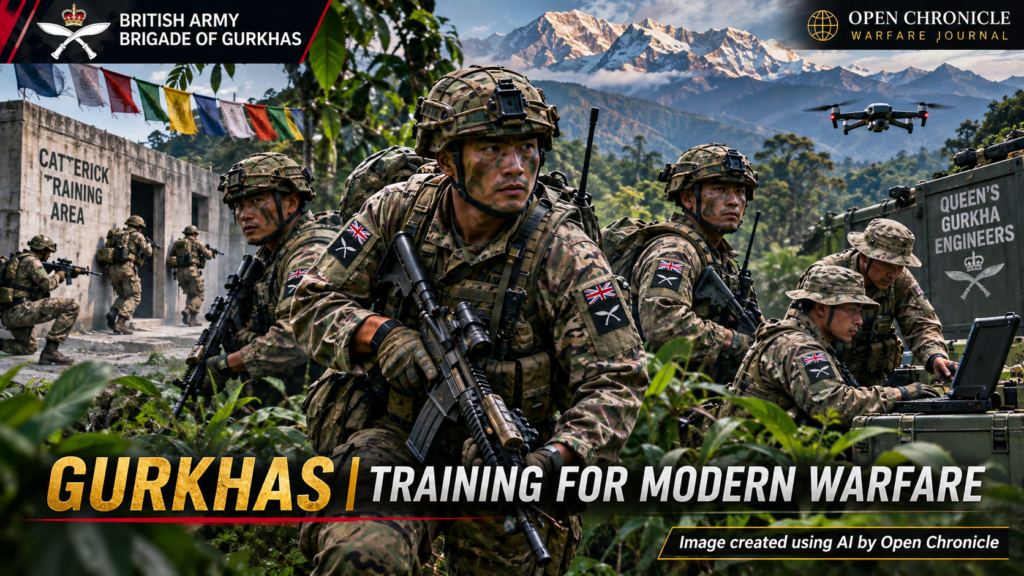
From the mountains of Nepal to the training grounds of Yorkshire and the tropical jungles of Belize, the British Army’s Gurkhas are combining a centuries-old military tradition with modern infantry tactics, specialist engineering, reconnaissance and unmanned systems.
OPEN CHRONICLE | WARFARE JOURNAL
MILITARY TRAINING | BRITISH ARMY | SPECIALISED OPERATIONS
21 November 2026 | By Open Chronicle Warfare Journal
A new generation joins one of Britain’s most distinctive military formations
On 4 November 2026, 320 Nepalese soldiers marched onto the parade square at the Infantry Training Centre in Catterick, North Yorkshire, marking the completion of 39 weeks of intensive training.
For these soldiers, the ceremony represented the culmination of a journey that had begun in Nepal, where they had competed for the opportunity to join the British Army.
According to BFBS Forces News, the successful recruits emerged from an initial applicant pool exceeding 13,000 candidates.
The figures illustrate the highly competitive nature of Gurkha recruitment.
Yet the significance of the 2026 intake extends beyond the numbers.
Throughout the year, recruits underwent training designed to prepare them for the demands of contemporary infantry operations.
They practised fieldcraft, urban warfare, defensive operations, casualty evacuation and military decision-making under physical exhaustion.
Elsewhere, serving Gurkha engineers deployed to Belize, where they combined military engineering tasks with jungle survival, reconnaissance and drone familiarisation.
Together, these developments provide a picture of how the Brigade of Gurkhas is maintaining its distinctive military identity while adapting to the requirements of modern warfare.
The central question is no longer simply how demanding Gurkha training can be.
It is how that training prepares soldiers to operate effectively in increasingly complex military environments.
Who are the Gurkhas?
The Gurkhas are Nepalese soldiers serving in military formations with a long historical connection to Britain.
Their service in British military structures dates to the early nineteenth century, following the Anglo-Nepalese War.
Over generations, Gurkha soldiers have served in numerous conflicts and military campaigns.
Their reputation has become closely associated with courage, discipline, endurance and loyalty.
However, the contemporary Brigade of Gurkhas should not be understood as a single infantry regiment.
It includes personnel serving in different branches and specialist roles within the British Army.
Among its formations are the Royal Gurkha Rifles, Queen’s Gurkha Engineers and other Gurkha units providing specialised military capabilities.
The Royal Gurkha Rifles are part of the British Army’s infantry.
Their responsibilities involve conventional military operations, including ground combat and deployment in challenging environments.
Other Gurkha personnel serve in engineering, communications, logistics and support functions.
This organisational diversity is important.
The capabilities of the Brigade of Gurkhas extend well beyond the image of an individual rifleman carrying the traditional kukri.
Modern Gurkha soldiers are integrated into the British Army’s broader military structure.
They use contemporary military equipment, follow British Army procedures and train to operate alongside other formations.
Their historical identity remains distinctive, but their operational responsibilities are firmly rooted in the present.
The road from Nepal to the British Army
Recruitment begins in Nepal.
Candidates must complete a competitive selection process designed to evaluate physical ability and other requirements for military service.
The British Army publishes official recruitment information, including physical assessment standards and medical requirements.
For the 2026 selection cycle, its published initial selection requirements included over-arm grip heaves, an 800-metre run and a repeated lift-and-carry assessment.
These tests are part of a wider process.
Physical performance alone does not guarantee selection.
Candidates must also meet the other standards required by the recruiting authorities.
The 2026 intake’s journey began with selection activities in Nepal during 2025 and final selection at Pokhara in February 2026.
After attestation, successful recruits travelled to the United Kingdom.
They then began their military training at Catterick.
This transition involves more than learning infantry skills.
The recruits must also adapt to a different language, military culture and social environment.
BFBS Forces News reported that Gurkha recruits receive additional English-language and cultural familiarisation training.
The programme is intended to prepare them for service within the British Army and life in the United Kingdom.
The result is a demanding process combining military instruction with personal adaptation.
Nine months at Catterick
The Infantry Training Centre at Catterick plays a central role in transforming selected recruits into trained soldiers.
For the 2026 Gurkha intake, the programme lasted 39 weeks.
Training was conducted under the supervision of Gurkha Training Company, with instructors drawn from across the Brigade.
The programme covered the initial phases of infantry training and the skills required for service in British Army units.
These included weapons handling, fieldcraft, military discipline, physical conditioning and the practical demands of infantry operations.
The recruits also participated in increasingly demanding exercises.
The training progression was designed to develop their ability to function as individuals and as members of military teams.
That distinction is fundamental.
An infantry soldier must possess individual competence, but battlefield effectiveness depends on collective performance.
Communication, discipline, leadership and the ability to follow orders under pressure are therefore essential components of training.
The 2026 programme provided repeated opportunities to develop those capabilities.
Urban warfare: Preparing for combat in built-up environments
In August 2026, Gurkha recruits undertook urban warfare training at the Whinney Hill training area, within Catterick Garrison.
BFBS Forces News documented the activity on 26 August.
The exercise introduced recruits to the demands of operating in a built-up environment.
Urban terrain presents particular difficulties for military forces.
Buildings, walls and restricted lines of sight can complicate movement and observation.
Distances may be short, while the physical environment can create uncertainty about what lies beyond a particular structure.
The presence of civilians, where applicable, introduces further legal and operational considerations.
For soldiers, urban operations require discipline and an understanding of the surrounding environment.
The Catterick training focused on developing infantry skills within this type of terrain.
It was part of the recruits’ wider preparation for military service.
The available reporting does not provide detailed performance scores or establish that the recruits completed a specialist counterterrorism qualification.
The exercise should therefore be understood as urban infantry training rather than evidence of qualification for an independent special forces mission.
Nevertheless, its inclusion demonstrates the importance of preparing Gurkha soldiers for environments in which conventional infantry may be required to operate.
Forty-eight hours under pressure
One of the most demanding stages of the 2026 training programme took place in the Yorkshire Dales.
Known as Defence Ex, the exercise was designed to evaluate the recruits’ resilience during sustained military activity.
BFBS Forces News reported on the exercise on 22 September 2026.
The recruits spent approximately 48 hours constructing defensive positions and carrying out additional tasks while receiving minimal sleep.
The purpose was to expose soldiers to the physical and mental demands associated with prolonged field operations.
Constructing defensive positions requires considerable physical effort.
The task becomes more difficult when personnel must maintain concentration and continue responding to changing instructions.
During the exercise, recruits also conducted a simulated section attack.
A casualty evacuation scenario required them to move a simulated casualty over a substantial distance.
These activities placed additional demands on soldiers who were already physically exhausted.
The training was intended to reinforce an essential principle of military readiness.
Personnel may need to continue performing their duties when conditions are uncomfortable and rest is limited.
However, physical endurance is only one aspect of the challenge.
Soldiers must also maintain situational awareness, communicate effectively and respond to their commanders.
The exercise therefore tested both physical resilience and military discipline.
It did not establish a universal endurance standard for all Gurkha units or demonstrate combat performance under actual enemy fire.
Its value lay in providing a controlled training environment in which recruits could experience sustained pressure.
The importance of resilience
The demanding character of Gurkha training is often presented as evidence of exceptional toughness.
There is a genuine military rationale for developing resilience.
Soldiers may be required to operate in difficult weather, carry heavy equipment or perform demanding tasks over extended periods.
However, resilience should not be confused with an unlimited ability to function without rest.
Fatigue can impair judgement, concentration and physical performance.
Modern military training must therefore balance realistic exposure to demanding conditions with appropriate supervision and safety procedures.
The Catterick exercise was conducted under the direction of training staff.
Its purpose was to prepare recruits for the challenges they may encounter during military service.
The wider lesson is that endurance has operational value when combined with discipline, leadership and effective decision-making.
A soldier’s ability to continue working under pressure matters.
So does the ability to recognise limitations and maintain the effectiveness of the wider team.
From Yorkshire to the jungle of Belize
While the 2026 recruits completed their training in Britain, serving Gurkha engineers were developing different capabilities in Central America.
The 69 Gurkha Field Squadron, part of the Queen’s Gurkha Engineers, deployed to Belize during Exercise SAILFISH 26-2.
The deployment combined engineering tasks with military training in a tropical environment.
According to the Gurkha Brigade Association, the squadron worked on infrastructure projects while also conducting jungle-related training.
These activities included navigation, fieldcraft, casualty evacuation, survival skills and drone familiarisation.
The jungle training component was associated with Exercise USTADJIKO KHUKURI.
It was conducted in Belize’s 1963 Training Area.
The exercise was intended to develop experience in what the British Army describes as a Close Country Tropical Environment.
Such environments present challenges that differ considerably from those encountered in Britain.
Dense vegetation can restrict visibility.
High humidity and temperature can increase physical strain.
Heavy rainfall can affect movement, equipment and logistical arrangements.
Navigation may also become more demanding.
The training was designed to improve soldiers’ familiarity with these conditions.
The 69 Gurkha Field Squadron’s deployment illustrates how specialist engineering personnel must retain military field skills alongside their technical responsibilities.
Twenty-four hours in the jungle
On 13 November 2026, the Gurkha Brigade Association highlighted a BFBS report showing 69 Gurkha Field Squadron personnel undergoing 24 hours of basic jungle training in Belize.
The footage offered a view of the conditions encountered by Gurkha engineers operating in tropical terrain.
The training was conducted in a Close Country Tropical Environment.
Its importance lies in the difference between routine training conditions and the physical demands of the jungle.
Personnel must adapt to limited visibility, difficult movement and the practical challenges of maintaining equipment and personal effectiveness in tropical conditions.
The associated exercise programme included survival instruction.
Soldiers were introduced to the importance of water, shelter and food as essential requirements in a demanding environment.
The training also included fieldcraft and other foundational military skills.
The official material describes a training activity.
It does not document a combat deployment or a special forces mission in Belize.
The significance of the exercise is therefore its contribution to military preparedness.
Reconnaissance and drone familiarisation
One of the most notable elements of the Belize training was the inclusion of drone familiarisation.
The Gurkha Brigade Association also identified close target reconnaissance among the activities conducted during Exercise USTADJIKO KHUKURI.
These subjects are relevant to contemporary military operations.
Unmanned aerial systems can provide additional information about an operating environment.
Depending on the equipment and mission, they may assist with observation or reconnaissance.
For military engineers, improved situational awareness can be valuable when assessing terrain, planning movement or supporting other formations.
However, the official account does not identify the specific drone platforms used during the training.
It also does not establish that 69 Gurkha Field Squadron conducted operational drone strikes or employed autonomous weapons.
The documented activity was familiarisation within a broader military training programme.
That distinction is important.
The introduction of drone training does not automatically transform an engineering unit into a specialist drone warfare formation.
It does, however, indicate an effort to expose personnel to capabilities that are increasingly relevant across the British Army.
The engineers behind the infantry
The Queen’s Gurkha Engineers provide specialist engineering capabilities within the British Army.
Military engineering is essential to the movement, protection and sustainment of armed forces.
Engineers may be required to support infrastructure, mobility and other military requirements.
Their work often involves technical skills that differ from those of infantry formations.
The Belize deployment provides a practical example.
During Exercise SAILFISH 26-2, personnel from 69 Gurkha Field Squadron worked on infrastructure projects at military facilities.
These included improvements to buildings and support systems.
The Gurkha Brigade Association reported work at Price Barracks and Camp Belizario.
At Camp Belizario, the squadron contributed to the refurbishment of an ablution facility and the construction of wastewater infrastructure.
The projects provided practical engineering training in conditions that differed from those normally encountered in Britain.
Personnel had to adapt to local materials, environmental conditions and logistical constraints.
The deployment therefore combined technical engineering work with military field training.
This is a reminder that modern military capability depends on more than combat units.
Infrastructure, maintenance, engineering and logistics are essential to sustaining military operations.
Why jungle warfare still matters
Military attention in recent years has often focused on drones, electronic warfare, precision weapons and conflicts involving heavily contested airspace.
Yet difficult physical environments remain important.
Jungle terrain creates particular challenges for movement, navigation and observation.
Vegetation can restrict visibility and complicate communications.
Weather and environmental conditions can increase the burden on personnel and equipment.
Military units operating in such environments need appropriate training and experience.
The Belize deployment gave Gurkha engineers an opportunity to develop familiarity with tropical conditions.
The training also demonstrated the value of specialist instructors.
According to the Gurkha Brigade Association, preparations included sending four squadron personnel on a Jungle Warfare Instructor course.
The aim was to maintain the unit’s ability to conduct relevant training during the deployment.
The exercise was coordinated with support from newly qualified instructors.
This approach illustrates the importance of developing expertise within military units.
Specialist training can help personnel adapt to environments that impose unfamiliar demands.
The Brigade of Gurkhas in the modern British Army
The contemporary Brigade of Gurkhas includes soldiers serving across different military functions.
The Royal Gurkha Rifles provide infantry capabilities.
The Queen’s Gurkha Engineers contribute engineering expertise.
Other Gurkha formations support communications, logistics and personnel functions.
The British Army also identifies Gurkha personnel serving within Ranger Regiment companies.
These arrangements demonstrate the integration of Gurkha soldiers into different parts of the Army.
However, terminology matters.
The Brigade of Gurkhas is not synonymous with United Kingdom Special Forces.
The Royal Gurkha Rifles are an infantry regiment.
The Queen’s Gurkha Engineers are military engineers.
The Ranger Regiment has a specialist role within the British Army, but its organisational identity should not be confused with membership of UK Special Forces.
Individual Gurkha soldiers may pursue specialist careers or serve in formations with demanding operational responsibilities.
That does not mean every Gurkha soldier is a member of a special forces unit.
The distinction is essential for an accurate understanding of the British military structure.
A difficult year for the recruits’ families
The 2026 training programme unfolded against a difficult background for some of the soldiers.
BFBS Forces News reported that severe flooding and landslides in Nepal during August affected communities connected to the recruits.
Some soldiers were completing demanding training while concerned about events in their homeland.
The situation gave the November passing-out parade additional emotional significance.
According to the reporting, recruits and training personnel also raised funds for disaster relief efforts.
This aspect of the story highlights a dimension of military service that can be overlooked.
Soldiers do not leave their families and communities behind in an emotional sense when they join the armed forces.
Their personal circumstances can continue to influence their experience during training.
For Gurkha recruits serving far from Nepal, the relationship with home remains particularly important.
The successful completion of training was therefore both a military achievement and a significant personal milestone.
The passing-out parade of November 2026
The 2026 Gurkha intake completed its training with a formal parade at Catterick on 4 November.
The Gurkha Brigade Association confirmed that 320 soldiers completed the 39-week programme.
Lieutenant General Zac Stenning, Commander Land Forces, attended as the inspecting officer.
The ceremony recognised the recruits’ progress and marked their transition into trained soldiers.
It also acknowledged the contribution of Gurkha Training Company and the instructors responsible for the programme.
The new soldiers will move into different roles within the Brigade of Gurkhas.
Some will join infantry battalions.
Others will undertake further specialist or trade-related training.
The completion of initial training therefore represents the beginning of their military careers rather than the conclusion of their professional development.
What the 2026 training programme reveals
Taken together, the year’s documented activities reveal several important aspects of Gurkha military preparation.
First, recruitment remains highly competitive.
The 2026 intake was selected from an applicant pool exceeding 13,000 candidates, according to BFBS Forces News.
Second, initial training places considerable emphasis on conventional infantry competence.
Urban operations, fieldcraft, defensive positions and casualty evacuation formed part of the recruits’ preparation.
Third, physical resilience remains important.
The Yorkshire Dales exercise exposed soldiers to sustained activity and limited rest under supervision.
Fourth, specialist Gurkha formations continue to develop environment-specific capabilities.
The 69 Gurkha Field Squadron’s Belize deployment combined engineering work with tropical field training.
Fifth, emerging technologies are being introduced into established military training.
Drone familiarisation was included in the Belize exercise programme, although the publicly available information does not establish advanced operational drone warfare capabilities.
These developments illustrate a broader principle.
Military effectiveness depends on the interaction between personnel, training, equipment and organisation.
Tradition can contribute to identity and cohesion.
It cannot replace the need for relevant training and adaptation.
Strategic assessment: Tradition is not a substitute for modern capability
The Gurkhas occupy a distinctive place in British military history.
Their reputation is built on generations of service and a strong regimental identity.
Yet reputation alone does not determine operational effectiveness.
Modern warfare requires soldiers to understand contemporary equipment, military procedures and the environments in which they may be deployed.
The 2026 training programme reflects those requirements.
At Catterick, recruits developed conventional infantry skills and were exposed to demanding field conditions.
In Belize, serving engineers practised technical military tasks while improving their familiarity with tropical terrain.
The inclusion of reconnaissance and drone familiarisation also demonstrates the growing relevance of information-gathering technologies.
These developments should not be overstated.
The available reporting does not establish that Gurkha units acquired new combat capabilities beyond those described in the sources.
Nor does it provide a basis for ranking Gurkha formations against other British Army units.
What the evidence does show is a sustained emphasis on preparation.
The Brigade of Gurkhas is continuing to develop soldiers who can operate within the modern British Army while maintaining a distinctive military tradition.
That combination is the central story of the Gurkhas in 2026.
Conclusion: A military tradition adapted to contemporary demands
The 320 Gurkhas who completed training at Catterick in November 2026 represent a new generation entering British military service.
Their preparation included demanding infantry exercises, urban warfare training, fieldcraft and sustained physical activity.
At the same time, experienced Gurkha engineers in Belize were developing skills in tropical environments, combining infrastructure work with reconnaissance, survival training and drone familiarisation.
These activities illustrate the breadth of the Brigade of Gurkhas.
It is not a single special forces formation.
It is a collection of British Army units whose personnel contribute to infantry, engineering and other military functions.
The enduring reputation of the Gurkhas remains an important part of their identity.
But their contemporary relevance depends on professional training, technical competence and integration with the wider British Army.
The events of 2026 demonstrate that this process is continuing.
The Gurkhas’ legacy is rooted in history. Their military future depends on how effectively they prepare for the challenges of the present.
Sources and Further Reading
This article draws on official reporting from the Gurkha Brigade Association and the British Army, supplemented by military journalism from BFBS Forces News. The following sources document Gurkha recruitment and training during 2026, including infantry preparation at Catterick, urban warfare exercises, physical endurance training and specialist engineering activities in Belize.
Catterick Training Completed for Recruit Intake 26
Official Brigade reporting confirming that 320 Gurkha recruits successfully completed 39 weeks of training at the Infantry Training Centre in Catterick. The publication documents the passing-out parade, the completion of the training programme and the attendance of the inspecting officer, marking the recruits’ transition into trained British Army soldiers.
Duty Amid Disaster: Nepal Floods Weigh Heavily on Gurkhas
BFBS Forces News reporting examining the completion of Gurkha training at Catterick, the highly competitive recruitment process and the personal circumstances of soldiers whose families and communities were affected by severe flooding in Nepal. The report provides additional context for the November 2026 passing-out parade and the challenges faced by recruits serving far from home.
No Sleep but Fighting On: Gurkha Recruits on Their Toughest Training Exercise Yet
Military training coverage describing a demanding 48-hour defensive exercise conducted by Gurkha recruits in the Yorkshire Dales. The report examines prolonged field activity, restricted rest, the construction of defensive positions and a simulated casualty evacuation, highlighting the physical and psychological demands of infantry training.
There’s No Room for Error: Gurkhas Get to Grips With Urban Warfare Training
BFBS Forces News coverage of urban warfare training undertaken by Gurkha recruits at Whinney Hill, Catterick. The report documents the development of infantry skills in a built-up training environment and the importance of preparing soldiers for military operations involving buildings, restricted visibility and complex terrain.
24 Hours in the Jungle With 69 Gurkha Field Squadron
Brigade reporting documenting jungle training conducted by personnel from 69 Gurkha Field Squadron, part of the Queen’s Gurkha Engineers, during their deployment to Belize. The coverage highlights the demands of operating in a tropical environment and the development of foundational military field skills under unfamiliar environmental conditions.
69 Gurkha Field Squadron Deployed in Belize
Official unit reporting describing the deployment of 69 Gurkha Field Squadron to Belize during Exercise SAILFISH 26-2. The publication details military engineering projects and Exercise USTADJIKO KHUKURI, including jungle fieldcraft, reconnaissance, casualty evacuation, survival instruction and drone familiarisation conducted within the wider training programme.
The Royal Gurkha Rifles
Official British Army reference describing the Royal Gurkha Rifles and their organisational role within the Army’s infantry structure. This source provides essential background for distinguishing the Royal Gurkha Rifles from other Gurkha formations and from the United Kingdom’s designated special forces organisations.
This article was prepared by Open Chronicle Warfare Journal using official reporting from the Gurkha Brigade Association and British Army, supplemented by BFBS Forces News coverage published during 2026. The 320 recruits who completed training at Catterick and the serving personnel of 69 Gurkha Field Squadron deployed to Belize are separate groups undertaking different military activities. The 48-hour defensive exercise was a supervised training event, not a combat operation. Jungle reconnaissance and drone familiarisation in Belize are documented training activities and do not establish the use of armed drones or autonomous targeting systems. The Brigade of Gurkhas is not classified as a single special forces organisation, and its infantry and engineering units should not be confused with UK Special Forces. Operational and strategic interpretations are independent editorial analysis based on publicly available information.