

Reported cyber intrusions affecting the CIA, the Office of the Director of National Intelligence and potentially the National Geospatial-Intelligence Agency have raised concerns about the resilience of America’s intelligence infrastructure, the exploitation of cybersecurity tools and the growing challenges of protecting government information systems.
By Open Chronicle News Desk
November 25, 2026
CYBERSECURITY | INTELLIGENCE | NATIONAL SECURITY | UNITED STATES
The United States intelligence community is facing renewed scrutiny over the security of its digital infrastructure following reports of cyberattacks affecting several of the country’s most important intelligence agencies.
According to information disclosed by U.S. government officials on November 24, and attributed in the supplied report to reporting by The New York Times, the Central Intelligence Agency (CIA) and the Office of the Director of National Intelligence (ODNI) experienced cyber intrusions affecting systems used for open-source intelligence analysis.
The National Geospatial-Intelligence Agency (NGA), an organisation responsible for providing geospatial intelligence to American military and national security decision makers, was also reportedly affected.
Although the available accounts indicate that classified information was not compromised, the precise extent of the intrusion and whether sensitive unclassified information was extracted remain unclear.
The incidents raise a fundamental national security question: how effectively can the United States protect the increasingly interconnected digital infrastructure upon which its intelligence community depends?
1. A Cyberattack at the Heart of American Intelligence
The incidents were independently reported on November 24 by Reuters and the Associated Press, following the original reporting by The New York Times.
Reuters reported that some unclassified information had been exposed, while the ODNI stated that critical capabilities and classified systems had not suffered disruption.
A source speaking to the Associated Press indicated that the CIA incident had been resolved. However, the identity of the attackers and the precise nature of the compromised information had not been established publicly.
The distinction between classified and unclassified information is important, but it should not obscure the potential intelligence value of the affected systems.
Even when the underlying information is publicly accessible, the methods used to collect, organise, interpret and distribute it can reveal sensitive institutional priorities.
2 Principal agencies CIA and ODNI | OSINT Affected capability Open-source intelligence |
Not reported Classified data exposure | Unknown Attacker identity |
2. The Intelligence Agencies Affected
The reported intrusion is particularly significant because it concerns organisations occupying central positions within the American national security architecture.
 | Central Intelligence Agency (CIA) BREACH REPORTED BY MULTIPLE NEWS ORGANISATIONS Responsible for foreign intelligence collection, analysis and other national security activities. Open-source intelligence complements its traditional intelligence disciplines. |
 | Office of the Director of National Intelligence (ODNI) BREACH REPORTED | CORE FUNCTIONS UNAFFECTED Coordinates the activities of the United States intelligence community and supports national intelligence priorities. |
 | National Geospatial-Intelligence Agency (NGA) REPORTED INVOLVEMENT | NOT INDEPENDENTLY ESTABLISHED Provides geospatial intelligence through the analysis of imagery, geographical information and other relevant data. |
The reported involvement of multiple organisations raises questions about shared digital infrastructure, common software dependencies and the management of security across institutional boundaries.
3. What Is Open-Source Intelligence and Why Does It Matter?
Open-source intelligence, commonly known as OSINT, has become an increasingly important component of modern intelligence operations.
Unlike traditional intelligence collection involving clandestine human sources or classified surveillance capabilities, OSINT relies on information that is publicly or commercially available.
Its value lies not simply in collecting information, but in transforming fragmented data into meaningful assessments capable of supporting national security decisions.
▤ News media | ◎ Satellite imagery | ◇ Social media | ▦ Commercial data |
In March 2024, the CIA and ODNI jointly released the Intelligence Community OSINT Strategy for 2024 to 2026, formally recognising the growing importance of this intelligence discipline.
The strategy identified four strategic priorities:
- Improving coordination in the acquisition and sharing of open-source information.
- Integrating open-source intelligence collection management.
- Developing innovative analytical capabilities.
- Strengthening the skills and professional methods of intelligence personnel.
The latest breach therefore affects an area that the United States has explicitly identified as strategically important to the future of intelligence collection.
4. Why Unclassified Information Can Still Be Sensitive
One of the most important lessons emerging from the incident is that information does not need to be classified to possess significant intelligence value.
An adversary gaining access to an intelligence analysis platform could potentially learn more about the organisation conducting the research than about the original information itself.
The strategic value of such access could include knowledge of analytical priorities, institutional interests, research methodologies and relationships between different intelligence products.
| Information type | Potential intelligence value |
|---|---|
| Publicly available information | Understanding the material being collected |
| Analytical products | Identifying institutional assessments and priorities |
| Research activity | Understanding areas of strategic interest |
| User information | Identifying personnel and organisational responsibilities |
| System metadata | Understanding institutional workflows |
| Commercial information | Revealing access to specialised information resources |
These are potential exposure scenarios, not a confirmed inventory of compromised information.
There is currently insufficient public evidence to establish which of these categories, if any, were accessed during the reported intrusion.
Nevertheless, the incident illustrates why modern intelligence organisations must protect the analytical environment as well as the information it contains.
5. ARTEX and the Problem of Dual-Use Cybersecurity Tools
According to the supplied report, investigators suspect that a cybersecurity tool identified as ARTEX may have been involved in the intrusion.
The report describes ARTEX as a Chinese-developed security application released publicly in July 2026 and subsequently exploited by malicious actors.
Its reported involvement highlights a broader challenge confronting the cybersecurity industry: technologies developed to strengthen digital security can also be misused.
Security assessment applications, automated vulnerability discovery systems and artificial intelligence platforms can serve legitimate defensive purposes while simultaneously creating opportunities for abuse.
▼ | ▼ |
☑ LEGITIMATE DEFENCE Security assessment Vulnerability detection Risk reduction | ⚠︎ MALICIOUS MISUSE Unauthorised access Digital espionage Information theft |
The geographical origin of a software application does not establish the nationality, location or institutional affiliation of the person using it.
Furthermore, the independently retrieved Reuters and Associated Press reports do not identify ARTEX as the confirmed means of intrusion.
Its reported involvement must therefore remain a provisional investigative lead rather than an established technical finding.
The FBI had already issued a warning
Further research by Open Chronicle identified an important federal cybersecurity advisory published before the intelligence community breach became public.
On November 13, 2026, the FBI issued FLASH-20261113-001, a cybersecurity alert specifically addressing ARTEX and its exploitation by malicious actors.
The advisory describes an AI-driven penetration testing framework that has been misused in international cyber campaigns affecting government organisations, financial institutions, technology companies and critical infrastructure.
Specialist publication Nextgov/FCW also reported suspected ARTEX involvement in the intelligence community intrusion on November 24.
These findings strengthen the credibility of the investigative lead, although they do not establish definitive attribution or confirm the precise mechanism behind the CIA and ODNI breach.
67,000 Individuals reportedly affected by attacks against South Korean financial institutions | 2,250+ Downstream tenants potentially accessible in a separate supply chain compromise | 1,600+ Publicly exposed ARTEX console instances identified by researchers as of early November |
Source: FBI FLASH-20261113-001. These figures concern separate international findings and do not quantify the impact of the CIA or ODNI breach. Exposed console instances are not necessarily malicious deployments.
6. Is China Behind the Intelligence Agency Cyberattacks?
The possibility of Chinese involvement represents one of the most politically sensitive aspects of the investigation.
Western intelligence and cybersecurity agencies have repeatedly accused actors associated with Chinese state institutions of conducting cyber espionage against foreign governments, telecommunications providers, defence contractors and private companies.
Beijing has consistently rejected allegations of state involvement in such activities.
In September 2025, an international cybersecurity advisory published by the Cybersecurity and Infrastructure Security Agency (CISA) documented alleged connections between Chinese technology companies, intelligence institutions and international espionage campaigns.
Earlier American government assessments also identified the group known as Volt Typhoon as a threat to critical infrastructure resilience.
More recently, Microsoft Security Research reported on October 21, 2026, that a threat actor it identifies as Storm-0940, assessed by Microsoft as aligned with the Chinese state, had employed ARTEX in a separate international supply chain campaign.
However, evidence linking ARTEX to previous Chinese-aligned operations cannot automatically establish responsibility for the latest intelligence community breach.
Cyber attribution requires the examination of multiple sources of evidence, including forensic findings, infrastructure relationships, historical behaviour and intelligence assessments.
The use of a particular software application, on its own, is insufficient to establish state responsibility.
7. A Growing Series of Cybersecurity Incidents Across Washington
The intelligence community breach has emerged against a background of significant technological disruptions affecting several American government institutions.
These incidents have increased public concern over the security and reliability of federal information systems.
However, it is essential to distinguish confirmed cybersecurity breaches from technical failures whose causes may be unrelated to malicious activity.
The concentration of incidents within a relatively short period deserves attention, but temporal proximity should not be confused with evidence of operational coordination.
8. The FBI and the National Crime Information Center
The reported incident involving the FBI’s National Crime Information Center (NCIC) presents a different category of national security and public safety concern.
The NCIC supports information sharing between federal, state and local law enforcement organisations throughout the United States.
Its operational importance extends beyond criminal investigations, supporting the work of police officers and other authorised agencies.
A compromise affecting such infrastructure could potentially raise concerns about the confidentiality of law enforcement information, the integrity of records and the availability of essential services.
At present, the available reporting does not establish the full scope of the incident.
The investigation will need to determine whether information was accessed, whether records were affected and whether additional protective measures are necessary.
9. The NSA Outage: Cyberattack or Technical Failure?
The disruption of an internal classified communications network operated by the National Security Agency has added to the broader atmosphere of concern.
Unlike the reported intelligence analysis breach, the NSA outage has not been publicly established as a malicious cyber intrusion.
According to the supplied report, officials rejected the suggestion that a cyberattack was responsible.
This distinction is fundamental.
A system can become unavailable for numerous reasons, including software defects, infrastructure failures, configuration errors, maintenance complications and unsuccessful technology upgrades.
The consequences may nevertheless be serious when the affected infrastructure supports national security functions.
| Type of incident | Principal concern |
|---|---|
| Cyber intrusion | Unauthorised access to information or systems |
| Data breach | Exposure or theft of protected information |
| Technical outage | Loss of system availability |
| Software failure | Disruption caused by defective technology |
| Configuration error | Security or operational weaknesses |
| Supply chain compromise | Exposure through external technology dependencies |
Understanding the cause of each incident is essential to implementing an effective response.
Treating every technical failure as a cyberattack risks distorting the threat assessment and undermining public confidence.
10. Artificial Intelligence Is Changing the Cybersecurity Landscape
The reported exploitation of ARTEX illustrates a wider transformation in the relationship between artificial intelligence and cybersecurity.
For decades, cybersecurity operations have depended heavily on human expertise, specialised knowledge and the ability to identify weaknesses within complex technological environments.
Artificial intelligence is changing the speed and scale at which some of these activities can be performed.
The consequences extend to both defenders and malicious actors.
☑ Cyber defence ✓ Automated threat detection ✓ Security monitoring ✓ Vulnerability assessment ✓ Incident response support ✓ Improved risk analysis | ⚠︎ Malicious exploitation ▸ Accelerated cyber operations ▸ Automated malicious activity ▸ Increased operational scale ▸ Lower technical barriers ▸ Greater pressure on defenders |
The challenge is no longer simply whether an organisation can detect an intrusion.
It is whether its defensive processes can operate at a speed appropriate to an increasingly automated threat environment.
11. America’s Intelligence Modernisation Programme
The latest incidents are particularly noteworthy because the United States intelligence community has already been pursuing a substantial modernisation of its information technology and cybersecurity infrastructure.
On March 26, 2026, the ODNI announced what it described as the largest intelligence community technology and cybersecurity modernisation effort in its history.
The programme included improvements in network resilience, data centre infrastructure, automated threat detection, security authorisation processes and the adoption of a Zero Trust security strategy.
The announcement also identified artificial intelligence as an important component of future cybersecurity capabilities.
The existence of such a programme does not mean that all vulnerabilities have been eliminated.
Large institutions face significant challenges when modernising complex environments while maintaining continuous operational availability.
Legacy infrastructure, multiple security requirements, external technology suppliers and the need for interoperability can complicate even well-funded cybersecurity initiatives.
The November breach provides an opportunity to examine whether the modernisation programme is delivering the intended level of resilience.
12. Zero Trust and the Future of Intelligence Network Security
Traditional cybersecurity models often placed considerable emphasis on protecting the perimeter of an organisation’s network.
Modern security strategies increasingly recognise that threats can emerge from compromised identities, trusted applications, internal systems and external technology dependencies.
Zero Trust seeks to address these challenges by avoiding implicit trust based solely on network location.
Its underlying principles include continuous verification, limited access privileges, protection of individual resources and ongoing monitoring.
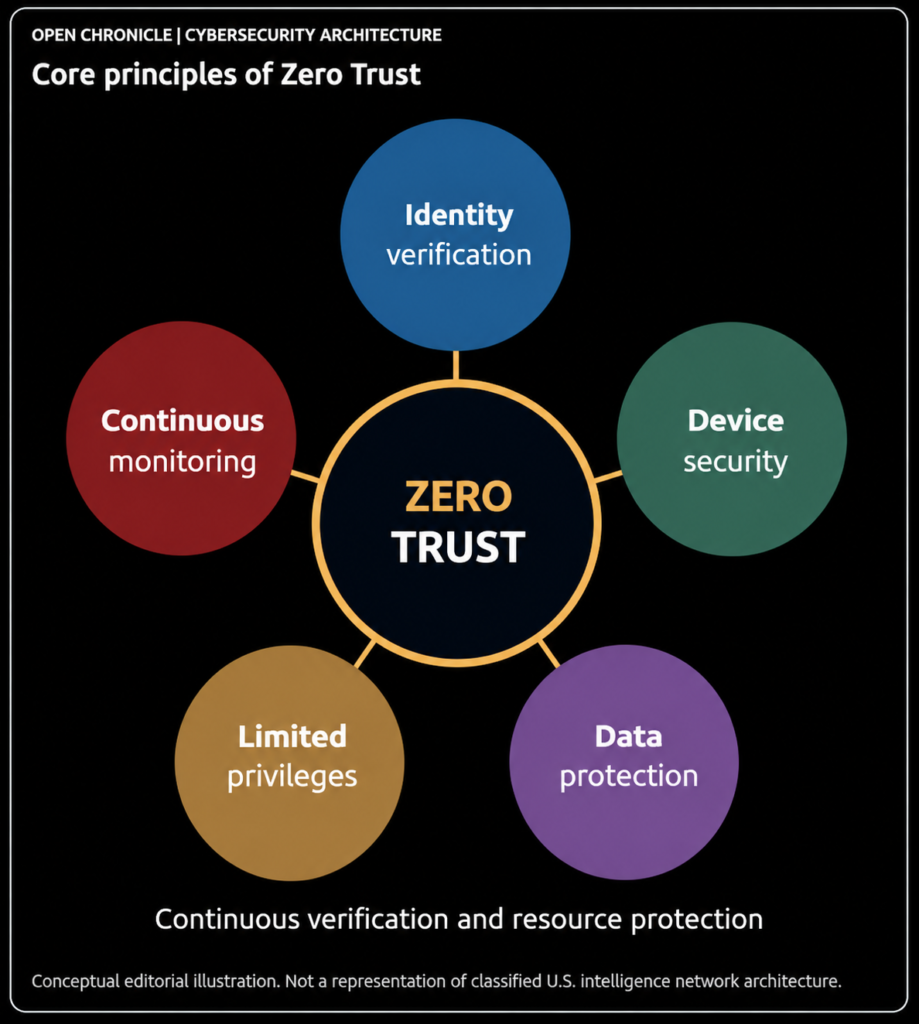
For intelligence organisations, such principles are particularly important because information may be distributed across numerous agencies, analytical platforms and security environments.
The objective is not merely to prevent unauthorised entry, but also to limit the potential consequences of a successful intrusion.
13. Cyber Espionage as an Instrument of Geopolitical Competition
Cyber espionage has become an established element of international strategic competition.
Unlike conventional military operations, cyber activities can occur continuously without producing an immediate visible confrontation between states.
Governments may seek information concerning diplomatic negotiations, military capabilities, technological developments, economic policies and the strategic intentions of potential adversaries.
Intelligence organisations are therefore both participants in and targets of this competition.
The reported compromise of American intelligence analysis infrastructure demonstrates the potential strategic value of targeting the institutions responsible for understanding foreign threats.
For an adversary, information about what another country’s intelligence community is investigating may be almost as valuable as some of the intelligence itself.
The broader geopolitical consequences could include increased diplomatic tensions, additional cybersecurity investment, stronger counterintelligence measures and greater scrutiny of international technology dependencies.
None of these potential consequences establishes that the November incident was necessarily a state-sponsored espionage operation.
14. Six Priorities for Strengthening Federal Cyber Resilience
The National Institute of Standards and Technology (NIST) Cybersecurity Framework 2.0 provides a useful structure for assessing organisational cybersecurity capabilities.
Its six core functions encompass governance, identification, protection, detection, response and recovery.
⚖ 01 Govern Establish institutional responsibility, oversight and risk management. | ⌕ 02 Identify Understand critical assets, dependencies and potential vulnerabilities. |
☑ 03 Protect Implement appropriate safeguards for information and infrastructure. | ◎ 04 Detect Identify suspicious activity and potential security incidents. |
⚠︎ 05 Respond Coordinate containment, investigation and incident management. | ↻ 06 Recover Restore affected capabilities and strengthen future resilience. |
Applying these principles consistently across federal institutions will require more than additional cybersecurity software.
It will require effective governance, adequate resources, trained personnel, independent security assessments and the ability to learn from previous incidents.
15. Open Chronicle Strategic Assessment
The reported intelligence community breach should be examined within the broader transformation of national security in the digital age.
Five strategic dimensions deserve particular attention.
Five lessons from the intelligence community breach
Intelligence infrastructure is itself a strategic target
The systems used to understand foreign threats can become valuable targets for espionage and information theft.
Unclassified does not mean strategically insignificant
Analytical methods, research priorities and aggregated information may possess considerable intelligence value.
Artificial intelligence is accelerating cyber competition
Automated capabilities are increasing pressure on traditional security processes and institutional response mechanisms.
Cyber attribution requires rigorous evidence
The origin of a software application cannot independently establish the identity or government affiliation of an attacker.
Resilience is as important as prevention
Intelligence organisations must be capable of containing incidents, protecting essential functions and restoring affected systems.
The most important strategic lesson is that cybersecurity can no longer be regarded exclusively as a technical support function.
For intelligence organisations, cybersecurity is inseparable from operational effectiveness, counterintelligence and national security.
16. What Remains Unanswered?
Despite the growing volume of reporting, several fundamental questions remain unresolved.
| Outstanding question | Strategic importance |
|---|---|
| Who conducted the intrusion? | Establishes potential responsibility and motive. |
| Was ARTEX definitively involved? | Clarifies the technological nature of the incident. |
| What information was compromised? | Determines the actual intelligence impact. |
| Was information extracted? | Establishes whether unauthorised access resulted in data theft. |
| How long did the compromise persist? | Helps assess the extent of potential exposure. |
| Was the NGA directly affected? | Establishes the institutional scope of the breach. |
| Were external suppliers involved? | Clarifies possible third-party dependencies. |
| Were other federal incidents connected? | Determines whether a broader campaign existed. |
| What corrective measures were implemented? | Helps evaluate future institutional resilience. |
| Will Congress conduct a formal review? | Determines the extent of legislative oversight and accountability. |
Until these questions are answered, assessments of the incident’s full strategic consequences must remain provisional.
Conclusion: Protecting the Institutions That Protect America
The reported cyberattacks against American intelligence agencies represent more than another episode in the continuing struggle against digital threats.
They highlight the growing dependence of national security institutions on complex information systems, commercially available data, interconnected analytical platforms and rapidly evolving artificial intelligence technologies.
The apparent preservation of classified systems is reassuring, but it does not eliminate the potential consequences of compromising unclassified intelligence infrastructure.
The challenge facing Washington is to modernise its digital capabilities while preserving operational continuity, institutional accountability and public confidence.
As artificial intelligence transforms both cyber defence and malicious cyber activity, the institutions responsible for identifying threats must themselves remain capable of resisting them.
The security of intelligence is no longer measured solely by the secrecy of information, but also by the resilience of the systems that transform information into knowledge.