
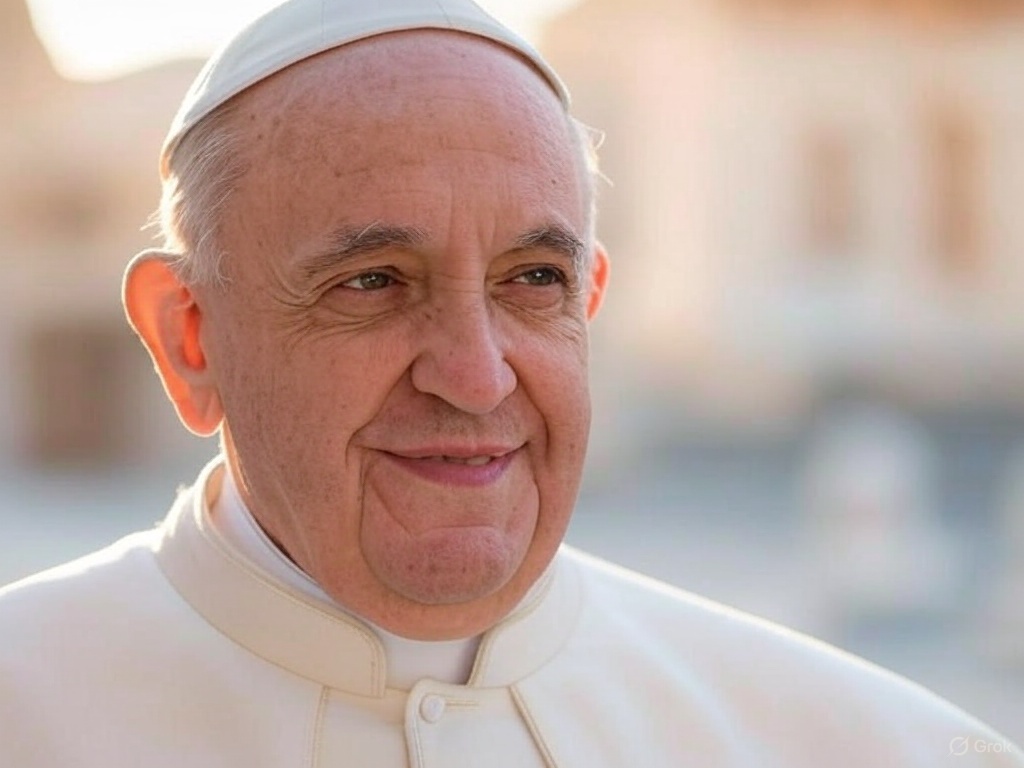
Image Credentials: Image Title: Pope Francis Dies of Stroke and Heart Failure, Vatican Confirms Source: AI-Generated Image (Grok, xAI) Date: April 2025 Attribution: Created by AI-generated imagery (Grok, xAI), and it does not depict a real-world scene.
Final Resting Place to Be Humble Tomb at St. Mary Major Basilica
By Staff Writer with Agencies
VATICAN CITY, April 21, 2025 — The Vatican announced on Monday that Pope Francis has died of a stroke and subsequent irreversible heart failure, following a long struggle with respiratory illness. He was 88 years old.
The Argentine pontiff, born Jorge Mario Bergoglio, passed away at 7:35 a.m. at his residence in the Domus Santa Marta, where he had returned only weeks earlier after a five-week hospitalization for double pneumonia. Though he had resumed light duties, the pontiff’s health had remained fragile in recent months.
The official statement came from Cardinal Kevin Farrell, the Vatican camerlengo, who is now overseeing the administration of the Church during the interregnum.
“At 7:35 this morning, the Bishop of Rome, Francis, returned to the home of the Father,” Farrell said in a solemn announcement. “His entire life was dedicated to the service of the Lord and of his Church.”
A Final Wish for Simplicity
In keeping with his lifelong humility and devotion to the poor, Pope Francis decreed that he be buried in a simple underground tomb at St. Mary Major Basilica, rather than in the Vatican grottoes where most popes are laid to rest. The tomb will bear only the name “Franciscus”, in Latin.
This basilica held deep personal significance for the pope. He frequently visited the Salus Populi Romani, a Byzantine icon of the Virgin Mary housed in the basilica, especially before and after his international apostolic journeys.
From the Streets of Buenos Aires to the Heart of the Vatican
Pope Francis, elected in March 2013 as the 266th pope of the Roman Catholic Church, was the first from Latin America and the first Jesuit to ascend to the papacy. His tenure was marked by a pastoral emphasis on mercy, care for the environment, and outreach to society’s marginalized, including the poor, refugees, and the LGBTQ+ community.
His death ends a 12-year papacy defined by efforts to reform the Church and renew its focus on spiritual simplicity and service.
Health Struggles in Final Months
Francis had long suffered from health issues, including sciatica and chronic respiratory problems stemming from the removal of part of his right lung in his youth. His condition worsened in mid-February when he was admitted to Rome’s Gemelli Hospital with a severe case of pneumonia.
Though he returned to the Vatican in March and made a brief public appearance on Easter Sunday, his weakened state was evident. On that final day, he waved and smiled from the balcony of St. Peter’s Basilica, offering a blessing in what would become his last message to the faithful.
Awaiting the Next Chapter
The date of Pope Francis’ funeral has yet to be announced, but according to tradition, the burial must occur between the fourth and sixth day following his death. His passing has initiated the “sede vacante” period, during which the seat of St. Peter is vacant.
The conclave of cardinals will convene in the coming weeks to elect a new pope. Until then, the Church enters a time of mourning, reflection, and transition.
Cardinal Farrell concluded the Vatican’s announcement with words of gratitude:
“With immense gratitude for his example as a true disciple of the Lord Jesus, we commend the soul of Pope Francis to the infinite, merciful love of God, One and Triune.”
Flags across the Vatican are flying at half-staff, and bells of St. Peter’s Basilica tolled through the morning as the world begins to mourn one of the most transformative papacies in modern Catholic history.