
OPEN CHRONICLE HISTORY MAGAZINE · ANCIENT GREECE · ARCHAEOLOGY · HISTORY OF TECHNOLOGY
Discovered in a shipwreck off a small Greek island, the Antikythera mechanism revealed an astonishing truth about ancient engineering. More than 2,000 years ago, craftsmen built a sophisticated machine capable of modelling celestial cycles and predicting eclipses. Its discovery transformed our understanding of what the ancient world could achieve.
By Open Chronicle History Desk
In 1901, divers exploring an ancient shipwreck near the Greek island of Antikythera recovered what appeared to be an unremarkable lump of corroded bronze.
The object was broken, encrusted with marine deposits and almost impossible to identify.
It had spent approximately two thousand years beneath the Mediterranean Sea.
Among the marble statues, bronze sculptures, pottery and other valuable objects recovered from the wreck, the mysterious fragments attracted relatively little attention.
But hidden inside the corrosion was something extraordinary.
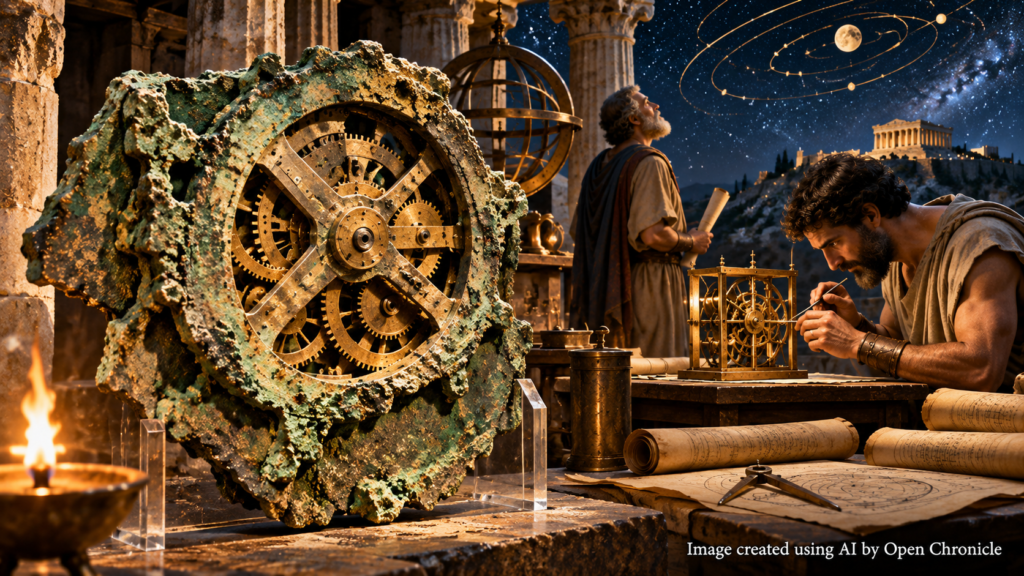
A complex arrangement of bronze gears.
The remains of a mechanical instrument unlike anything previously known from the ancient world.
As researchers gradually examined the fragments, they began to understand that the object had once been capable of performing intricate astronomical calculations.
It could represent the movements of the Sun and Moon, track calendar cycles and predict eclipses.
Its design required a sophisticated understanding of mathematics, astronomy and precision mechanical engineering.
Today, the device is known as the Antikythera mechanism.
It is frequently described as the world’s oldest known analogue computer.
And its existence raises one of the most fascinating questions in the history of technology.
How could ancient Greek craftsmen build such an advanced machine, and why did comparable mechanical instruments become so rare in the surviving historical record?
The answer leads from a Roman-era shipwreck to the intellectual world of Hellenistic Greece, where mathematics, astronomy and engineering reached levels of sophistication that historians are still working to understand.
A Shipwreck That Changed the History of Technology
The story begins in the spring of 1900.
Greek sponge divers, operating near the small island of Antikythera between Crete and the Peloponnese, encountered the remains of an ancient shipwreck.
The vessel lay at considerable depth, making exploration dangerous with the diving equipment available at the time.
The divers discovered an extraordinary collection of objects.
Among them were bronze and marble sculptures, luxury goods and other artefacts that suggested the ship had been carrying valuable cargo through the Mediterranean.
An official archaeological recovery operation began later that year.
The expedition became one of the earliest major underwater archaeological investigations.
The ship is generally believed to have sunk during the first century BC, although the precise date and circumstances remain uncertain.
Its cargo reflected the movement of luxury objects and cultural treasures through the Mediterranean during a period of expanding Roman power.
The mysterious bronze mechanism was recovered during these operations.
Initially, however, its significance was not understood.
The object appeared to be little more than a collection of damaged metal fragments.
Its true complexity remained hidden.
The Moment the Gears Were Recognised
In May 1902, the archaeologist Valerios Stais noticed that one of the recovered fragments contained what appeared to be a gear wheel.
This was an astonishing observation.
Ancient Greek civilisation was well known for its achievements in philosophy, mathematics, medicine, architecture and astronomy.
But a complex mechanical device containing numerous interlocking gears seemed far removed from the conventional picture of ancient technology.
The discovery raised immediate questions.
Was the object part of an astronomical instrument?
Could it have been used to calculate calendar dates?
Was it a navigation device?
Or did it belong to a technological tradition that historians had underestimated?
For decades, researchers struggled to answer these questions.
The mechanism was badly damaged.
Only part of the original object had survived.
Corrosion concealed important details.
And the available scientific techniques made it difficult to investigate the internal structure without risking further damage.
The instrument remained one of archaeology’s most puzzling discoveries.
A Machine Built More Than Two Thousand Years Ago
The Antikythera mechanism was probably manufactured during the second or early first century BC.
Its precise place of manufacture remains uncertain.
The instrument was originally housed inside a wooden case, approximately the size of a substantial book or small box.
Its front and back contained dials, pointers and inscriptions.
Inside, a complex arrangement of bronze gears transmitted movement through the mechanism.
A user could operate the device through an external control, allowing its displays to represent astronomical and calendrical relationships.
The surviving fragments preserve evidence of at least 30 gears, although the original mechanism probably contained more.
Its engineering was remarkably sophisticated.
Some gears were designed to represent cycles that required mathematical relationships involving different periods of time.
Others helped reproduce the changing apparent motion of celestial bodies.
The mechanism was not powered by electricity.
It did not contain electronic circuits.
It did not execute programmable instructions in the modern digital sense.
Nevertheless, it performed a function recognisable in the history of computing.
It used a physical mechanical system to model and calculate relationships between astronomical quantities.
That is why researchers describe it as an analogue computer.
What Could the Antikythera Mechanism Actually Do?
The surviving evidence indicates that the instrument was designed primarily to represent astronomical cycles and calendar relationships.
Its functions were more sophisticated than those of an ordinary clock or calendar.
The mechanism could track the position of the Sun and Moon through the zodiac.
It represented the phases of the Moon.
It incorporated a calendar system associated with the ancient Greek world.
It could also indicate periods during which solar or lunar eclipses might occur.
One of its most remarkable features was its ability to represent the irregular apparent motion of the Moon.
The Moon does not move across the sky at a perfectly uniform apparent speed.
Its orbital motion varies because its orbit is elliptical.
Ancient Greek astronomers had developed mathematical models to describe this variation.
The Antikythera mechanism translated such mathematical relationships into mechanical movement.
This was an extraordinary achievement.
It required not only astronomical knowledge but also the ability to manufacture components with sufficient precision for multiple gears to operate together.
The mechanism demonstrates that at least some ancient craftsmen were capable of combining advanced theoretical knowledge with practical mechanical engineering.
Predicting Eclipses with Bronze Gears
One of the most securely established functions of the mechanism concerns eclipse prediction.
The rear of the instrument included a display associated with the Saros cycle.
The Saros is a period of approximately 18 years, 11 days and 8 hours, during which the geometry of the Sun, Earth and Moon returns to a similar configuration.
This cycle allows eclipses to recur in broadly predictable patterns.
The Antikythera mechanism incorporated a spiral dial representing 223 lunar months.
Markings associated with this cycle indicated potential eclipse events.
The device also contained an additional display related to the Exeligmos cycle, which helped account for changes in the timing of eclipse recurrences.
This did not mean the mechanism could predict every detail of an eclipse with modern astronomical accuracy.
The visibility of an eclipse depends upon geographical position and other factors.
But the machine could represent the recurrence of eclipse opportunities using a sophisticated mathematical cycle.
The achievement is remarkable because it transformed astronomical theory into a compact mechanical instrument.
Instead of consulting extensive tables or performing calculations from the beginning, a user could manipulate the mechanism to explore celestial relationships.
The Moon’s Changing Motion
The mechanism’s lunar display is especially important for understanding its technological sophistication.
Modern imaging has revealed evidence of an ingenious gear arrangement designed to reproduce variations in the Moon’s apparent motion.
This involved a pin-and-slot mechanism that could generate a non-uniform output from rotating components.
The system reflected the mathematical astronomy developed in the Hellenistic world.
Greek astronomers understood that simple uniform circular motion could not adequately describe every observed celestial phenomenon.
They therefore developed increasingly sophisticated geometrical models.
The Antikythera mechanism embodied aspects of this theoretical tradition in metal.
It was not simply a decorative representation of the heavens.
It was a functioning mathematical model.
That distinction explains why the discovery has had such a profound impact upon the history of science.
The Olympic Games and the Calendar of the Ancient World
The mechanism also connected astronomy to the organisation of human life.
One of its rear displays represented a 19-year cycle known as the Metonic cycle.
This cycle reflects the relationship between solar years and lunar months.
Nineteen solar years correspond approximately to 235 lunar months.
Such relationships were important in ancient calendar systems, particularly where religious festivals and civic activities depended upon lunar dates.
The instrument also contained a display associated with the four-year cycle of major Panhellenic athletic festivals.
These included the Olympic Games and other important competitions.
This feature reveals an important aspect of the machine’s purpose.
The Antikythera mechanism was not concerned exclusively with abstract astronomy.
It connected celestial cycles to the rhythms of Greek society.
Religion, civic life, festivals and astronomical observation were closely related.
The device therefore belonged to a culture in which mathematical knowledge could have practical, ceremonial and intellectual applications.
The Intellectual World That Made It Possible
To understand the Antikythera mechanism, we must look beyond the object itself.
Its construction was possible because Hellenistic Greece possessed a sophisticated scientific tradition.
Following the conquests of Alexander the Great in the fourth century BC, Greek intellectual culture spread across an extensive network of cities and kingdoms.
Major centres of learning developed in places such as Alexandria, Rhodes and other parts of the eastern Mediterranean.
Astronomers studied celestial movements.
Mathematicians developed geometrical methods.
Engineers designed mechanical devices.
Inventors experimented with water power, pneumatics, levers, pulleys and other mechanisms.
This intellectual environment produced remarkable figures.
Archimedes, active during the third century BC, investigated mathematics, mechanics and hydrostatics.
Hipparchus, working during the second century BC, made important contributions to observational and mathematical astronomy.
Other Greek scholars developed theoretical models that could be translated into mechanical representations.
The Antikythera mechanism emerged from this wider world of technical knowledge.
Its existence is therefore less mysterious when viewed within the achievements of Hellenistic science.
What remains extraordinary is the sophistication of its surviving engineering.
Was Archimedes Connected to the Mechanism?
Archimedes is frequently mentioned in discussions of the Antikythera mechanism.
The connection is understandable.
Ancient literary sources describe mechanical devices associated with Archimedes that represented celestial movements.
The Roman writer Cicero referred to astronomical instruments connected with Archimedes and other Greek thinkers.
These accounts suggest that mechanical models of the heavens were known in antiquity.
But there is no evidence that Archimedes personally designed or constructed the surviving Antikythera mechanism.
He died in 212 BC, probably decades before the device was manufactured.
It is possible that later engineers drew upon traditions of mathematical and mechanical knowledge associated with his work.
But the specific relationship cannot be established.
The same caution applies to Hipparchus.
Some features of the mechanism are consistent with sophisticated lunar theories associated with Hellenistic astronomy.
Yet no surviving inscription identifies its maker.
The machine remains anonymous.
Its creator may have been a highly skilled craftsman working in collaboration with astronomers.
Or it may have emerged from a workshop where scientific and mechanical expertise were closely integrated.
The identity of its maker remains one of its greatest mysteries.
How Modern Science Revealed the Hidden Machine
he modern understanding of the mechanism developed gradually.
During the twentieth century, researchers began to recognise that the object contained a complex astronomical gear system.
One of the most influential investigators was the historian of science Derek J. de Solla Price.
Working with radiographic techniques, Price examined the internal structure of the fragments.
His research, particularly his 1974 monograph Gears from the Greeks, helped establish the mechanism as a sophisticated ancient astronomical calculator.
Later investigations transformed the field.
In 2005, an international research collaboration employed advanced imaging methods, including high-resolution X-ray computed tomography.
These techniques allowed researchers to examine internal components that were invisible from the surface.
They also revealed inscriptions that had been obscured by corrosion.
The results were published in Nature in 2006.
The research confirmed the extraordinary complexity of the mechanism and provided new evidence for its astronomical functions.
Further studies in 2008 clarified its eclipse-prediction system and the significance of its calendrical displays.
The object that had once appeared to be a corroded lump of bronze was becoming a detailed mechanical record of ancient scientific knowledge.
Reconstructing the Missing Parts
Despite these advances, the original mechanism remains incomplete.
Only a portion of its components survives.
Many gears, pointers and structural elements are missing.
Researchers must therefore distinguish between what the surviving fragments demonstrate and what modern reconstructions propose.
This distinction became especially important in 2021.
A team led by researchers at University College London published a proposed reconstruction of the mechanism’s front display in Scientific Reports.
The model sought to explain how the instrument might have represented planetary movements using complex arrangements of gears.
The research combined surviving physical evidence, inscriptions and ancient astronomical relationships.
Its proposed design was an important contribution.
But it was not a complete recovery of the original mechanism.
Several aspects of the front display remain debated.
The exact arrangement of missing gears cannot be established with certainty.
Different reconstructions may satisfy some of the same surviving constraints.
The Antikythera mechanism is therefore both a remarkable technological discovery and an ongoing scientific puzzle.
Could It Predict the Movements of the Planets?
One of the most intriguing questions concerns the five planets visible to the naked eye.
Mercury, Venus, Mars, Jupiter and Saturn were known to ancient astronomers.
Their apparent movements presented considerable mathematical challenges.
Unlike the Sun and Moon, planets sometimes appear to reverse direction against the background stars.
Ancient astronomers developed geometrical models to account for these phenomena.
Inscriptions associated with the Antikythera mechanism indicate that planetary cycles were relevant to its design.
Modern reconstructions have proposed mechanisms capable of representing these movements.
However, the physical evidence for the complete planetary display is less secure than the evidence for the lunar, solar and eclipse functions.
It would therefore be misleading to describe every proposed planetary feature as an established fact.
The most defensible conclusion is that the mechanism was designed within a tradition of sophisticated astronomical modelling, and its surviving inscriptions suggest an interest in planetary phenomena.
Exactly how the missing components represented those phenomena remains under investigation.
Why Was Such Technology Lost?
This question gives the Antikythera mechanism much of its popular fascination.
If ancient Greek craftsmen could build such a sophisticated machine, why do we not possess hundreds of similar devices?
Why does the surviving record contain such a long gap before comparable geared astronomical instruments become well documented?
The answer begins with the fragility of historical evidence.
Bronze was valuable.
Objects made from it could be melted down and reused.
Wooden cases decayed.
Mechanical instruments could break, become obsolete or be discarded.
Many ancient scientific works disappeared because manuscripts were not continuously copied.
Workshops vanished.
Patrons died.
Political systems changed.
The survival of a complex ancient machine over two thousand years would have been extremely unlikely under ordinary circumstances.
The Antikythera mechanism survived because it was lost at sea.
The shipwreck preserved fragments that might otherwise have been destroyed or recycled.
Its apparent uniqueness may therefore tell us as much about the accidents of archaeological preservation as it does about the rarity of ancient mechanical knowledge.
Did the Romans Destroy Greek Technology?
The decline of certain ancient technological traditions is sometimes attributed to Roman conquest or the later collapse of the Roman Empire.
Such explanations are too simple.
Roman civilisation absorbed and adapted substantial elements of Greek science and engineering.
Greek-speaking scholars continued to work under Roman rule.
Mechanical knowledge did not disappear suddenly when Rome became the dominant Mediterranean power.
Nevertheless, the institutions supporting specialised scientific work changed over time.
Royal patronage, wealthy collectors, educational centres and technical workshops could rise or decline according to political and economic circumstances.
A highly specialised device might require a combination of astronomical expertise, skilled metalworking and financial support.
If demand for such instruments declined, their production could become less common.
The historical record does not allow us to reconstruct a continuous manufacturing tradition for mechanisms identical to the Antikythera device.
But neither does it justify the claim that humanity completely forgot how gears worked for more than a thousand years.
Geared devices and astronomical instruments continued to develop in different societies.
The history of mechanical technology was not a simple progression from Greek brilliance to medieval ignorance.
It involved preservation, adaptation, regional innovation and changing technical traditions.
The Medieval World Was Not Technologically Empty
The idea that the Antikythera mechanism disappeared into a thousand-year technological darkness reflects an outdated understanding of history.
Mechanical engineering continued to evolve after antiquity.
In the Byzantine world, scientific and technical traditions survived in various forms.
Scholars working in Islamic societies translated, studied and developed Greek mathematical and astronomical knowledge.
Engineers created sophisticated mechanical devices, including water clocks and automated mechanisms.
Astronomical instruments became increasingly elaborate.
In medieval Europe, mechanical clockmaking eventually produced complex geared systems capable of representing time and celestial movements.
The famous astronomical clock associated with Richard of Wallingford at St Albans in the fourteenth century illustrates the sophistication of later medieval mechanical astronomy.
These developments were not necessarily direct descendants of the Antikythera mechanism.
The lines of technological transmission remain difficult to trace.
But they demonstrate that precision mechanical engineering did not simply vanish from human civilisation.
The real historical question is more specific.
Why do we possess so little surviving evidence of complex geared astronomical computers from the centuries immediately following the Hellenistic period?
That question remains open.
A Computer Before Computers?
Calling the Antikythera mechanism a computer is useful, provided the term is understood correctly.
A modern digital computer stores and processes information through electronic systems.
It can execute programmable instructions and perform an enormous range of calculations.
The Antikythera mechanism did none of these things.
Its calculations were embodied in physical relationships between gears.
Turning the mechanism changed the positions of its displays according to predetermined mathematical ratios.
It was therefore an analogue calculating device designed for a specialised purpose.
The machine could represent astronomical relationships because its mechanical structure encoded them.
In that sense, the mechanism belongs to the long history of computing.
It demonstrates that the idea of constructing a physical device to perform mathematical operations is far older than modern electronics.
The underlying intellectual achievement is extraordinary.
Ancient engineers translated abstract mathematical relationships into a functioning mechanical system.
What the Mechanism Reveals About Ancient Greece
The most important lesson of the Antikythera mechanism is not that ancient Greeks possessed modern technology.
They did not.
It is that our assumptions about the technological capabilities of past societies can be profoundly misleading.
The ancient world was not divided neatly between abstract philosophers and practical craftsmen.
At least in some intellectual and technical environments, mathematical theory and skilled manufacturing could interact closely.
The mechanism required knowledge of astronomical cycles.
It required geometric reasoning.
It required the ability to produce and assemble gears.
It required inscriptions explaining complex functions.
And it required a cultural setting in which such an instrument had value.
The device therefore represents more than one ingenious invention.
It provides evidence of a sophisticated relationship between science, craftsmanship and the organisation of knowledge.
The Machine That Rewrote Technological History
When the Antikythera mechanism was recovered from the sea, historians possessed an incomplete picture of ancient mechanical engineering.
The surviving literary record suggested that Greek inventors had experimented with complex devices.
But the physical evidence was limited.
The mechanism changed that.
It demonstrated that a sophisticated geared astronomical calculator had existed more than two thousand years ago.
Its complexity challenged conventional assumptions about the technical possibilities of the Hellenistic world.
Modern imaging revealed features that earlier researchers could scarcely have imagined.
And each new reconstruction has raised further questions about the knowledge and craftsmanship required to produce it.
The mechanism remains one of the most important archaeological discoveries in the history of science.
Not because it proves the existence of a lost civilisation with modern technology.
But because it reveals how much genuine ancient technological achievement can disappear from the historical record.
A Lost Machine, an Unfinished Story
More than two thousand years ago, an unknown craftsman or group of craftsmen constructed a machine capable of transforming the movements of bronze gears into a representation of the heavens.
The instrument reflected generations of astronomical observation, mathematical reasoning and mechanical experimentation.
It was eventually placed aboard a ship.
That ship sank near Antikythera.
The mechanism disappeared beneath the Mediterranean.
Centuries passed.
Empires rose and fell.
Scientific traditions evolved.
Mechanical technology developed in new directions.
Then, in 1901, divers recovered the corroded remains of a device that would force historians to reconsider the achievements of ancient engineering.
Today, researchers continue to examine its fragments, reconstruct its missing components and debate the precise extent of its capabilities.
Its greatest mystery may never be fully resolved.
We may never know who built it.
We may never discover how many similar instruments once existed.
And we may never reconstruct every detail of its original design.
But one conclusion is beyond doubt.
The Antikythera mechanism did not merely calculate the movements of the heavens. It changed the way we understand the intellectual and technological achievements of the ancient world.
Historical Sources and Further Reading
This article draws on archaeological research, ancient astronomical history and scientific investigations of the Antikythera mechanism. The following studies distinguish the device’s established functions from proposed reconstructions of its missing components.
Nature | Decoding the Ancient Greek Astronomical Calculator Known as the Antikythera Mechanism
Freeth and colleagues, 2006. Landmark research using advanced surface imaging and X-ray tomography to investigate the surviving gears, inscriptions, lunar motion and eclipse prediction.
Nature | Calendars with Olympiad Display and Eclipse Prediction on the Antikythera Mechanism
Freeth, Jones, Steele and colleagues, 2008. Research identifying important features of the mechanism’s calendrical displays, eclipse prediction system and cycle of Panhellenic athletic festivals.
Scientific Reports | A Model of the Cosmos in the Ancient Greek Antikythera Mechanism
Freeth and colleagues, 2021. A detailed proposed reconstruction of the front astronomical display, incorporating planetary cycles, surviving inscriptions and complex mechanical gearing.
Nature Astronomy | Our Current Knowledge of the Antikythera Mechanism
Seiradakis and Edmunds, 2018. A scholarly review of the mechanism’s discovery, surviving evidence, established astronomical functions and unresolved questions concerning its origins, purpose and construction.
The Antikythera mechanism is widely recognised as the oldest surviving complex geared astronomical calculator. However, much of the original instrument is missing. While its lunar, solar, calendrical and eclipse functions are supported by substantial physical evidence, reconstructions of its complete planetary system remain scientific interpretations. No surviving evidence conclusively identifies the original maker or establishes how many comparable devices existed in antiquity.