
OPEN CHRONICLE HISTORY MAGAZINE · MIDDLE AGES · MEDIEVAL EUROPE
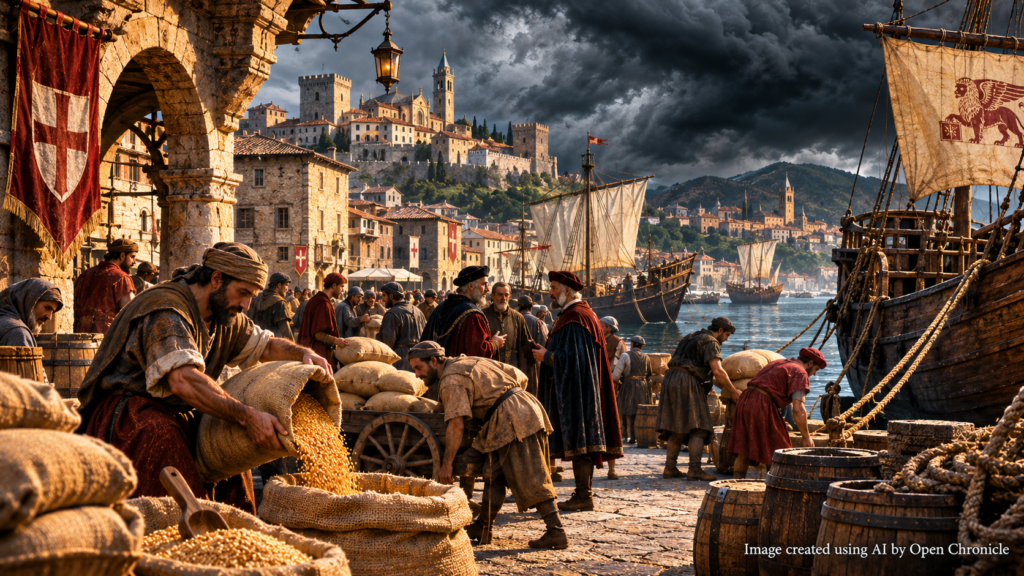
In 1347, European merchants were searching for grain, security and commercial opportunity. Their ships moved through a world of changing climate, food shortages and expanding trade networks. But those same connections may have helped carry one of history’s deadliest pandemics into Europe.
By Open Chronicle History Desk
In the autumn of 1347, ships arriving in Mediterranean ports carried goods from a vast commercial world stretching across Europe, the Black Sea and Asia.
They also entered a continent on the edge of catastrophe.
Within a few years, the Black Death would kill an enormous proportion of Europe’s population, devastate cities and villages, disrupt economies and permanently alter the social order.
For centuries, historians have examined how the plague reached Europe. Merchants, maritime routes, military campaigns and the movement of infected rodents and their parasites have all featured in explanations of its spread.
But a more unsettling question has emerged from research into the relationship between climate, food supplies and medieval commerce.
Could the trading networks that helped European societies survive periods of food insecurity also have helped introduce the disease that devastated them?
A scientific study published in Communications Earth & Environment in December 2025 explored this possibility, connecting environmental pressures, grain movements and the spread of plague through the Mediterranean world.
Its implications reach beyond the history of a medieval pandemic.
The Black Death was not simply a biological disaster. It unfolded within a deeply interconnected world in which climate, trade, political decisions and human survival were already closely linked.
To understand how the plague reached Europe, we must first understand why medieval Europeans depended on networks extending far beyond their own fields and cities.
Europe Before the Black Death
Europe in the early fourteenth century was neither an isolated nor a uniformly impoverished continent.
During the preceding centuries, agricultural expansion, population growth and commercial development had transformed large parts of medieval society.
Forests were cleared, marshes drained and new settlements established.
Towns expanded.
Markets connected rural producers with urban consumers.
Italian maritime republics developed extensive commercial networks across the Mediterranean and Black Sea.
Merchants from Genoa and Venice traded with ports controlled by Byzantine authorities, Italian colonial administrations, Muslim rulers and the Mongol successor states.
Goods moved over remarkable distances.
Spices, silk, textiles, metals, grain and other commodities travelled through networks linking European consumers to the eastern Mediterranean, Central Asia and beyond.
The commercial world was complex, multilingual and politically fragmented.
Yet it was also increasingly interconnected.
This interconnectedness created opportunities for prosperity.
It also created vulnerabilities.
When crops failed in one region, distant grain supplies could help sustain urban populations.
But the same ships that transported food could also transport animals, insects and pathogens.
The infrastructure of survival could become an infrastructure of contagion.
The Climate That Shaped Medieval Life
Agriculture remained the foundation of medieval economic life.
Most Europeans depended directly or indirectly upon cereal production.
Wheat, rye, barley and oats supplied much of the population’s daily food.
Harvest failures could therefore have immediate consequences.
The early fourteenth century had already demonstrated the danger.
Between 1315 and 1317, severe weather and agricultural disruption contributed to the Great Famine across much of northern Europe.
Heavy rainfall, crop failures, livestock disease and rising food prices produced widespread suffering.
The famine weakened communities and exposed the limitations of medieval food systems.
Although the Black Death arrived decades later, the earlier disaster illustrated a persistent reality.
European societies were highly sensitive to environmental change.
The relationship between climate and agriculture was not straightforward.
Different regions experienced different conditions, and harvest outcomes depended on local soils, farming practices, institutions and markets.
Nevertheless, shifts in temperature and rainfall could influence food availability over extensive areas.
By the 1340s, environmental pressures were interacting with the political and commercial systems that supplied Mediterranean cities.
The question was no longer simply whether local farmers could produce enough food.
It was whether merchants could obtain supplies elsewhere.
The Mediterranean’s Hunger for Grain
The great commercial cities of medieval Italy depended upon food arriving from beyond their immediate territories.
Genoa and Venice were particularly important maritime powers.
Their wealth rested partly upon their ability to connect distant markets.
But urban populations could not survive on commerce alone.
They needed bread.
Grain supplies therefore became a matter of economic stability and political concern.
The Mediterranean grain trade linked Italian markets with regions including Sicily, southern Italy, North Africa and the Black Sea.
These connections allowed merchants to respond to shortages by searching for alternative suppliers.
When harvests failed or prices rose, imported grain could help relieve pressure.
Yet dependence on distant supplies meant that food security was increasingly tied to maritime movement.
Ships travelled between ports carrying cargoes, crews, provisions and sometimes unwanted biological passengers.
Trade reduced certain risks while creating others.
This contradiction lies at the centre of the new interpretation of the Black Death’s arrival.
The Black Sea: A Gateway Between Worlds
During the thirteenth and fourteenth centuries, the Black Sea became an important commercial frontier for Italian merchants.
Genoese and Venetian trading interests extended into ports connected to the Mongol world.
One of the most significant settlements was Caffa, known today as Feodosia, on the Crimean Peninsula.
Caffa occupied a strategic position between maritime routes and the commercial networks of Eurasia.
Merchants could obtain commodities arriving from inland territories and transport them across the Black Sea toward the Mediterranean.
The settlement was therefore more than an isolated colonial outpost.
It formed part of an extensive system of commercial exchange.
That system also connected environments inhabited by wildlife capable of maintaining plague bacteria.
The bacterium responsible for plague, Yersinia pestis, circulates naturally among certain rodent populations and their fleas.
Human epidemics can occur when ecological and social conditions allow the pathogen to cross into human populations and spread.
The precise historical pathways involved in the fourteenth-century pandemic remain subjects of investigation.
But the Black Sea’s position within Eurasian commerce made it a plausible route through which plague could move toward Mediterranean Europe.
The Siege of Caffa
One of the most frequently discussed episodes in the history of the Black Death concerns the siege of Caffa in the 1340s.
Forces associated with the Golden Horde confronted the Genoese settlement.
A later account by the Italian notary Gabriele de’ Mussi described plague among the besieging forces and claimed that infected corpses were thrown into the city.
This story has often appeared in popular histories as an early example of biological warfare.
But the evidence requires caution.
De’ Mussi was not an eyewitness to the siege, and historians have questioned important elements of his account.
It is not established that the alleged use of infected corpses caused the plague’s introduction into Europe.
Nor can the entire European pandemic be traced securely to one incident.
The siege remains relevant because it occurred within a region where military conflict, commercial activity and plague transmission may have intersected.
It illustrates the instability of the Black Sea trading environment.
But the broader history of the Black Death cannot be reduced to a single dramatic episode.
Trade networks, ecological conditions and repeated movements of people and goods offer a more complicated explanation.
The Scientific Evidence from Central Asia
One of the most important developments in recent Black Death research came from ancient DNA.
In 2022, scientists published a study in Nature examining human remains from burial grounds near Lake Issyk-Kul in present-day Kyrgyzstan.
Some gravestones dated to 1338 and 1339 referred to deaths associated with pestilence.
Researchers identified ancient Yersinia pestis DNA in individuals buried at the sites.
Genetic analysis placed the bacterial strains close to a major diversification event in the evolutionary history of the plague pathogen.
The findings provided important evidence connecting the emergence of the Black Death lineage to Central Asia in the years before the European pandemic.
They did not reconstruct every step by which the disease reached Mediterranean ports.
But they strengthened the understanding that the pandemic emerged within a wider Eurasian ecological and commercial context.
The disease that devastated Europe was part of a history extending far beyond Europe itself.
A New Question: Did Food Insecurity Help Spread the Plague?
The 2025 study in Communications Earth & Environment examined an additional dimension of the pandemic.
Its central concern was the relationship between environmental change, food supply and the movement of plague into Mediterranean Europe.
The researchers proposed that climate-related pressures affecting grain production and availability may have contributed to changes in commercial activity.
Under this interpretation, Italian cities facing food insecurity had incentives to seek supplies through wider trading networks, including routes connected to the Black Sea.
Those movements could have increased opportunities for the plague pathogen to reach Mediterranean ports.
The argument is significant because it changes the emphasis of the historical question.
Instead of asking only where the plague originated, it asks why particular commercial connections may have become especially important at the moment when the disease was spreading.
The proposed mechanism links three processes:
-
Environmental pressures affecting agricultural production and food availability.
-
Commercial responses intended to secure grain supplies.
-
Maritime connections capable of transporting plague into new regions.
This is a compelling historical hypothesis.
But it is not proof that one particular grain shipment introduced the Black Death.
Nor does it establish that grain trade was the only route of transmission.
The movement of people, animals and merchandise occurred across many overlapping networks.
The study’s value lies in demonstrating how environmental and economic pressures may have shaped the conditions under which the pandemic spread.
October 1347: The Plague Reaches Sicily
Traditional historical accounts identify the arrival of plague in Sicily in October 1347 as one of the decisive moments in the pandemic’s European expansion.
The chronicler Michele da Piazza described ships arriving at Messina and the rapid appearance of a devastating disease.
The details of individual voyages remain difficult to verify.
Nevertheless, Sicily’s role as a major Mediterranean crossroads made it particularly vulnerable to diseases moving through maritime commerce.
From the Mediterranean, plague spread across Europe with extraordinary speed.
Genoa, Venice, Marseille and other trading centres became part of the expanding epidemic.
The disease then moved through regional networks connecting ports, towns, roads and inland settlements.
The pandemic did not spread uniformly.
Geography, population density, movement patterns, environmental conditions and local circumstances influenced its progression.
But commercial connectivity provided opportunities for transmission over distances that would otherwise have been much harder to cross.
The same networks that linked medieval markets helped connect the continent’s populations to a biological threat they could neither see nor understand.
How Did the Disease Travel?
The Black Death was caused by Yersinia pestis, a bacterium responsible for plague.
The disease can manifest in several forms, including bubonic, septicemic and pneumonic plague.
Historically, fleas associated with infected rodents have played an important role in plague transmission.
But scientists continue to investigate the relative importance of different transmission pathways during the medieval pandemic.
Human ectoparasites, direct transmission under particular circumstances and the movement of infected animals have all featured in scientific discussions.
The exact balance of these mechanisms in fourteenth-century Europe remains debated.
What is clear is that maritime trade could move potential hosts and vectors across considerable distances.
Ships provided enclosed environments containing people, cargo, food stores and sometimes rodents.
Ports then connected maritime arrivals with dense urban populations and inland transport routes.
This made trading networks epidemiologically significant even when merchants had no knowledge of infectious microorganisms.
Medieval people understood that disease could spread between places.
But they lacked the bacteriological knowledge required to identify Yersinia pestis or its transmission ecology.
Their responses were therefore shaped by religious belief, medical traditions, observation and attempts to control movement.
A Continent Transformed by Death
Between 1347 and the early 1350s, the Black Death devastated Europe.
Estimates of mortality vary considerably, but many historians place European population losses at roughly one-third to one-half, with substantial differences between regions.
Some communities suffered catastrophic losses.
Others experienced lower mortality.
The pandemic also affected parts of Asia, North Africa and the Middle East.
Its consequences extended beyond the immediate death toll.
Families disappeared.
Agricultural land was abandoned.
Workshops lost skilled workers.
Religious institutions struggled to care for the sick and bury the dead.
Local administrations faced severe disruption.
The pandemic transformed the relationship between labour, land and political authority.
In regions where population losses were especially severe, surviving workers could sometimes demand higher wages or better conditions.
Landowners confronted labour shortages.
Governments attempted to regulate wages and preserve existing social arrangements.
The English Statute of Labourers of 1351 reflected official efforts to control wages and labour mobility after the demographic catastrophe.
But the effects of the Black Death were neither immediate nor identical everywhere.
Long-term economic and social transformations depended on regional institutions, political structures and subsequent developments.
The pandemic accelerated some changes while interacting with processes already underway.
Did the Black Death End Feudalism?
A familiar historical claim holds that the Black Death destroyed feudalism.
The reality was more complicated.
The enormous reduction in population altered bargaining relationships between workers and landowners in many parts of Europe.
Where labour became scarce, some peasants gained opportunities to negotiate better terms.
In parts of western Europe, labour services and traditional obligations gradually weakened.
Yet elsewhere, elites sought to reinforce their authority.
In parts of eastern Europe, later developments contributed to stronger forms of labour dependency rather than immediate liberation.
The Black Death therefore did not produce one universal social outcome.
It created pressures that different societies managed in different ways.
The pandemic was a major turning point, but its consequences depended upon political power, economic institutions and the ability of communities to respond.
The Social Cost of Fear
The Black Death also exposed the destructive consequences of fear and uncertainty.
Without a scientific understanding of the disease, many communities searched for explanations in religion, astrology, environmental theories and accusations against supposed enemies.
Jewish communities were falsely accused of poisoning wells and spreading plague.
These accusations contributed to massacres and persecution in several European regions.
Such violence was not a rational response to the disease.
It reflected existing prejudice, political tensions and the exploitation of public fear.
Religious interpretations of the pandemic also varied.
Some people regarded the catastrophe as divine punishment.
Others turned to prayer, charitable activity or penitential movements.
Medical practitioners attempted to explain and treat the disease using the knowledge available to them.
The pandemic was therefore not only a biological event.
It was a crisis of belief, authority, trust and social cohesion.
The Paradox of Medieval Globalisation
The most striking implication of the grain-trade hypothesis concerns the unintended consequences of human adaptation.
When societies face environmental pressures, they attempt to protect themselves.
They trade.
They migrate.
They search for alternative supplies.
They build connections.
These responses can increase resilience.
But they may also expose populations to new risks.
Medieval Italian merchants were not deliberately spreading disease when they transported grain and other commodities.
They were participating in commercial systems that supported urban life.
Yet the movement of goods across ecological boundaries could create opportunities for pathogens to travel.
This is the paradox at the centre of the story.
The networks that made medieval cities more resilient to local shortages may also have increased their exposure to distant epidemics.
The argument does not mean that trade was inherently destructive.
Nor does it mean that isolation would have provided a simple solution.
Without commerce, many urban populations would have faced serious food shortages and economic disruption.
The historical problem was not trade itself.
It was the interaction between expanding connectivity and biological hazards that medieval societies lacked the knowledge and institutions to manage effectively.
What Historians Still Do Not Know
Despite major advances in historical research, several questions remain unresolved.
The precise route taken by the plague between Central Asia and the Mediterranean has not been reconstructed in full.
The relative contribution of different transport networks remains uncertain.
The role of particular animal hosts and parasites during the European pandemic continues to be investigated.
And the degree to which climate-related grain shortages directly altered the commercial movements responsible for plague transmission requires further testing.
The 2025 research offers an important contribution by connecting environmental history with the study of medieval disease.
But historical interpretation must distinguish between a plausible mechanism and a fully demonstrated chain of causation.
No single study can explain every aspect of a pandemic that unfolded across multiple continents and complex ecological environments.
The strongest explanation will emerge from combining documentary evidence, archaeology, climate reconstruction, ancient DNA and epidemiological modelling.
That interdisciplinary approach is already changing how historians understand the Black Death.
A Warning from the Medieval World
The Black Death is sometimes presented as a catastrophe belonging to a distant and technologically primitive age.
But the societies it devastated were sophisticated in ways that are easy to underestimate.
They possessed extensive trading networks, financial institutions, maritime technology and systems for transporting food across considerable distances.
Their commercial world was capable of responding to local shortages by drawing upon distant resources.
That achievement was remarkable.
It also made societies dependent upon connections whose consequences they could not always predict.
The new research into climate, grain and plague reminds us that historical disasters rarely arise from a single cause.
They emerge when environmental conditions, economic systems, political decisions and biological processes interact.
The arrival of plague in Europe was not simply a matter of infected ships crossing the sea.
It was part of a wider history of people attempting to survive in an interconnected world.
When Survival Created Vulnerability
In 1347, European merchants were doing what merchants had done for centuries.
They connected regions, moved commodities and supplied markets.
Their ships helped sustain cities that could not rely entirely on local agriculture.
Those networks were among the great achievements of medieval commerce.
Yet they may also have helped transport a pathogen that transformed European history.
The Black Death killed millions, destabilised institutions, intensified persecution and reshaped economic relationships across the continent.
Its causes cannot be reduced to one grain shortage, one ship or one trading port.
But the possibility that food-security responses contributed to the disease’s arrival reveals a profound historical irony.
The same connections that helped societies confront one danger may have exposed them to another.
And that is perhaps the most important lesson of the Black Death.
History’s greatest catastrophes do not always emerge from the failure of human systems. Sometimes they emerge from the unexpected consequences of systems that were working exactly as people intended.
Historical Sources and Further Reading
This article draws on peer-reviewed research into medieval climate, grain trade, plague transmission and ancient DNA. The sources distinguish established historical and genetic evidence from newer interpretations of how food insecurity may have influenced the arrival of the Black Death in Europe.
Communications Earth & Environment | Climate-Driven Changes in Mediterranean Grain Trade
Martin Bauch and Ulf Büntgen, 4 December 2025. A peer-reviewed investigation proposing that volcanic cooling, Mediterranean food shortages and emergency grain imports from the Black Sea helped create conditions for the introduction and spread of plague in 1347.
Nature | The Source of the Black Death in Fourteenth-Century Central Eurasia
Spyrou and colleagues, 2022. Genetic analysis of human remains from burial grounds in present-day Kyrgyzstan, identifying Yersinia pestis strains associated with a major diversification preceding the Black Death pandemic.
PubMed Central | The Source of the Black Death in Fourteenth-Century Central Eurasia
Open-access full text of the 2022 Nature investigation, including archaeological context, burial inscriptions, ancient bacterial genomes and the evidence linking the pandemic’s early evolutionary history to Central Eurasia.
Zenodo | Supporting Data on Medieval Climate, Famine and Plague
Research data associated with the 2025 study, including documentary and environmental evidence used to investigate climate anomalies, cereal shortages and the commercial networks implicated in the arrival of the Black Death.
This article distinguishes established evidence for the Black Death’s bacterial cause and early Eurasian history from the proposed relationship between climatic deterioration, emergency grain imports and plague transmission in 1347. The grain-trade hypothesis is supported by interdisciplinary research but does not conclusively identify every route of transmission or establish that a particular shipment introduced the disease. Medieval mortality estimates and the relative importance of transmission mechanisms remain subjects of scholarly investigation.