
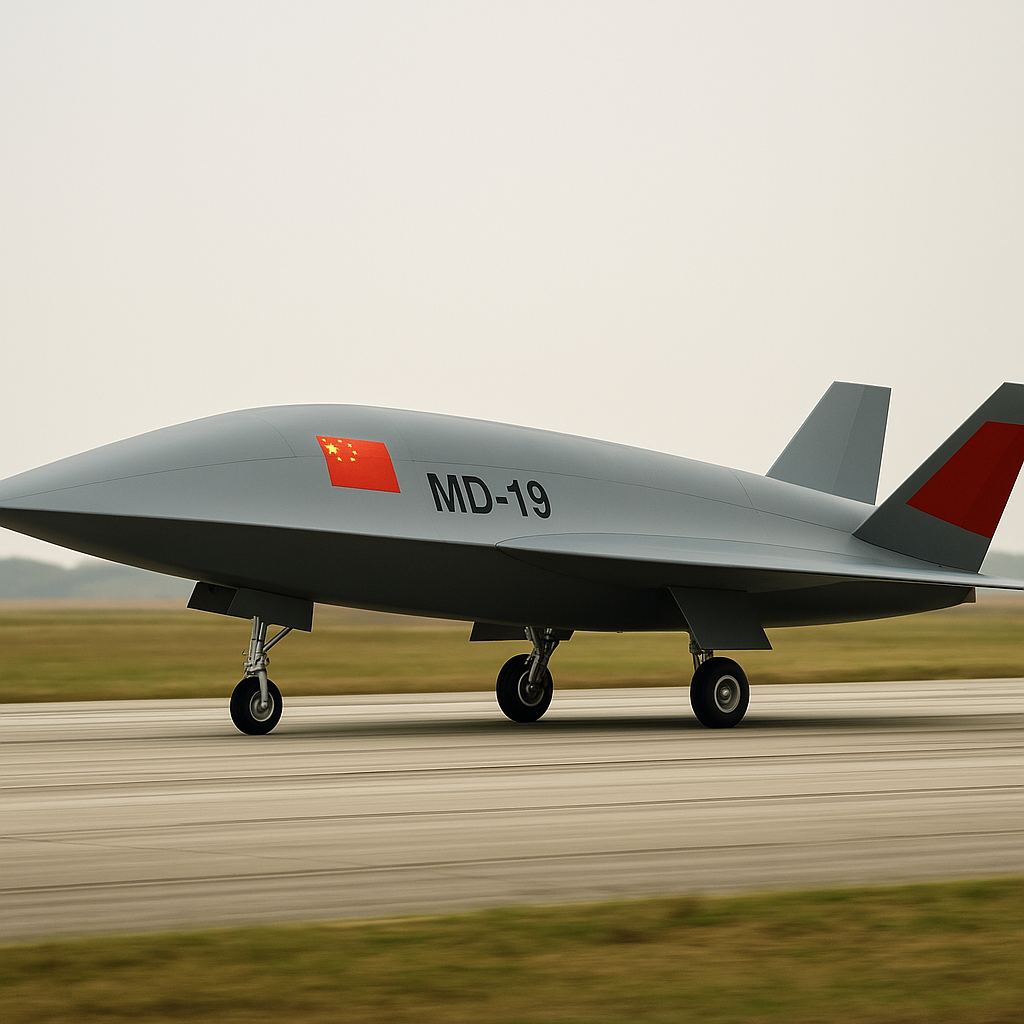
Image Credentials: Image Title: China’s Hypersonic MD-19 Drone Lands Flawlessly, Shocking Pentagon and Shifting Global Aerospace Calculus Source: AI-Generated Image (ChatGpt, AI) Date: April 2025 Attribution: Created by AI-generated imagery (ChatGpt, AI), and it does not depict a real-world scene.
By Staff Writer
South China Sea — In an unprecedented leap for aerospace engineering, China has successfully landed its MD-19 hypersonic drone on a conventional runway following a high-speed flight in December 2024. The sleek, wedge-shaped aircraft, capable of exceeding Mach 5, marks a world-first in reusable hypersonic drone technology, shocking analysts and Pentagon officials alike.
Developed by Chinese scientists under the Qian Xuesen Science and Technology Youth Task Force, the MD-19 represents a formidable convergence of artificial intelligence, aerodynamic innovation, and strategic military ambition. Roughly the size of a compact car, this unmanned drone not only survived hypersonic speeds but also returned safely, autonomously decelerating to land horizontally—a feat no other nation has yet achieved.
The drone was launched from a Tengden TB-001, a medium-altitude combat drone, and in a separate test, from a high-altitude balloon, demonstrating its flexible deployment capability. This versatility, alongside footage released by the Chinese Academy of Sciences, has sent shockwaves through Western defense circles.
“This changes the equation,” said a senior U.S. defense official speaking on condition of anonymity. “Reusable hypersonic systems with conventional landing capability redefine what’s possible in aerial warfare.”
Unlike air-breathing scramjets like the U.S. X-51A or Stratolaunch’s Talon-A, the MD-19 likely uses a rocket engine, trading endurance for reliability and simplicity. Its compact size, delta wings, and canted tails offer exceptional stability at hypersonic velocities. Analysts believe it may carry payloads for surveillance or testing experimental weaponry, though official specifications remain classified.
China has completed 9 flight experiments in 5 categories & achieved horizontal landing of hypersonic aircraft for 1st time after completing near space launch & flight test.
1st time by MD-19 hypersonic vehicle landed in 2020.
Now declassified.
Can fly @ Mach 7 for long distance. pic.twitter.com/KaGnDdHMfv— tphuang (@tphuang) December 16, 2024
At the core of its breakthrough lies China’s growing technological ecosystem. The drone’s development, led by the Institute of Mechanics and the Guangdong Aerodynamic Research Academy, leveraged data from the JF-12 wind tunnel, one of the most advanced hypersonic testing facilities in the world.
Researcher Gao Fei hinted at the MD-19’s brainpower, describing its flight systems as guided by “biological intelligence,” suggesting deep-learning AI models that mimic natural cognition. These capabilities allow the drone to fly complex missions without human intervention.
Academic institutions like Zhejiang University played a key role in the MD-19’s evolution, exemplifying China’s coordinated civil-military innovation model. In contrast, U.S. programs like the ARRW have faced delays and ballooning budgets, underscoring the efficiency gap between China’s state-backed model and America’s contractor-driven system.
The drone’s implications for regional security are profound. Flying at near-space altitudes, the MD-19 is nearly impossible to intercept using traditional missile defenses like Aegis or Patriot systems. Experts warn of its potential role in intelligence gathering or as a testbed for hypersonic strike systems, especially in volatile regions like the Taiwan Strait or South China Sea.
“With a launch from a TB-001 or a balloon, this drone can appear anywhere without warning,” said Dr. Lena Morris of the Center for Strategic and Budgetary Assessments. “It’s a stealthy, fast-moving eye in the sky, and possibly much more.”
Beyond the battlefield, China is positioning the MD-19 as a symbol of its scientific renaissance. The Youth Task Force behind the drone has flown nine missions in six years, including near-space recovery trials, embodying a narrative of youthful talent and national pride. Their story, featured prominently on Chinese state media, underscores the propaganda value of technological supremacy.
China’s growing lead in hypersonic drones contrasts with Russia’s reliance on single-use systems like the Kinzhal or Zircon, and India’s still-developing technology. While the U.S. remains ahead in stealth and precision weapons, the MD-19 exposes vulnerabilities in America’s hypersonic arsenal.
A December 18 post from Chinese social media platform X described the drone’s landing as a “breakthrough for humanity,” capturing the moment’s symbolic power. Military experts in Washington, Tokyo, and Canberra are now reassessing defense strategies amid concerns over China’s accelerating pace.
Yet questions persist. Can China scale this technology to larger drones or hypersonic aircraft? Will reliance on rocket propulsion limit operational endurance compared to scramjet systems? And how will the Pentagon respond?
One thing is certain: the MD-19 signals the beginning of a new phase in the aerospace arms race, where speed, autonomy, and reusability define air dominance.
As one Chinese official quipped following the test: “The future has landed—and it landed on our runway.”