
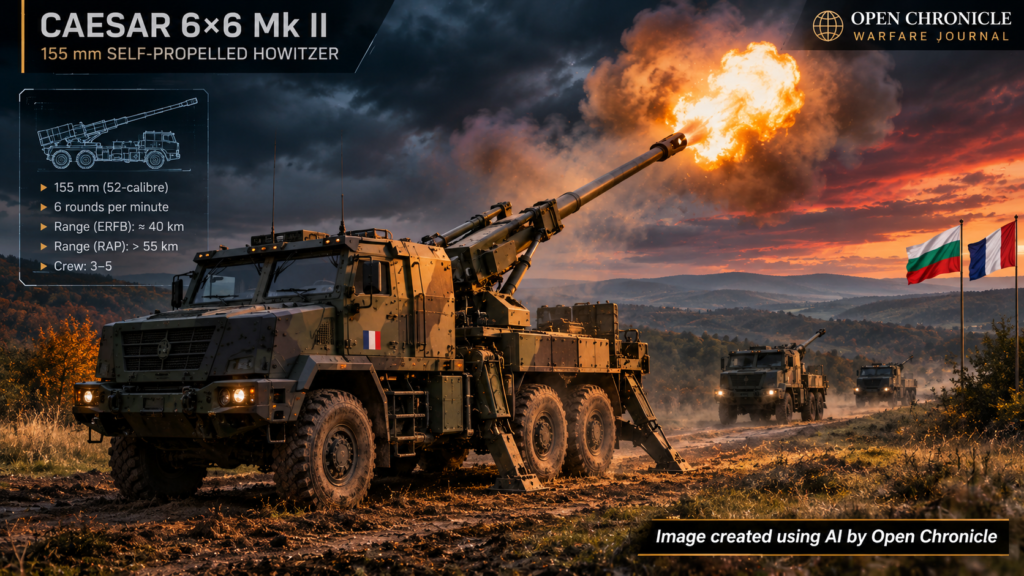
Bulgaria has advanced plans to acquire 57 French CAESAR self-propelled howitzers, ammunition and supporting equipment through a European joint procurement framework. The programme could transform the country’s artillery capabilities, but parliamentary approval, final contracts and delivery arrangements remain critical steps.
OPEN CHRONICLE | WARFARE JOURNAL
LAND | WEAPONS & SYSTEMS | DEFENCE PROCUREMENT
17 November 2026 | By Open Chronicle Warfare Journal
Bulgaria takes a major step towards modern artillery
Bulgaria is moving forward with one of its most important land forces modernisation programmes, proposing the acquisition of 57 French CAESAR self-propelled howitzers as part of a wider effort to strengthen the country’s artillery capabilities and fulfil NATO defence commitments.
On 16 November 2026, the Bulgarian Council of Ministers announced that it would submit an investment expenditure project to the National Assembly for approval.
The proposed acquisition covers 57 new 155 mm self-propelled howitzers, ammunition and associated support equipment for the Bulgarian Land Forces.
The government also authorised the defence minister to negotiate and sign individual joint procurement orders with France.
The project forms part of Bulgaria’s defence capability development priorities and is intended to receive financing through the European Union’s Security Action for Europe, or SAFE, instrument.
For the Bulgarian Army, the programme represents more than a straightforward equipment replacement.
It could mark a substantial transition from artillery systems inherited from the Soviet military tradition towards modern, mobile, digitally integrated weapons using NATO-standard ammunition.
However, the programme has not yet reached every stage necessary for delivery.
The government’s announcement constitutes a significant procurement decision and a mandate to proceed with the next contractual steps.
It should not be confused with confirmation that all 57 systems have been ordered under a final supply contract, manufactured or delivered.
That distinction is central to understanding the actual status of Bulgaria’s artillery modernisation.
What the Bulgarian government approved
The official government announcement of 16 November identifies the acquisition of 155 mm self-propelled howitzers as a priority within Bulgaria’s long-term military development plans.
The project is linked to the country’s armed forces development planning through 2026 and its Defence Capabilities Development Programme 2032.
Its stated operational objectives include strengthening counterbattery warfare, providing direct fire support to manoeuvre formations and engaging opposing reserves.
These requirements reflect the continuing importance of artillery in modern land warfare.
Counterbattery operations seek to detect and engage hostile artillery systems, reducing their ability to fire against friendly forces.
Fire support for manoeuvre formations allows infantry and armoured units to operate with the support of indirect fires.
Longer-range artillery can also engage selected targets beyond the immediate forward line, depending on available ammunition, targeting information and rules of engagement.
The government has identified a capability gap in indirect fire support that the CAESAR acquisition is intended to address.
The planned package includes the howitzers themselves, ammunition and supporting equipment.
The final composition of the acquisition will depend on the approved project and subsequent procurement orders.
Procurement status: A government decision is not a delivered weapon
The programme’s procedural status requires careful explanation.
Bulgaria joined a European framework arrangement for joint CAESAR procurement on 8 January 2025.
The arrangement involves France and other participating European countries.
A framework agreement creates a basis for cooperation and future procurement.
It does not necessarily mean that every participating country has already placed an individual order.
On 11 November 2026, the Bulgarian government advanced a separate agreement concerning the joint procurement of 155 mm ammunition with France.
On 16 November, the cabinet moved the wider 57-howitzer investment project towards parliamentary approval and authorised the next acquisition steps.
As of 17 November, the available official documentation does not establish that a final Bulgarian order for all 57 howitzers has been signed.
Nor does it provide a complete confirmed delivery schedule.
The procurement should therefore be described as a government-backed acquisition project advancing towards contractual implementation.
It is not yet a completed delivery programme.
This distinction matters because military procurement can involve several years between initial approval, contract signature, production, delivery and operational readiness.
A weapon becomes militarily useful only after it has been delivered, supported, integrated into units and operated by trained personnel.
Why Bulgaria needs new artillery
Bulgaria’s artillery inventory has historically included equipment developed during the Soviet era.
Among its legacy systems is the 2S1 Gvozdika, a tracked self-propelled howitzer armed with a 122 mm gun.
The 2S1 was designed for a different technological and operational environment.
Although systems of this generation can remain useful under certain conditions, their capabilities differ substantially from those of contemporary 155 mm artillery.
Modern artillery requirements increasingly emphasise mobility, rapid fire missions, digital fire control and integration with surveillance and targeting networks.
The experience of the war in Ukraine has reinforced the importance of artillery survivability.
Artillery systems can be threatened by counterbattery radar, drones and other reconnaissance capabilities.
Once a firing position is detected, an opposing force may attempt to engage it with artillery, missiles or unmanned systems.
The ability to complete a fire mission and relocate quickly is therefore a major operational consideration.
The CAESAR was developed around this requirement.
Its wheeled configuration and automated fire-control functions are intended to allow artillery units to deploy, fire and move with comparatively limited time spent at a firing position.
For Bulgaria, adopting such a system could improve tactical mobility and reduce dependence on ageing artillery platforms.
However, replacing equipment alone will not eliminate the need for reconnaissance, logistics, command systems and trained crews.
The CAESAR system: A different approach to self-propelled artillery
CAESAR stands for Camion Équipé d’un Système d’Artillerie.
Developed in France and manufactured by KNDS France, the system combines a 155 mm artillery gun with a wheeled vehicle platform.
Unlike heavily armoured tracked self-propelled howitzers, CAESAR emphasises mobility and rapid deployment.
Its design allows the weapon to be transported by road and moved between firing positions without relying on a tracked chassis.
The system has been employed by French forces and exported to several international customers.
Its operational history includes deployments in Afghanistan, Iraq and other theatres.
CAESAR systems have also been supplied to Ukraine, where the conflict has provided further evidence of the challenges facing contemporary artillery.
The weapon’s 155 mm gun uses a 52-calibre barrel.
In artillery terminology, this describes a barrel length equivalent to 52 times the bore diameter.
The configuration supports long-range indirect fire when paired with suitable ammunition.
The system can employ different categories of NATO-standard 155 mm ammunition, subject to the relevant compatibility and qualification requirements.
For Bulgaria, this would provide a foundation for greater ammunition interoperability with allied armies.
CAESAR Mk II: The next generation
KNDS has developed the CAESAR 6×6 Mk II as an upgraded version of its established wheeled artillery system.
The newer configuration incorporates improvements to mobility, crew protection and digital fire-control capabilities.
According to the manufacturer’s published technical documentation, the Mk II uses a 6×6 chassis with a 460-horsepower engine.
Its combat weight is below approximately 26.7 tonnes.
The system is designed for a crew of three to five personnel.
Its gun has a published firing rate of six rounds per minute.
The manufacturer also identifies automatic laying and relaying functions, a protected cabin and integration with modern command and control systems.
These features are intended to improve both operational efficiency and survivability.
The protected cabin is particularly relevant because wheeled artillery vehicles must balance mobility against crew protection.
A heavier armoured vehicle may provide different levels of protection, but at the cost of additional weight and logistical demands.
The Mk II represents an attempt to improve protection while preserving the mobility advantages associated with the CAESAR concept.
Which CAESAR variant will Bulgaria receive?
The Bulgarian government’s announcement confirms the intended acquisition of 57 CAESAR howitzers but does not itself provide a complete public technical configuration for every vehicle.
Bulgarian reporting published on 17 November describes a proposed combination of three earlier CAESAR 6×6 Mk I systems and 54 CAESAR 6×6 Mk II systems.
That breakdown is important, but it must be attributed correctly.
It is a reported project configuration, not a manufacturer-confirmed delivery record.
Until the final acquisition orders and specifications are publicly available, the precise configuration should remain subject to confirmation.
This distinction also affects technical comparisons.
Specifications published for the CAESAR Mk II should not automatically be applied to every howitzer within the proposed Bulgarian package.
The two generations share the broader CAESAR artillery concept, but they differ in vehicle configuration, protection and other characteristics.
For procurement analysis, identifying the exact variant is as important as identifying the weapon family.
The importance of 155 mm ammunition
The transition to 155 mm artillery has important consequences beyond the acquisition of new vehicles.
NATO armies widely employ 155 mm ammunition for medium and heavy artillery.
This creates opportunities for common procurement, allied support and ammunition interoperability.
However, the designation 155 mm does not mean that every ammunition type can be used by every artillery system without qualification.
Compatibility depends on the gun, propellant system, ammunition design and relevant technical approvals.
The CAESAR family supports a range of ammunition types, including conventional high-explosive projectiles and certain precision-guided rounds.
Different projectiles can provide different ranges and effects.
The manufacturer’s published figures for the Mk II identify a range of approximately 40 kilometres with suitable extended-range ammunition.
Longer ranges are possible with particular specialised ammunition.
These are manufacturer specifications, not a guarantee that Bulgaria will acquire every compatible ammunition type.
The actual capabilities available to Bulgarian artillery units will depend on the ammunition included in procurement orders and subsequently delivered.
Ammunition is part of the capability, not an accessory
Bulgaria’s separate agreement process with France concerning 155 mm ammunition is therefore strategically important.
A modern howitzer without adequate ammunition stocks cannot provide sustained military capability.
Artillery readiness depends on the availability of projectiles, propellant charges, fuzes, maintenance resources and reliable transport.
It also depends on the ability to replenish ammunition during prolonged operations.
The war in Ukraine has demonstrated the scale of ammunition consumption that can occur during high-intensity conflict.
European governments have responded by expanding ammunition production and exploring joint procurement arrangements.
For Bulgaria, acquiring CAESAR systems alongside an ammunition programme could help align equipment modernisation with the requirements of sustained artillery operations.
The government has not yet provided a complete publicly confirmed schedule covering the delivery of all associated ammunition.
Reported quantities should therefore be distinguished from quantities established in final signed orders.
Why the European SAFE programme matters
The Bulgarian acquisition is being developed under the European Union’s Security Action for Europe financing framework.
SAFE was established to support urgent defence investment and strengthen European industrial capacity.
The instrument provides up to €150 billion in long-maturity loans for participating European Union member states.
It is intended to support acquisitions involving priority military capabilities, including ammunition, missiles, artillery and air defence.
SAFE also encourages joint procurement.
Rather than each country negotiating entirely separate purchases, participating states may cooperate through shared acquisition frameworks.
This approach can provide manufacturers with greater visibility over demand.
It may also reduce fragmentation in European defence procurement and improve interoperability between national armed forces.
However, SAFE is a financing instrument, not a grant programme that automatically pays for every military purchase.
Participating states remain responsible for their financing commitments under the applicable arrangements.
Nor does access to SAFE financing mean that a particular procurement has already been completed.
National approvals, contractual procedures and industrial delivery schedules remain necessary.
France’s role in the acquisition
France is the lead country in Bulgaria’s proposed joint CAESAR procurement.
This arrangement reflects the wider European interest in collaborative artillery acquisition.
The Bulgarian government has identified the French defence minister as the counterpart for the individual procurement orders.
The programme builds on a framework arrangement involving France, Croatia and Estonia, which Bulgaria joined in January 2025.
Other European countries have also pursued CAESAR acquisitions or participated in related procurement initiatives.
The multinational structure may provide advantages in coordinating equipment requirements and industrial production.
It could also support cooperation in training, logistics and ammunition supply.
However, participation in a common framework does not mean that every country will receive identical equipment configurations or delivery schedules.
National contracts and operational requirements can differ.
For Bulgaria, the final terms will determine how the proposed fleet is delivered, supported and integrated into the armed forces.
What the programme could mean for NATO’s eastern flank
Bulgaria occupies an important position in southeastern Europe and along the western Black Sea.
Its territory is relevant to NATO’s regional defence planning, military mobility and allied operations.
Modernising Bulgarian artillery would strengthen a national capability that can also contribute to collective defence.
The potential advantages include greater mobility, improved digital integration and the use of NATO-standard ammunition.
Artillery units equipped with CAESAR could potentially operate alongside allied formations using compatible communications and fire-support procedures.
However, interoperability is not achieved through ammunition calibre alone.
It also requires compatible command systems, operational procedures, training and logistics.
The Bulgarian Army would need to integrate the new howitzers into its wider force structure.
This process would involve crews, maintenance personnel, artillery observers, communications specialists and support units.
The strategic value of the programme will therefore depend on the complete military capability delivered, not simply on the number of guns purchased.
The battlefield lesson from Ukraine
The conflict in Ukraine has reinforced several lessons concerning modern artillery.
One is the continuing importance of indirect fire in supporting ground operations.
Another is the vulnerability of artillery units to persistent surveillance.
Drones can identify firing positions, monitor movements and support the correction of artillery fire.
Counterbattery radar and other sensors can contribute to the detection of artillery activity.
These threats increase the importance of mobility, concealment and coordination.
CAESAR’s design emphasises the ability to conduct fire missions and relocate rapidly.
According to KNDS, the Mk II can enter action in less than 45 seconds and leave a firing position in less than 40 seconds under specified conditions.
Such figures describe manufacturer-stated system performance.
Actual operational times depend on crew proficiency, terrain, ammunition, mission requirements and other factors.
Mobility can reduce exposure, but it does not make an artillery system immune to detection or attack.
Survivability increasingly depends on a combination of mobility, protection, electronic warfare, camouflage and tactical discipline.
Counterbattery warfare: The operational priority
The Bulgarian government’s official announcement specifically identifies counterbattery warfare as one of the intended capabilities of the new artillery.
This is a significant detail.
Counterbattery operations involve locating and engaging enemy artillery systems.
They require more than a gun capable of firing at long range.
An effective counterbattery capability depends on the coordination of sensors, command systems, targeting information and available weapons.
Counterbattery radars may help identify the origin of incoming artillery fire.
Unmanned aircraft and other reconnaissance assets can contribute additional information.
Fire-control systems then support the assignment and execution of appropriate fire missions.
A modern artillery platform can be an important component of this process.
However, without effective reconnaissance and command integration, its potential may not be fully realised.
The Bulgarian procurement will therefore be most consequential if it forms part of a wider modernisation of the country’s artillery support architecture.
Mobility versus protection
The choice of a wheeled self-propelled howitzer reflects a particular balance between mobility, protection and logistical requirements.
Tracked self-propelled artillery systems may offer advantages in certain terrain conditions and can incorporate substantial armour protection.
Wheeled systems such as CAESAR place greater emphasis on road mobility and comparatively rapid movement over longer distances.
This can be useful for forces that need to reposition between operational areas.
Wheeled vehicles may also present different maintenance and transport requirements from tracked platforms.
However, no platform type is universally superior.
Performance depends on terrain, threats, support arrangements and operational doctrine.
The CAESAR Mk II introduces additional cabin protection compared with earlier configurations.
Nevertheless, the vehicle should not be treated as equivalent to a heavily armoured tracked howitzer in every aspect of protection.
Its operational concept relies on mobility, rapid firing procedures and appropriate tactical employment.
The industrial significance for KNDS
The Bulgarian project would add to the international demand for CAESAR systems.
For KNDS France, additional orders can contribute to production planning and the expansion of an established artillery customer base.
European demand for artillery has increased as governments reassess defence requirements and ammunition stocks.
The war in Ukraine has also intensified interest in systems capable of supporting sustained land operations.
However, increasing demand creates industrial challenges.
Manufacturers must coordinate vehicle production, artillery components, ammunition availability and supporting equipment.
Delivery schedules may be affected by production capacity, supply chains and competing customer requirements.
A final Bulgarian contract would therefore need to be assessed in the context of KNDS’s broader production commitments.
As of 17 November 2026, the available official Bulgarian announcement does not establish a complete binding delivery timetable for the proposed fleet.
What will the programme cost?
Financial reporting published in Bulgaria on 17 November identifies a proposed programme value of approximately €686 million.
The same reporting describes a broader package involving ammunition, fire-control support and other equipment.
These figures provide useful insight into the possible scale of the investment.
However, they should be treated as reported project figures pending confirmation against the final approved investment documentation and signed procurement orders.
A programme budget is not necessarily identical to the final contractual price.
Likewise, dividing the total programme value by 57 would not provide a reliable unit price for a CAESAR howitzer.
The package may include ammunition, training, vehicles, command equipment and other support costs.
A meaningful procurement comparison requires a clear understanding of what each national contract includes.
For the Warfare Journal, the relevant financial question is not simply the apparent price of one gun.
It is the cost of establishing a complete, sustainable artillery capability.
From purchase to operational readiness
The acquisition of 57 modern howitzers would represent a substantial increase in Bulgaria’s potential artillery capability.
But equipment delivery is only one stage.
Crews must be trained to operate the systems.
Maintenance personnel require appropriate technical qualifications.
Spare parts, diagnostic equipment and repair facilities must be available.
Artillery commanders must incorporate the weapons into national doctrine and operational planning.
The armed forces must also establish reliable ammunition supply and storage arrangements.
Digital fire-control integration is another important requirement.
If Bulgaria intends to employ the new howitzers in multinational operations, interoperability with allied command and communications systems will be essential.
The interval between contract signature and full operational readiness can therefore be significant.
The programme’s success will depend on how effectively Bulgaria manages this wider transition.
Five questions that will determine the programme’s success
1. When will the Bulgarian National Assembly approve the investment project?
Parliamentary approval is a necessary milestone before the programme can proceed through the remaining procurement stages.
2. When will the individual acquisition orders be signed?
The final orders will establish binding commitments and clarify the contractual status of the proposed purchase.
3. What exact CAESAR configuration will Bulgaria acquire?
Bulgarian reporting describes a mixture of Mk I and Mk II systems, but the final contractual configuration requires confirmation.
4. What ammunition and support package will accompany the howitzers?
The military value of the fleet will depend on ammunition stocks, fire-control integration, training and maintenance.
5. When will the first systems enter operational service?
Delivery dates and operational readiness milestones will determine when the investment begins to provide practical military capability.
Strategic assessment: A modernisation project with regional importance
Bulgaria’s proposed CAESAR acquisition illustrates a broader European trend.
NATO members are investing in artillery systems that combine mobility, precision fire support and compatibility with allied ammunition standards.
The emphasis is not solely on acquiring weapons with longer ranges.
It is also on creating artillery forces that can operate within modern reconnaissance and command networks.
For Bulgaria, the transition from Soviet-era artillery to CAESAR could be particularly consequential.
It would support the modernisation of national land forces and strengthen the country’s contribution to NATO collective defence.
The programme also demonstrates the increasing importance of European joint procurement mechanisms.
France’s role as lead country and the use of SAFE financing connect Bulgaria’s national requirements with wider European defence industrial policy.
Yet the ultimate significance of the programme remains dependent on implementation.
Government approval does not guarantee rapid delivery.
A modern gun does not automatically create a modern artillery force.
And the number of systems ordered does not, by itself, establish operational readiness.
The real test will be whether Bulgaria can convert its procurement plans into trained, equipped and sustainable artillery formations.
Conclusion: From Soviet artillery to NATO-standard firepower
Bulgaria’s move towards acquiring 57 CAESAR self-propelled howitzers represents an important step in the modernisation of its armed forces.
The project is intended to address recognised gaps in indirect fire support, counterbattery warfare and the ability to support manoeuvre formations.
It would also deepen Bulgaria’s participation in European defence procurement and strengthen its alignment with NATO artillery standards.
The CAESAR family offers established capabilities in mobility, digital fire control and long-range 155 mm artillery.
The Mk II introduces additional improvements in protection and vehicle performance.
However, the acquisition remains at a decisive procedural stage.
Parliamentary approval, final orders, production arrangements and delivery schedules must still be confirmed.
The strategic significance of the programme is clear.
Its operational impact will become measurable only when the planned systems are delivered, integrated and ready for military service.
For Bulgaria, the objective is not simply to replace old guns with new ones.
It is to build a modern artillery capability capable of contributing to national defence and NATO operations in an increasingly demanding European security environment.
Sources and Further Reading
This investigation draws on official Bulgarian government decisions, technical documentation issued by KNDS France, European Union defence financing documentation and supplementary reporting from Bulgarian news organisations. The sources distinguish government proposals, procurement frameworks, technical specifications and reported acquisition details from confirmed contracts and equipment deliveries.
Decisions of 16 November 2026
Primary government documentation concerning Bulgaria’s proposed acquisition of 57 CAESAR self-propelled howitzers, ammunition and associated support equipment. The announcement addresses the submission of the investment project to the National Assembly and authorisation for the defence minister to proceed with joint procurement arrangements involving France. The original document is published in Bulgarian.
Defence Procurement Decisions of 11 November 2026
Official documentation detailing Bulgaria’s participation in joint procurement arrangements for 155 mm ammunition with France. The decision provides additional context concerning the acquisition framework, the role of the French government and the remaining national approval and contractual procedures. The original document is published in Bulgarian.
CAESAR 6×6 Mk II Technical Specifications
Official technical datasheet published by KNDS France covering the CAESAR 6×6 Mk II self-propelled howitzer. The documentation provides manufacturer specifications concerning the 155 mm artillery gun, vehicle configuration, mobility, ammunition capacity, firing rate, crew protection and digital fire-control architecture.
CAESAR Mk II Product Documentation
Manufacturer information concerning the CAESAR Mk II artillery system, including its mobility characteristics, 155 mm firepower, protected crew cabin and ammunition compatibility. The product documentation provides additional technical context for assessing the capabilities and limitations of the modernised CAESAR platform.
Security Action for Europe (SAFE)
European Commission documentation explaining the Security Action for Europe financing instrument, which provides up to EUR 150 billion in loans to support defence investment. The framework addresses joint procurement, priority military capabilities and efforts to strengthen Europe’s defence industrial capacity.
Bulgarian Armed Forces Modernization Projects Discussed With France
Reporting by the Bulgarian News Agency on bilateral defence discussions between Bulgaria and France. The report provides background concerning proposed military modernisation projects, including CAESAR artillery, radar systems and other French defence equipment.
Bulgaria’s Proposed CAESAR Acquisition Package
Bulgarian media reporting describing a proposed CAESAR acquisition programme valued at approximately EUR 686 million. The report identifies a possible combination of Mk I and Mk II howitzers, ammunition quantities and supporting equipment. These details are attributed to the publication and should not be interpreted as confirmation of final contract terms or equipment deliveries.
This article was prepared by Open Chronicle Warfare Journal using official Bulgarian government decisions published on 11 and 16 November 2026, technical documentation issued by KNDS France, European Commission documentation concerning the SAFE defence financing instrument and supplementary reporting from the Bulgarian News Agency and Bulgarian media. The proposed acquisition of 57 CAESAR self-propelled howitzers is distinguished from parliamentary approval, signed individual procurement orders, production and physical delivery. As of 17 November 2026, the official sources examined do not establish that all 57 systems have been ordered under a final supply contract or delivered to the Bulgarian Armed Forces. Reported programme costs, ammunition quantities and the proposed mix of Mk I and Mk II variants are attributed to Bulgarian media pending confirmation through final procurement documentation. Manufacturer-published technical specifications refer to identified CAESAR variants and ammunition types and do not establish the precise configuration or operational performance of Bulgaria’s future fleet. Strategic and operational assessments are independent editorial analysis based on publicly available information.