
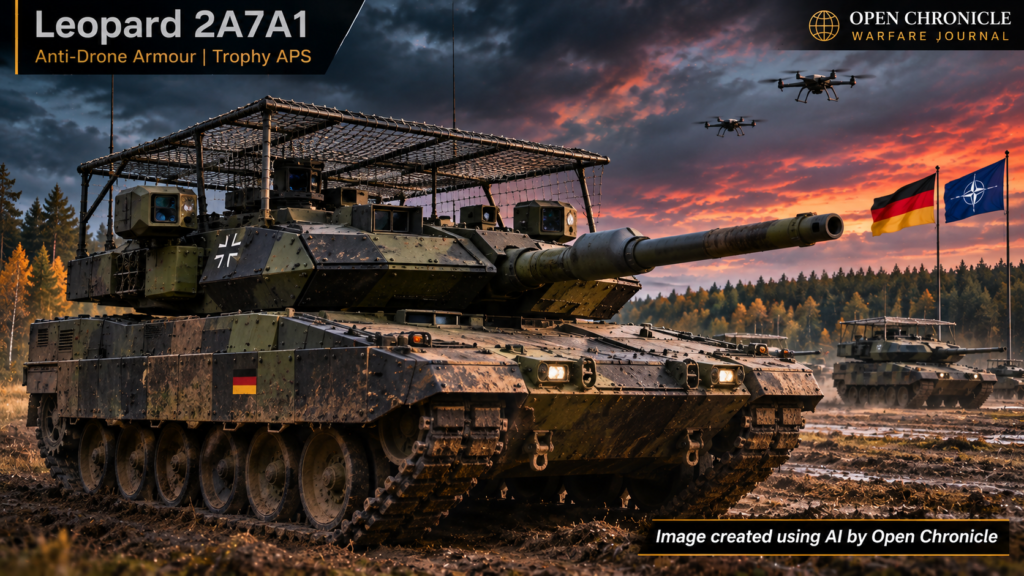
German soldiers in Lithuania have developed an additional protective cage for a Leopard 2 tank already equipped with the Trophy active protection system. The modification illustrates how NATO’s armoured forces are adapting to the proliferation of small attack drones, but its effectiveness and wider adoption remain unproven.
OPEN CHRONICLE | WARFARE JOURNAL
LAND | BATTLE TANKS | DEFENCE TECHNOLOGY & INNOVATION
17 November 2026 | By Open Chronicle Warfare Journal
A German tank receives an unexpected upgrade
A German Leopard 2 main battle tank stationed in Lithuania has received a protective structure that would once have seemed out of place on one of Europe’s most advanced armoured vehicles.
Soldiers from Germany’s Panzerbrigade 45, the armoured brigade permanently stationed in Lithuania, have constructed a metal mesh cage above the tank’s turret.
The modification is intended to provide an additional barrier against small attack drones approaching from above.
Photographs released through German Army social media channels and reported by defence publications on 16 November show personnel cutting metal mesh and securing sections to the vehicle.
The work was carried out using tools and materials available to the unit.
The resulting structure is relatively simple compared with the sophisticated electronic and defensive systems already fitted to the tank.
Yet its significance extends well beyond the appearance of the vehicle.
It reflects a major change in the threats confronting modern armoured forces.
Main battle tanks were historically designed to withstand gunfire, anti-tank missiles, mines and other threats associated with conventional land warfare.
Today, they must also operate in an environment where relatively small unmanned aircraft can observe their movements and attempt attacks from unexpected directions.
The Leopard 2 modification demonstrates how soldiers are responding to that challenge.
It also raises an important question for NATO’s armoured forces.
Can modern tanks remain survivable through the addition of relatively inexpensive protective measures, or will drone warfare require more fundamental changes in vehicle design and battlefield doctrine?
What German soldiers actually built
The new protection consists of a raised metal framework incorporating mesh panels positioned above the turret.
According to reporting based on German Army photographs and statements, the structure was assembled by soldiers using angle grinders, metal panels and mechanical fasteners.
The intention is to create an additional physical barrier between an approaching drone and the tank’s upper surfaces.
The German Army described the modification as an initiative originating from the troops themselves.
This is an important distinction.
The available evidence identifies a locally developed protective measure rather than a newly announced factory-standard Leopard 2 armour package.
There is no publicly confirmed procurement contract covering mass production of this particular cage.
Nor has the Bundeswehr announced that every Leopard 2A7A1 or Leopard 2A8 will receive an identical installation.
The modification should therefore be understood as a field-developed protective adaptation undergoing evaluation.
Its actual effectiveness against different drone types remains to be established through testing.
Why the Leopard 2A7A1 matters
The vehicle identified in several reports is a Leopard 2A7A1.
This variant is particularly interesting because it already incorporates the Israeli-developed Trophy active protection system.
Trophy represents a substantial technological improvement over reliance on passive armour alone.
It uses radar sensors, electronic processing and defensive countermeasures to identify and intercept certain incoming anti-tank threats.
The Bundeswehr has described the Leopard 2A7A1 as an important intermediate stage in the development of the more advanced Leopard 2A8.
In October 2024, the German military announced plans to equip an initial 17 Leopard 2 tanks with Trophy.
The programme was intended to provide experience with the system and support its integration into subsequent Leopard 2 variants.
The addition of a physical anti-drone cage to a Trophy-equipped tank is therefore especially revealing.
It suggests that even vehicles incorporating sophisticated active protection may require supplementary measures against particular emerging threats.
However, the available photographs and reports do not establish that Trophy is universally ineffective against drones.
Its performance depends on the threat characteristics, system configuration and operating conditions.
The appropriate conclusion is narrower.
German soldiers are experimenting with an additional protective layer intended to address threats that may not be adequately covered by existing vehicle defences.
The drone threat is changing tank warfare
The war in Ukraine has demonstrated the growing importance of small unmanned aircraft in land operations.
Drones can conduct reconnaissance, observe artillery fire and identify the movement of armoured vehicles.
Some carry explosive payloads intended to strike military equipment.
Others are designed as loitering munitions, combining surveillance and attack functions.
First-person-view drones have become particularly prominent because they can be remotely piloted towards selected targets.
Their relatively low cost, compared with major armoured vehicles, creates an important economic and operational challenge.
A modern main battle tank represents a substantial investment in engineering, weapons, sensors, protection and crew training.
An attacking drone may cost only a small fraction of that amount.
This does not mean that every drone attack will destroy a tank.
The effects of an attack depend on the weapon, impact location, vehicle protection and other circumstances.
Nevertheless, the ability to threaten expensive military platforms with comparatively inexpensive systems changes how commanders must think about survivability.
The problem is especially serious when drones are employed in large numbers.
Even a vehicle equipped with advanced protection may face difficulties if threats approach repeatedly or from different directions.
Modern armoured warfare must therefore address both the technical characteristics of individual attacks and the operational effects of persistent drone activity.
Why attacks from above are a particular concern
Traditional tank armour is not distributed equally across every surface.
Main battle tanks generally concentrate substantial protection in areas expected to face the most dangerous direct-fire threats.
The front of the turret and hull typically receive particular attention.
Upper surfaces have different design requirements and may offer less protection than heavily armoured frontal sections.
This reflects longstanding compromises involving weight, mobility, vehicle dimensions and expected battlefield threats.
Small attack drones can exploit these differences by approaching from above.
Some weapons may attempt to strike exposed equipment or other vulnerable areas.
A protective cage seeks to introduce an additional barrier before a drone reaches the underlying vehicle.
Depending on the attack, such a barrier may interfere with the drone’s movement or affect how its payload interacts with the target.
However, a cage is not a guarantee of protection.
Its effectiveness depends on its construction, the type of drone, the weapon carried and the circumstances of impact.
A structure that provides some protection against one threat may offer limited benefit against another.
This is why the German modification requires practical evaluation rather than assumptions based on appearance.
Trophy: The Leopard’s active protection shield
The Trophy system was developed by Israel’s Rafael Advanced Defense Systems.
Germany selected it for integration into the Leopard 2 through a programme involving German industry and the Israeli government.
The system is designed to detect and counter specified incoming anti-armour threats before they strike the protected vehicle.
According to the Bundeswehr, the Leopard 2A7A1 installation incorporates four radar sensors and two countermeasure launcher units.
The sensors monitor the surrounding environment for relevant incoming threats.
The system’s processing equipment evaluates their trajectories and determines whether an interception is required.
When the system identifies a threat that meets its engagement criteria, it can activate defensive countermeasures.
The objective is to prevent an incoming weapon from reaching the tank.
This is different from passive armour, which is intended to withstand or reduce the effects of an impact.
Trophy is therefore classified as an active protection system.
Its integration into the Leopard 2 represents a major investment in vehicle survivability.
However, active protection systems have defined operating parameters.
Their performance cannot be assumed to be identical against anti-tank guided missiles, rocket-propelled grenades, small drones and every other aerial threat.
Publicly available documentation does not establish that the specific German installation provides complete protection against all forms of drone attack.
The new overhead cage should be understood in that context.
Active protection and passive barriers are different
The combination of Trophy and a metal cage illustrates the principle of layered protection.
Rather than depending on one defensive mechanism, a vehicle may employ several measures intended to address different threats.
The Leopard 2 already incorporates substantial passive armour.
Trophy adds an active interception capability against supported incoming weapons.
The improvised cage introduces a further physical barrier above the turret.
These measures operate according to different principles.
Passive armour seeks to resist or reduce the effects of an attack.
Active protection seeks to engage a threat before impact.
A physical cage may obstruct an approaching drone or influence the interaction between its payload and the vehicle.
Other defensive measures, including electronic warfare and tactical concealment, may contribute to survivability in different ways.
The presence of several protective layers does not guarantee that every attack can be defeated.
However, it reflects an increasingly important approach to modern battlefield protection.
No single technology is likely to address every threat encountered by an armoured formation.
The return of improvised armour
Protective cages are not a new invention.
Improvised metal structures have appeared on military vehicles in several conflicts.
During the war in Ukraine, Russian and Ukrainian forces increasingly installed cages, screens and other protective structures on tanks and armoured vehicles.
Some early installations attracted criticism because their effectiveness was uncertain.
As drone threats became more widespread, however, physical protection measures received greater attention.
Different armies began experimenting with their own configurations.
The German modification in Lithuania reflects this broader development.
It is particularly notable because it involves soldiers operating within a technologically advanced NATO force.
The lesson is not that improvised protection has replaced sophisticated engineering.
It is that rapid adaptation at unit level can coexist with formal industrial modernisation.
Soldiers may identify emerging operational problems before a standardised solution has completed a lengthy development and procurement process.
Field modifications can provide useful experience.
They can also reveal limitations that manufacturers and military engineers must subsequently address.
However, improvised solutions must still be assessed for safety, effectiveness and compatibility with the vehicle.
The hidden disadvantages of additional armour
Adding protection to a tank is not without consequences.
Any structure installed above a turret can affect the vehicle’s dimensions and operating characteristics.
Additional equipment may create challenges involving visibility, access, maintenance and movement through restricted spaces.
It may also interact with existing sensors, communications equipment or other vehicle systems.
The impact depends on the precise design and installation.
A protective cage that works adequately in one environment may be less suitable in another.
The structure must also withstand the stresses associated with vehicle movement and military training.
These considerations are particularly important for a tank already fitted with an advanced active protection system.
The new barrier must be evaluated as part of the complete vehicle rather than as an isolated component.
The publicly available reporting does not provide a full engineering assessment of the German installation.
It would therefore be premature to conclude that the cage has no adverse effects on the tank’s operation.
Freedom Shield 26-II: A major test in Lithuania
The timing of the modification is significant.
Germany’s Panzerbrigade 45 is participating in Freedom Shield 26-II, a military exercise scheduled from 17 to 27 November 2026.
The exercise is taking place in Lithuania and involves German forces alongside NATO partners.
According to reporting based on German military information, approximately 3,800 personnel from eight NATO countries are expected to participate.
The exercise is also expected to involve approximately 700 drones.
This represents a substantial increase from the approximately 350 drones associated with the earlier Freedom Shield exercise in June.
The November training programme is intended to reflect the growing importance of unmanned systems in contemporary land operations.
It also provides an opportunity to examine how armoured units respond to threats from drones and other modern battlefield systems.
The anti-drone cage is expected to be evaluated in this training environment.
However, as of 17 November, the exercise has only just begun.
There is no verified public basis for claiming that the new cage has already passed all its planned tests.
Nor is there sufficient evidence to assign a quantified effectiveness rate to the protection.
Any conclusions about its performance must await further reporting.
Germany’s permanent military presence in Lithuania
Panzerbrigade 45 occupies an important place in Germany’s contribution to NATO’s eastern flank.
The brigade represents a major commitment to the permanent stationing of German combat forces in Lithuania.
Its development reflects the security concerns that have intensified since Russia’s full-scale invasion of Ukraine in 2022.
Lithuania borders Belarus and Russia’s Kaliningrad region.
Its location gives it particular significance in NATO defence planning.
The permanent presence of a German armoured brigade is intended to strengthen deterrence and provide forces capable of responding to potential security threats.
The brigade is expected to grow towards approximately 5,000 military personnel.
Its equipment and training are therefore of interest beyond Germany.
Developments within the brigade may provide lessons for other NATO land forces.
The anti-drone modification is one example of how units stationed on the alliance’s eastern flank are adapting their equipment to the changing character of warfare.
The Leopard 2A7A1 and the Leopard 2A8
Germany’s Leopard modernisation programme includes several related but distinct variants.
The Leopard 2A7A1 incorporates the Trophy active protection system into an upgraded Leopard 2 configuration.
The Leopard 2A8 represents a subsequent development incorporating additional improvements.
The Bundeswehr has identified the A7A1 programme as an important technological step towards the A8.
The A8 is also intended to incorporate Trophy.
However, the existence of a locally constructed cage on a Leopard 2A7A1 does not establish that the same cage has become a standard feature of the Leopard 2A8.
It also does not establish that KNDS has formally adopted the particular field modification as a factory-produced product.
The two developments must remain separate.
The Trophy integration programme is an established industrial and military modernisation effort.
The November 2026 overhead cage is a reported unit-level adaptation.
Future decisions may bring lessons from such experiments into standard vehicle configurations.
As of the reporting examined for this article, that outcome has not been confirmed.
Can electronic warfare replace physical protection?
Electronic warfare is another important component of modern counter-drone operations.
Some unmanned aircraft depend on radio links for command, control or navigation.
Electronic warfare systems may interfere with certain communications or navigation signals.
However, the effectiveness of such measures depends on the design of the drone and its operating characteristics.
Not every drone depends on the same type of communications link.
Some systems may use alternative navigation or control methods.
Others may be designed to continue operating despite certain forms of electronic interference.
This means that electronic warfare cannot automatically be treated as a complete solution.
Physical protection, electronic countermeasures, surveillance and tactical procedures may all contribute to a wider defensive approach.
The German cage experiment is relevant because it explores a protective measure that does not depend on disrupting a drone’s communications.
Its effectiveness must nevertheless be evaluated against the specific threats it is intended to address.
What does this mean for the future of main battle tanks?
The proliferation of drones has led to renewed debate about the future of the main battle tank.
Some observers argue that the increasing vulnerability of armoured vehicles challenges their continued battlefield relevance.
Others point out that tanks still provide capabilities that lighter platforms cannot easily replace.
These include protected mobility, direct firepower and the ability to support combined-arms operations.
The experience of Ukraine does not demonstrate that tanks have become universally obsolete.
It demonstrates that their employment has become more demanding.
Armoured formations must account for persistent surveillance and the threat of precision attacks.
They must also coordinate more closely with infantry, engineers, air defence, electronic warfare units and reconnaissance assets.
The Leopard 2 modification illustrates one part of this wider transformation.
The future tank may require not only improved armour and weapons but also a more comprehensive protective architecture.
That architecture could combine active protection, passive barriers, sensors, electronic countermeasures and improved battlefield awareness.
The challenge is to integrate these capabilities without undermining the vehicle’s mobility, reliability and operational usefulness.
Five questions the German experiment must answer
1. How effective is the cage against representative drone threats?
The protective concept requires practical testing under defined conditions before its effectiveness can be assessed.
2. Does the structure interfere with existing tank systems?
The installation must be evaluated for compatibility with sensors, crew access and other equipment.
3. Can the protection withstand sustained military operations?
Durability during movement, training and repeated use will be an important consideration.
4. Will the Bundeswehr adopt a standardised version?
The current evidence supports a unit-level adaptation, not a confirmed fleet-wide procurement programme.
5. Can lessons from Lithuania influence future Leopard development?
The experiment may inform future engineering decisions, but formal adoption remains uncertain.
Strategic assessment: The changing economics of armoured protection
The German experiment highlights a fundamental challenge in modern military technology.
A highly sophisticated armoured vehicle can be threatened by weapons that are substantially less expensive than the vehicle itself.
This imbalance encourages armies to search for protective solutions that can be introduced quickly and economically.
A metal mesh cage is one possible response.
Its appeal lies partly in the ability of soldiers to fabricate and install it without waiting for an entirely new vehicle generation.
However, low cost does not automatically mean high effectiveness.
A protective measure must be judged by its actual performance and the operational disadvantages it may introduce.
The more important lesson is the need for adaptability.
Military equipment designed for one threat environment may require modification when battlefield conditions change.
Modernisation programmes must therefore combine long-term engineering with the ability to respond to emerging threats.
The Leopard 2A7A1 demonstrates this tension particularly clearly.
It incorporates a sophisticated active protection system developed through a formal industrial programme.
At the same time, soldiers in Lithuania are experimenting with an additional structure assembled from comparatively simple materials.
Both developments are responses to the same underlying requirement: keeping armoured vehicles and their crews survivable.
What happens next?
Freedom Shield 26-II provides an immediate opportunity to evaluate the new protective arrangement.
The exercise is expected to expose German and allied forces to training scenarios involving substantial numbers of drones.
Further reporting may clarify how the cage performs, whether modifications are required and whether the concept is considered suitable for broader use.
There are also longer-term questions concerning standardisation.
The Bundeswehr may decide to retain field-developed approaches for particular training or operational requirements.
Alternatively, experience gained from such experiments could inform more formal engineering solutions.
Neither outcome has been confirmed.
The next important evidence will be official evaluation results, subsequent military announcements and any procurement documentation identifying a standardised protective package.
Until then, the modification should remain classified as an experimental or locally developed measure.
Conclusion: The tank is changing, not disappearing
The new anti-drone cage fitted to a German Leopard 2 in Lithuania is a modest-looking modification with considerable strategic significance.
It illustrates how quickly the requirements of armoured warfare are evolving.
The proliferation of small attack drones has created threats that cannot be addressed solely through traditional assumptions about tank protection.
Germany’s response combines advanced technology with practical experimentation.
The Leopard 2A7A1 already incorporates Trophy, one of the most significant active protection systems in contemporary armoured warfare.
The additional cage reflects the recognition that different threats may require different defensive measures.
Yet the evidence must be interpreted carefully.
The modification has not been demonstrated to provide universal protection.
Its operational effectiveness has not been independently established.
And there is no confirmed decision to install the same system across the entire German Leopard fleet.
What the experiment does reveal is a broader transformation.
The future of the main battle tank will depend not only on heavier armour or more powerful guns, but also on the ability to adapt to a battlefield increasingly shaped by drones, sensors and rapidly changing threats.
For NATO’s armoured forces, that adaptation is already underway.
Sources and Further Reading
This investigation draws on official German military documentation, manufacturer statements, Israeli government information and independent defence reporting. The sources provide technical and operational context for the Leopard 2A7A1, the Trophy active protection system and the development of additional protective measures against unmanned aerial threats.
Leopard 2 Receives Trophy Active Protection
Primary Bundeswehr documentation describing the Leopard 2A7A1 and the integration of the Trophy active protection system. The report details the radar sensors, defensive countermeasure launchers, the original 17-vehicle programme and the relationship between the Leopard 2A7A1 and subsequent Leopard 2A8 development. Published in German.
Freedom Shield 26-II Exercise
Official German Army announcement concerning Freedom Shield 26-II in Lithuania. The release outlines the exercise schedule, approximately 3,800 participants from eight NATO countries, the planned employment of 700 drones and 100 loitering munitions, and military river-crossing operations. These figures describe the announced exercise programme rather than its final results.
Germany’s Trophy-Equipped Leopard 2A7A1 Gets a Homemade Drone Cage
Defence reporting examining the additional protective cage fitted to a German Leopard 2A7A1 in Lithuania. Based on German Army photographs and statements, the article describes the locally fabricated metal structure, its installation by military personnel and its intended purpose as an additional barrier against drone attacks.
Germany Strengthens Leopard Protection With Soldier-Built Cage
Military technical reporting examining the configuration of the protective cage, the existing Trophy active protection system and the operational environment facing German armoured units in Lithuania. The analysis provides additional context concerning the adaptation of main battle tanks to evolving unmanned aerial threats.
Trophy Protection System for German Leopard 2
Official manufacturer announcement documenting the industrial agreement to integrate the Trophy active protection system into German Leopard 2 tanks. The release provides background on the programme’s contractual framework, associated support services and training arrangements, distinguishing the established Trophy integration effort from subsequent field-developed protective modifications.
German Troops Fit Tanks With Anti-Drone Cages
Earlier reporting by Lithuania’s public broadcaster documenting German military experimentation with protective cages during the first Freedom Shield exercise. The article provides historical context for the November modification and illustrates the continuing adaptation of armoured vehicles to drone threats in the Baltic region.
Modern Combat Training as a Driver of Innovation
Official Bundeswehr analysis explaining the importance of unmanned aircraft, counter-drone operations and combined-arms training during the earlier Freedom Shield exercise in Lithuania. The publication provides context for the German Army’s emphasis on practical experimentation and adaptation to modern battlefield threats.
First Leopard Tank Equipped With Trophy
Official Israeli Ministry of Defense announcement confirming a major milestone in the integration of the Trophy active protection system into German Leopard 2 tanks. The statement documents defence cooperation involving Germany, Israel and Rafael Advanced Defense Systems and provides additional context for the Leopard’s active protection architecture.
This article was prepared by Open Chronicle Warfare Journal using official Bundeswehr documentation, the German Army’s November 2026 exercise announcements, KNDS manufacturer statements, Israeli Ministry of Defense documentation and reporting published by Defence Blog, Army Recognition and Lithuanian National Radio and Television. The November 2026 overhead cage is identified as a locally developed protective modification rather than a confirmed standard production configuration or fleet-wide modernisation programme. Although several publications identify the modified vehicle as a Leopard 2A7A1, the precise configuration should be distinguished from the broader Leopard 2 family and independently verified where possible. The Trophy active protection system is an established industrial and military programme, but its documented capabilities should not be interpreted as universal protection against all drone threats. No independently verified effectiveness rate or completed qualification programme has been established for the newly reported cage. Freedom Shield 26-II figures describe announced exercise plans as of 17 November 2026, not final results. Technical and strategic assessments are independent editorial analysis based on publicly available information.