
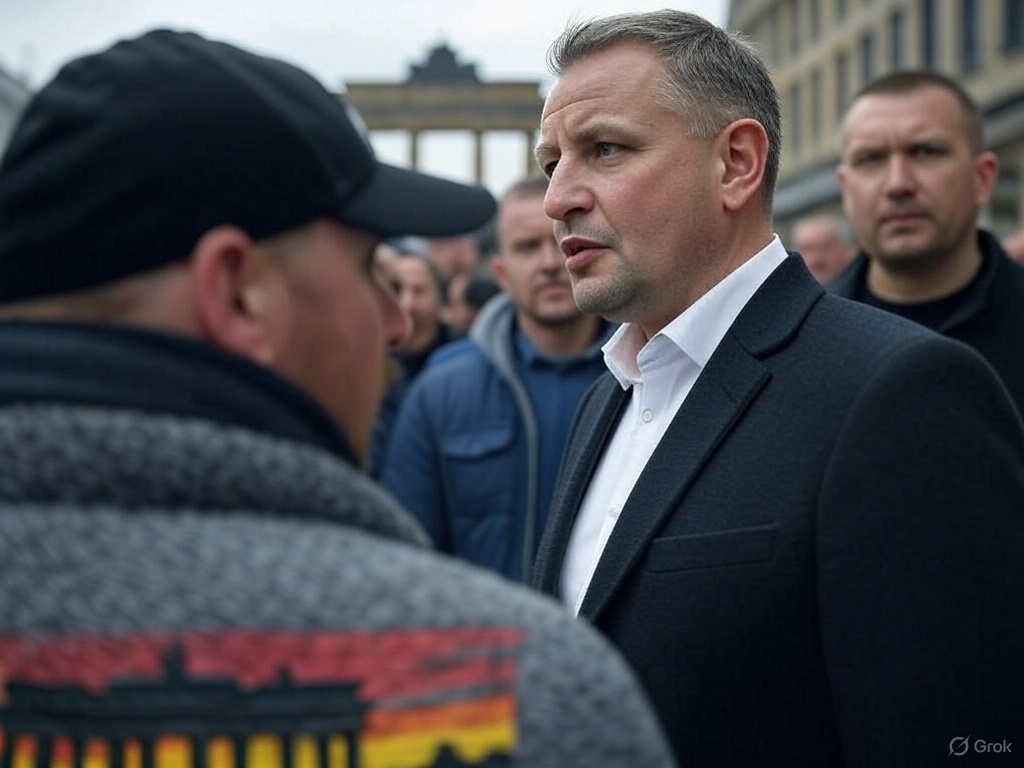
Image Credentials: Image Title: Germany’s Intelligence Agency Classifies AfD as Extreme-Right Party Source: AI-Generated Image (Grok, xAI) Date: May 2025 Attribution: Created by AI-generated imagery (Grok, xAI), and it does not depict a real-world scene.
By Staff Writer with Agencies
Berlin, May 2, 2025 – In a landmark decision, Germany’s Federal Office for the Protection of the Constitution (BfV) has officially classified the Alternative für Germany (AfD) party as a “confirmed right-wing extremist organization,” marking a significant escalation in the government’s stance against the far-right group. The announcement, made earlier today, grants authorities expanded powers to monitor the party’s activities, reigniting debates over democratic freedoms, political suppression, and the rising influence of extremist ideologies in Germany.
The AfD, which secured second place in the February 2025 federal election with 20.8% of the vote, has been a polarizing force in German politics. The party’s platform, heavily focused on anti-immigration policies and nationalist rhetoric, has drawn both fervent support and sharp criticism. The BfV’s decision comes after years of monitoring, with the agency citing the party’s “ethnic-based” conception of identity as fundamentally incompatible with Germany’s democratic order. “The AfD’s policies devalue entire population groups, violating their human dignity,” the agency stated, pointing to the party’s repeated anti-migrant, anti-Muslim, and xenophobic statements.
Interior Minister Nancy Faeser, who is set to leave office soon, defended the classification, stating, “The AfD discriminates against citizens with a migration history, treating them as second-class Germans. This is an assault on our democratic values.” The BfV’s findings also highlighted the party’s ties to extremist elements, noting that of the 38,800 far-right extremists identified in Germany last year, over 10,000 are AfD members.
The classification allows the BfV to intensify surveillance, including the use of informants, wiretapping, and other intelligence-gathering methods, under judicial oversight. While this move does not ban the AfD outright, it raises the stakes for a party that has already secured 152 seats in the Bundestag, making it the second-largest parliamentary group. Outgoing Chancellor Olaf Scholz cautioned against rushing into a ban, stating, “The justification is detailed, but any proceedings to ban the party must be carefully considered.”
The decision has sparked fierce reactions across the political spectrum. AfD co-leader Alice Weidel condemned the classification as “a politically motivated attack on democracy,” accusing the government of attempting to silence a party that represents one in five German voters. “This is a desperate move by the establishment to suppress the will of the people,” Weidel said in a statement. The AfD has long portrayed itself as a victim of a “cartel” of mainstream parties, a narrative that analysts warn could gain further traction following this decision.
Critics of the AfD, however, see the classification as a necessary step to protect Germany’s democratic institutions. “The AfD’s rhetoric and policies echo dangerous historical ideologies,” said political analyst Katja Hoyer. “Their exclusionary vision of ‘Germanness’ threatens the very foundations of our pluralistic society.” The party’s history of controversial statements—such as dismissing the Nazi era as “bird shit” in Germany’s history or praising Russian President Vladimir Putin—has fueled concerns about its intentions.
The timing of the classification adds another layer of complexity. With conservative leader Friedrich Merz set to be sworn in as chancellor in the coming days, the new government faces immediate pressure on how to handle the AfD’s growing influence. The party’s record number of parliamentary seats theoretically positions it to chair key committees, though other parties have so far refused to cooperate, maintaining a “firewall” against the far right. However, recent shifts—such as the CDU’s softening stance on working with the AfD in some contexts—suggest that this barrier may be eroding, raising fears among democracy advocates.
Public sentiment is deeply divided. While 69% of Germans surveyed in February viewed the AfD as a threat to democracy, the party’s doubling of its vote share since 2021 reflects significant support, particularly in eastern Germany, where economic disparities and dissatisfaction with the political establishment have fueled its rise. Some voters, like Liane Bach, an independent mayor from Thuringia, argue that AfD supporters are not extremists but rather citizens frustrated with the status quo.
The international context adds further weight to the decision. The AfD has received endorsements from figures like American billionaire Elon Musk, who has called it the “only party that can save Germany,” and has been linked to far-right movements across Europe. Its opposition to military aid for Ukraine, shared with the far-left Die Linke party, could complicate Germany’s foreign policy, especially as the new parliament navigates tensions with Russia.
As Germany grapples with this political earthquake, the BfV’s classification of the AfD as an extremist entity marks a critical juncture. While it aims to safeguard democracy, it risks deepening societal divisions and bolstering the AfD’s narrative of victimhood. For now, the question looms: can Germany contain the far-right surge without undermining the democratic principles it seeks to protect?
Explain BfV’s monitoring methods
The Federal Office for the Protection of the Constitution (BfV), Germany’s domestic intelligence agency, employs several methods to monitor organizations classified as threats to the democratic order, such as the AfD after its designation as a “confirmed right-wing extremist organization.” These methods are governed by strict legal frameworks, including the Federal Constitutional Protection Act, and require judicial oversight to balance security needs with civil liberties. Here’s a breakdown of the BfV’s key monitoring techniques:
-
Open-Source Intelligence (OSINT): The BfV collects publicly available information, such as speeches, social media posts, party manifestos, and media appearances. For the AfD, this includes analyzing statements from party leaders, publications, and online activity to identify extremist rhetoric or connections to known radical groups.
-
Human Intelligence (HUMINT): The BfV can deploy informants or undercover agents to infiltrate organizations. These operatives may attend AfD meetings, rallies, or events to gather firsthand information on the party’s internal activities, leadership intentions, and potential ties to violent extremist networks.
-
Signals Intelligence (SIGINT): With court approval, the BfV can conduct surveillance of communications, including wiretapping phone calls, monitoring emails, and tracking messaging apps. For AfD members under suspicion, this might involve intercepting communications to detect planning of anti-democratic activities or coordination with foreign entities.
-
Financial Monitoring: The BfV can investigate the party’s funding sources to identify potential illegal or foreign contributions. This includes tracking donations, membership fees, and other financial transactions to ensure compliance with German laws and to uncover links to extremist networks.
-
Observation and Surveillance: The agency may physically monitor key figures or events associated with the AfD. This can involve tailing individuals, photographing attendees at rallies, or using video surveillance to document activities that might indicate extremist behavior or intent.
-
Collaboration with Other Agencies: The BfV works with state-level intelligence offices, police forces, and international partners to share information. For instance, if the AfD is suspected of foreign ties—such as with Russian actors—the BfV might coordinate with the BND (Germany’s foreign intelligence service) to deepen its investigation.
These methods are subject to strict oversight. The BfV must justify its actions to independent bodies like the G10 Commission, which reviews surveillance measures, and the Federal Data Protection Commissioner, ensuring compliance with privacy laws. Courts must approve invasive measures like wiretapping, and the BfV is required to regularly report its findings to parliamentary committees. This framework aims to prevent abuse while allowing the agency to protect Germany’s democratic system from extremist threats.
Reporting by Open Chronicle Europe Desk. Source data includes official statements from German federal agencies and national media.