
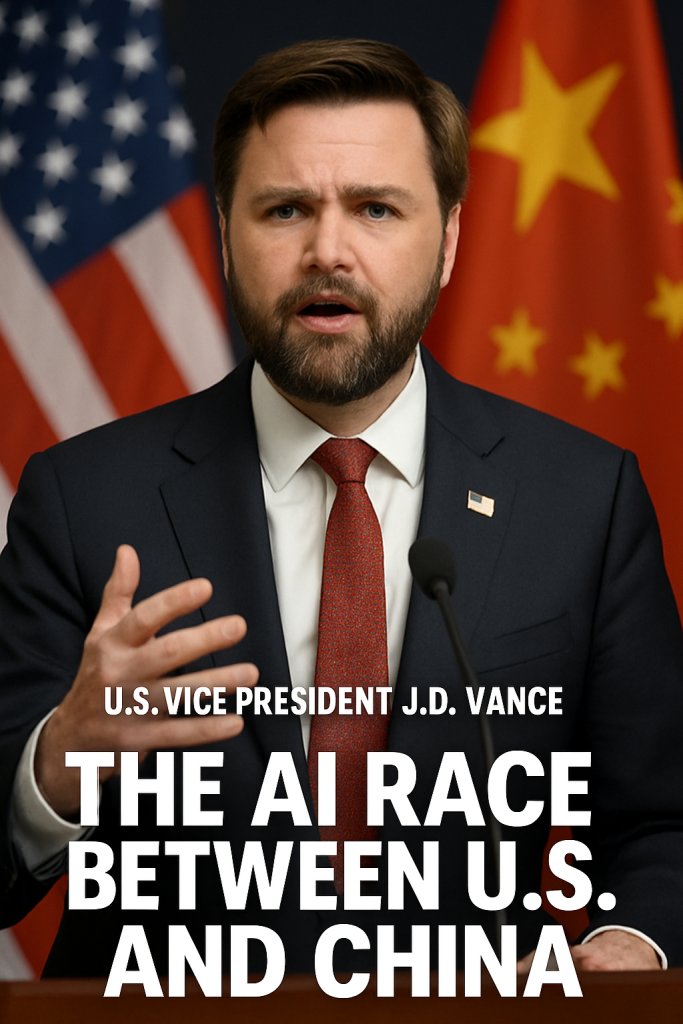
Image Credentials: Image Title: AI Arms Race: America’s Quest for Global Dominance Source: (sora.chatgpt) Date: May 2025 Attribution: Created by AI-generated imagery (sora.chatgpt), it does not depict a real-world scene.
By Staff Writer with Agencies
Washington, D.C. – May 25, 2025
In a bold statement that has sent ripples through both the tech and political spheres, U.S. Vice President J.D. Vance described the ongoing development of artificial intelligence (AI) as an “arms race” with China, warning that the United States could be left vulnerable in the face of advancing AI technologies from the People’s Republic of China (PRC). Vance’s remarks, made on May 21st, underscore the growing urgency in Washington as AI increasingly becomes a central battleground in the global race for technological supremacy.
Vance argued that if America were to pause its AI development due to safety concerns, it might find itself “enslaved to PRC-mediated AI.” His comments come amidst an escalating debate about how best to regulate AI, balancing innovation with security risks. The fear of AI’s potential as both a tool of economic dominance and a military asset has led to discussions on how to ensure that the U.S. remains the world’s leading force in the AI sector.
A Superpower Showdown
The framing of AI as the central component of a new “superpower showdown” between the U.S. and China is gaining traction. In Washington, AI has taken on a symbolic importance akin to the space race of the 20th century, an arena where global hegemony could be won or lost. America’s AI industry, already worth billions, is accelerating as it positions itself to be the leader in the next technological revolution.
On May 15th, President Donald Trump brokered a deal with the United Arab Emirates (UAE), which he claimed would help ensure American “dominance in AI.” The deal, touted as a major step forward, is expected to foster deep cooperation between U.S. AI companies and the UAE, positioning both nations to be at the forefront of AI development and deployment across industries from healthcare to defense.
AI as the Backbone of America’s Global Leadership
This growing focus on AI dominance is not just limited to diplomatic deals or political rhetoric. Major players in the U.S. tech industry are also making their voices heard. Executives from leading companies such as OpenAI, AMD, CoreWeave, and Microsoft have lobbied for lighter regulations, emphasizing that the continued success of American AI companies hinges on minimal government interference. They argue that overregulation could stifle innovation, pushing tech companies to relocate to more AI-friendly regions.
In a broader strategic move, the U.S. government is planning an ambitious investment program aimed at strengthening the nation’s AI infrastructure. According to reports, the U.S. plans to invest over $1 trillion in data centers for AI models by 2030. This large-scale initiative is being framed as essential for maintaining America’s technological edge, ensuring that it has the necessary infrastructure to support next-generation AI models that require enormous amounts of computational power and data storage.
The Stakes of AI Regulation
The question of how to regulate AI, particularly in the context of international competition, has become one of the most pressing issues in global governance. Proponents of lighter regulation, like those at OpenAI and Microsoft, argue that a competitive and open environment is crucial for maintaining America’s technological edge. In contrast, advocates for stronger AI safety protocols caution that the unchecked development of AI could lead to catastrophic outcomes, both from a societal and security perspective.
With China already making strides in AI development, the U.S. faces increasing pressure to push forward aggressively or risk falling behind. The rivalry between the two superpowers has led to a situation where AI isn’t just a matter of technology, but of national security, economic prosperity, and global leadership. The U.S. must now determine whether to prioritize innovation or regulation, and how to balance the two in a way that secures its place at the top of the global AI race.
Conclusion
As the AI arms race heats up, the world watches closely to see how the U.S. will respond. With its trillion-dollar investment and strategic international deals, the U.S. is betting big on AI as the cornerstone of its future dominance. But the path forward is fraught with challenges, including how to ensure that the development of this powerful technology is both responsible and sustainable. The next decade may very well determine whether America retains its position as the world’s technological hegemon or if another country, like China, rises to claim the future of artificial intelligence.
In the race for AI supremacy, the stakes couldn’t be higher.