
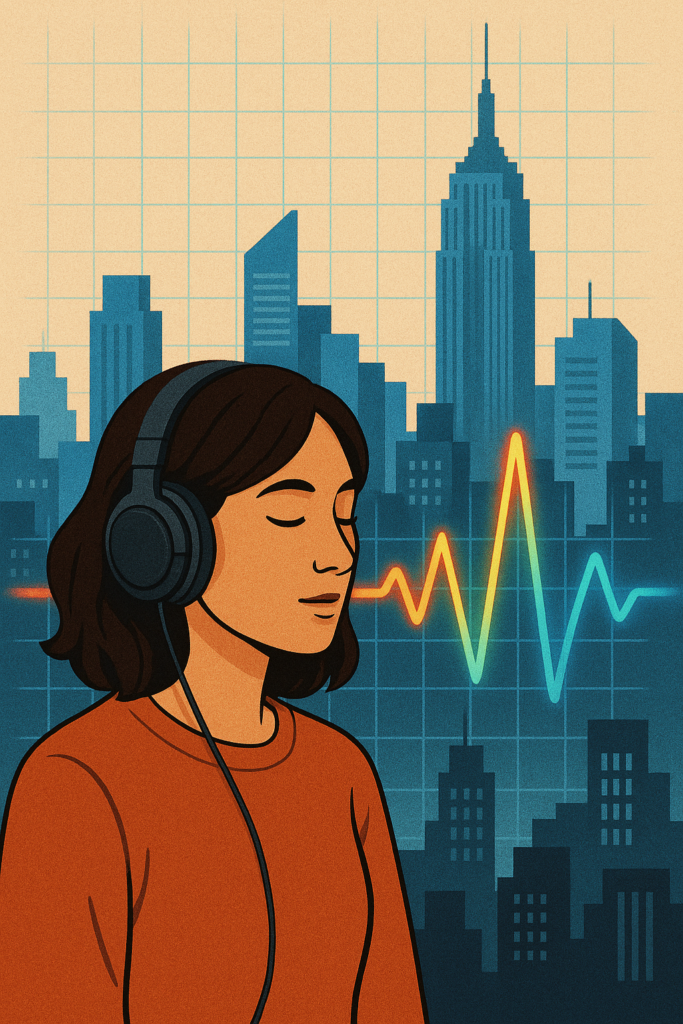
Image Credentials: Image Title: Listening to the ‘Heartbeat’ of a City: How AI Is Mapping Urban Emotion Source: (sora.chatgpt) Date: May 2025 Attribution: Created by AI-generated imagery (sora.chatgpt), it does not depict a real-world scene.
By Open Chronicle Science Desk | May 27, 2025
A new frontier in urban research is emerging, one that goes beyond traffic flow and infrastructure to explore the emotional pulse of a city. Researchers at the University of Missouri have developed an artificial intelligence-powered system that listens not just to what a city looks like, but how it feels to the people living in it.
Led by Jayedi Aman, assistant professor of architectural studies, and Tim Matisziw, professor of geography and engineering, the project uses AI to analyze public Instagram posts, tagging the emotional tone of text and images to create real-time “sentiment maps” of urban environments. This innovative approach could change how cities are designed, managed, and understood—from a focus on function to an emphasis on feeling.
Reading Cities Through Social Sentiment
At the heart of the research is a deceptively simple idea: what people post online reflects how they feel in physical space. The team trained artificial intelligence models to analyze both the visual and textual elements of location-tagged social media content, classifying posts by emotional tone such as joy, calm, frustration, or anxiety.
They then paired this data with Google Street View images of the same locations, using a second AI system to assess the physical characteristics of the space, green areas, density, architectural design, and more. The result is a digital overlay that connects emotional responses to the built environment.
“Instead of only asking people how they feel in surveys, we can now passively sense how people are reacting to their surroundings using data they already share,” said Aman, who heads the newly established Spatial Intelligence Lab at Mizzou.
Toward an Emotional Urban Twin
The team’s next step is building what they call an urban digital twin—a virtual model of a city that integrates emotional feedback alongside traditional data like traffic or weather.
Imagine a city dashboard where decision-makers can track not just air quality and congestion, but also where citizens are feeling happiest, most stressed, or most relaxed. Such a tool could help urban planners and policymakers fine-tune services, improve public safety, or even gauge community morale after a disaster.
“If a park is generating consistently positive posts, we can start to decode which features, shade, quiet, and design are contributing to that,” Aman explained. “Likewise, a district with mostly negative posts may need attention in terms of safety, noise, or accessibility.”
AI as Empathic Infrastructure
The researchers are careful to point out that AI is not replacing human experience, but enhancing it. “AI doesn’t replace people—it helps us see patterns that might otherwise be hidden,” said Matisziw. “And in doing so, it can make cities more responsive, humane, and inclusive.”
This form of AI-augmented urban sensing holds particular promise for addressing inequality in city experiences. While traditional urban planning tools often privilege data-rich or affluent areas, emotion-sensing AI can draw from a broader base of publicly shared sentiment, providing new insight into how underserved neighborhoods are experienced and perceived.
Designing Cities That Feel Right
The emotional mapping of cities aligns with a broader trend in urban studies: a shift from planning for efficiency to planning for well-being. “We envision a future where emotional data sits alongside traffic and crime stats on a mayor’s dashboard,” Aman said. “Because cities shouldn’t just work—they should feel right for the people who live in them.”
As urban centers become denser and more complex, tools like these could play a critical role in ensuring that the human experience remains central. Whether guiding the design of public spaces or shaping responses to crisis, understanding the emotional landscape of a city may prove as essential as understanding its infrastructure.
Story Source:
Materials provided by University of Missouri-Columbia. Note: Content may be edited for style and length.
Journal Reference:
- Jayedi Aman, Timothy C. Matisziw. Urban sentiment mapping using language and vision models in spatial analysis. Frontiers in Computer Science, 2025; 7 DOI: 10.3389/fcomp.2025.1504523