
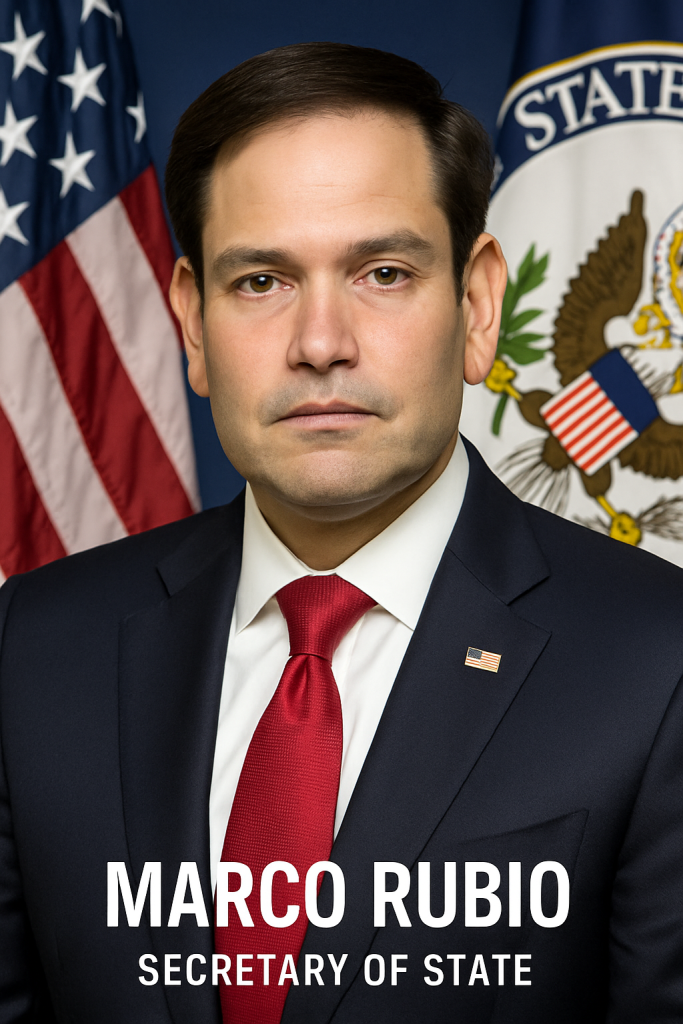
Image Credentials: Image Title: Rubio Announces Crackdown on Chinese Student Visas Amid Broader Immigration Reforms Source: (sora.chatgpt) Date: May 2025 Attribution: Created by AI-generated imagery (sora.chatgpt), it does not depict a real-world scene.
By Staff Writer | Open Chronicle with Agencies
WASHINGTON — U.S. Secretary of State Marco Rubio announced Wednesday a sweeping new visa policy targeting Chinese nationals studying in critical fields, as part of the Trump administration’s growing crackdown on immigration, foreign influence in education, and threats to national security.
In a terse, two-sentence press release, Rubio declared that the State Department will work “aggressively to revoke” the visas of Chinese students with alleged ties to the Chinese Communist Party (CCP) or those enrolled in disciplines considered sensitive to U.S. national interests.
Rubio said the department would coordinate with the Department of Homeland Security to implement the visa revocations. The release also indicated that visa criteria for applicants from both the People’s Republic of China and Hong Kong will be revised to include heightened scrutiny of future applications.
Sec. Rubio unveils sweeping and ‘aggressive’ crackdown on Chinese student visas “under President Trump leadership,” with an emphasis on those connected to the Chinese Communist Party or studying in critical fields. pic.twitter.com/LRsPss1lj6
— Joe_S_Pure🩸 (@Joe_S_Pure) May 29, 2025
No specific reason was given for the timing of the action, but it arrives amid heightened political pressure in Washington to confront Chinese influence on American soil. The announcement follows a series of Trump administration policies targeting foreign students and institutions, including recent measures directed at combating perceived anti-Semitism on U.S. campuses.
FALLOUT FOR UNIVERSITIES AND STUDENTS
With over 277,000 Chinese students studying in the U.S. as of 2024, according to Department of Education statistics, the proposed changes could have significant repercussions for American universities. Only Indian students outnumber Chinese nationals in U.S. higher education, with Chinese students contributing billions annually in tuition and associated fees.
University officials, already grappling with declining enrollments and rising political scrutiny, are expected to push back on the move, citing academic freedom and financial strain.
A RETURN TO HARDLINE SECURITY MEASURES
Rubio’s announcement echoes the policies of the first Trump administration’s controversial China Initiative, which aimed to root out alleged intellectual property theft and espionage by Chinese nationals in American academia and industry. That initiative, launched by the Justice Department, was widely criticized for racial profiling and discriminatory practices, leading the Biden administration to discontinue it in February 2022. However, prosecutions of suspected espionage continued under different frameworks.
Some Republican lawmakers have advocated for reinstating the initiative in some form. Representative Riley Moore (R-W.Va..) introduced legislation in March to ban all student visas for Chinese nationals, claiming the current system enables “Chinese spying.”
“The CCP poses an existential threat to the U.S.,” Moore said in a statement following Rubio’s announcement. “We should not be letting 300,000 Chinese nationals into our research institutions every year.”
ENHANCED SCREENING AND POLITICAL TARGETING
Rubio further ordered a suspension of all new student visa interviews at U.S. embassies and consulates pending the implementation of new screening protocols. According to State Department officials, the new measures will expand the vetting of applicants’ social media activity and political affiliations.
The administration has recently used students’ online posts, particularly those critical of U.S. foreign allies, as justification for detention and deportation. Rubio has previously stated that visa restrictions will apply to applicants “whose political stances could harm U.S. foreign policy objectives.”
NEW POLICY ON CENSORSHIP AND SANCTIONS
In a separate but related move, Rubio also introduced a visa ban targeting foreign officials and individuals “complicit in censoring Americans,” suggesting the U.S. will begin leveraging visa restrictions as a tool to combat foreign repression beyond its borders.
Though details remain sparse, the announcements signal a growing alignment between immigration policy, national security, and ideological considerations under the Trump administration’s second term.
REACTION AND UNCERTAINTY
The Chinese government has not officially responded to the policy changes, but past measures have drawn harsh condemnation from Beijing, which has accused the U.S. of racism and Cold War-style paranoia.
With growing tensions across academia, diplomacy, and global technology, Wednesday’s announcement could mark a major turning point in how the United States manages its educational and strategic relationship with China, one defined increasingly by suspicion, competition, and restriction.