
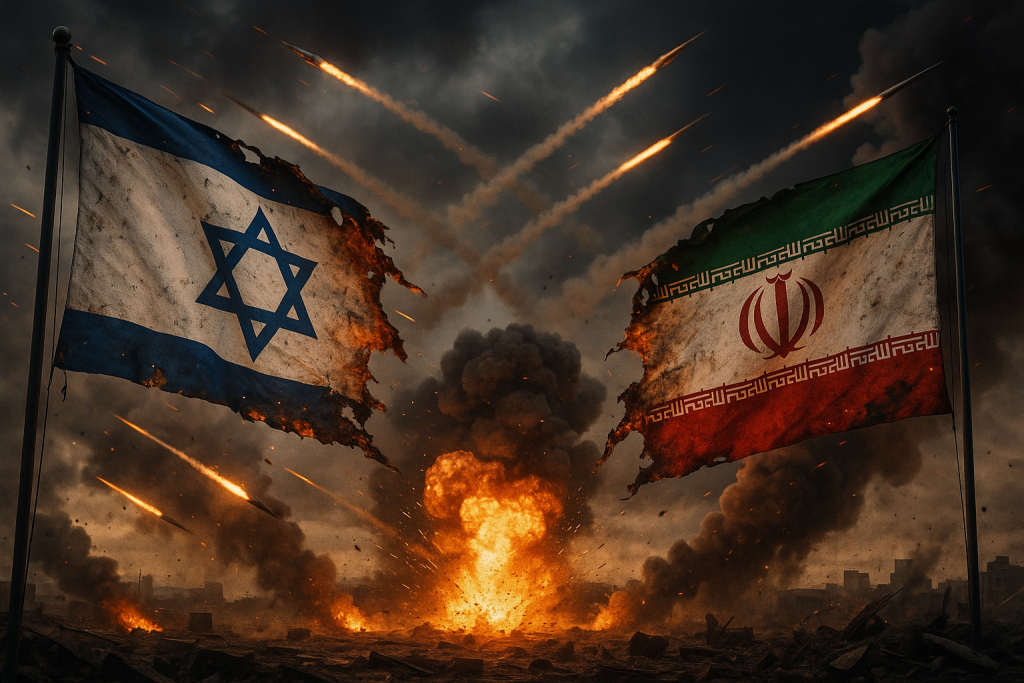
Image Credentials: Image Title: Israel-Iran War Enters Second Week as Diplomacy Falters and Strikes Intensify Source: (sora.chatgpt) Date: June 2025 Attribution: Created by AI-generated imagery (sora.chatgpt), it does not depict a real-world scene.
Geneva talks yield no breakthrough as civilian toll rises and U.S. weighs military involvement
Geneva / Tel Aviv / Tehran — June 21, 2025 — The war between Israel and Iran surged into its second week on Friday with no diplomatic breakthrough in sight, despite four hours of intensive negotiations in Geneva involving European foreign ministers and Iran’s top diplomat. As airstrikes and missile attacks continued to crisscross the region, the conflict shows no signs of de-escalating.
Diplomacy in Stalemate
The high-stakes talks in Geneva — held behind closed doors — failed to yield any concrete path toward peace. Iranian Foreign Minister Abbas Araghchi reiterated Tehran’s conditional openness to diplomacy but drew a hard line against engaging with the United States while Israeli strikes persisted.
“Iran is ready to consider diplomacy if aggression ceases and the aggressor is held accountable for its committed crimes,” Araghchi told reporters.
European diplomats, including representatives from Germany, France, and Switzerland, expressed cautious optimism that further negotiations could be arranged, but acknowledged that deep mistrust continues to impede progress. No date has been set for another round of talks.
Israel Vows to Continue Air Campaign
Back in Jerusalem, Prime Minister Benjamin Netanyahu affirmed that Israel’s military campaign would persist “for as long as it takes” to neutralize what he called the “existential threat” posed by Iran’s nuclear programme and ballistic missile arsenal.
The Israeli military, having targeted Iranian nuclear facilities, missile sites, and military leadership since the war’s eruption on June 13, has declared it is prepared for a “prolonged campaign.” Top Israeli military commanders emphasized that while Israel can inflict heavy damage on Iran’s capabilities, destroying underground nuclear sites such as Fordo may be impossible without U.S. military intervention.
Trump’s Calculus: Bunker-Buster Decision Looms
Former U.S. President Donald Trump, who has taken the unprecedented step of delaying a decision on American involvement for up to two weeks, remains a wildcard in the crisis. The Pentagon has confirmed that only the U.S. holds the arsenal of bunker-buster bombs capable of penetrating facilities like Fordo, buried deep beneath Iran’s mountainous terrain.
Trump, facing mounting pressure from allies and domestic critics alike, has so far refrained from authorizing military force, though senior defense officials say contingency plans are in place.
Civilian Suffering Mounts
The human toll of the conflict is rising steeply. According to a Washington-based Iranian human rights group, at least 657 people have been killed in Iran, including 263 civilians, with over 2,000 wounded. Iran’s most high-profile losses include senior members of the Revolutionary Guard and nuclear scientists.
In retaliation, Iran has launched over 450 ballistic missiles and 1,000 armed drones at Israel, according to the Israeli military. While Israel’s Iron Dome and David’s Sling defense systems have intercepted most projectiles, at least 24 people have been killed in Israel and hundreds more wounded.
Scenes of chaos have unfolded at border crossings, particularly near Agarak village in southern Armenia, where hundreds of civilians and foreign nationals are fleeing Iranian territory following Israeli airstrikes.
Global Concern and Escalation Risks
The international community has expressed deep concern that the Israel-Iran war could ignite a broader regional conflict. The proximity of nuclear infrastructure, the scale of military assets involved, and the lack of clear diplomatic traction make this one of the most volatile confrontations in recent Middle Eastern history.
Analysts warn that without a rapid shift toward de-escalation, the war risks drawing in larger powers and triggering economic and political upheaval across the region — and beyond.
As air raid sirens continue to wail in Tel Aviv and Tehran, and diplomats scramble behind the scenes, the world watches nervously, hoping that diplomacy can catch up with the pace of war.