
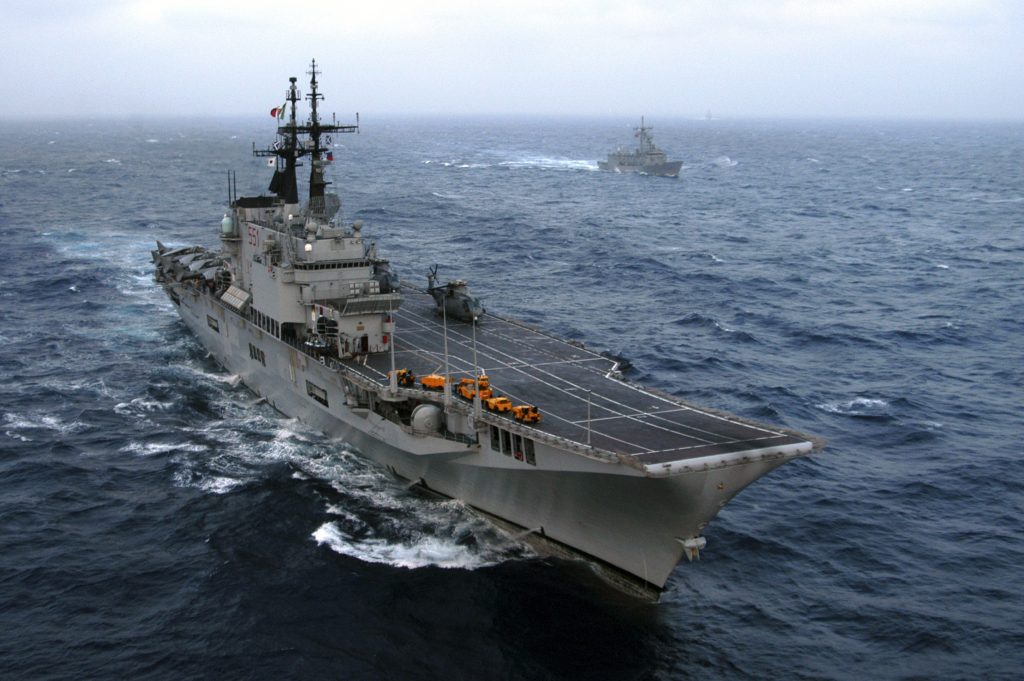
Image: Giuseppe Garibaldi in 2004 – By U.S. Navy photo by Photographer’s Mate Airman Rob Gaston – http://www.navy.mil; exact Source, Public Domain, (Wikipedia)

Giuseppe Garibaldi was an Italian aircraft carrier, the first through-deck aviation ship ever built for the Italian Navy, and the first Italian ship built to operate fixed-wing aircraft. Although she was widely recognised as a carrier first and foremost, she was officially designated as an aircraft-carrying cruiser. The ship was equipped with short take-off and vertical landing (STOVL) aircraft and helicopters. Giuseppe Garibaldi was involved in combat air operations over Somalia, Kosovo, Afghanistan, and Libya.
The ship was retired in 2024 and replaced by the LHD Trieste.
Design
The Giuseppe Garibaldi was the fourth ship of the Italian Navy to be named after the 19th-century Italian General Giuseppe Garibaldi. All four ships, including the missile cruiser, together with an image of Garibaldi, were depicted in the crest.
Built by Fincantieri (Italcantieri) at the Monfalcone shipyards on the Gulf of Trieste, it was laid down on 26 March 1981, launched on 11 June 1983, and commissioned on 30 September 1985. Garibaldi was classed as an anti-submarine warfare carrier (ASW) and was based in Taranto.
The ship was powered by four Fiat COGAG gas turbines built under license from GE, offering a sustained power of 81,000 hp (60 MW). Driving two shafts, the ship had a maximum speed of 30 knots (56 km/h; 35 mph) and could travel for 7,000 nautical miles (13,000 km; 8,100 mi) at around 20 knots (37 km/h; 23 mph).
The ship was equipped with four Otomat Mk2 short-range surface-to-surface missile systems installed at the stern of the vessel (removed in 2003 to improve the flight deck and satellite communications) and two ILAS three triple tube torpedo launchers. Defences were provided by two eight-cell SAM launchers firing the SARH Aspide missile, and three Oto Melara Twin 40L70 DARDO CIWS.
The ship also had several countermeasures, including two SCLAR twenty-barrel launchers for chaff, decoy, flares, or jammers, the SLQ-25 Nixie and SLAT anti-torpedo systems, and ECM systems.
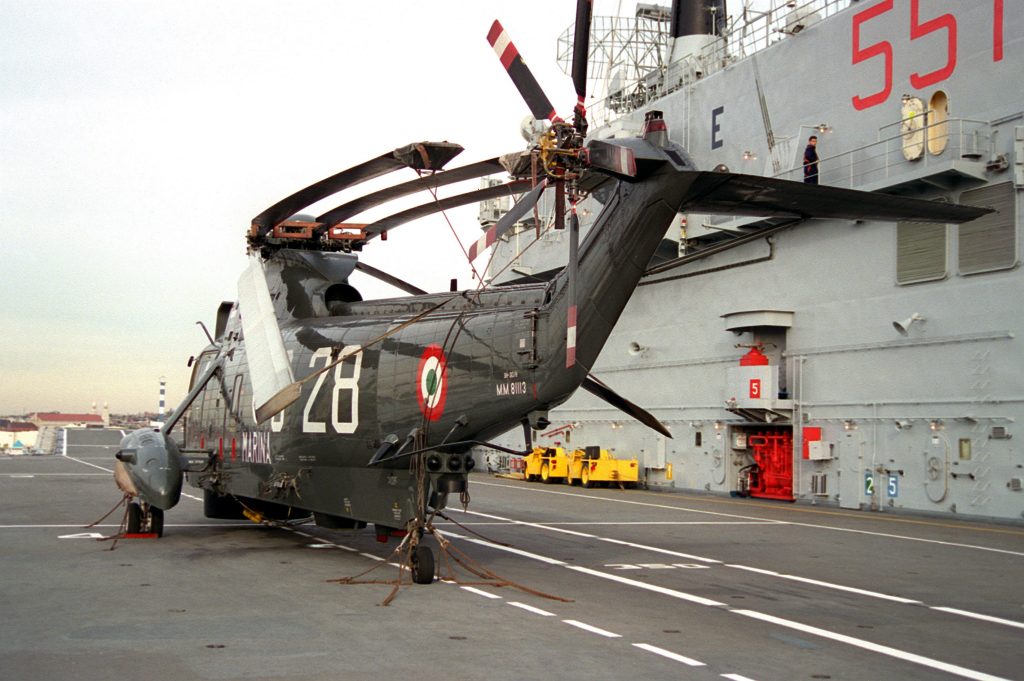
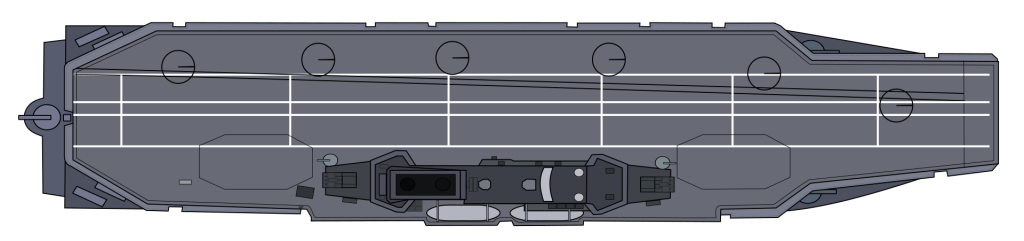
The air arm consisted of a maximum of sixteen AV-8B Harrier IIs and two search and rescue helicopters, or eighteen Agusta helicopters, or a mix of helicopters and fighters. The flight deck had the characteristic off-axis design with a 6.5-degree ski-jump for STOL aircraft; it was 174 m (571 ft) long and 30.4 m (100 ft) wide.
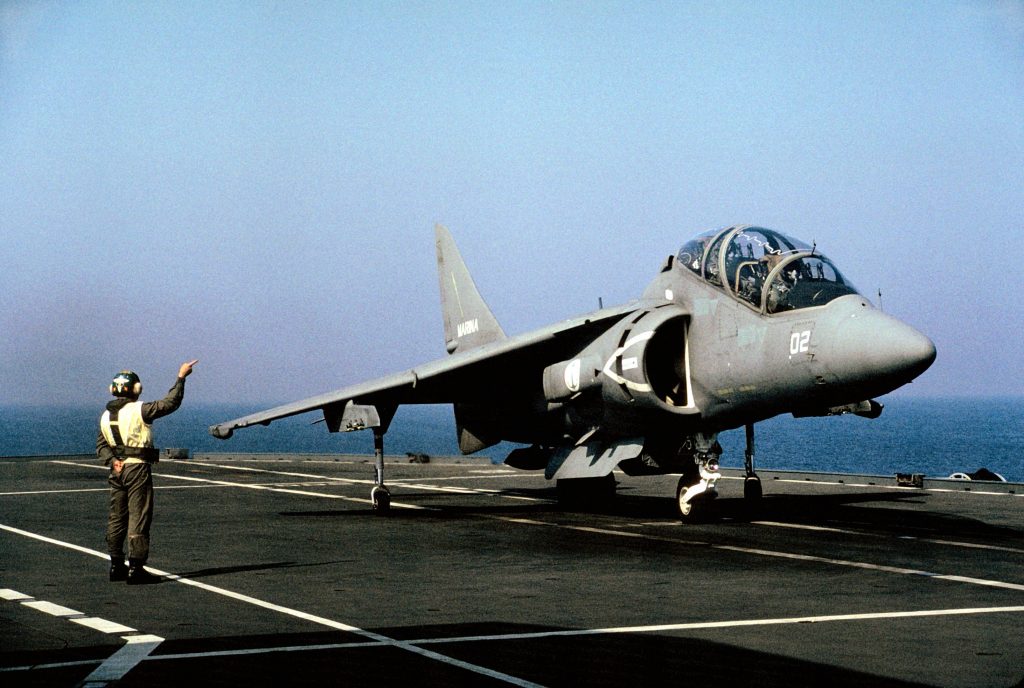
A 1937 law gave control of all national fixed-wing air assets to the Italian Air Force, and the navy was only permitted to operate helicopters. At the time of the ship’s commissioning of Garibaldi, the Italian Naval Aviation did not receive her Harriers, so it was reclassified as an Incrociatore portaeromobili (Italian for Aircraft carrying cruiser). Until 1988, only Italian helicopters landed on her deck, as well as Royal Navy Sea Harriers during NATO joint maneuvers. The ban on fixed-wing aircraft was lifted in 1989, and the Italian Navy acquired Harrier II fighters to fly from the Giuseppe Garibaldi.
In 2009, Giuseppe Garibaldi was replaced as the flagship of the Italian Navy by the new and larger carrier Cavour.
The ship underwent a modernization in 2003 and a major restructuring in 2013.
In March 2025, it was stated that the Indonesian Navy was interested in acquiring the ship from Italy, along with its air wing of Harrier II jets.
Combat operations

In 1999, with the Kosovo War in the Balkans, Italy committed Harrier AV-8B II+ fighters embarked aboard Giuseppe Garibaldi from 13 May to early June 1999. The planes carried out 30 sorties in 63 hours of flight. The aircraft used Mk 82 GBU-16 bombs and AGM-65 Maverick missiles. The Italian naval force, in addition to the aircraft carrier Giuseppe Garibaldi with her air group, included the Maestrale-class frigate Zeffiro.
Following the attacks of 11 September 2001 and the war on terror declared by U.S. President Bush, Italy participated in Operation Enduring Freedom in Afghanistan. Giuseppe Garibaldi was engaged as the commanding ship of GRUPNAVIT I, 1 Italian Naval Group, which also included Zeffiro, the patrol team, and the airman supplier in Etna. The group set sail from Taranto on 18 November 2001. They trained in the Indian Ocean from 3 December 2001 to 1 March 2002 and returned to Taranto on 18 March 2002. During the mission, the AV-8B Harrier unit carried out 288 missions for a total of 860 hours of flight. Tasks carried out included interception/interdiction, sea and air support, and aircraft interdiction in Afghanistan.
Participating in the 2011 military intervention in Libya after the transfer of authority to NATO and the decision to participate in strike air-ground operations, the Italian government assigned under NATO command four Italian Navy AV-8B plus (from Garibaldi) in addition to Italian air force aircraft. As of 24 March, the Italian Navy was engaged in Operation Unified Protector with the light aircraft carrier Garibaldi, the Maestrale-class frigate Libeccio, and the auxiliary ship Etna. Additionally, the Orizzonte-class frigate Andrea Doria and the Maestrale-class frigate Euro were patrolling off the Sicilian coast in an air-defence role. In total, until the end of the mission in Libya, the eight Italian Navy AV-8Bs flying from the carrier Giuseppe Garibaldi dropped 160 guided bombs during 1221 flight hours.
| History | |
|---|---|
| Italy Navy
|
|
| Name | Giuseppe Garibaldi |
| Namesake | Giuseppe Garibaldi |
| Builder | Fincantieri, Monafalcone Shipyard, Monfalcone (Gorizia) |
| Cost | Lire 428 billion (1981) (equivalent to €903.63 million in 2019) |
| Laid down | 26 March 1981 |
| Launched | 11 June 1983 |
| Commissioned | 30 September 1985 |
| Decommissioned | 1 October 2024 |
| Homeport | Taranto |
| Identification | Pennant number: 551 |
| Motto | Obbedisco “I Obey” |
| Status | Retired |
| General characteristics | |
| Type | ASW aircraft cruiser/aircraft carrier |
| Displacement |
|
| Length | 180.2 m (591 ft) |
| Beam | 33.4 m (110 ft) |
| Draught | 8.2 m (27 ft) |
| Propulsion |
|
| Speed | 30 kn (56 km/h; 35 mph)+ |
| Range | 7,000 nmi (13,000 km; 8,100 mi) at 20 kn (37 km/h; 23 mph) |
| Complement |
|
| Sensors & processing systems |
|
| Electronic warfare & decoys |
|
| Armament |
|
| Aircraft carried |
|
| Notes | flight deck is length 174.0 m (570.9 ft) and 30.0 m (98.4 ft) wide |

References
- ^ Gardiner, Robert (1983). Conway’s All the World’s Fighting Ships 1947–1982, Part One: The Western Powers. Annapolis, Maryland: Naval Institute Press. p. 66. ISBN 0-87021-918-9.
- ^ “Giuseppe Garibaldi Portaeromobili”. GlobalSecurity. Archived from the original on 29 November 2014. Retrieved 1 January 2015.
- ^ “Garibaldi” (in Italian). 11 August 2016. Archived from the original on 2016-08-11. Retrieved 14 June 2023.
- ^ Thomas Newdick (15 February 2021). “All You Need To Know About Italy’s F-35 Carrier That Just Arrived In The US”. The War Zone. Retrieved 14 June 2023.
- ^ Dreadnaughtz (17 March 2023). “Giuseppe Garibaldi, 1st Italian STOVL carrier”. Naval Encyclopedia. Retrieved 14 June 2023.
- ^ Giuseppe Garibaldi – light aircraft carrier[usurped] military-today.com
- ^ “Issue 11 – Harrier: The Harrier Abroad”. Aviation Classics. 28 July 2011. Archived from the original on 1 January 2015. Retrieved 1 January 2015.
- ^ “Indonesia interested in Italian carrier ITS Giuseppe Garibaldi”. Jane’s. 6 March 2025. Retrieved 24 March 2025.
- ^ “contributo nazionale operazione “Odissey Dawn””. Italian Ministry of Defense. 11 June 2011. Archived from the original on July 20, 2011.
- ^ “Operazione “Unified Protector”: navi italiane partecipano all’embargo” (in Italian). Italian Ministry of Defense. 25 March 2011. Archived from the original on 14 April 2019.
- ^ “Libia: nave Andrea Doria nel canale di Sicilia con compiti di difesa aerea da attacchi missilistici” (in Italian). GrNet.it. 19 March 2011. Archived from the original on 7 December 2014. Retrieved 1 January 2015.
- ^ Kington, Tom (14 December 2011). “Italy Gives Bombing Stats for Libya Campaign”. Defense News. Archived from the original on 28 July 2012. Retrieved 1 January 2015.
Continue exploring related Open Chronicle Encyclopedia entries through the categories associated with this article.
Explore this subject

Staff Writers at Open Chronicle produce trusted journalism, strategic analysis and authoritative reference content across global affairs, geopolitics, defense, science, history, technology, business, culture and sport. Their work combines accurate reporting with historical perspective and analytical depth, helping readers understand not only what is happening, but why it matters. Beyond daily news coverage, Staff Writers contribute to the Open Chronicle Encyclopedia, investigative features, original research projects and long-form reports, building a comprehensive knowledge platform designed to inform, educate and preserve reliable information for a global audience.