
OPEN CHRONICLE | GLOBAL NEWS DESK
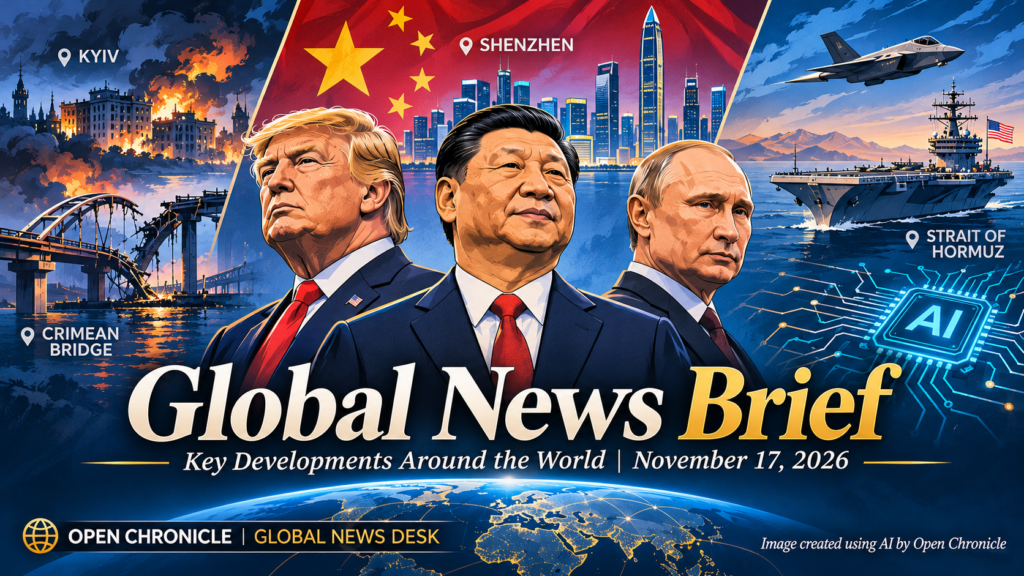
Russia and Ukraine intensify attacks on critical infrastructure as Donald Trump travels to Asia for major diplomatic talks. Reports of a possible Iranian attack raise security concerns in Washington, while tensions across the Middle East, Asian airspace incidents, economic uncertainty and humanitarian crises dominate the international agenda.
By Open Chronicle News Desk
November 17, 2026 | World News | International Relations | Global Security
A World of Escalating Risks and Intensifying Diplomacy
November 17 opens with a striking contradiction in international affairs. Major powers are preparing for high-level diplomatic negotiations while military operations, regional security alerts and economic tensions continue to intensify.
President Donald Trump is travelling to Asia ahead of planned discussions involving Chinese President Xi Jinping and Russian President Vladimir Putin. The anticipated meeting in Shenzhen, scheduled for November 19, has become a focal point for questions about nuclear stability, international security and the future of relations between the world’s most influential military powers.
At the same time, Russia and Ukraine are exchanging attacks on strategically important bridges. Ukrainian strikes have reportedly damaged the Crimean Bridge, while Russian attacks have disrupted transport infrastructure in Kyiv and affected essential services.
In the Middle East, reports attributed to American intelligence officials suggest that Iran may be considering attacks involving radiological material against targets in the United States. These allegations remain unconfirmed publicly and require particular caution because of their potentially serious implications.
Further east, Japan and South Korea have scrambled military aircraft amid reports of Russian aviation activity, while China is intensifying diplomatic engagement ahead of the APEC summit.
Beyond the immediate security headlines, November 17 also brings developments in global trade, climate negotiations, migration, humanitarian assistance, artificial intelligence and public safety.
This edition organises the day’s major developments by region and theme, separating reported events, official allegations and broader strategic implications.
Editorial status: This briefing is based on the international headlines and developing reports supplied to the Open Chronicle News Desk. Some incidents, casualty figures and official allegations remain subject to independent verification.
PART I | EUROPE AND THE RUSSIA–UKRAINE WAR
1. Russia and Ukraine Target Strategic Bridges as Fighting Intensifies
Ukrainian forces struck the Kerch Bridge, which connects Russia with the occupied Crimean Peninsula, for a second consecutive day.
Russian-installed authorities confirmed that traffic had been suspended. Reports and photographs suggested significant structural damage, including the possible collapse of a road arch into the water.
The precise extent of the damage remained disputed, with Russian officials describing it as more limited than Ukrainian accounts suggested.
The bridge has considerable strategic and symbolic importance.
Constructed following Russia’s 2014 annexation of Crimea, it provides a direct transport connection between the peninsula and Russian territory. It has also been used for civilian traffic and military logistics.
Ukraine has repeatedly targeted the crossing as part of its campaign to disrupt Russian supply routes.
Meanwhile, Russian forces struck two major bridges across the Dnipro River in Kyiv.
Kyiv Mayor Vitali Klitschko reported damage to the North and South bridges, disruption to parts of the metro network, and interruptions to electricity and water supplies.
The attacks illustrate the increasing importance of transport infrastructure in a conflict where both sides are attempting to weaken the other’s capacity to move personnel, equipment and essential supplies.
2. Moscow Claims More Than 1,400 Ukrainian Drones Intercepted
Russia’s Defence Ministry reported that its air defence systems intercepted 1,441 Ukrainian drones during a major overnight attack.
If accurate, the figure would represent one of the largest single-day drone interception totals announced by Moscow during the war.
The reported attacks affected numerous Russian regions, including areas surrounding Moscow.
However, the number represents a Russian government claim. Independent verification of the total number launched, intercepted or reaching their targets was not available.
The scale of the reported operation nevertheless reflects the growing importance of long-range unmanned systems in the conflict.
Ukraine has increasingly used drones to attack energy facilities, industrial complexes, military infrastructure and logistical targets far beyond the front line.
Russia, meanwhile, continues large-scale missile and drone attacks against Ukrainian cities and infrastructure.
3. Ukraine Appeals for Air Defence as European Allies Consider New Assistance
Ukraine is renewing appeals for additional air defence equipment amid concerns about further Russian attacks during the winter.
Germany has announced plans for another assistance package involving Patriot air defence missiles, with Norway participating in the procurement effort.
Reports refer to approximately $300 million in support for PAC-2 and PAC-3 interceptors.
These missiles are particularly important for defending against certain aircraft, cruise missiles and ballistic threats.
Ukraine’s need for interceptors remains acute because large-scale Russian attacks can place significant pressure on available defensive inventories.
European governments are also discussing the longer-term sustainability of assistance, including procurement, industrial production and financial commitments.
At the diplomatic level, Ukrainian representatives have continued consultations with American and European officials about possible security guarantees and future negotiations.
The central question remains whether diplomatic discussions can produce meaningful progress while military operations continue at high intensity.
4. European Security: Sanctions, Migration and Political Pressure
Several European governments are considering further measures against Russia, including sanctions and possible restrictions on the entry of Russian military personnel.
EU foreign policy chief Kaja Kallas has argued for a stronger European role in discussions about Ukraine’s future.
The debate reflects concerns that negotiations involving Washington, Moscow and Beijing could marginalise European governments and Ukraine itself.
Elsewhere, five European countries are reportedly exploring a return centre in Rwanda for rejected asylum seekers.
The proposal has renewed debate over migration management, legal safeguards and the responsibility of European states toward people seeking protection.
In France, trade unions are preparing additional strikes and demonstrations over wages and living costs.
In the Czech Republic, a collision involving two trains near Prague reportedly injured multiple passengers and disrupted railway services.
These developments highlight the range of challenges confronting European governments, from continental security to domestic economic pressures and public safety.
PART II | UNITED STATES AND THE AMERICAS
5. US Intelligence Reports Raise Concerns About a Possible Iranian Radiological Attack
One of the most sensitive developments of November 17 involves reports that American intelligence agencies have identified possible Iranian plans for an attack using a radiological dispersal device, commonly described as a dirty bomb.
According to the headlines supplied to the Open Chronicle News Desk, the alleged planning could involve targets in Washington, including senior American officials.
The allegations are serious but require careful distinction between intelligence assessments, operational planning and confirmed threats.
There is no independently established evidence in the material reviewed that Iran has deployed such a device, that an attack is imminent, or that a specific operational plan has been confirmed publicly.
A dirty bomb is not the same as a nuclear weapon. It uses conventional explosives to disperse radioactive material rather than producing a nuclear detonation.
The principal concerns associated with such a device include contamination, disruption, public fear and potentially serious exposure risks.
The reports emerge amid heightened tensions between Washington and Tehran, including military incidents involving Bahrain and the Strait of Hormuz.
Vice President JD Vance has said that President Trump is considering options to increase pressure on Iran.
The administration faces the challenge of responding to possible threats without triggering an uncontrolled escalation.
6. Trump Begins Asian Diplomatic Tour Ahead of Shenzhen Summit
President Donald Trump is travelling through Asia ahead of a planned trilateral meeting with Chinese President Xi Jinping and Russian President Vladimir Putin on November 19.
The White House has confirmed the meeting, which is expected to address nuclear arms control, Iran and wider strategic relations.
Trump has also indicated that Ukraine and trade could feature in the discussions.
The summit is unusual because it brings together the leaders of three nuclear-armed powers whose relationships are marked by strategic rivalry, economic interdependence and disagreements over major international conflicts.
The meeting is expected to take place in Shenzhen during the APEC summit period.
The White House has cautioned that no immediate arms control agreement is expected, suggesting the discussions may serve primarily to establish a framework for further negotiations.
Trump’s itinerary also includes the Philippines, where ASEAN-related diplomatic meetings and regional security discussions are taking place.
Questions about a possible meeting with North Korean leader Kim Jong Un have also emerged, although no such encounter has been officially confirmed.
7. Canada and China Expand Trade Cooperation
Canadian Prime Minister Mark Carney and Chinese President Xi Jinping have agreed to extend and expand trade arrangements, providing additional tariff relief and strengthening commercial cooperation.
According to the Canadian government, the new measures cover approximately C$400 million in additional Canadian exports, particularly agricultural and seafood products.
The arrangement includes reduced trade barriers affecting frozen pork, shrimp, molluscs and other seafood.
Canada has also agreed to extend certain tariff relief measures for Chinese steel and aluminium products.
The agreement comes as Ottawa seeks to diversify commercial relationships amid continuing uncertainty over US trade policy.
The Canadian government said that more than 90% of bilateral trade now benefits from reduced tariffs.
The development illustrates how American tariff policy is encouraging some trading partners to explore closer economic relationships with China, even while security disagreements remain.
8. United Airlines Technology Failure Disrupts US Flights
A technical problem affecting United Airlines caused delays and cancellations across its operations.
The airline subsequently reported that the issue had been resolved.
Reports indicated that hundreds of flights were affected, while American aviation authorities said the disruption was not caused by a failure of the Federal Aviation Administration’s own systems.
The incident has renewed attention on the resilience of aviation technology, including airline dispatch systems and the infrastructure supporting flight operations.
Vice President Vance has called for substantial investment in American aviation infrastructure.
The disruption also comes amid broader concerns about ageing air traffic systems and the potential consequences of technical failures in highly interconnected transport networks.
9. Jeffrey Epstein Death Controversy Returns to Public Attention
The death of convicted sex offender Jeffrey Epstein has returned to the headlines following statements attributed to a forensic expert who questioned the original suicide determination.
The expert reportedly argued that aspects of the autopsy record could be consistent with strangulation.
However, an expert’s interpretation of forensic findings does not establish that a homicide occurred.
Epstein died in federal custody in August 2019. His death was officially ruled a suicide by hanging.
The renewed claims should therefore be presented as a disputed forensic opinion, not as a confirmed reversal of the official finding.
Any change to the established determination would require authoritative new evidence and a formal reassessment by the relevant authorities.
10. Latin America: Security, Corruption and Political Developments
In Costa Rica, authorities are investigating the killing of a journalist who had reportedly exposed alleged connections involving drug trafficking.
The case has raised concerns about organised crime and the safety of investigative journalism.
Brazilian federal police are reportedly examining allegations involving a donor network connected to US Vice President JD Vance. The nature and status of that investigation require further verification before any conclusions can be drawn.
In Guatemala, authorities have intensified security operations following the declaration of a state of siege.
Elsewhere, Ecuador’s president has rejected claims that the United States operates a military base in the country, amid reporting about American troop deployments.
These stories illustrate the continuing intersection of organised crime, security cooperation, political accountability and institutional stability across the Americas.
PART III | MIDDLE EAST AND NORTH AFRICA
11. Iran, Bahrain and the Strait of Hormuz: Regional Security Under Pressure
Tensions between Iran, the United States and regional partners remain among the most significant international security concerns.
Bahrain has reported intercepting Iranian aerial attacks, while Iran’s Islamic Revolutionary Guard Corps has claimed operations against American-linked military facilities in the country.
American officials have condemned the attacks and reiterated support for Bahrain.
Meanwhile, reports indicate that an oil tanker was struck twice in the Strait of Hormuz and subsequently caught fire.
The precise circumstances, responsibility and extent of damage require confirmation.
The Strait of Hormuz is one of the world’s most important maritime energy corridors. Disruption to shipping in the area can affect insurance costs, freight rates and global energy markets.
Iranian officials have also warned against attacks on infrastructure such as dams, arguing that such facilities could become targets in an expanding conflict.
These statements increase concerns about the potential extension of hostilities to civilian infrastructure.
Strategic significance: The immediate danger is not limited to direct military confrontation. Maritime incidents, attacks on infrastructure and threats against civilian facilities can generate wider economic and humanitarian consequences.
12. Gaza, the West Bank and Lebanon: Civilian Protection Remains a Major Concern
The humanitarian situation in Gaza remains fragile amid reports of continuing Israeli military operations, damaged infrastructure and flooding affecting displaced communities.
The United Nations has reported that an Israeli airstrike occurred close to one of its fuel convoys.
Fuel supplies are essential for hospitals, water systems, humanitarian transport and emergency services.
In the occupied West Bank, Palestinian officials reported that a woman was killed and several others wounded in an incident involving Israeli settlers.
The circumstances and responsibility for individual incidents require independent investigation.
In Lebanon, the conflict continues to affect civilian communities, with reports of damaged homes and families struggling to obtain essential assistance.
Iranian parliamentary speaker Mohammad Bagher Qalibaf has argued that regional stability cannot be achieved without an end to the war in Lebanon.
The developments demonstrate how interconnected conflicts continue to complicate diplomatic efforts across the Middle East.
13. Yemen: Houthi Advances Increase Pressure on Aden
Yemen’s internationally recognised authorities are facing renewed military pressure as Houthi forces reportedly advance toward Aden.
Government-aligned forces have reinforced defensive positions, while reports describe substantial fighting in areas south of Taiz.
The Yemeni parliament has also reportedly approved legislation classifying the Houthi movement as a terrorist organisation and criminalising its financial support.
The reported battlefield developments raise concerns about the future security of Aden, a major port city and political centre for the internationally recognised government.
The consequences could extend beyond Yemen.
Instability around the Bab al-Mandeb Strait threatens shipping routes connecting the Red Sea with the Gulf of Aden and the Indian Ocean.
A further deterioration could disrupt international trade and complicate humanitarian access to a country already affected by years of conflict.
14. Syria and Lebanon: Reconstruction, Returns and Regional Diplomacy
United Nations reporting cited in the supplied headlines indicates that nearly four million Syrians have returned since the fall of Bashar al-Assad’s government.
Despite the scale of returns, humanitarian needs remain substantial.
Housing, electricity, employment, healthcare and public infrastructure continue to present major challenges.
The World Bank is reportedly developing a new five-year partnership framework to support Lebanon’s reconstruction and economic recovery.
Such programmes could help rebuild essential infrastructure, but their effectiveness will depend on political stability, financing and institutional capacity.
Türkiye is also continuing diplomatic engagement concerning Syria, including the future of the Syrian Democratic Forces and regional connectivity projects.
PART IV | ASIA AND THE INDO-PACIFIC
15. Japan and South Korea Scramble Fighter Jets Amid Russian Aviation Activity
Japan has reportedly scrambled fighter aircraft after two suspected Russian military planes entered Japanese airspace.
Tokyo lodged a protest with Moscow, according to the supplied reports.
Taiwan also reported detecting Russian military aircraft near its eastern coast.
South Korea has been monitoring regional aviation activity and reportedly deployed fighters in response to developments in the area.
These incidents come at a particularly sensitive diplomatic moment, shortly before the planned summit involving Trump, Xi and Putin.
Airspace violations and military aviation encounters can increase the risk of miscalculation, particularly when aircraft operate near contested or strategically sensitive areas.
The incidents also highlight the expanding geographical significance of Russia’s military relationship with China and North Korea.
The precise flight paths and whether every reported incident constituted an airspace violation require confirmation from the relevant authorities.
16. North Korea: Kim Jong Un Inspects Tourism Development as Diplomatic Speculation Grows
North Korean leader Kim Jong Un has inspected tourism infrastructure near the Chinese border, including the Samjiyon development area.
Photographs and reports have also focused on his daughter accompanying him during the visit.
The inspection comes amid speculation about whether Kim could meet President Trump during the American leader’s Asian tour.
China has said it has no information about such a meeting.
Although the possibility has attracted considerable attention, no official confirmation has emerged.
North Korea’s relationship with Russia remains another major security concern.
Moscow has publicly acknowledged the participation of North Korean personnel in operations connected to the Russia–Ukraine war.
Reports that Pyongyang continues supplying ballistic missiles to Russia have prompted further appeals from Ukraine for additional air defence assistance.
17. Mongolia: President Resigns Amid Railway Corruption Allegations
Mongolian President Ukhnaa Khurelsukh has reportedly announced his resignation following allegations connected to railway development and corruption.
The reports indicate that he has denied wrongdoing and presented his resignation as a means of addressing the allegations.
The development could have significant domestic political consequences.
Mongolia occupies an important geographical position between Russia and China and depends heavily on transport infrastructure and mineral exports.
Railway projects are therefore economically and strategically important.
The allegations, their evidentiary basis and the constitutional process following the reported resignation require confirmation through Mongolian institutional sources.
18. ASEAN Summit: Regional Leaders Focus on Trade and Security
Leaders from Southeast Asia and their international partners are meeting in Manila for the ASEAN summit and associated diplomatic gatherings.
The agenda includes trade, maritime security, regional connectivity, technological development and relations with major powers.
India’s Prime Minister Narendra Modi has emphasised cooperation with ASEAN, including proposals concerning tourism and maritime collaboration.
China has highlighted the importance of its economic relationship with Southeast Asia while discussions continue over a code of conduct for the South China Sea.
The absence of a new deadline for concluding those negotiations reflects longstanding disagreements over maritime rights, security arrangements and enforcement mechanisms.
Australia and the Philippines are also strengthening defence cooperation amid continuing tensions in the South China Sea.
The meetings illustrate ASEAN’s challenge of maintaining regional cooperation while navigating competition between China and the United States.
19. South Asia: Political Pressure, Workers’ Protests and Women’s Rights
In Pakistan, former Prime Minister Imran Khan has appealed for medical assistance amid concerns about his health in detention.
His family has warned that his condition could deteriorate.
The allegations and his medical situation require assessment through credible independent reporting.
In Bangladesh, garment workers have reportedly blocked roads and clashed with police during protests over wages and working conditions.
The garment industry is a major contributor to Bangladesh’s export economy, making labour disputes economically significant.
In Afghanistan, women continue to pursue education and professional ambitions through informal and clandestine networks despite restrictions imposed by the Taliban.
These accounts underscore the continuing consequences of policies that limit women’s access to education, employment and public life.
The International Court of Justice’s proceedings concerning allegations of genocide against the Rohingya in Myanmar also remain an important issue for international accountability.
PART V | AFRICA
20. Sudan: Drone Warfare Deepens the Humanitarian Emergency
Sudan’s war continues to produce devastating consequences for civilians.
Reports citing United Nations assessments suggest that drones account for a growing share of conflict-related deaths in 2026.
The precise proportion and methodology require confirmation, but the increasing use of unmanned systems is consistent with wider changes in modern warfare.
Drone attacks can affect communities far from traditional front lines, while damage to transport networks and essential infrastructure complicates humanitarian operations.
Millions of people remain displaced, and humanitarian agencies continue to warn about food insecurity, disease and restricted access to vulnerable populations.
The conflict illustrates the danger of rapidly expanding military technologies in environments where civilian protection and accountability mechanisms are already severely weakened.
21. Mozambique, Nigeria and Regional Governance
In Mozambique, an opposition leader is reportedly facing trial over violence associated with the disputed 2024 elections.
The proceedings have renewed questions about political accountability, electoral legitimacy and judicial independence.
In Nigeria, continuing insecurity and poverty are preventing millions of children from attending school.
Kidnapping, forced marriage, displacement and inadequate educational infrastructure remain serious obstacles.
Elsewhere, African governments are pursuing new economic and financial partnerships, including climate investment and greater use of currencies other than the US dollar in international trade.
These developments reflect the continent’s simultaneous challenges of political stability, human development and economic diversification.
PART VI | GLOBAL ECONOMY, TECHNOLOGY AND CLIMATE
22. Artificial Intelligence: Washington Tightens Restrictions on China’s Access to Advanced Chips
The United States is reportedly introducing additional restrictions intended to prevent Chinese companies from gaining indirect access to advanced American semiconductor technology.
The measures focus not only on physical chip exports but also on remote access to computing capacity hosted in third countries.
This approach reflects concerns that export restrictions can be circumvented through cloud services, intermediaries and overseas data centres.
Singapore has been drawn into the debate amid investigations involving the possible diversion of Nvidia technology.
Singaporean officials have stated that the country will not condone businesses using its jurisdiction to violate applicable foreign laws.
China, meanwhile, is expanding efforts to develop domestic artificial intelligence capabilities and reduce dependence on American technology.
The dispute demonstrates how computing infrastructure has become an increasingly important component of economic and national security strategy.
23. Cybersecurity: Reports of Attacks Affecting Major Global Brands
Reports indicate that a cyberattack affected websites associated with numerous international brands, potentially exposing visitors to malicious content or data theft.
Some headlines refer to 178 affected brands, including prominent technology, banking and retail organisations.
The incident requires further technical verification, particularly regarding the mechanism of compromise, the number of affected websites and whether customer data was actually accessed.
The reports nevertheless highlight the security risks associated with third-party website services, advertising networks and shared software dependencies.
A compromise affecting a single service provider can potentially expose users across multiple unrelated websites.
24. Financial Markets: AI Valuations and Economic Growth Under Scrutiny
Global financial markets are experiencing renewed concern about the sustainability of valuations associated with artificial intelligence.
Technology shares have reportedly declined in Asian and American markets, with particular pressure on semiconductor-related companies.
South Korea’s Kospi has also fallen amid weakness in technology stocks.
Some economists and former financial regulators have warned that excessive investment expectations could create vulnerabilities if AI-related revenues fail to justify current valuations.
At the same time, demand for computing infrastructure remains substantial.
The central uncertainty is whether the expansion of AI investment will produce productivity gains and commercial returns sufficient to support the scale of spending.
This is a debate about economic sustainability rather than evidence that a market collapse is inevitable.
25. COP31: Climate Finance and Technology Dominate Negotiations in Türkiye
The COP31 climate negotiations continue in Türkiye, where delegates are debating climate finance, fossil fuel policy and support for vulnerable countries.
Kyrgyzstan has called for assistance to protect glaciers and water resources, highlighting the importance of climate adaptation in Central Asia.
African governments are also seeking stronger financial commitments and investment mechanisms.
American Democratic representatives have pledged continued engagement on climate policy despite divisions over the federal government’s approach.
The UN climate leadership has also warned that artificial intelligence presents both opportunities and risks for climate action.
AI could improve energy management, forecasting and environmental monitoring, but the expansion of data centres increases demand for electricity, water and infrastructure.
The negotiations face a familiar challenge: translating political commitments into measurable financial and environmental results.
26. Global Health: WHO Warns Progress Against Antimicrobial Resistance Is Insufficient
The World Health Organization has warned that international progress in combating antimicrobial resistance remains inadequate to meet targets set for 2030.
Antimicrobial resistance occurs when microorganisms evolve in ways that reduce the effectiveness of medicines used to treat infections.
It threatens healthcare systems by making common infections more difficult and expensive to treat.
The challenge is particularly serious in countries with limited laboratory capacity, weak surveillance systems and restricted access to appropriate medicines.
The WHO’s warning underscores the importance of coordinated investment in infection prevention, responsible antimicrobial use, diagnostics and pharmaceutical research.
PART VII | INTERNATIONAL SOCIETY AND PUBLIC SAFETY
27. Pope Leo XIV Concludes South American Tour
Pope Leo XIV has completed an extensive visit to South America, including engagements in Peru.
During an exchange with journalists, he joked that the reporters accompanying him appeared more exhausted than he was.
The trip attracted attention for its demanding schedule and public appearances.
One incident involved a rosary bracelet striking the Pope near the eye during an encounter with members of the public.
Reports indicate that he treated the incident lightly and expressed forgiveness.
The visit also included discussions about the Catholic Church’s future, including questions concerning the priesthood and religious practice.
28. Indonesia Earthquake and Other Public Safety Developments
A magnitude 6.6 earthquake was reported near Tual, Indonesia.
The extent of damage, possible casualties and tsunami-related assessments should be confirmed through Indonesian disaster management and geological authorities.
In the Czech Republic, emergency services responded to a train collision near Prague.
In the United States, technical disruptions affected airline operations and online banking services, raising questions about the resilience of essential digital systems.
These incidents illustrate how natural hazards, transport accidents and technological failures can create immediate disruption even outside conflict zones.
PART VIII | THE GLOBAL PICTURE
29. Five Forces Shaping November 17
Five Forces Shaping November 17
The developments of November 17 reveal five interconnected forces shaping the international environment.
Diplomacy and Military Escalation Are Advancing Simultaneously
The planned Shenzhen summit represents an opportunity for dialogue among major powers, but the intensification of attacks in Ukraine and tensions involving Iran demonstrate how difficult it will be to translate diplomatic engagement into stability.
Critical Infrastructure Is Becoming a Central Security Concern
Bridges, energy installations, shipping corridors, aviation networks and digital platforms are increasingly exposed to military operations, technical failures and cyber threats.
Economic Relationships Are Being Reorganised Around Strategic Competition
Canada’s expanding commercial cooperation with China, American semiconductor restrictions and changing regional trade arrangements demonstrate how security concerns are influencing economic decisions.
Humanitarian Crises Remain Vulnerable to Geopolitical Priorities
Civilian suffering in Gaza, Sudan, Yemen, Ukraine and Afghanistan continues while governments concentrate on military strategy, diplomatic negotiations and domestic political pressures.
Technology Is Changing Both the Instruments of Power and the Sources of Vulnerability
Long-range drones, advanced semiconductors, autonomous systems and interconnected digital infrastructure are transforming national security while introducing new risks for governments, businesses and civilians.
Open Chronicle editorial synthesis based on developments reported on November 17, 2026.
Conclusion | A World Preparing for Negotiations While Confronting Escalation
November 17, 2026, illustrates the widening distance between diplomatic ambitions and developments on the ground.
The forthcoming meeting between Donald Trump, Xi Jinping and Vladimir Putin has the potential to open discussions on nuclear stability, international security and major geopolitical disputes.
Yet the intensification of military operations in Ukraine demonstrates that diplomatic preparations do not necessarily produce an immediate reduction in hostilities.
The same contradiction is visible in the Middle East, where security warnings and military incidents continue despite efforts to contain regional escalation.
Across Asia, governments are navigating strategic competition while attempting to preserve economic cooperation.
In Europe, leaders face difficult decisions about security assistance, migration and economic resilience.
And globally, humanitarian emergencies, climate negotiations and technological disruption continue to demand sustained international attention.
The coming days will be particularly important.
The Shenzhen summit could clarify whether the three major powers are prepared to establish meaningful diplomatic processes or whether their discussions will remain largely symbolic.
Developments in Ukraine and the Middle East will provide an equally important measure of whether international tensions are moving toward containment or further escalation.
The defining question of November 17 is whether diplomacy can begin to reduce the risks that military, economic and technological competition continue to create.
Sources and Further Reading
Selected reporting and official documentation. Links are kept outside the article body for publication.
Associated Press | Russian Air Defences Down More Than 1,400 Ukrainian Drones
November 17, 2026. Reporting on the Kerch Bridge attacks, Russian interception claims and strikes against Kyiv.
Reuters | Russian Strikes Hit Two Bridges in Kyiv
November 17, 2026. Reporting on damaged bridges, transport disruption and interruptions to electricity and water supplies.
Agence France-Presse | Ukraine and Russia Hit Key Bridges Ahead of Summit
November 17, 2026. Coverage of the intensifying infrastructure attacks and their diplomatic context.
Radio Free Europe/Radio Liberty | Trump to Discuss Iran and Nuclear Arms
November 14, 2026. Background on the November 19 summit and its proposed diplomatic agenda.
Prime Minister of Canada | Mark Carney Meets Xi Jinping
November 17, 2026. Official Canadian government account of the bilateral meeting in Shenzhen.
Government of Canada | Expanded Trade Partnership With China
November 17, 2026. Official details of tariff relief, commercial agreements and market access.
Institute for the Study of War | Russian Offensive Campaign Assessment
November 16, 2026. Military assessment of Ukrainian operations against the Kerch Bridge and Russian logistical infrastructure.
This global briefing combines selected independently corroborated reporting, official government documentation and additional developing headlines supplied to the Open Chronicle News Desk.
Not every reported incident has been independently verified. In particular, allegations concerning a possible Iranian radiological attack, disputed intelligence activities, some casualty figures, reported political investigations and the extent of damage to military infrastructure require further corroboration.
Military interception figures are attributed to the authorities reporting them. Claims about alleged criminal conduct do not establish guilt. Predictions about diplomatic outcomes and broader strategic consequences are identified as editorial analysis.
The briefing reflects information available during the morning of November 17, 2026. Developments may change as official statements, independent investigations and further reporting become available.