
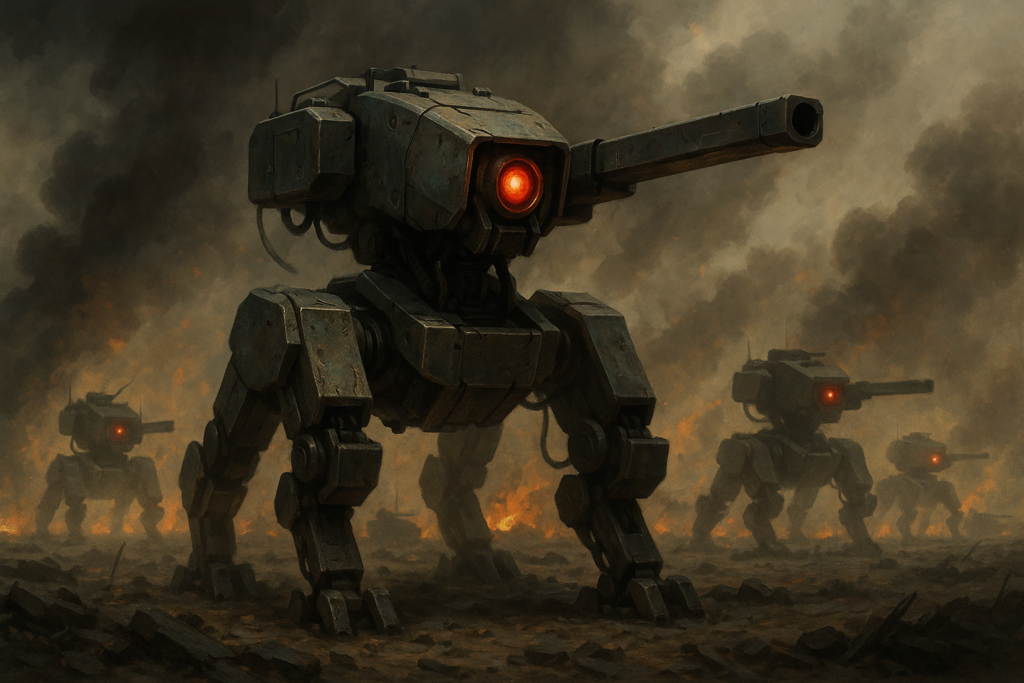
Image Credentials: Image Title: Beyond the Hype: Study Argues Human Judgment Remains Irreplaceable in Military Strategy Amid AI Advancements Source: (Sora.ChatGPT) Date: September 2025. Attribution: Created using AI-generated imagery (Sora.ChatGPT), this does not depict a real-world scene.
By Staff Writer | Open Chronicle
ATLANTA, GA – The vision of autonomous machines governing the battlefield, a staple of science fiction and political rhetoric, faces a significant reality check. New research from the Georgia Institute of Technology contends that while artificial intelligence (AI) can transform certain aspects of warfare, the military cannot rely on it for the core elements of strategy and human judgment.
The study, published in the journal International Security, breaks down AI decision-making into four key components: data, prediction, judgment, and action. While machine learning has made staggering advances in prediction, forecasting outcomes based on data, it remains critically dependent on humans for the initial data input and, most importantly, for the final judgment call.
“The conditions that make AI work in commerce are the conditions that are hardest to meet in a military environment because of its unpredictability,” said Dr. Jon Lindsay, an associate professor at Georgia Tech and co-author of the paper alongside Professor Avi Goldfarb from the University of Toronto. “Machines are good at prediction, but they depend on data and judgment, and the most difficult problems in war are information and strategy.”
The research challenges the prevailing “substitution theory,” which assumes that policymakers can directly replace human soldiers with AI, thereby creating a more efficient and less vulnerable force. Instead, Lindsay and Goldfarg propose a “complement theory,” where AI should be seen as a tool that augments, not replaces, human decision-makers.
To illustrate this, the authors contrast a commercial application with the realities of war. Companies like Rio Tinto successfully use self-driving trucks because they operate in a stable, predictable environment with abundant, unbiased data from clear traffic patterns and maps. War, by its very nature, is defined by a lack of reliable data, deception, and inherently controversial judgments about objectives and values.
The study suggests AI is best employed in “bureaucratically stabilized” environments, tasks like personnel management, administration, logistics, and equipment repairs. The real pitfalls, they argue, lie in applying AI to highly interpretive and creative strategic problems.
“All the excitement and the fear are about killer robots and lethal vehicles,” Lindsay noted. “But the worst case for military AI in practice is going to be the classically militaristic problems where you’re really dependent on creativity and interpretation.”
The researchers also highlight the strategic consequences of AI adoption. If human judgment is the linchpin for effective AI use, then military hierarchies may shift power to those who design data systems and make policy decisions. This also creates new vulnerabilities; adversaries will inevitably seek to compromise both the data feeding AI systems and the judgment processes of human commanders, potentially through misinformation or data corruption.
In effect, the push for more AI could make human oversight even more critical. As the automation of prediction accelerates, the value of reliable data and sound human judgment skyrockets.
“The question becomes,” Lindsay concludes, “We’ve automated action with precision weapons, we’ve automated data collection with sensors, and now we’re automating prediction with AI. So, when are we going to automate judgment, or are there components of judgment that cannot be automated?”
Until that question is answered, the study firmly concludes that tactical and strategic decision-making by humans will continue to be the most vital component of warfare, with AI serving as a powerful, but limited, complementary tool.
Story Source:
Materials provided by Georgia Institute of Technology.Note: Content may be edited for style and length.
Journal Reference:
- Avi Goldfarb, Jon R. Lindsay. Prediction and Judgment: Why Artificial Intelligence Increases the Importance of Humans in War. International Security, 2022; 46 (3): 7 DOI: 10.1162/isec_a_00425