
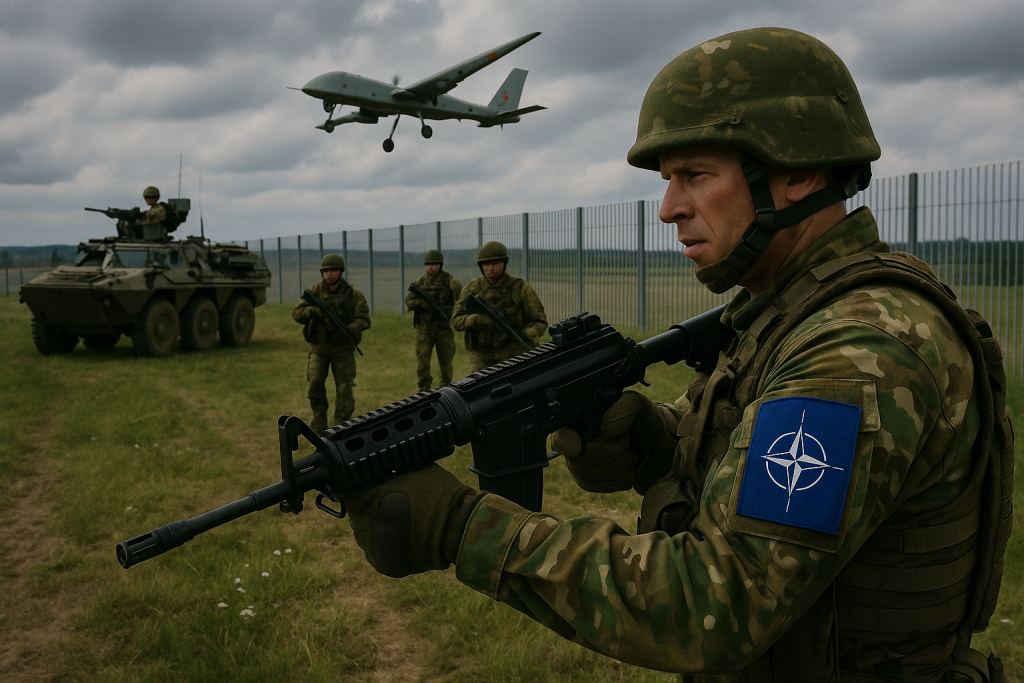
Image Credentials: Image Title: NATO Reinforces Eastern Border After Russian Drone Breach Source: (Gemini) Date: September 2025. Attribution: Created using AI-generated imagery (Gemini), this does not depict a real-world scene.
By Staff Writer | Open Chronicle with Agencies
In response to a major Russian drone incursion into Polish airspace, NATO has launched a multinational operation aimed at reinforcing its eastern border. The operation, named Eastern Sentry, was initiated on Friday after Poland reported that 19 Russian drones entered its territory overnight, between September 9 and 10. The incident, which Poland described as deliberate, prompted a rapid and coordinated military response across NATO member states.
A Swift Military Response
The breach marked one of the most serious violations of airspace involving Russia since the full-scale invasion of Ukraine began in February 2022. Although previous missile fragments and drone debris had landed in neighboring countries, this marked the first time NATO forces actively intercepted multiple drones on alliance territory. Fighter jets and air defense systems from several NATO members, including France, Germany, Denmark, and the United Kingdom, are now being deployed to the region.
-
France is sending three Rafale fighter jets.
-
Germany is contributing four Eurofighters.
-
Denmark is deploying two F-16s and a naval vessel.
-
The United Kingdom and other allies have pledged further support.
NATO's Supreme Allied Commander Europe announces "integrated" defensive line from the north of Finland through the Baltic states, Poland and down to the Black Sea in response to drone attack.
The UK, France and Denmark have already pledged equipment #EasternSentry #NATO #Russia pic.twitter.com/53FnWd2FfA
— Georg von Harrach (@georgvh) September 12, 2025
The operation is being led by General Alexus G. Grynkewich, NATO’s European forces commander, who emphasized that the deployment of both ground forces and air defense systems would begin immediately. As part of the broader operation, communication between border countries is being expanded to ensure swift responses to any potential threats.
Although NATO spokespeople have stated that “there is no immediate military threat,” they stressed that defensive measures are crucial. The incident, which saw some drones crash in residential areas and agricultural fields in eastern Poland, raised alarms but resulted in no reported injuries. Civilian air traffic in major Polish cities, including Warsaw, Rzeszów, and Lublin, was temporarily suspended.
Political and Diplomatic Reactions
The drone incursion prompted Poland to invoke Article 4 of the NATO treaty, which triggered emergency consultations among the alliance’s 32 member states. This clause allows member countries to seek consultations if they believe their territorial integrity, political independence, or security is threatened. In response, the United Nations held a Security Council session on Friday in New York to address the escalation.
Poland’s Secretary of State Marcin Bosacki presented photographs of debris and damage from the drone strikes, asserting, “We know, and I repeat, we know that it was not a mistake.” The United States, in a strong diplomatic stance, affirmed its commitment to defending NATO territory. Acting UN Ambassador Dorothy Shea called the incursion a violation of international law and the UN Charter, while US President Donald Trump suggested the incident might have been unintentional, further complicating the situation.
Russia, for its part, denied targeting Poland and claimed that its drone strikes were focused solely on Ukraine. Russia’s Defense Ministry noted that the drones involved had a range of no more than 700 kilometers, making it “physically impossible” for them to have come from Russian positions. Belarus, which shares a border with Poland and is allied with Moscow, suggested that Ukrainian jamming systems might have caused the drones to veer off course, eventually drifting into Polish airspace.
The Growing Regional Impact
This drone breach has elevated tensions in a region already on edge due to the ongoing war in Ukraine. The United Nations political chief, Rosemary DiCarlo, noted that the incident underscores the growing regional impact of the war, calling for an immediate ceasefire and the cessation of attacks on civilians and infrastructure.
Meanwhile, Ukraine itself is dealing with its own wave of drone and missile strikes. Ukrainian President Volodymyr Zelenskyy reported that over 400 drones and 40 missiles struck 15 Ukrainian regions during the same period as the Polish drone incursion. Despite the ongoing attacks, Zelenskyy reiterated his calls for increased pressure on China to use its influence to end the war and urged continued international support.
The Zapad Military Exercises
Adding to the already tense atmosphere, Russia and Belarus began large-scale joint military exercises, known as Zapad, on Friday. These exercises, held every four years, are particularly concerning due to their proximity to NATO’s eastern borders. Official figures indicate 13,000 troops are participating, though Polish officials estimate the number may be much higher. The exercises, which include drills near the strategic Suwałki Gap, a key corridor between Poland and Lithuania, have raised concerns of potential miscalculations or accidents that could further escalate tensions.
While NATO officials have stated that the Zapad exercises do not pose an immediate threat, they acknowledged that heightened military activity in the region increases the risk of conflict by miscalculation. NATO leaders, including Dutch Prime Minister Mark Rutte, have condemned the drone incident as “dangerous and unacceptable” and called for stronger drone defense systems along the alliance’s eastern flank.
Looking Ahead: A More Robust NATO Response
In light of these recent developments, NATO is expected to continue strengthening its defensive posture along its eastern borders. NATO officials have expressed support for a proposal from EU Commission President Ursula von der Leyen for a “drone wall” to protect vulnerable borders from future incursions. Meanwhile, G7 finance ministers held virtual talks on potential sanctions against countries that may be aiding Russia’s military operations.
The situation remains fluid, with the possibility of further military developments as Russia, Belarus, and NATO all engage in significant military maneuvers in the region. With NATO’s new operation, Eastern Sentry, now in full swing, the alliance is signaling its commitment to maintaining security and deterring further threats to its member states. The coming weeks may see continued diplomatic and military efforts aimed at de-escalating this complex and volatile situation.