
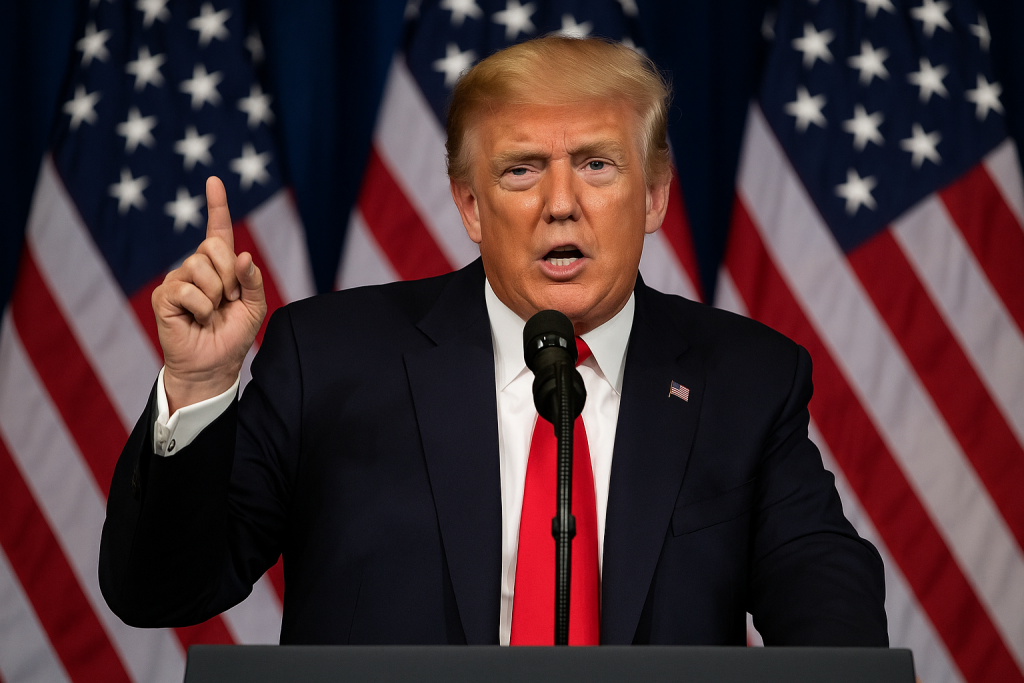
Image Credentials: Image Title: Trump Warns Critical TV Networks Could Face License Revocation Amid Jimmy Kimmel Suspension Controversy Source: (Sora.ChatGpt) Date: September 2025. Attribution: Created using AI-generated imagery (Sora.ChatGpt), this does not depict a real-world scene.
By Staff Writer | Open Chronicle with Agencies
The suspension of Jimmy Kimmel Live! by ABC has ignited a storm of controversy in the United States, bringing issues of free speech, media independence, and government influence to the forefront. The decision followed remarks by Kimmel about the fatal shooting of conservative influencer Charlie Kirk, comments that triggered political backlash and, ultimately, the removal of his program from the schedule.
While many saw the move as an internal broadcasting decision, President Donald Trump escalated the debate by suggesting that networks critical of him could lose their broadcasting licenses. Speaking to reporters aboard Air Force One after his second state visit to the UK this week, Trump repeated his long-standing complaints about media bias.
“I read someplace that the networks were 97 percent against me. I get 97 percent negative … and if they’re 97 percent against and they give me only bad publicity, press, and they’re getting a license, I would think maybe their license should be taken away,” he said. Trump described late-night television as “an arm of the Democrat Party” and accused shows of systematically excluding conservative voices.
BREAKING 🚨 President Trump just called for ABC and NBC to LOSE their Licenses or start paying up “BIG” time to use the “most valuable airwaves”
TERMINATE THEIR LICENSES NOW
GET IT DONE pic.twitter.com/BIHzEiD8Pd
— MAGA Voice (@MAGAVoice) August 25, 2025
Reaction from Late-Night Hosts
Kimmel’s fellow comedians quickly rallied to his defense, using their own programs to challenge both ABC’s suspension and Trump’s rhetoric.
Jon Stewart hosted a special episode of The Daily Show, satirically presenting himself as a “patriotically obedient host.” He mocked the administration’s approach, warning that attempts to police speech amounted to “a smokescreen to obscure an unprecedented consolidation of power.”
Seth Meyers on NBC echoed these sentiments, quipping that any past criticism of Trump could be dismissed as “just AI,” while Stephen Colbert was more direct, calling the suspension “a blatant assault on the freedom of speech.” His program’s official social media accounts declared solidarity with Kimmel and his staff.
Jimmy Fallon took a more personal approach, describing Kimmel as “a decent, funny and loving guy” while urging for his return to television. Veteran host David Letterman, speaking at The Atlantic Festival, condemned the suspension as “ridiculous” and a sign of “managed media.” He argued that no one should lose their platform simply for refusing to “suck up” to authority.
Political and Cultural Fallout
The controversy has reverberated far beyond Hollywood. Former President Barack Obama weighed in, characterizing the suspension and Trump’s threats as “precisely the kind of government coercion that the First Amendment was designed to prevent.” He accused the administration of weaponizing regulatory bodies against critics, a move he described as a dangerous escalation of cancel culture by those who often denounce it.
Actors including Ben Stiller and Jamie Lee Curtis, also voiced support for Kimmel and broader concerns over freedom of expression. The Screen Actors Guild–American Federation of Television and Radio Artists (SAG-AFTRA) released a statement condemning the suspension as “the type of suppression and retaliation that endangers everyone’s freedoms.”
The FCC and Media Regulation
The Federal Communications Commission (FCC) entered the fray when Chairman Brendan Carr told Fox News that broadcasters must remain accountable to the public interest. He added, “If broadcasters don’t like that simple solution, they can turn their license in to the FCC.”
This stance further alarmed free speech advocates, who view the remarks as an open threat to media independence. Critics argue that tying broadcast licenses to favorable coverage of the president undermines the constitutional protections of a free press.
The Shooting of Charlie Kirk
The flashpoint for this controversy was the killing of Charlie Kirk, a polarizing conservative commentator and ally of Trump. Kirk was fatally shot during an event at Utah Valley University last week. Authorities charged Tyler Robinson, 22, who could face the death penalty if convicted.
Kimmel’s on-air remarks about the tragedy, including accusations that the “Maga gang” was attempting to deflect responsibility, sparked the backlash that led ABC to pull his show. Trump later told reporters he was “doing very good” in response to questions about Kirk’s death, comments Kimmel criticized as an inappropriate way to grieve the loss of a political ally.
A Struggle Over Speech and Power
The intersection of tragedy, politics, and entertainment has turned the suspension of one late-night show into a national debate about free expression. For supporters of Kimmel, the suspension is an ominous sign of censorship under political pressure. For Trump and his allies, it highlights what they see as entrenched media hostility and partisan bias.
At stake is not just the future of one program but the broader role of media in American democracy. As questions of censorship, licensing power, and the limits of presidential influence continue to unfold, the battle over late-night television has become a proxy for deeper struggles over free speech and political power in the United States.