
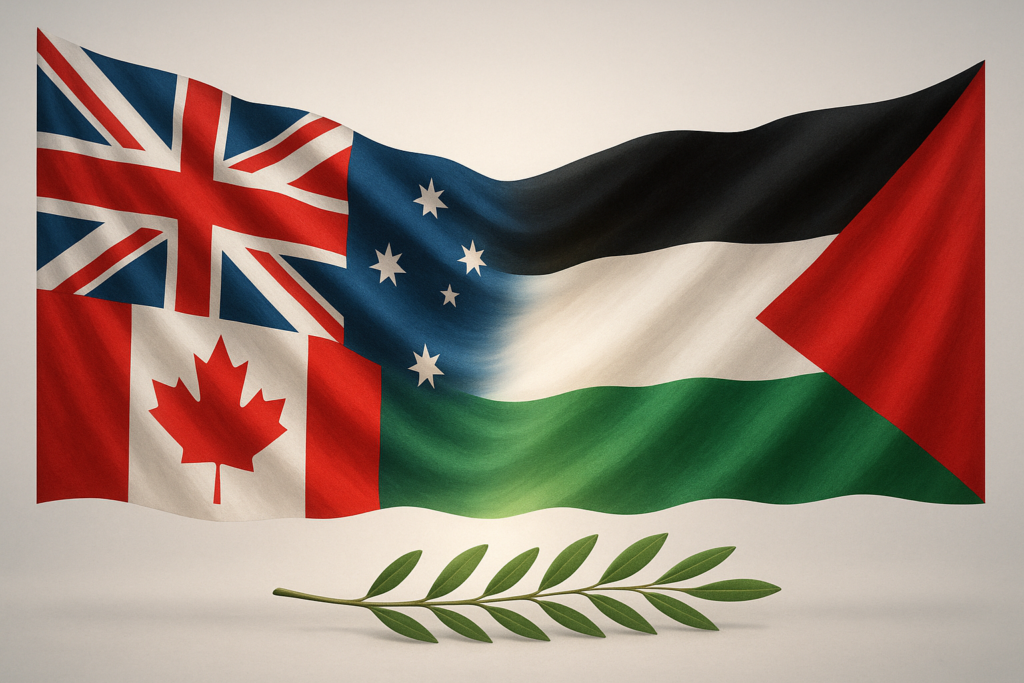
Image Credentials: Image Title: UK, Australia and Canada Recognize Palestinian State in Historic Diplomatic Shift Source: (Sora.ChatGpt) Date: September 2025. Attribution: Created using AI-generated imagery (Sora.ChatGpt), this does not depict a real-world scene.
By Isabella Harper | Staff Writer with Agencies
The United Kingdom, Canada, and Australia formally announced Sunday that they will recognize a Palestinian state, marking a historic moment in the decades-long struggle for Palestinian statehood. The coordinated move comes despite strong opposition from Israel and the United States.
British Prime Minister Keir Starmer confirmed the decision, framing it as an attempt to “revive hope of peace for the Palestinians and Israelis.” Speaking in London, Starmer stressed that the recognition was not a concession to Hamas.
“Hamas is a brutal terror organization,” he said. “Our call for a genuine two-state solution is the exact opposite of their hateful vision. This solution is not a reward for Hamas, because it means Hamas can have no future, no role in government, no role in security.”
Canadian Prime Minister Mark Carney echoed those sentiments, writing on social media: “Canada recognizes the State of Palestine and offers our partnership in building the promise of a peaceful future for both the State of Palestine and the State of Israel.”
Australia became the latest U.S. ally to announce plans to recognize a Palestinian state in response to the dire humanitarian situation in Gaza, following recent moves by Canada, France and Britain. https://t.co/WWZXXGg4KP pic.twitter.com/MNQx6x3dvd
— The Washington Post (@washingtonpost) August 11, 2025
Australian Prime Minister Anthony Albanese issued a similar statement, calling the recognition part of “a coordinated international effort to build momentum for a two-state solution.” He added: “Today’s act of recognition reflects Australia’s longstanding commitment to a two-state solution, which has always been the only path to enduring peace and security for the Israeli and Palestinian people.”
The move is largely symbolic but carries significant historical weight, particularly for Britain, whose 1917 Balfour Declaration laid the foundation for the eventual creation of Israel. More than 140 countries have already recognized Palestine, and more are expected to follow at the UN General Assembly this week, including France.
Israeli Prime Minister Benjamin Netanyahu condemned the decision. “We will have to fight both at the UN and in all other arenas against the false propaganda against us and the calls for the establishment of a Palestinian state that will endanger our existence and constitute an absurd reward for terrorism,” he said.
French President Emmanuel Macron defended the recognition process, arguing it was necessary to undermine Hamas. “If we want to stop this war, if we want to isolate Hamas, recognition and the peace plan that comes with it is a precondition,” Macron told CBS’s Face the Nation.
The announcement came just days after a state visit by U.S. President Donald Trump, who voiced opposition to the plan. “I disagree with the prime minister on that score,” Trump said.
Washington and Tel Aviv have long resisted calls for Palestinian recognition, arguing that it undermines direct negotiations and rewards Hamas for its Oct. 7, 2023, attack on Israel, which killed about 1,200 people and saw 251 hostages taken. Israel says 48 hostages remain in Gaza, with around 20 believed to be alive.
For Palestinians, the recognition marks a symbolic correction of what they view as a century of injustice. Husam Zomlot, the Palestinian head of mission in London, told the BBC that the decision helps “end the denial of our existence that started in 1917.” He added: “The British people should celebrate a day when history is being corrected, when wrongs are being righted.”
As the international debate intensifies, the recognition by three key Western allies represents one of the most significant diplomatic shifts in the Israeli-Palestinian conflict in recent years.
Key Milestones in International Recognition of Palestine
-
1988: The Palestine Liberation Organization (PLO) declared the independence of the State of Palestine. Within weeks, over 70 countries formally recognized it.
-
2012: The United Nations General Assembly voted to upgrade Palestine to “non-member observer state” status, with 138 countries in favor.
-
2014: Sweden became the first European Union member to officially recognize Palestine while still an EU member.
-
2021: More than 140 countries recognized Palestine, but none of the most powerful Western allies of the U.S. had joined.
-
2025: The United Kingdom, Canada, and Australia announced coordinated recognition of Palestine, marking a historic shift among U.S.-aligned powers. France signaled plans to follow.