
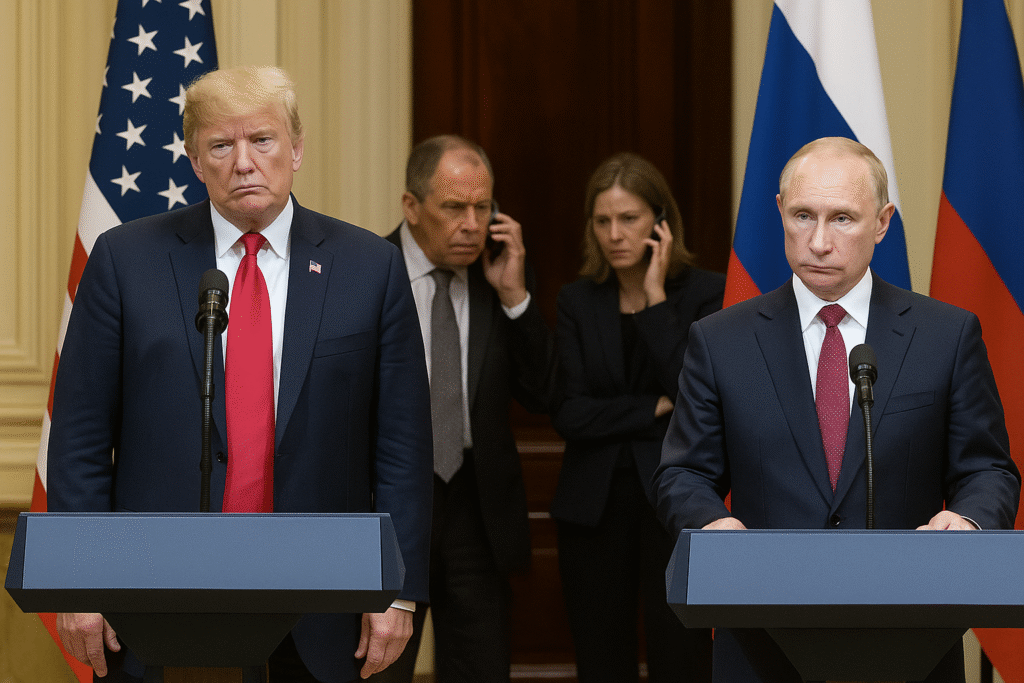
Image Credentials: Image Title: Trump-Putin Meeting in Hungary Called Off as Tensions Flare Over Ukraine Peace Talks Source: (sora.openai) Date: October 2025. Attribution: This image was created using AI-generated imagery (sora.openai) and does not depict a real-world scene.
Elliot Hayes | Senior Editor with Agencies
Plans for a second summit between U.S. President Donald Trump and Russian President Vladimir Putin in Budapest have been abruptly cancelled, the White House confirmed on Tuesday. The decision comes after a tense phone call between the U.S. and Russian foreign ministers derailed efforts to prepare for renewed peace negotiations over the war in Ukraine.
The two leaders had tentatively agreed to meet in Hungary after a two-hour call last week that Trump described as showing “great progress.” However, Moscow’s decision to cancel an in-person preparatory meeting between Russian Foreign Minister Sergei Lavrov and U.S. Secretary of State Marco Rubio effectively halted the process.
According to diplomatic sources, the conversation between Lavrov and Rubio turned contentious when Lavrov rejected Washington’s proposal to freeze the current front line in Ukraine. Despite the friction, the White House sought to play down the breakdown, calling the exchange “productive” and insisting there were “no plans for President Trump to meet with President Putin in the immediate future.”
Lavrov later confirmed that Moscow had not shifted its position. “Russia has not changed its stance compared to the understandings reached during the Alaska summit,” he told reporters in Moscow.
A Diplomatic Rift Widens
Western officials have interpreted the cancellation as a sign that peace remains distant. “Russia has been clear that their position has not changed, so why the meeting?” one European diplomat told The Telegraph.
Putin’s government continues to demand sweeping concessions from Ukraine, including the full surrender of the Donetsk region, of which Russian forces currently control about 78 percent. During their last call, Putin reportedly offered to relinquish claims to parts of Zaporizhzhia and Kherson if Kyiv agreed to surrender the entire Donbas region.
The offer was rejected by Ukrainian President Volodymyr Zelensky, who insists any negotiations must be based on the current front lines. “The front line can be the beginning of diplomacy. Meanwhile, Russia is once again doing everything to avoid diplomacy,” Zelensky said on social media.
He also criticized Trump’s refusal to authorize deliveries of long-range Tomahawk missiles to Ukraine, arguing that advanced weaponry would force Moscow back to the table. “The more Ukrainian long-range capabilities there are, the greater Russia’s readiness to end the war,” Zelensky said.
Pressure Mounts in Washington and Europe
Trump’s decision to cancel the Budapest meeting has been welcomed in European capitals, where officials feared he might pressure Zelensky into territorial concessions. The so-called “coalition of the willing,” a bloc of 30 pro-Ukraine nations chaired by Britain and France, quickly accused Moscow of using “stalling tactics” to delay any real negotiations.
British Prime Minister Keir Starmer has called an emergency meeting of the coalition in London, which Zelensky will attend in person. NATO Secretary-General Mark Rutte is expected to present a new 12-point peace proposal to Trump on Wednesday. The plan, modeled partly on Trump’s recent Gaza ceasefire initiative, reportedly includes the return of kidnapped Ukrainian children, reconstruction funding, and a formal pathway toward European Union membership for Ukraine.
According to sources close to the talks, Rutte and other European officials are appealing to Trump’s sense of legacy and leadership in an attempt to keep him engaged with Ukraine’s cause.
Putin Holds His Line
For his part, Putin remains steadfast in his demands. The Kremlin insists that Ukraine must withdraw entirely from Donetsk and Luhansk before peace can be achieved. “We have an understanding between the presidents, but there are no final details,” Kremlin spokesman Dmitry Peskov told reporters. “Neither President Trump nor President Putin gave exact dates.”
Despite the uncertainty, Trump has recently sounded more aligned with Kyiv’s position. Speaking to reporters, he said he wanted the fighting to “stop at the lines where they are, the battle lines,” suggesting a freeze of the current front rather than new territorial concessions.
Whether that stance holds in the face of renewed Russian pressure remains to be seen. For now, the cancelled summit underscores how fragile the diplomatic balance remains — and how far the world still is from seeing an end to Europe’s deadliest war in decades.