
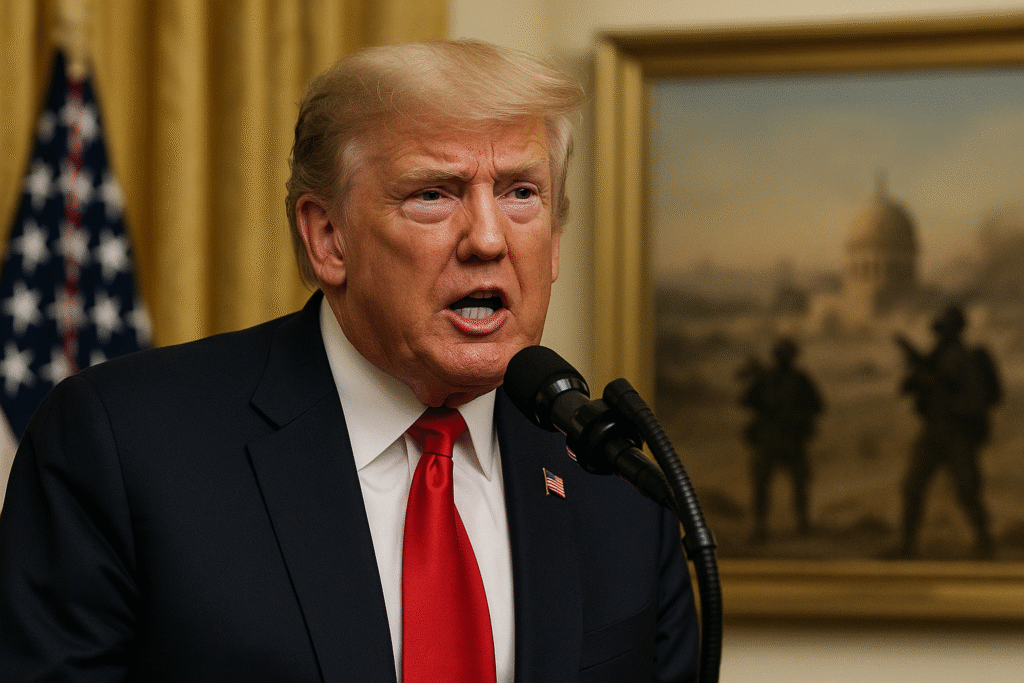
Image Credentials: Image Title: Trump Claims Middle East Nations Offered to Fight Hamas in Gaza Source: (sora.openai) Date: October 2025. Attribution: This image was created using AI-generated imagery (sora.openai) and does not depict a real-world scene.
Elliot Hayes | Senior Editor with Agencies
US president renews his threats to the Palestinian group, calling for “fast, furious, brutal” consequences if ceasefire collapses.
A Fragile Peace Under Fire
United States President Donald Trump claimed on Tuesday that several countries in the Middle East have offered to send forces into Gaza to fight Hamas, renewing his warnings to the Palestinian group amid an increasingly fragile ceasefire.
“Numerous of our now great allies in the Middle East, and areas surrounding the Middle East, have explicitly and strongly, with great enthusiasm, informed me that they would welcome the opportunity, at my request, to go into Gaza with a heavy force and ‘straighten out Hamas’ if Hamas continues to act badly,” Trump wrote on Truth Social.
The statement marks one of Trump’s most aggressive remarks since the truce took effect earlier this month. It also underscores the growing uncertainty surrounding the US-brokered ceasefire, which many observers say is hanging by a thread.
Trump’s Claim and Indonesia’s Role
While Trump did not specify which nations made such offers, he singled out Indonesia for what he described as “great assistance” in the region.
“I would like to thank the great and powerful country of Indonesia, and its wonderful leader, for all of the help they have shown and given to the Middle East, and to the USA,” Trump said.
Jakarta, along with several regional governments, has indeed expressed willingness to deploy peacekeeping forces to Gaza as part of a stabilization mission. However, none have publicly stated a readiness to engage Hamas militarily. Indonesia’s foreign ministry reaffirmed its position on humanitarian peacekeeping, not combat.
Trump, meanwhile, described what he saw as a rare “spirit of unity” among regional actors.
“The love and spirit for the Middle East has not been seen like this in a thousand years,” he wrote. “It is a beautiful thing to behold! I told these countries, and Israel, ‘Not yet!’ There is still hope that Hamas will do what is right.”
But his warning carried an unmistakable threat.
“If they do not, an end to Hamas will be fast, furious, and brutal!”
A Ceasefire Under Strain
The latest escalation in rhetoric comes as Israel faces mounting criticism over its conduct during the ceasefire. Since the truce took effect on October 10, Israeli forces have killed nearly 100 Palestinians, according to Gaza health authorities. Israel claims the victims were approaching restricted zones near military positions, though such areas remain poorly marked.
Humanitarian aid, a key component of the agreement, has also been severely restricted. The Gaza Government Media Office reported that only 986 aid trucks have entered the enclave since the ceasefire began, a fraction of the 6,600 trucks promised under the deal.
On Sunday, the situation deteriorated further when Israel launched a new wave of airstrikes, killing dozens of Palestinians and halting aid shipments altogether. The attack followed the deaths of two Israeli soldiers in Rafah. Israel accused Hamas of responsibility, though the group denied involvement, saying the incident occurred in an area under Israeli control.
US media outlets later suggested that the soldiers may have been killed by unexploded ordnance.
The Uncertain Future of Gaza
The temporary truce, once touted by Washington as a diplomatic breakthrough, now faces existential questions, not only about its longevity but also about Gaza’s future governance.
Trump has repeatedly insisted that Hamas must disarm, calling it a prerequisite for any long-term peace. Yet Hamas maintains that disarmament is impossible without the creation of a Palestinian state, a demand Israel continues to reject.
In an interview with Fox News on Sunday, Trump acknowledged that “there is no hard timeline” for Hamas’s disarmament.
That same day, Vice President JD Vance, visiting Israel, suggested that an international stabilization force might be necessary before Hamas could begin disarmament, describing it as a step toward “building a lasting security infrastructure in Gaza.”
Between Threat and Diplomacy
Trump’s remarks highlight the tension between his administration’s hardline posture toward Hamas and its desire to preserve the ceasefire it helped broker.
Analysts say the president’s latest statements may be aimed as much at domestic audiences, showcasing strength ahead of an election year — as at Hamas leaders in Gaza.
Still, his threats echo familiar patterns from earlier in his presidency, when bombastic declarations on social media were often followed by measured diplomatic action behind the scenes. Whether this episode follows the same script remains to be seen.
For now, Gaza remains under siege, Israel’s air raids continue intermittently, and millions of civilians wait for the promised surge in humanitarian aid that has yet to materialize.
As one regional diplomat put it, “Trump talks about a ‘beautiful spirit’ in the Middle East. But for the people of Gaza, there is no beauty — only survival.”
FACT BOX | The Situation at a Glance
-
Ceasefire Start: October 10, 2025
-
Palestinians Killed Since Ceasefire: ~100
-
Aid Trucks Delivered: 986 out of expected 6,600
-
Main Mediator: United States
-
Key Actors: Israel, Hamas, Egypt, Indonesia, U.S.
-
U.S. Vice President JD Vance: Supports international “security infrastructure” in Gaza
-
Hamas Position: Disarmament linked to Palestinian statehood
-
Trump’s Warning: “Fast, Furious, Brutal” end if Hamas violates truce
World Affairs Open Chronicle Magazine — October 2025 Edition
Reporting on Global Politics, Conflict, and Diplomacy.