
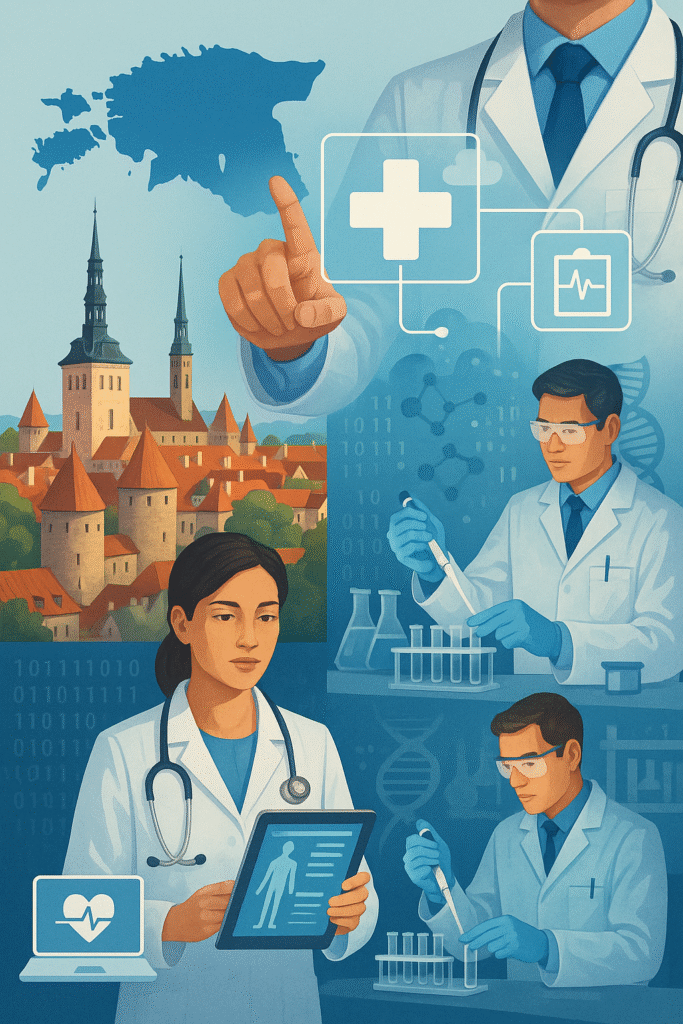
Image Credentials: Image Title: Estonia’s Digital Health DNA: Trust, Data, and Biotech in Focus Source: (sora.openai) Date: November 2025. Attribution: This image was created using AI-generated imagery (sora.openai) and does not depict a real-world scene.
By Isabella Harper | Staff Writer
Estonia, a small country with a population of just 1.3 million, has carved out a formidable reputation in the digital world, particularly in healthcare. Known for its e-governance and digital infrastructure, Estonia has leveraged technology, data, and innovation to reshape healthcare systems and become a leader in life sciences. With initiatives like nationwide e-health records, a thriving biotech hub in Tartu, and a growing health-tech startup scene, Estonia is proving that even a small nation can have a massive impact on global healthcare.
Estonia’s Digital Healthcare Revolution
In 2014, during a visit to Tallinn, former U.S. President Barack Obama jokingly remarked that he “should have called the Estonians” when setting up his healthcare website, a nod to Estonia’s unparalleled success in digital governance. From online voting and digital ID cards to near-universal e-health records, Estonia has built a digital ecosystem that serves as a global model.
But how did Estonia achieve such a transformation? According to Rannar Park of the e-Estonia Briefing Centre, the key to success is trust. “Trust is earned in drops and lost in buckets,” Park says, emphasizing the importance of security and citizen control, particularly in sensitive sectors like healthcare.
Estonia’s approach has been one of decentralization and transparency. By ensuring that no single entity holds all patient data, citizens maintain ownership of their own health records. This approach has allowed for the creation of the Estonian Central Health Information System, which houses over 200 million medical documents, from prescriptions to test results.
A cornerstone of Estonia’s digital health infrastructure is the X-Road platform, a secure, decentralized data-exchange system that enables healthcare providers, insurers, and patients to access comprehensive medical histories online. The platform is a major success story for the country, facilitating interoperability not only across Estonia but also throughout the European Union, where cross-border e-prescriptions are now fully operational.
Health-Tech Startups: Estonia’s Growing Innovation Hub
Estonia’s compact size and innovative spirit make it an ideal environment for health-tech startups. With a government-backed accelerator program like Health Founders Estonia (HFE), the country is rapidly scaling its health-tech sector. HFE’s goal is ambitious: to foster the growth of 100 health-tech companies over the next decade, placing Estonia at the forefront of global health innovation.
Among the most notable startups is LifeYear, a company that is revolutionizing cardiac care with its remote patient management platform. With more than 400,000 people currently waiting for treatment in the UK’s National Health Service (NHS), LifeYear aims to reduce hospital visits and readmissions through digitized care pathways. CEO Siim Saare explained, “Our goal is to improve outcomes for patients while addressing one of the biggest challenges for the NHS.”
Another pioneering company, Better Medicine, is using artificial intelligence (AI) to improve diagnostic accuracy in oncology. Its tool, BMVision Kidney, helps radiologists detect kidney lesions from CT scans, addressing a critical gap in kidney cancer detection. Dr. Martin Reim, the company’s founder and CMO, explains, “Our AI acts as a second pair of eyes, reducing errors and speeding workflows.”
Estonia is also seeing success in the field of migraine care. Migrevention is using digital solutions to reduce the average nine-week waiting time for treatment in the NHS. CEO Katrina Laks, who has struggled with migraines herself, aims to improve patient outcomes by piloting these solutions in outpatient clinics.
In oncology, Antegenes is applying precision medicine to cancer screening. The company’s polygenic risk models identify high-risk patients, allowing for earlier and more personalized interventions. Antegenes’ work extends through telemedicine partnerships in the UK, increasing access to critical healthcare services for underserved populations.
A Thriving Biotech Ecosystem: From Biobank to Biotech Hub
Estonia’s biotech ambitions are anchored in the Estonian Biobank, established in 2001 and managed by the University of Tartu. With over 210,000 participants—approximately 20% of the country’s population, the Biobank is a goldmine for both medical research and personalized medicine. Participants can access insights into their health risks and ancestry through the My Genome portal. The Biobank’s high level of public support—only 1% of people oppose it, is a testament to Estonia’s deep commitment to data security and transparency in health research.
The Biobank also supports commercial innovation. Finnish company Nightingale Health has analyzed 200,000 samples from the Biobank, creating valuable biomarker profiles that contribute to early disease prevention strategies.
Estonia’s biotech future is being shaped not only in Tallinn but also in Tartu, a city that is becoming a hub for biotech innovation. At the University of Tartu, the TeamPerMed project integrates genomics, IT, clinical medicine, and socio-economic data to develop EU-wide guidelines and AI-driven decision-support tools.
The Innovation of Icosagen and the Tartu Biotech Ecosystem
One of the standout biotech companies in Tartu is Icosagen, a contract development and manufacturing organization (CDMO) founded by entrepreneur and scientist Mart Ustav. Icosagen specializes in biologics, including antibody discovery, protein production, and cell-line development. The company is also at the forefront of advanced therapies like CAR T-cell treatments and antibody–drug conjugates (ADCs).
Other notable companies in the Tartu ecosystem include TBD Pharmatech, which produces small-molecule pharmaceutical ingredients, and Gearbox Biosciences, which is working to tackle antibiotic resistance and support gene and mRNA therapies.
Trust, Data Protection, and the Cybersecurity Challenge
While Estonia’s digital health systems have attracted global praise, they are not without their challenges. In late 2023, Asper Biogene OÜ, an Estonian genetic testing company, suffered a major cyberattack that compromised approximately 100,000 files containing personal and health data. The breach was traced to a four-person group, highlighting the growing cybersecurity risks associated with highly digitized healthcare systems.
In response, experts are stressing the importance of data protection, transparency, and clear governance. Hardi Tamm, CEO of Asper Biogene, emphasized the need for “precautionary care in organizing data security,” especially as cyber threats continue to evolve. Estonia’s Data Protection Inspectorate has called for stronger safeguards and independent data protection officers to ensure that health data remains secure.
Despite these challenges, Estonia’s commitment to building secure, transparent, and interoperable digital health systems is unwavering. As the country continues to lead in digital governance, it offers a model for modernizing healthcare globally. As Mart Ustav of Icosagen succinctly puts it: “We will find the way. Or if there is no way, we will build it.”
Conclusion
Estonia’s digital health revolution is a testament to the power of trust, data, and innovation. Through a combination of decentralized health records, cutting-edge biotech research, and a thriving health-tech startup ecosystem, Estonia is paving the way for a new era of healthcare. While challenges like cybersecurity remain, the country’s agility and commitment to transparency and security will continue to shape the future of healthcare, both in Europe and beyond. Estonia is proving that even a small nation can make a big impact on global health innovation.
-
e-Estonia Briefing Centre. (2021). The Estonian digital society: A model for the future. Retrieved from https://e-estonia.com
-
Estonian Biobank. (2020). A cornerstone for personalized medicine and research in Estonia. Retrieved from https://www.biobank.ee
-
Nightingale Health. (2022). Using blood biomarkers for early disease detection. Retrieved from https://www.nightingalehealth.com
-
Health Founders Estonia (HFE). (2023). Health technology innovation in Estonia. Retrieved from https://www.healthfounders.ee
-
LifeYear. (2023). Improving cardiac care pathways in the UK with digital solutions. Retrieved from https://www.lifeyear.com
-
Better Medicine. (2022). AI-enhanced diagnostic tools for oncology. Retrieved from https://www.bettermedicine.ai
-
Asper Biogene OÜ. (2023). Cybersecurity breach in Estonia’s health-tech sector. Retrieved from https://www.asperbiogene.ee
-
Icosagen. (2023). Advancements in biologics and CAR T-cell therapies in Estonia. Retrieved from https://www.icosagen.com
-
Mart Ustav, Founder of Icosagen. (2023). Biotech innovation in Tartu. Interview with BioTech Insight
-
The Estonian Data Protection Inspectorate (EDPI). (2023). Cybersecurity and data protection in Estonia’s health-tech sector. Retrieved from https://www.aki.ee
-
Rannar Park, e-Estonia Briefing Centre. (2022). Building trust in digital health. Interview with Digital Health Review
-
Siim Saare, CEO of LifeYear. (2023). Transforming cardiac care in the UK through Estonian digital health innovation. Retrieved from https://www.lifeyear.com
-
Tartu University. (2023). The TeamPerMed project: Integrating genomics and AI for personalized medicine. Retrieved from https://www.ut.ee