
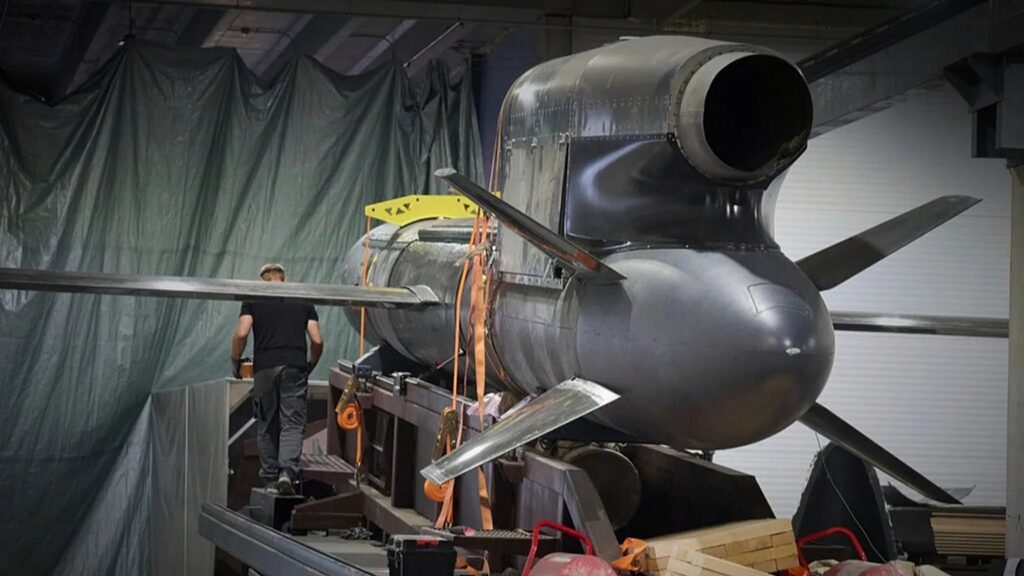
Image: from Tymofiy Mylovanov X@Mylovanov
Kyiv is quietly preparing for a future where its long-range strike capability is decoupled from the uncertainties of foreign aid. Ukraine’s Fire Point design bureau has announced plans to shift to the mass serial production of its new FP-7 and FP-9 ballistic missiles by mid-2026, a move that could fundamentally alter the strategic balance on the Eastern Front.
The proposed output, measured in hundreds of missiles per month, would provide Ukraine with a sustained indigenous magazine capable of pressuring Russian logistics, command nodes, and critical energy infrastructure deep within operational depth. Fire Point’s chief designer indicated this ambitious production pivot could begin as early as May 2026, pending firm state orders and financing.
FP-7: The Tactical Entry Point
The FP-7 tactical ballistic missile serves as the entry point for Ukraine’s modern ballistic program, with codification expected by the end of this year.
- Range and Payload: Its declared range exceeds 200 kilometers, carrying a 150-kilogram warhead.
- Performance: It reaches a peak velocity of 1,500 meters per second and a flight altitude of roughly 65 kilometers.
- Construction: The airframe is constructed entirely from composite materials, providing the structural integrity needed for high thermal loads during atmospheric reentry.
- Targeting: With a stated accuracy of 14 meters, the FP-7 is a versatile option for targeting intermediate storage sites, command posts, or energy infrastructure close to the contact line.
Codification of the FP-7 will allow for accelerated integration into existing Ukrainian firing units, streamlining its immediate deployment.
🇺🇦🦅🚀 We will find out in the near future what stage the development of the FP-7 and FP-9 ballistic missiles is at, — the chief designer of Fire Point
📌The FP-1 drone is the cheapest in its class, which is also the most effective.
📌 It is very, very difficult to get through… pic.twitter.com/k0bZgohHIx
— The Ukrainian Review (@UkrReview) October 10, 2025
FP-9: Strategic Deep Strike
The FP-9 represents a major shift in scale and strategic capability, opening operational scenarios comparable to intermediate-range systems.
- Range and Payload: It boasts a declared range of 855 kilometers and carries a massive 800-kilogram warhead.
- Evasion: A terminal speed of 2,200 meters per second and an estimated flight altitude of 70 kilometers give it a trajectory capable of circumventing some standard Russian layered air defenses.
- Accuracy: An accuracy of about 20 meters allows for precise strikes on critical infrastructure without relying on area-effect munitions.
The FP-9 retains a monoblock configuration with a single propulsion phase, meeting Ukraine’s requirement for a comparatively economical long-range strike option when weighed against the cost of cruise missiles.
Engineering Lineage and Industrial Prowess
The external geometry of the FP-7 and FP-9 has drawn attention due to its acknowledged similarity to the Russian 48N6 missiles used by the S-300PM and S-400 systems. Fire Point notes that this proven geometry reduces development risk. However, all guidance, control, and electronic components have been replaced with indigenous Ukrainian systems. The study of the original 48N6’s ballistic behavior, after its repeated use in a surface-to-surface role against Ukraine, was crucial in designing the lighter composite airframes with optimized inertial characteristics.
This ambitious production projection is supported by Fire Point’s existing capabilities. The company already routinely delivers complex platforms, including the Flamingo FP-5 cruise missiles (which can reach 3,000 kilometers) and the widely deployed FP-1 first-person-view (FPV) drones, which account for a significant percentage of harassment strikes inside Russia. This robust, agile production base, heavily reliant on local components, makes the projection of several hundred ballistic missiles per month plausible, contingent upon securing the necessary solid propellants and high-density composite materials.
The combined fielding of the 200 km FP-7 and the 855 km FP-9 would dramatically change Ukraine’s operational depth, limiting Moscow’s logistical freedom and creating tactical openings by straining defensive systems with repeated, high-volume salvos.